
#On the Name and the House
The word enters the Codex attached to a boy. Every file that uses it names him first: Benedict Veyrault of Dijon, who went into a Benedictine house at fourteen and came out of it some years later having reorganised the archive and ruined the abbot. The Church inherited the designation before any Synodal clerk existed to classify it. In our records it means less than it means in sermons, and my office requires me to give the smaller meaning.
As far as the shelves of Strasbourg can testify, a Benedictine was a monk of a house that went by that name. Such a house kept a rule, copied books, stored grain and owned buildings solid enough to outlast the men who later wanted them. The rule itself has never reached my desk. I hold no founder's life, no register of vows and no superior with a seal I could authenticate. What survives is property, habit and claim: a reading room, a chapel, four vaults, a cask, and one Burgundian archivist whose training lasted half a century longer than his vocation did.
So I must write the history of an order from the furniture it left behind. Inquisitors have hanged men on thinner inventories.
#On the Monk of Dijon
The parent dossier gives the account, and I will not improve on it. Veyrault entered the house at fourteen, took minor orders at nineteen, and by twenty-three had rebuilt the monastery archive into a system that could find anything. It found the abbot's letters to a vintner of Beaune. The index cross-referenced them, the cross-reference reached a diocesan auditor, the auditor reached the abbot, and the young monk was transferred to Strasbourg. Nobody in Burgundy objected. No record I am permitted to cite names the house or the abbot, and I will not supply names. A Hieromnemon who invents an abbot so he can mock him has lost the right to mock Veyrault.
The cloister gave him a method: the shelf-mark, the cross-index, and the habit of copying a thing twice so that its absence from a third place becomes evidence. In Strasbourg he built the Bureau of Records with it. Wartime clerks were logging baptisms, relief issues and supply carts long before he arrived among them. Veyrault took over those ledgers rather than inventing them. Around A.S. 78 he combined them into one machine with one appetite, and in A.S. 80 the Great Ledger of Souls began the unbroken run it keeps today. His maxim was "To misremember is to betray salvation." "Nothing is forgotten" belongs to Records. Neither saying is carved over any monastery door known to me, and I have looked, at some cost to my knees.
Earlier Codex editions attributed the founding of the Bureau of Records to A.S. 93.
Corrected. Recordkeeping networks were already working through the war years. Veyrault consolidated them around A.S. 78, and the Ledger has run since A.S. 80. The Concordat of Strasbourg in A.S. 90 and the successor council of A.S. 93 ratified an institution that had been stamping paper for more than a decade. A founding date is a convenience for engravers. Records keeps all of them.
Later files cover how far that machine eventually reached. In time, being registered decided a citizen's rations, permits and name, and being left out decided whether anyone remembered the citizen at all. Villages withered after their entries went quiet. Epernay was struck from the Ledger, and the Redaction did the rest. None of this can be charged to a cloister in Burgundy, because a rule that taught a boy to index letters gave the grown man no instruction to unmake a city. The Ledger records only that the boy and the man wrote in the same hand.
#On Houses Taken into Service
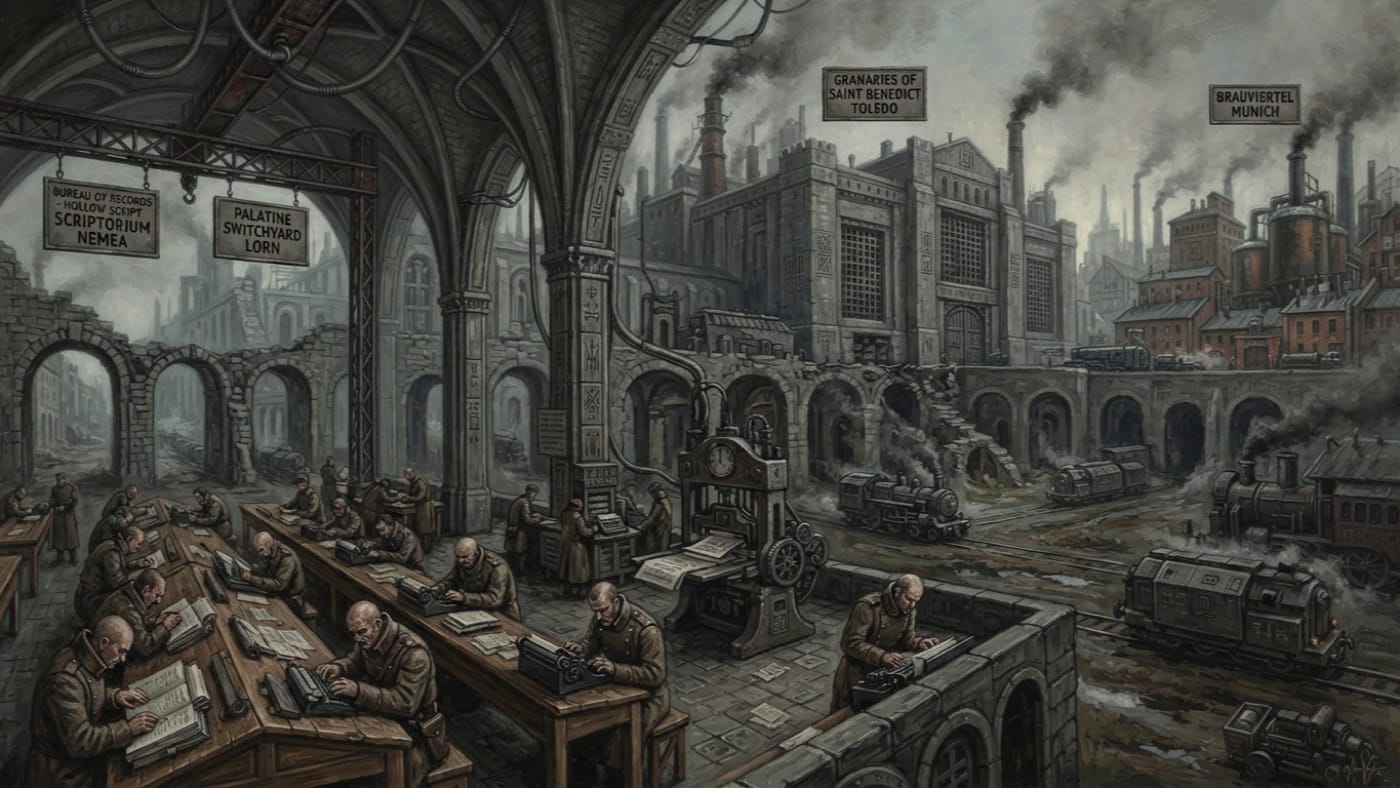
In A.S. 96 the Bureau needed somewhere to reconcile records that disagreed. Veyrault's commission settled on a chalk ridge above a river ford in the Heartlands, where a Benedictine house had stood until the Atheist Wars reduced it to rubble and a single reading room. The builders kept the reading room and enlarged it. They left the rubble where it lay, and the Hollow-Script Scriptorium rose over both. Monks once read at those desks. Records novices now copy, correct and burn at them under lampglass, in ash-ink, against quota. In the under-vaults the novices sometimes find shelves older than the Synod. The Abbot-Registrar has classified those shelves as ornament.
Solene of Lyon was the first to hold that title. She took the west desk in the founding year and died at it in the same cycle. Her title borrows a monastic word, but her appointment came by Records writ. I find no document that makes her a Benedictine, and none that makes the Nemea chapterhouse a continuation of the house beneath it. The Bureau took the building. Its charter never asks whether it took the vocation with it.
The Palatine Switchyard of Lorn is a shorter story. An older market town once stood where three supply corridors met, with grain merchants, smiths and a small Benedictine chapel. In A.S. 104 the Bureau of War requisitioned the whole town on a Tuesday, and by Friday the chapel was a dispatch office. Kneelers went out and sorting tables came in, and the office grew into the Manifest Basilica, where seven hundred clerks stamp freight in shifts. I can find the chapel's dedication in no surviving register. The clerks have not asked about it, and neither has the Bureau of War.
Nemea kept a reading room and made it read harder. Lorn kept four walls and changed what passed between them. Neither case proves a decree against the order, and neither proves the order consented. A local requisition is evidence of one local requisition, and nothing wider. The Bureau of War does not sign treaties with chapels.
#On Bread and the Culture in the Cask
The Granaries of Saint Benedict stand west of the rebuilt cathedral precinct of Toledo: four vaults named Lent, Rule, Cellar and Mercy. Their charter claims descent from a Benedictine relief house founded after the Concordat. Their lower masonry is older than their paperwork. Either the monks built on something already standing, or the charter was written to fit stones already in place. The name is attested. The genealogy rests on the granary's own paper. I find no Benedictines holding the keys today. Those belong to the city, the cathedral and the Bureau of Tithes, and Records has added a fourth lock that opens nothing.
Then came A.S. 185. Famine spread across Iberia, and Strasbourg answered Toledo's petitions by asking for better petitions. Governor-Praelate Alaricus opened the reserves at second bell, before remote approval arrived, under an emergency writ drafted for disasters nobody expected to see. Children received the first loaves. Every sack was counted, every household marked before a witness, and every shortfall matched to its clause. Strasbourg later named the opening an exemplar of Synodal benevolence. Whatever the founders meant by a relief house, the most monastic act in the granary's record belongs to a provincial administrator who had a ledger and no patience for the post.
Munich makes the louder claim and supports it worse. The brewers of the Bräuviertel keep Saccharum Benedictum, a yeast culture they say Benedictine monks hid in a reliquary cask while Rationalist soldiers burned the monastery above them. In the story the monks died, the cask survived and the beer improved. The documents stop supporting the story at about that point. No monastic inventory lists the cask. No relic seal hangs from its hoops. No Benedictine survived to sign a deposition, and the earliest account sits three copies removed from a tavern ledger. The Bureau of Relics received the first petition for authentication in A.S. 98. It has declined that petition every year since, without once condemning the culture. Tithes collects on every barrel, which is the closest the yeast is likely to come to authentication.
I cannot say which monastery burned. Its custodians do not name it, and I will not lend them Dijon or Nemea to improve their provenance.
#On the Surviving Record
Here is the tally. A trained hand in Strasbourg whose habits became a Bureau. A reading room in Nemea, still full of desks under new management. A chapel in Lorn that became the first desk of a basilica. A granary in Toledo whose charter claims a relief house and whose ledgers prove a famine. A cask in Munich whose provenance the Bureau declines to touch with either hand.
My own reading, which no one has asked for, is that a cloister that copies everything and a bureau that registers everyone differ mainly in what they do with the copies. That reading is mine. No founding document of either says so, and I will not forge one to win the argument.
My files do not establish whether a Benedictine order still exists as a body, with a superior, a roll and a house that answers to the name. Being absent from the Ledger is serious. I have seen what it does to villages, and I decline to inflict it on monks because of an empty shelf. The name is still in use on vault doors, on beer, and as the given name of the man who built the Ledger.