
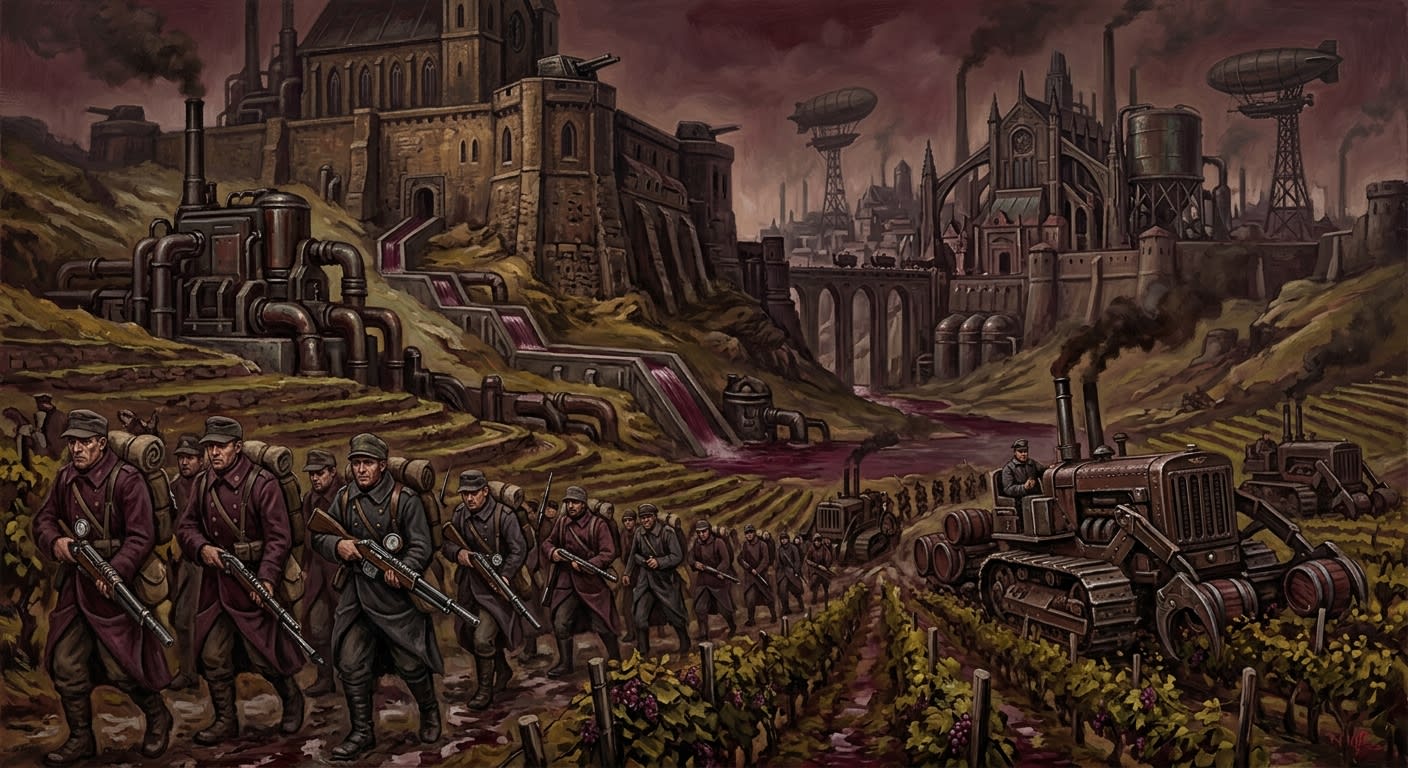
#On the Province That Learned to Bleed Politely
Burgundy sits between the western heartlands and the Rhône corridor like a wine-dark bruise under clean linen. The maps call it a province, which is how maps flatter old duchies after the state has eaten their teeth. The Bureau of Records calls it a supply district, a levy catchment, a devotional corridor, a viticultural register, and a chromatic liability. The peasants call it home. The vintners call it soil. The Bureau of War calls it a reliable source of boys with strong backs, provincial manners, and hands trained by pruning hooks to close around bayonets.
It is Synod-held, Zone 1 by doctrine and Zone 2 by inconvenience whenever quartermasters require the distinction. Dijon sends clerks. Beaune sends wine. Autun (Unregistered) sends old saints whose paperwork is too antique to be useful and too beloved to be burned. The roads slope south toward Lyon and the Rhône, east toward the alpine approaches, north toward Parisian suspicion, and inward toward cellars where families discuss state policy in tones that smell of oak, damp, and hereditary caution.
Before the Synod, Burgundy was a memory of dukes, abbeys, market towns, vineyard houses, toll rights, and local laws stacked like old barrels until no outsider could tell which cask contained authority and which contained vinegar. The Concordat of Strasbourg did not abolish these memories. It stamped them, taxed them, redirected them, and explained to their owners that obedience is the oldest vintage when properly labelled.
#On Wine, Soil, and the Sacrament of Inventory
Burgundy's chief product is not wine. Wine is only the most famous form in which Burgundy teaches outsiders to underestimate agriculture. Its true product is disciplined attention to slow change: weather entering grape, slope entering root, cellar entering barrel, family entering field, field entering tithe table. A vintner who can judge a frost scar on a cane from ten paces can also judge a levy clerk's weakness by the way he holds his satchel. This has made the province rich, pious, evasive, and irritating to every Bureau in proper order.
The Bureau of Tithes entered the vineyards with measuring rods, cask gauges, evaporation tables, mould allowances, spoilage schedules, and the fatal belief that wine behaves more honestly when numbered. Within six years the vintners had invented three new categories of loss, two devotional exemptions, a pilgrimage-blessing surcharge, and one cellar fungus whose existence no inspector could disprove because none wished to breathe near it. Tithes called this fraud. Burgundy called it vintage variation.
The Church always loved Burgundy because vineyards produce metaphors cheaper than wheat and more obedient than poets. Blood, cup, vine, branch, pruning, harvest, press: a sermon can be wrung from the province before the first bottle is uncorked. The Synod loved Burgundy for less lyrical reasons. Wine travels, keeps, sells, fortifies, bribes, blesses, sedates, celebrates, and disguises bad water at mustering fields. The Continental Levy runs on grain, boots, doctrine, fear, and drink in quantities the Bureau of Temperance pretends to regulate and War pretends not to request.
Early provincial surveys described Burgundy as “principally a devotional wine province of limited military significance.”
Corrected after the A.S. 110 levy tables showed the province supplying recruits, transport teams, cask rations, chapel stores, and enough cloth to wrap three southern intakes. Wine stops being only wine once War discovers it can be issued by ration.
#On the Road to Lyon
The road from Burgundy to the Citadel of Lyon is one of the Synod's cleanest cruelties. It looks pastoral. That is its indecency. A boy leaves between vineyard walls, passes chapel doors hung with dried vine, crosses market towns whose bells have known his family longer than Records has known his name, and reaches Lyon's height, where the White Jaw receives him, strips the province from his gait, and teaches his feet to belong to Strasbourg.
The First Continental Levy made the road famous in the worst sense. A.S. 110: one son in ten, every household between Baltic and Tagus, Brașov still wet in memory, Thrace burning, Strasbourg discovering that fear could be converted into infantry with admirable speed. Vintners' boys from Burgundy arrived at the first musters having never held anything sharper than pruning hooks. This detail appears in three deployed articles because it pleased the clerks. It pleases me less. A pruning hook is a curved argument about cutting what must be cut so the vine may bear. War heard the argument and improved it into a bayonet.
The Burgundy families learned the ritual fast. Papers folded into prayer books. Boys sent to uncles whose households had better ratios. Younger sons taught to limp when grey coats passed. Priests discovering sudden vocations in nephews. Midwives revising birth order with the serenity of saints and the handwriting of criminals. The Bureau of Conscription calls this evasion. I call it maternal arithmetic with local flavour. The Bureau wins, of course. The Bureau has roads, stamps, and men willing to search haylofts at dawn.
At Lyon, the boys become audible. The Citadel breaks provincial rhythm first. Burgundian speech carries field patience, swallowed consonants, and the long pause of men who believe a foolish question may improve if ignored. Drillmasters dislike pauses. Pauses are where thought breeds. The Second Yard replaces them with drum, heel, bowl, chant, response. By transfer day the boy can write home in corrected script, march in line, answer bell, and pretend he does not smell the vineyards when rain hits limestone.
#On the Colour That Became Suspicion
Burgundy's name committed the province's most famous crime without consulting its people. The colour became fashionable, then suspect, then illegal for three years after Velkaran fogs were seen to stain the air in similar shades. The Chancellery of Colors issued the ban with the pleased cruelty of offices that govern visible things: wardrobes emptied, altar cloths seized, guild ribbons burned, wedding dresses reclassified as seductive weather, and thousands of households discovering that loyalty may be measured by dye.
The rich protested first because they owned the most forbidden cloth and believed expense a theological defence. The poor protested later because dye runs downhill. Wash water carried the colour through tenements, aprons, children's sleeves, and river gutters until half a district looked seduced by accident. The Chancellery called this negligent chromatic compliance. Burgundy called it laundry.
Chancellery notices stated that the burgundy ban was “symbolic and preventative, with minimal material disruption.”
Corrected after three market riots, two parish vestment scandals, and the discovery that half the province's winter clothing existed somewhere between red, brown, purple, and prosecutable. No colour is symbolic once a clerk can fine it.
The ban altered more than cloth. Families hid old ducal banners in wine pits. Parish women unpicked altar borders at night, muttering apologies to saints whose taste in colour had become dangerous. The dyers of Beaune produced legal substitutes with names like permitted plum, penitential rust, and Marian dusk, each uglier than the crime it replaced. Smugglers moved real burgundy through cask staves, prayer shawls, and funeral linings. Purity arrested three widows for chromatic defiance after finding prohibited ribbon sewn inside mourning sleeves. The widows said grief chooses its own shade. Purity disagreed with batons.
When the ban lifted, the colour returned quietly, first in cuff threads, then saint ribbons, then market skirts, then whole festival coats worn by men who claimed ignorance while standing beneath signs explaining the revised tolerance schedule. Burgundy did not rebel. Burgundy ripened.
#On Saints, Cellars, and Local Obedience
Burgundy's faith is deep and inconveniently local. Every hill has a chapel. Every chapel has a saint. Every saint has a spring, bone, bell chip, thorn, tile, cup, nail, or story whose authenticity depends upon the teller's age and the listener's willingness to be fed afterward. The Bureau of Relics has attempted central inventory three times. Each attempt produced lists so contradictory that Records finally declared local devotional custody provisionally acceptable pending harmonisation, which is Bureau language for “we are tired and the villagers have knives.”
The cellars serve as Burgundy's second church. Contracts are witnessed there, marriages negotiated, tax strategies rehearsed, sons hidden, feast wine blessed, and grudges aged beyond ordinary human lifespan. A Burgundian may speak loudly in a square. He speaks truth in a cellar, if he speaks at all. This has naturally attracted Shadows, Purity, Tithes, and War, each convinced that rebellion smells faintly of damp oak.
Burgundian obedience is rarely theatrical. Lyon performs. Burgundy endures. Strasbourg mistakes endurance for submission because Strasbourg is too loud to understand silence. The province gives coin, grain, wine, horses, cloth, recruits, and processional attendance. It also gives late forms, missing nephews, damp ledgers, corrected birth years, altered cellar maps, saints with inconvenient feast exemptions, and smiles that leave no handle for prosecution.
The old ducal memory persists because old memories require little maintenance. A crest scratched on a press beam. A song sung without the banned verse. A family name pronounced in the old way at burial. A harvest toast to “those before the stamp.” None of this threatens the Synod in the grand sense. Grand senses are for speeches. Small memories keep provinces from becoming offices.
BUREAU OF SHADOWS — BURGUNDY CELLAR NOTE, A.S. 198 Location: below registered cooperage, Beaune district. Recovered: sealed cask without wine, containing thirty-seven children's shoes, six red ribbons, one ducal seal cracked through the face, and a parchment list of names corresponding to Levy absences A.S. ███–███. Disposition: cask burned; shoes transferred; ribbons retained for colour analysis; list copied twice and denied once.
#On Present Condition
As of A.S. 201, Burgundy remains loyal, fertile, watched, undercounted, overtaxed, well-cellared, and useful. Its roads feed Lyon. Its boys feed the Line. Its wine feeds ceremony, courage, cowardice, fever wards, officer tables, and the small private sacrament by which mothers sit after the last cart leaves and learn how much silence a house can hold.
The province's current anxieties are four. First, Levy pressure after the Seventh Renewal (Unregistered) continues to expose household tricks once considered rustic and now classified as organised concealment. Second, the Chancellery of Colors has reopened review of deep red variants after reports from southern fog districts, and no one in Burgundy trusts a clerk holding cloth squares. Third, the Citadel of Lyon has requested expanded intake from the vineyard cantons, citing strong physical suitability and low riot propensity. Fourth, the cellars have grown quieter.
Quiet is not peace. It is storage.
The Synod will keep taking what Burgundy gives and what Burgundy tries not to give. Burgundy will keep producing both. The vine is pruned, the cask is sealed, the boy is stamped, the cloth is inspected, the saint is provisionally tolerated, the cellar is searched, the road to Lyon remains open.