
#On the Arithmetic of the Womb
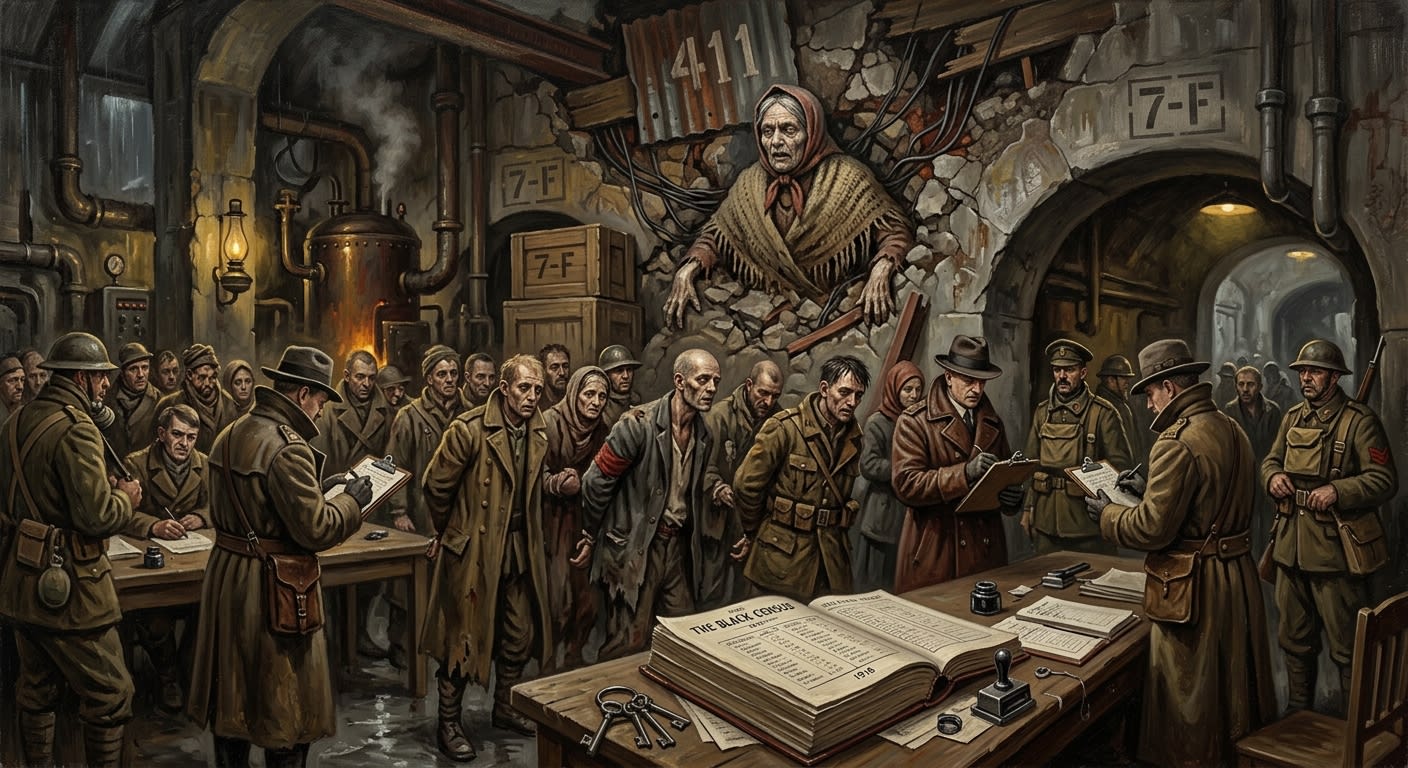
Four hundred and eleven soldiers. One mother. The Bureau of Medicine calls this an estimate. I call it blasphemy with a denominator.
The Black Census of Metz was the moment the Ash-Mother ceased to be a soldiers' epithet and became Classification 7-F: Reproductive Infrastructure, Hostile. Before Metz, the phrase belonged to trenches, chaplains, and men who had seen pits in the east and returned with mud under their nails and a permanent distrust of cradles. After Metz, the phrase entered the files of the Bureau of Medicine, and once Medicine names a horror, the rest of the Synod may deny it only in better stationery.
It happened after a post-battle action near Metz, in the contested strip beyond the orderly city whose western warehouses still pretend the war is a logistics problem with artillery attached. A demon-held bastion had been reduced by siege guns and Purity teams. The banners went up. The bodies were sorted. Captured Thralls were chained in rows for census, examination, disposal, and whatever theological word the officer in charge preferred for counting men who had been made into enemy tools before their first confession.
The census detail included two Medicine anatomists, one Records clerk, six Purity lictors, a War adjutant, and a bell-priest whose only duty was to strike a handbell whenever a corpse moved after notation. He struck it nine times before noon. None of the nine rose fully. They only tilted their heads toward the counting table, like schoolboys waiting to have a wrong sum corrected.
There were four hundred and eleven in the captured regiment. Each bore identical sigils burned beneath the collarbone, each had the same left-eye ash clouding, each responded to bell-pressure with the same flinch in the jaw. Ordinary field practice would have filed them as a Thrall regiment of unknown provenance, stripped useful intelligence, burned the bodies, and let War claim a victory. An inquisitor noticed that their teeth were wrong.
The upper incisors shared a notch. No wound. No tribal mark. A hereditary defect, repeated with the neatness of a copied seal. The inquisitor halted the burn detail and summoned Medicine.
#On the Counting
The census began with mouths. This is appropriate. Most truths enter bureaucracy through the mouth, either as testimony, confession, or dental evidence extracted from a corpse too late to object. Medicine charted the notch, jaw angle, palate seam, left molar absence, and six further traits whose names are too ugly for public prose and too useful to omit from sealed appendices. The first day's conclusion was kinship. The second day's conclusion was impossible kinship. By the third day, the counting room smelled of vinegar, lamp-smoke, and professional panic.
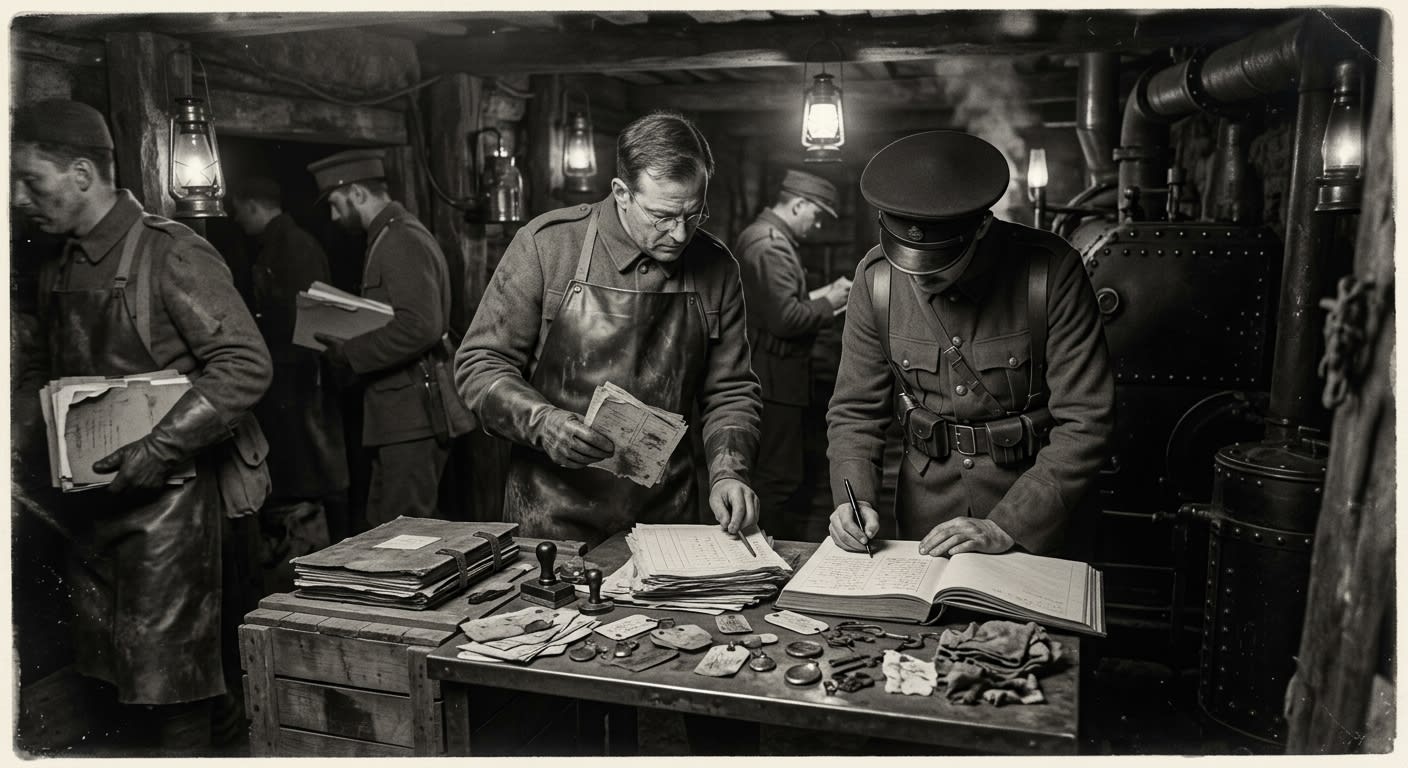
Sorcery-genealogical methods were then authorised. The phrase deserves suspicion. A genealogy is a family tree when performed by a parish clerk and an accusation when performed by Medicine under Purity guard. The examiners used ash-scrapings from sigil tissue, marrow slivers, baptismal absence tests, blood warmed over relic copper, and a silver-thread concordance frame borrowed from the Bureau of Relics and returned with three stains no one admitted making.
The concordance frame identified kinship among the four hundred and eleven, then folded the regiment, line by line, toward a single source. Cousin marks collapsed into sibling marks. Sibling marks collapsed into offspring marks. Generational distance, expected to spread outward, curved inward like a clerk rewriting a family register with a hot nail. At the centre stood one woman, already dead for decades, whose name had been removed from every captured roster except one nursery chit found under lime in a wall cavity.
The chit did not give a name. It gave a tally.
NURSERY CHIT — TRANSLITERATION SEALED SOURCE: wall cavity, lower east bastion, Metz position Visible marks: maternal cell designation; issue count; ash-transfer authorization Final line: ███████████████████████████████ Medicine note: “The word rendered here as ‘mother’ may also mean ‘furnace,’ depending on inflection.”
#On the Woman in the Mortar
The woman herself had been dead for decades by the time Metz took its census. Her surviving descendants numbered in the thousands. The four hundred and eleven captured soldiers were one regiment, one harvest, one filed portion of a larger production line. The Bureau of Medicine's conservative extrapolation, based on the Metz data, placed the upper bound at twelve hundred live births from a single Ash-Mother across an unnaturally extended lifespan.
Twelve hundred. The number sits badly on the page. It should. Any reader comfortable with it should report to Purity for examination, or to Tithes for employment.
Her ashes had been mixed into the mortar of the enemy bastion. The engineers discovered this when the first wall sample, placed in a blessed settling dish, formed grey milk around the pestle. The second sample did the same. The third spoke through the glass. Bureau of Engineering attempted a material classification and produced the phrase “structurally dependent upon maternal remains,” which is the sort of line that proves engineers can write poetry when sufficiently frightened.
A preliminary Bureau of War abstract described the Metz structure as an “enemy bastion reinforced with ash.”
Corrected. The bastion was not reinforced with ash. It was dependent upon her. The distinction is load-bearing.
Every stone was birthed of her agony, in the language of the unsealed account. More precisely, the mortar carried calcium, lactate salts, marrow residue, and a repeating obedience signature that matched the four hundred and eleven captured soldiers. Men made from her body defended walls made from her body. The Shadow Court does not waste material. It has, in certain departments, a thrift that would shame the Bureau of Tithes.
#On the Demolition
The Inquisitors ordered the bastion demolished. Engineering requested three days to prepare a controlled break. Purity granted six hours. War objected to the delay. Medicine requested preservation of two intact wall sections. Doctrine, receiving a summary late and in bad humour, approved demolition with sample retention. This is why the Synod wins wars: every office receives a fragment of what it wanted and enough insult to remain awake.
Hammers struck at first compline. The wall screamed.
The sound began in the mortar seams and passed through stone like breath through cracked teeth. Men dropped tools. One Inquisitor recited the Litany Against Echoes and missed three lines. The captured Thralls, chained fifty yards away, opened their mouths together and made no sound at all. Their silence was worse. It had discipline.
The screaming intensified when the western face was breached. Milk ran down the stones. There is no dignified way to write that sentence. Milk ran down the stones. It pooled in the rubble and curdled where it touched sanctified salt. Medicine collected samples until a Purity captain threatened to shoot the next examiner who knelt. Engineering drove wedges. War brought powder. The second blast opened the central span, and for eleven breaths the sound became a woman's voice counting.
No transcript is authorised. Three men wrote numbers anyway on their sleeves. All three sleeves were confiscated. One man later scratched the same sequence into his mess table with a spoon. He was disciplined for damage to Bureau property, which was cheaper than admitting prophecy.
Engineering's first report classified the sound as “structural stress vocalisation.”
Corrected in sealed appendix after witness review. The approved public phrase remains “structural stress vocalisation.” The private phrase is unavailable to citizens with appetites.
#On Classification 7-F
The Black Census forced a problem that Doctrine had spent years arranging behind curtains. Debrecen had shown the pit. Zaragoza had shown the ash. Metz showed the arithmetic. A horror may be dismissed as atrocity while it remains local, singular, picturesque enough for sermon use. A horror that produces regiments enters logistics. Logistics is where denial goes to be audited.
Medicine drafted Classification 7-F within nine weeks. The first version used the phrase “maternal production unit.” I struck it out hard enough to tear the page. The second used “hostile reproductive source.” I struck that out too, though with less pleasure. The final classification reads: Reproductive Infrastructure, Hostile. It is still too clean, but all official language is a basin with a crack in it. Some blood must reach the floor.
The classification changed field practice. Captured Thralls with shared traits were no longer counted only as enemy dead or enemy prisoners. Their mouths were checked. Their marrow was sampled. Their sigils were compared. Field surgeons who had once begged for bandages were issued concordance needles and told to become genealogists between amputations. Purity, naturally, claimed priority over the results. War claimed tactical need. Records claimed custody. Medicine claimed technical authority. Mercy asked, much too late, whether any of the captives could be treated.
The answer came from the cells. The four hundred and eleven stopped breathing within the same minute.
#On the City That Lent Its Name
The Metz of the Black Census was not the comfortable western depot whose recruit baptisms make Tribune-Chaplains weep into their sleeves. It was the name attached to an eastern position, a scar-zone beyond the tidy warehouse maps, close enough to the city's supply identity that every Bureau found the association useful until it became embarrassing. Metz is like that. It supplies bread, mud, recruits, double-ledgers, punishment variants, and scandals that breed faster than auditors.
Local memory folded the census into older dread. Metz already had the Bridge of the Silent Toll, the receipts processions, the salt stories, the Queue Riot, the ash vault rumours, the small household superstitions by which citizens survive proximity to official usefulness. After the Black Census, midwives ironed family sheets twice. Fathers checked children's teeth by candlelight. Recruit sergeants, who had once inspected boots first, began inspecting mouths.
The Bureau of War disliked this. Superstition in rear depots damages throughput. Doctrine disliked the Bureau of War disliking it, because a population frightened in the correct direction can be made obedient without additional printing costs. Medicine disliked everyone and requested more samples. The Synod reached its usual harmony: contradictory instructions issued under separate seals, all enforceable, none reconcilable.
#On the Uses of One Woman
The woman at the centre of the Metz file has no public name. She has a designation, a tissue code, a presumed capture window, an estimated death range, a reproductive output bracket, and a mortar relation. The Bureau can tell you how many descendant lines survived to the census. It can estimate how many were burned in previous actions. It can calculate how much psychotropic residue her ash contributed per cubic yard of wall. It cannot tell you what lullaby, if any, she knew before the pit.
This failure is practical. Names invite cults, petitions, counterfeit relics, sentimental broadsheets, bad poems, and worse theology. A named victim becomes available for love. The Bureau prefers availability for procedure.
The four hundred and eleven received disposal rites in a form approved for hostile mortal remains with involuntary contamination. That phrase alone should have caused a schism. It caused a form revision. The wall rubble was burned, salted, burned again, ground, sealed in lead, and transported to three separate vaults so no single office could be accused of hoarding evidence or worshipping it. Three vaults. Three keys. Twelve signatures. One woman, divided after death by men who fear wholeness.
There are nights when the archive clerks report counting from the lead cabinets. Medicine says thermal contraction. Records says inventory echo. Doctrine says nothing, because Doctrine has learned the advantage of arriving last with the largest seal.
The cabinets count to four hundred and eleven.