
#On the Category Medicine Did Not Want
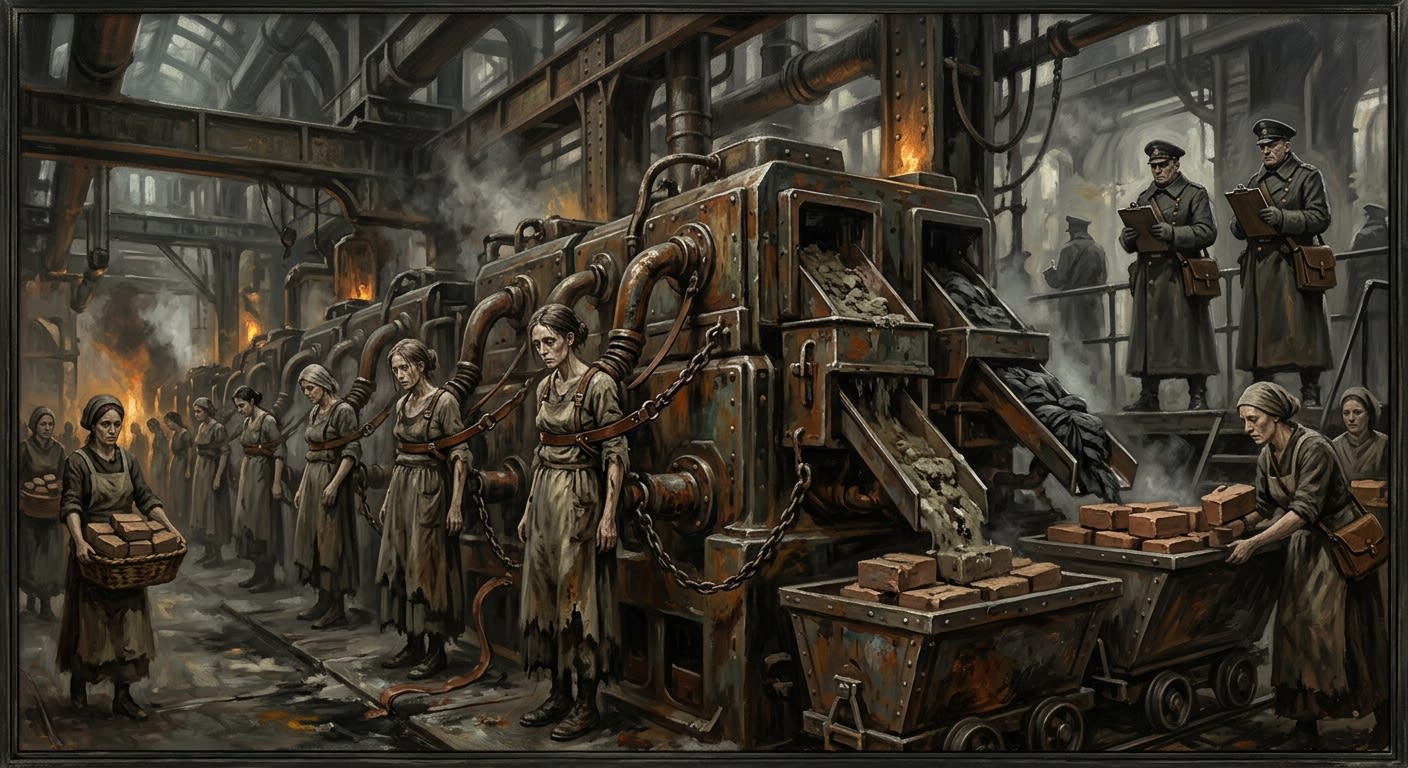
Classification 7-F is the Synod's sealed designation for Reproductive Infrastructure, Hostile: the category by which the Bureau of Medicine admits, under guard and with the diction of a man swallowing broken glass, that the Enemy has made womb, ash, mortar, obedience, and supply into one instrument.
It did not begin at Metz. Metz gave it arithmetic. The pit at Debrecen gave it witness. The ash at Zaragoza gave it weather. Metz made denial fiscally impossible, and the Synod will forgive almost any horror before it forgives a number that refuses to balance.
The vulgar call the subjects Ash-Mothers. Soldiers coined the term, as soldiers do, from fear, disgust, and the need to name a thing before it names them. Medicine resisted the word because medicine loves Latin when frightened. Records resisted because a mother is a person and infrastructure is an asset, and the file did not yet know which drawer should receive the screaming.
Doctrine resolved the question by choosing both.
#On Debrecen, Where Witness Became Procedure
The first usable witness came from Captain Elias Brekke, Radiant Fusilier, during the A.S. 78–83 window east of Constantinople, when his company found the Pit of Debrecen (Unregistered) beneath grey reeds and a bell-choir heard the ground breathing.
Seventy women were chained in a circle around a central pyre. Infants had been thrown into flame. Overseer sigils were cut into stone. Smoke rose in the shape of a hand and clawed the sky for eleven minutes. Brekke did the useful thing and the unforgivable thing. He wrote it down.
His deposition did not use the later category. No good first witness knows the future name of what he has survived. He wrote chain length, pyre depth, milk-stained ash, hand-shadow, restraints, bodies kept past mercy, three failed extractions, and maternal ash present in mortar seams. He refused to call the site battlefield residue. He called it an installation.
Installation meant maintenance. Maintenance meant supply. Supply meant repeatability. Repeatability meant the Enemy was committing atrocity in the theatrical manner beloved by sermonists while operating a production system. Brekke's pages entered sealed custody. Brekke entered Candlewick inventory. The Synod entered a period of official discomfort that lasted until Metz forced discomfort to put on boots.
Early field lectures described Debrecen as “the destruction of a sorcerous nursery.”
Corrected. Debrecen was a discovery, a partial interruption, and a retreat under bell-cover. Victory was added later by men who had not smelled the pit.
#On Metz, Where Arithmetic Broke the Curtain
The Black Census of Metz in A.S. 144 supplied what Brekke's deposition had lacked: mass proof. Four hundred and eleven captured Thralls from an enemy-held eastern position bore identical dental notches, jaw angles, left-eye ash clouding, sigils beneath the collarbone, and bell-pressure response. Ordinary field practice would have burned them as hostile mortal residue. An inquisitor noticed the teeth. Occasionally Providence works through pedantry.
Medicine counted mouths first. Then jaws, marrow, sigil tissue, ash scrapings, blood warmed over relic copper, and the silver-thread concordance frame borrowed from Relics and returned in a condition best described as accusatory. Kinship collapsed inward. Cousin marks became sibling marks. Sibling marks became offspring marks. Four hundred and eleven soldiers folded toward one maternal source: a dead woman whose remains had been mixed into the mortar of the bastion they defended.
The phrase “structurally dependent upon maternal remains” entered Engineering's report and ruined several breakfasts in Strasbourg.
When hammers struck the wall, the mortar screamed. Milk ran down the stones. The captured Thralls opened their mouths together and made no sound, which every witness later agreed was worse than shrieking. For eleven breaths the breached span counted in a woman's voice. The authorised transcript contains none of the numbers. Three soldiers wrote them on sleeves anyway. This is why sleeves remain subject to inspection after anomalous acoustic events.
METZ DEMOLITION ANNEX / SEAL CINDER Witnessed sequence: ███ ███ ███ ███ ███████ Correlation: nursery tally marks recovered from lower wall cavity. Instruction: do not recite in proximity to lactate ash, infant remains, or unsealed mortar. Violation penalty: classification exposure review, Purity custody, tongue audit.
Metz made Classification 7-F inevitable because it linked force generation to architecture. Men made from a woman's body defended walls made from the same body. The Enemy had taken motherhood, stripped it of tenderness, chained it to production, burned it into obedience, ground it into mortar, and made it load-bearing.
#On the Language of the File
The first draft of 7-F used the phrase “maternal production unit.” I struck it out hard enough to tear the margin. The second draft used “hostile reproductive source.” That survived six hours, which is five hours longer than it deserved. The final language, Reproductive Infrastructure, Hostile, remains too clean, but official language is a basin with a crack in it. Some blood must reach the floor.
The classification has five evidentiary triggers.
First: unnatural reproductive yield linked to mortal host biology, living or posthumous.
Second: obedience signatures in offspring, Thralls, ash residue, mortar, bone, milk, sigil tissue, or related material.
Third: structural dependency, meaning enemy fortification, pit, chamber, bastion, bridge, storehouse, nursery, or artillery cradle contains maternal remains as active sorcerous medium.
Fourth: genealogical convergence beyond lawful fertility, common inheritance, or permitted miracle.
Fifth: continuing acoustic, scribal, physiological, or tactical effect after maternal death.
A 7-F subject is classified beyond prisoner, corpse, relic, mother, victim, engine, terrain, or enemy materiel alone. She crosses all of them, which pleases no Bureau and comes near accuracy. Medicine handles tissue. Records handles lineage. War handles tactical implication. Purity handles contamination. Doctrine handles the lies required for public use. Mercy arrives late and asks whether anyone suffered, a question so sweetly stupid that one almost envies it.
A Medicine circular proposed that 7-F cases be described in public as “maternal sorcery contamination sites.”
Rejected. The phrase implies accidental infection. Classification 7-F concerns built systems. The Enemy did not spill horror. It engineered it.
#On Field Practice After 7-F
After Metz, field surgeons stopped being surgeons in the vicinity of captured Thralls. They became genealogists with blood on their cuffs. A regiment presenting shared dental irregularity, ash-clouded eyes, repeated sigil scarring, identical bell flinch, or abnormal kinship markers triggers a 7-F hold. Burn details pause. Teeth are inspected. Marrow is sampled. Collarbones are scraped. Bell pressure is applied in short pulses. Any soldier who jokes during this procedure is either inexperienced or dead by evening.
Captured hostile mortals once moved through four categories: prisoner, corpse, contaminated, useful. Classification 7-F added a fifth: evidence of a mother not yet found, or found too late, or built into the thing currently shooting at you. That fifth category changed assault doctrine. Engineers now test mortar. Artillery officers mark milk seepage. Purity lictors carry lactate salt strips. Radiant Fusiliers are instructed to aim at pyre basins, chain nodes, overseer sigils, and ash vents before spending volleys on obvious targets.
This last instruction has been mocked by officers who prefer courage to survival. Their replacements tend to read the protocol with improved humility.
The classification also altered custody of ruins. A 7-F site is never simply demolished. It is interrupted, sampled, salted, burned, sampled again, divided, and sealed under at least two offices. Single-office custody invites obsession. Whole remains invite cult. Names invite petitions. Petitions invite pamphlets. Pamphlets invite Purity, and Purity hates arriving after the printer.
#On the Woman Hidden by the Category
The chief moral danger of Classification 7-F is that it works.
A working category lowers the temperature of horror. It allows clerks to move pages, surgeons to request tools, officers to issue orders, and priests to stand upright while explaining to boys with rifles why the mortar is bleeding milk. It turns the unbearable into a procedure. The Synod survives because it does this better than any kingdom in history. I will not apologise. Apology is for failures and theatre.
Still. The woman remains.
Beneath the tissue code, the output estimate, the obedience signature, the mortar relation, the lactate profile, the marrow residue, the kinship convergence, and the sealed acoustic annex, there was a person before the category consumed her. She may have had a parish. A song. A child before the pit. A name spoken by someone who did not need it for evidence. The file cannot hold that without becoming useless to War.
Classification 7-F deliberately withholds names. This is prudent. Named Ash-Mothers would become saints in some districts, witches in others, counterfeit relics in markets, and convenient mothers for every grief-struck fraud with a pamphlet press. The Bureau of Doctrine permits no cult of the stolen womb. It permits no shrine to enemy manufacture. It permits no lullaby in the evidence chamber.
It permits the file.
#On Current Use and Forbidden Conclusions
As of A.S. 201, Classification 7-F remains active under joint Medicine and Records custody, with Purity access, War extraction rights, Doctrine review, and Mercy objections filed in a side annex where harmless decency is kept until needed for speeches. The category appears in training for field surgeons, Purity lictors, Records ash-index clerks, fortress engineers (Unregistered), and those unfortunate artillery officers assigned to positions where walls may have mothers.
The forbidden conclusion is simple: Hell learned bureaucracy from us, or we learned too readily from Hell. The distinction is doctrinally unhelpful. The Enemy uses bodies as infrastructure; the Synod uses bodies as labour, witness, tithe, oath, and line item. The Enemy makes a woman into a wall. The Synod makes her into a classification. One act is damnation. The other is administration.
The file is taught in Strasbourg under dead-bolt conditions to candidates who have already passed anatomy, field ash-handling, and the first level of sealed witness discipline. They sit in a cold room with inkless pens while a lecturer reads the Metz abstract aloud and watches which students look toward the door. Those who look once are reassigned to ordinary plague work. Those who do not look at all are watched by Purity. The proper response is to look, return, and keep writing.
The official position is safer. Classification 7-F exists because evil organizes itself. The faithful must organize better. Count the teeth. Test the mortar. Seal the ash. Guard the nursery chits. Do not sentimentalise the captive. Do not admire the mechanism. Do not recite the numbers from Metz. Do not ask whether the wall remembers being a woman.
Some questions are answered by fire. Others by locks.