
#On the Barracks' Office
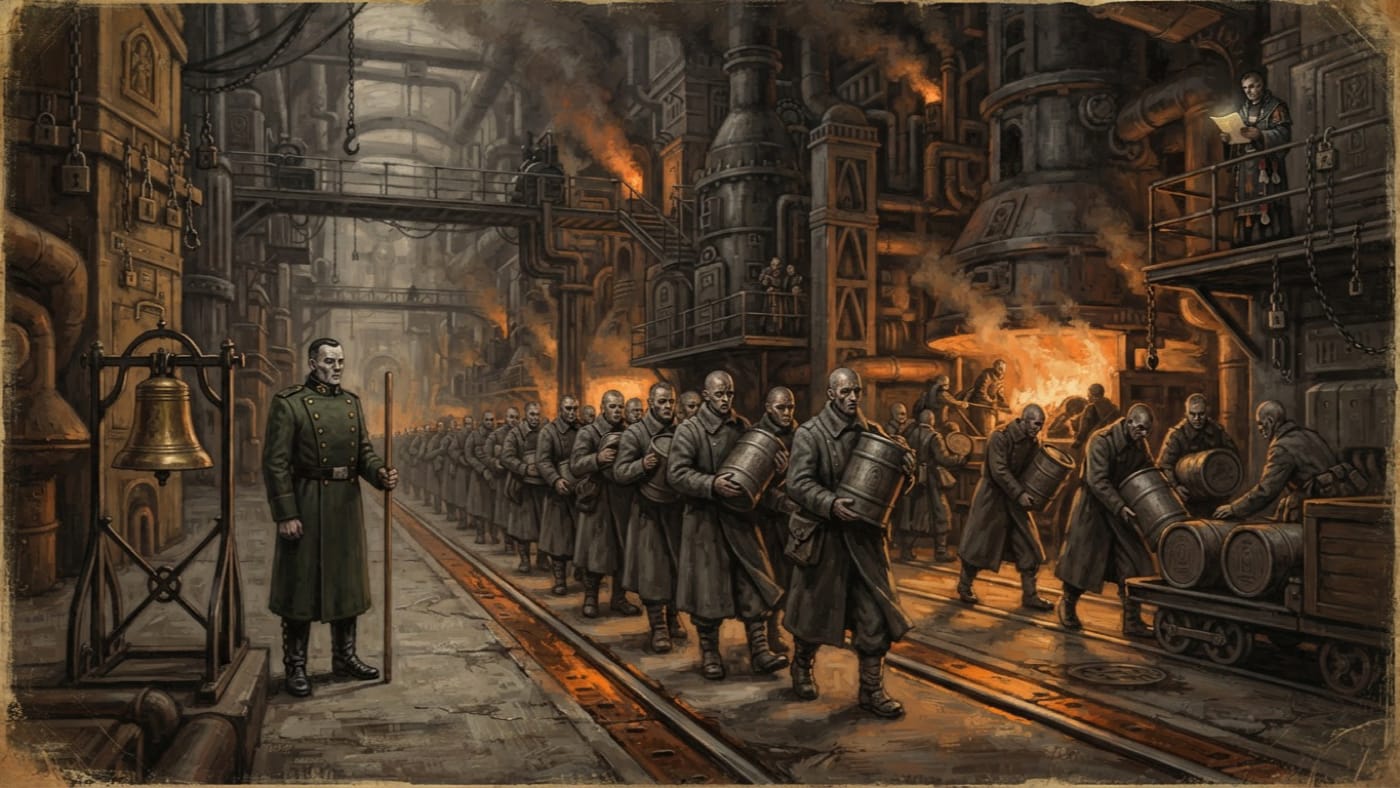
The catechism-barracks of Brast exist to make a human body keep time with a furnace. The training notice gives three purposes: cadence discipline, artillery fuel handling and pressure-bell compliance. The first is as old as armies. The second is dangerous. The third belongs only to a city where seventeen kilns ring their own hours and expect the people to answer.
Every training ground of the Church teaches obedience. Brast teaches it at a particular temperature. Essen-of-Hymnsteel drills hymn-frequency into rifle obedience, which means it trains the ear and the trigger finger. Brast drills furnace-rhythm into the whole animal: feet, lungs, shoulders, bowels and sleep. A recruit leaves Essen able to fire on the note. A recruit leaves Brast unable to stand still when a pressure bell sounds, and the Bureau of War counts this the more useful defect.
The guns of the Sagittal Line eat what Brast ships west to east. Someone must carry it, decant it, load it and resist the urge to sell it. Brast trains that someone. The work is rear-line, ill-paid and without honour. Its mistakes still reach the front on schedule.
#On the Material Received
Recruits arrive after mustering, wrist-stamped and shorn. They come in three streams, which the barracks drill together and record separately.
The first stream is Levy recruits classified Fit-Secondary. The Continental Levy has fed Brast since the First Continental Levy of A.S. 110, and the barracks belong to the city's growth in that era. No document I may cite records the day their first door was hung. The Bureau of Conscription, constituted in A.S. 112, now does the sorting: Fit-Primary to forward infantry, Fit-Secondary to extended drilling at Essen or Brast. The classification marks a boy as usable after further handling. The Bureau does not publish what he lacked, and neither shall I. Every adjective in a file invites an appeal.
The second stream is furnace labour transfers. These men are already of Brast and already coughing, moved from crews of the Crown onto the barracks rolls. They know the bells and despise the drill. In a week they teach the Levy boys more than the instructors manage in a month, and much of it later turns up in confession.
The third stream is penal technical crews, men whose sentences have been converted into usefulness. They know gauges, valves, couplings and locks, often from the wrong side of the lock. The barracks value their hands and distrust their mouths. They march in the same rank as the boys and eat after them.
#On Furnace-Rhythm
The first lesson is walking. Recruits march beside the pressure rails until their feet anticipate the bell schedules. At first they march to the drillmaster's count, then to the bell itself. At the end of the curriculum the bell is made late on purpose, and a recruit is marked correct if his feet keep going without it. A boy who has learned Brast feels fourth bell in his heels before the brass sounds.
The rails teach as well. They sweat, tick and shudder at the joints, and they run hot enough to raise blisters through a sleeve. A recruit judges his distance from a rail by the heat on one cheek. He learns to know a boiler cart by the sound of its wheels on slag, and he learns it fast. The boiler cart is the one instructor in Brast that never gives a lesson twice.
Then comes loading. Recruits practise under heat shimmer. The air bends over the kiln-light, and the drum in front of a man is never quite where his eye says it is. They learn to take a sealed chrismole drum from the decanting line without bruising its wax prayer, to read its serial mark and destination docket, and to pass it hand to hand at the bell's interval. A dropped drum loses its seal. A lost seal is a manifest question, and manifest questions belong to Sorn Vale. Recruits learn that name before they learn what a drum weighs.
Then comes singing. A man must sing before he touches a gauge and sing before he shoots. The rule is liturgical in form and mechanical in effect. The Calibration Choir under Ilyra Kest holds the fourth-bell distillation hymn to within three beats of the condensation rate. That tolerance belongs to the Gauge Ward and is no barracks grade. Recruits are taught only that the furnace keeps count and that a gauge touched in silence may answer badly. They sing poorly and constantly. Licences belong to the Gauge Ward. A recruit's office is to keep time and keep his hands where a Choir technician can see them.
Then comes smoke. A recruit must tell ordinary oil-smoke from the smoke that means a valve has begun composing a grievance. Ordinary chrismole smoke is sweet, low and heavy, and it leaves a black film on the tongue. Every instructor describes the other kind differently. Recruits are drilled to report it, never to describe it.
This is where the barracks meet the old problem of every furnace school in the Church. A man who loads fuel must know what fuel does. A man who knows what fuel does may decide he knows why. The Furnace Catechist tradition guards that border. It permits technical instruction where it keeps the line moving and polices explanation where explanation begins to make the clergy unnecessary. Brast's trainees learn when a valve is wrong. Why it went wrong is reserved to the Bureau of Engineering, the Furnace Chapterhouse and the Bureau of Doctrine, which have disagreed about it with great stamina. A penal crewman who offers a cause nobody asked for is corrected. A boy who repeats it is corrected harder.
Ordnance primers describe the Calibration Choir as "ritual accompaniment to distillation."
Corrected for every hand that carries fuel. The Choir is an operational office. Its hymn keeps the fourth-bell distillation in measure, and trainees are instructed to treat it as part of the works, with the reverence that implies. Accompaniment is what the barracks sing at supper.
#On the Cost of Correct Timing
The body pays first. It pays in heat, burns, fumes, ash lung, rail crush, boiler carts and fatigue, and in the procedural violence of instructors who correct a late foot with a stick. The Ash-Hospice Sisters treat the lungs and keep the accident record. That makes them the only people in Brast who know the barracks' true losses, and the last people anyone consults about them.
The body pays again through dependence. A trainee who has learned furnace-time finds he can keep no other. Brast lives on warm chits and heat debt, and the Boiler Commons ties a man's warmth to his shift-tempo. The barracks prepare a body perfectly for that arithmetic. Labour transfers go back to it. Levy boys carry its reflexes east. Warmth thieves can pick out a trainee by the way he leans toward a heat pipe, which is why the third line of the notice exists. Their offer comes at the hour a trainee is coldest, and it is always for the fuel he is about to be trusted with.
The dead pay last, in paperwork. In public filings, a recruit crushed under a boiler cart is no martyr. He is a logistics casualty, training-adjacent, non-front, pending family notification. His mother receives a letter that smells faintly of oil. The cart receives an inspection.
#On Present Instruction
In A.S. 199 a Brast-fed battery at Przemyśl put four rounds into a friendly rail junction. Eleven died and a supply train was crippled. No finding blames the barracks or anyone they trained, and I will not invent one to suit a paragraph. Ordnance blamed sabotage. Kest blamed the feedstock. The Compact blamed the Choir. The barracks drew no new rule from the affair. They drew a sermon. Every instructor in Brast now tells recruits about Przemyśl, and each tells it to prove the importance of whatever he happens to be teaching that hour.
As of A.S. 201 the city stands at Amber. Seven sealed drums are missing from the Manifest Court, and the machinery answers unpredictably. The notice's second line, report engines that answer, was once recited in the barracks as a pious formula. It is now read as an order with witnesses. A recruit who hears a boiler respond to a hymn is to report it by hour, by bell and by kiln, with no adjectives. The behaviour of the Sulking Engines is on record. Its cause is contested. Workers say the machines take offence. Engineers say the tolerances have drifted. Doctrine says the matter is under review. The barracks teach none of these accounts. A trainee who holds a theory starts listening to the boiler for proof, and a man listening for proof has stopped listening for the bell.
Strasbourg has dispatched Inquisitor-Mechanic Lux Thane Mire. His train has not arrived. The barracks rolls stand ready, with all three streams entered, every drum handled in training logged by serial, and every reported answer filed by bell. Whether he will find the barracks a school, a workshop or a confessional is his to determine. The instructors have already decided to agree with him.