
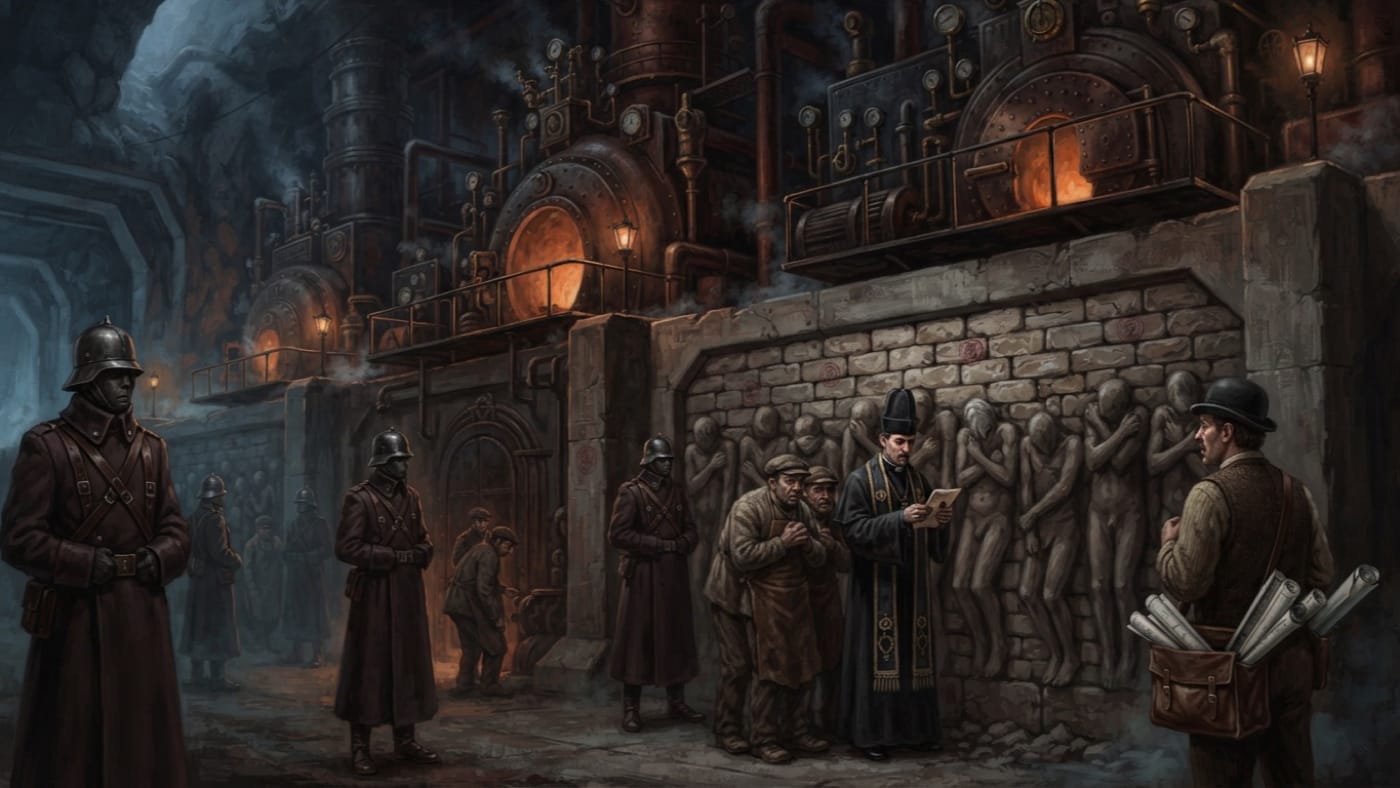
#On the Ownership of Cause
"Cause is a chain; chains have owners." — shift-start formula, wax-sealed doctrine card
The Causality Wars were never declared, and the archive holds no instrument that could end them. The name is a clerk's convenience, attached after the fact to a quarrel older than any filing of it.
The question is the one the furnace asks every shift. The Bureau of Engineering holds the specifications: load tables, valve tolerances, the drawings that tell a man how much fuel a firebox will bear before it decides otherwise. The Bureau of Doctrine holds the language in which any of that may be said aloud. One Bureau owns the facts. The other owns the sentences. The stoker owns a shovel.
Engineering would like you to believe it fights for knowledge. It fights for its knowledge, which is a narrower cause and a better-paid one. Its drawings are stamped for its own draughtsmen, and it has never petitioned for a stoker to read them. Doctrine would like you to believe it fights for souls. It fights for the report, the document written after the boiler fails, which decides whether the dead died of a seal or of a sin. Whoever writes the report owns the cause. Whoever owns the cause owns the remedy, the budget, and the next sermon.
Between the two stands the Furnace Catechist, who polices the border. The worker lives on it.
#On the Permitted Explanation
Doctrine's instrument is the Chain of Cause. It is a recitation that carries every flame downward from the Creator, through the heavenly order and the offices of the Church, through the Bureaus, the commandant and the foreman, into the stoker's hands and at last into the fuel, which burns because it has been given leave. In its present form it runs eleven minutes. It was a good deal shorter in A.S. 104 (1814 CE). That year fourteen stokers burned in a bastion powerhouse and the survivors demanded "truth lessons." Six preachers arrived with cards, loudhailers and Warden escorts, and they had no written mandate to quote. They improvised, and the improvisation held.
The Chain carries the doctrine, and the card does the work. Cards are issued under wax at shift start, and they operate by substitution. A pressure curve is spoken of as the breath of obedience. A mixture ratio is the proportion ordained. A thermal gradient is the will of the fire. Combustion efficiency has no card. No approved phrase exists for it, which is how the Bureau declares that a thing does not occur. Under Standing Order 14-P, any explanation outside the cards is unauthorised.
Watch it at a boiler face. A stoker sees the needle standing higher than it stood yesterday. The mechanical sentence takes three seconds. The approved sentence is "the breath of obedience grows strong," and a foreman may hear it as a report, as piety, or as noise. The card makes no distinction between a warning and a prayer. Depending on whose design you consult, that is either its flaw or its purpose.
Visitors confuse the Catechist with the Litany-Engineer because both chant near machinery. The Litany-Engineer measures, repairs and sings calibrated cant into the pipes, and the pipes answer. The dedicated records are plain that sanctioned sound has practical effect on the Synod's engines. The Catechist touches nothing. His office decides what may be said about the engine, by whom, and in which ledger. One keeps the boiler working, and the other keeps its story in order.
#On the Manuals and the Walls
The bloodiest engagement came in the winter of A.S. 134 (1844 CE). Manuals known collectively as Fuel Is Chemistry passed through six bastion powerhouses in a single season. They described combustion mechanically, with diagrams. The copy recovered at Bastion-Przemyśl contained a conversion table that let a literate stoker calculate a fuel load without consulting the approved catechism tables.
The table was the heresy. A diagram can be dismissed as a picture, but a table is a procedure, and a procedure needs no priest to perform it. With one in hand, a firebox could be kept inside its tolerances on the stoker's own arithmetic, and the Chain lost a link in every gallery where the table was copied out.
Doctrine entered the texts on the Index Damnatus. The Bureau of Purity sent its Lictors. At Przemyśl alone they immured forty-seven stokers, eleven foremen and three shift engineers, which makes sixty-one in the walls of one fortress. The other five powerhouses go unnamed in any record I may quote, and nobody who wishes to keep his post adds their dead to the sum.
Note the three shift engineers. Engineering lost its own men to the wall that winter, and no surviving filing shows it objected.
The Causality Purge arose from a spontaneous outbreak of Rationalist sentiment among uneducated labourers, who circulated crude mechanical tracts among themselves.
ERRATUM (Bureau of Doctrine, A.S. 147): The manuals originated with a senior draughtsman of the Bureau of Engineering, whose identity remains sealed under Bureau of Shadows File 44-K. His occupation and his access to fuel-load specifications are acknowledged. His name, his reasons, any office that sponsored him and his eventual fate are not.
The correction took thirteen years. The labourers stayed in the walls the whole time.
#On the Sermon at the Front
In A.S. 158 (1868 CE) the generators at Bastion-Shipka, which holds the pass through the Balkan Mountains, began to misbehave. Diesel flow went irregular. Pressure swung on the gauges with no cause the shift could name. The Bureau of Bells logged "foreign harmonics" in the resonance pipes.
Two findings went into the record. Doctrine attributed the disturbance to agents of Syrion. Engineering attributed it to corroded gaskets. Both remain on file under separate seals, and neither has been withdrawn. The Synod declined to reconcile them, and I decline after it.
The Synod issued a mandate instead. The Trench Sermon Mandate placed a Furnace Catechist at every power installation on the Line. The reasoning has a cold tidiness. The Pale Chanters have taught the Line that hostile sound can enter a pipe, and once it can, every engine room is a listening post. A stoker who improvises a diagnosis may be repeating whatever the pipe has just suggested. Better that the stoker report a disturbance of the spirit, step back and call the Catechist than argue with the noise.
The Causality Wars thus acquired a security clause. A Doctrine officer in a boiler pit became counter-intelligence, and Engineering could no longer call him dead weight without seeming to argue the enemy's convenience.
The Przemyśl record attributes fourteen "doctrinal compliance incidents" between A.S. 158 and A.S. 178 to warnings that existed in engineering terms and were given only in approved ones. Those fourteen were explosions, scaldings and gas releases. The reviews do not mention the Mandate. I note that they do not mention its absence either.
#On the Forbidden Lesson
In A.S. 187 (1897 CE), at Essen-of-Hymnsteel, a Furnace Catechist taught thermodynamics to an apprentice. This was the real article: carbon and oxygen, the mathematics of heat, the whole Chain with its heavenly links taken out.
Purity found out. The Catechist was immured, the apprentice went to the Paper Mines of Ulm, and the plant was reassigned entire.
Engineering filed an objection, and it should be read closely. It protests waste. A promising heat-systems mind, which Engineering regarded as its own future property, was being spent in a mine. The Catechist's fate appears nowhere in it. The objection was noted, and the apprentice stayed where Purity had put them.
#On the Unsettled Account
The war now runs through the corps as much as between the Bureaus. The Purists permit no technical word in any gallery, emergency or none. The Pragmatists let the engineer use his vocabulary while the boiler screams, then strike it from the report. The corps calls this two-track preaching. It keeps the plant running and the record clean, and it makes every Pragmatist the custodian of exactly the knowledge his office exists to suppress.
At the Chrismole Furnaces of Brast, Catechists preach the Chain to furnaces that sulk and refuse to fire for cantors they dislike. Engineering classifies this as an acoustic-mechanical disturbance. Doctrine reads it as Providence, and the furnaces read neither. At Essen, tools hum on unattended benches and the Wrong Choir sounds in the foundations. Doctrine preaches over it and Engineering measures beneath it, and the hum keeps its own schedule.
The Bureaus cannot even agree on how many Catechists exist, because Doctrine counts licences and Engineering counts interference. Their figures differ by some six hundred. The difference is filed as an administrative discrepancy. The question beneath it, whether the furnace roars by fuel or by command, stays in the cabinet marked Causality: Ongoing, and the drawer is shut for another year.