
#On the Lesser Knife
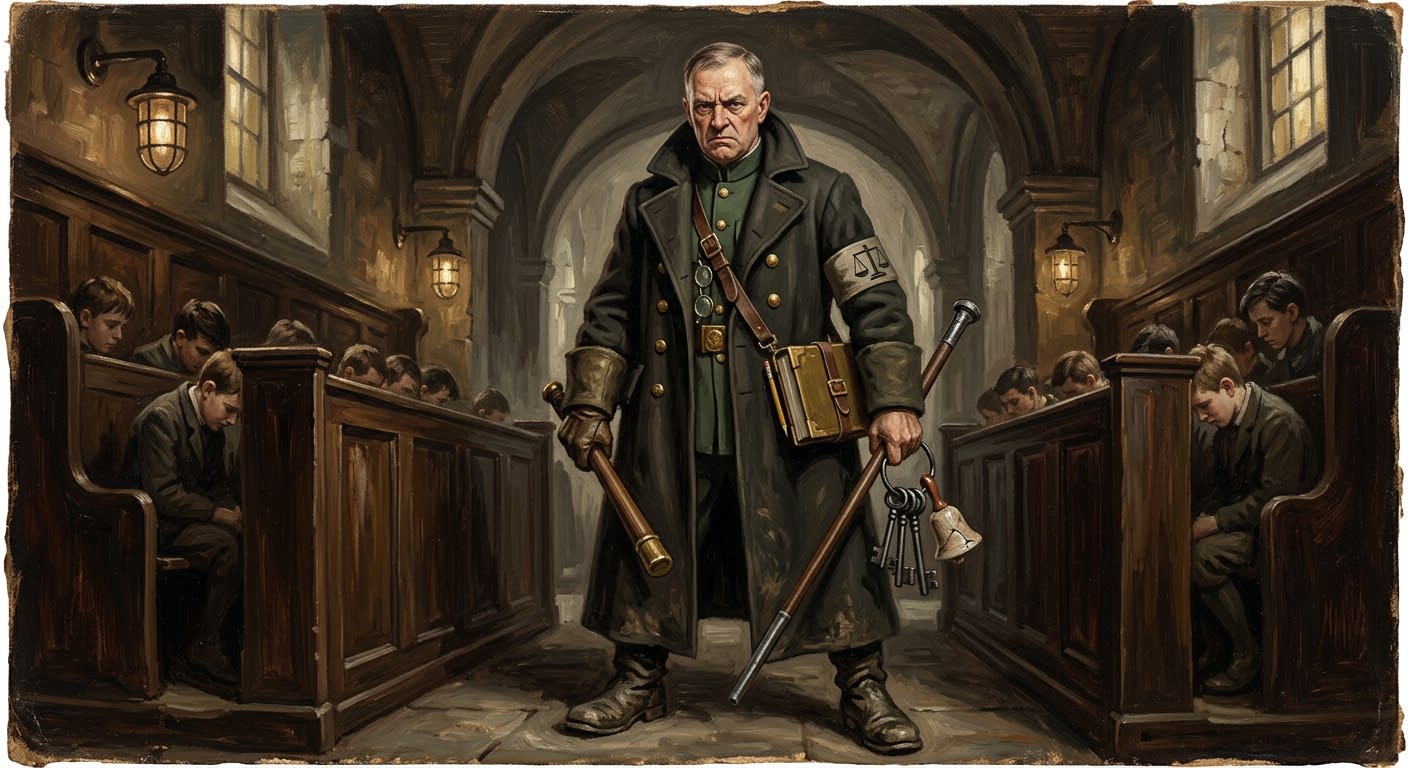
A Choir Warden is the aisle officer of Bastion-Irongate: breath-line monitor, page-keeper, pitch witness, silence accuser, heat concern initiator, and the small uniformed calamity standing close enough to hear whether a man's throat has begun telling the truth. He serves beneath the Choir Magistracy, beside the Gasket Choir, and above the workers whose lungs maintain the mountain while the mountain repays them in stone dust.
The office is minor only to people who have never stood in the Choir Nave with a failing note in their mouth. A magistrate condemns from the Warm Bench. A Choir Warden stands in the aisle, strikes the pitch, watches the candle, hears the crack, marks the book, and supplies the sentence with its first little bone.
His authority is intimate, and intimacy is the cruelest scale of government. The Choir Warden may not pronounce final sentence without Bench writ, may not revoke heat with his own hand, may not assign a man to the Hush Court as if pushing a broom into a cupboard. Such limits comfort Strasbourg. They comfort no one at Irongate. A Warden's mark enters the Beat Book; the Beat Book becomes a review; the review becomes a cold service pipe; the cold pipe becomes a child's cough; the cough becomes another note thinning in the pit.
#On the Birth of the Office
Before the Great Hush, there were foremen with cudgels and good ears. They walked the tunnel lines in the brute years, when the Irongate still pretended that its chant crews were supplemental to iron bracing and that the mountain would behave if sufficiently bolted. Then silence killed three thousand in the Third Lung. Pressure doors failed in sequence. Gaskets crept. Stone compacted men into an engineering lesson too large to ignore and too embarrassing to quote honestly.
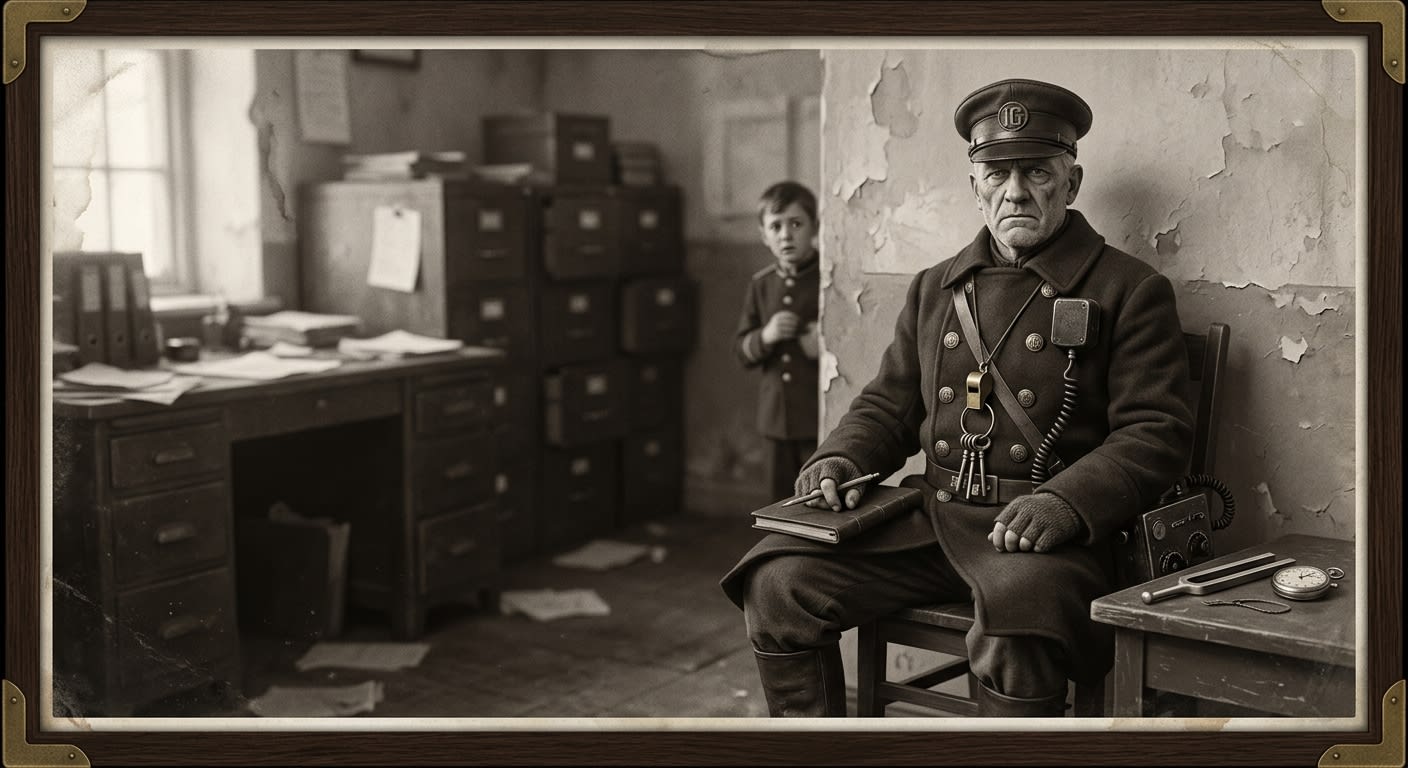
After A.S. 94, every throat acquired strategic value. The Bureau of Bells heard structural necessity. The Bureau of Doctrine heard wages of silence. Engineering heard liability and called it resonance. By A.S. 97 the Voice-License Tier System (Unregistered) required appointed monitors in every breath line. By A.S. 105 resident vocal classification had hardened the Warden into a permanent office. By A.S. 112 he had a uniform collar, because the Synod loves nothing so much as dressing an emergency until it can pass as tradition.
Early breath-line manuals call the Choir Warden a “chant assistant.”
Corrected. An assistant helps. A Choir Warden tests, marks, cites, confiscates, reports, and occasionally saves a chamber by ordering another man to sing through blood. The earlier term survives only in training pamphlets issued to recruits before they learn enough to desert.
The Warden's famous motto, Hold True, was painted above the south service aisle after the A.S. 112 collar reforms. It flakes in damp weather. The private motto travels better: No mercy audible above assigned pitch. I dislike admitting the superiority of unofficial prose, but the pits have a gift for theological compression.
#On Recruitment and the Ear
Choir Wardens are recruited from discharged chant workers, fifth-tier supervisors, retired pressure clerks, pitch-gifted infantry, and foreign resonance specialists borrowed from Saint-Helm's Cut when the Bureau of Bells decides that a cruelty learned in one mountain may prove useful in another. Saints are avoided. Saints make poor Wardens; they forgive at structurally inconvenient moments.
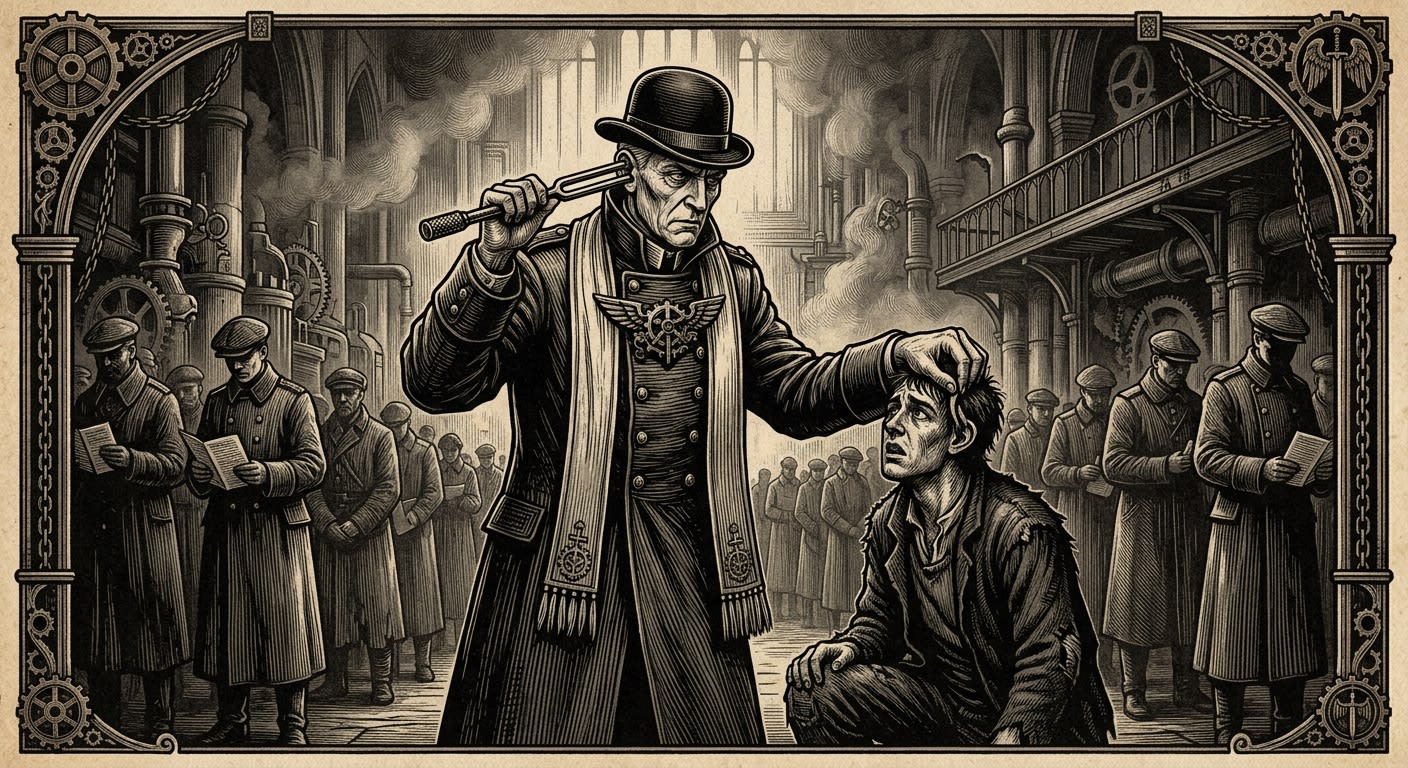
The first test is hearing. A candidate stands in a dry chamber under the side vault while three tones pass through brass: the official note, the drift note, and the false comfort, which is close enough to safety to tempt a sentimental ear. He names each. Then two workers sing together, one clean, one failing beneath the line. He names the failing throat. Then a clerk coughs behind a screen, and the candidate determines whether blood is present.
The final test uses a child. The child sings a licensed practice line and cracks deliberately at the seventh beat. The candidate must mark the crack. Hesitation fails. Pleasure fails. The acceptable candidate marks as if noting a hinge fault: exact, cold, unadorned. The Bureau calls this discipline. I call it the manufacture of useful damage.
Training lasts nine months in blessed paperwork and six weeks when pressure weather eats the roster. Novices learn pit geometry, candle-bend timing, lower-register drift, kin-cover detection, page custody, emergency overpressure order, baffle seam inspection, Underchord route caution, and the three silences: rest silence, dead silence, listening silence. Rest silence is permitted. Dead silence is structural enemy. Listening silence is suspect, because a worker who listens too carefully may hear the mountain before the page.
#On the Tools of the Aisle
The Warden carries pitch fork, candle clamp, throat mirror, wax page tags, chalk, slate baton, whistle, baffle key, Beat Book, and a folio chained to the belt. The folio holds pressure hymnal pages. The pages are numbered, sealed, distributed, recalled, and audited with the jealous severity of a miser counting teeth after a brawl. A missing page can buy food in the Underchords. A recalled page can buy passage. A page with a correction absent from official issue can buy belief, which is the most expensive contraband.
The slate baton is ceremonial by regulation and educational by bruising. It points to stance. It taps measure. It breaks knuckles when measure fails too often in the same family. The Bureau distinguishes these uses with language. The hand does not.
A.S. 112 Warden Training Circular describes the slate baton as “ceremonial and instructional.”
Amended. The baton has broken more bodies than ceremonies require. Its instructional value remains undeniable, since men learn quickly when their fingers are part of the lesson.
The Beat Book is worse than the baton. A baton hurts where it lands. A Beat Book hurts later, through offices. One dot for late entry. Two for breath theft. Cross for hidden cough. Crescent for suspected kin-cover. Black line for Underchord contact. Hollow square for Counterkey suspicion. Three small marks can outlive a man's appeal. Four can chill his bunk.
At First Watch, the Warden receives pit assignments: who stands where, which chamber requires damp correction, whose wife has begun widening her line to cover him, whose child carries gasket-rings, which page was revised overnight, which worker returned from the Breatheries with a throat officially sufficient and privately ruined. He walks. He listens. He marks.
#On Page Custody and Theft
Every Choir Warden is a priest of paper, though most would look better with less theology and more soap. The calibration pages are the Choir Magistracy's portable sovereignty. They state which note holds which chamber under which pressure condition. They decide whether a worker's memory is lawful, whether his practice is preparation or conspiracy, whether a correction saved from an old page is prudence or heresy.
Memorisation is encouraged for stable lines and feared for useful ones. A worker who knows a stanza may practise. A worker who practises may survive audition. A worker who survives without dependence on the page has acquired private property in a system designed to rent survival by the shift. Wardens enforce the compromise: learn enough to hold the mountain, never enough to hold yourself.
PAGE LOSS FILE 19-D / A.S. 200 Item: East-wall pit revision, damp wind, second movement. Custody: Choir Warden folio. Recovered: upper Underchords, copied in gasket grease on six walls. Unofficial correction: steadied Gauge Six. Official action: wall scraping; Warden dismissed; correction denied. Subsequent issue: identical correction under new title.
The Underchord Cartel buys Wardens by the little handles a life leaves exposed: medicine, debt, heat, children, old grievance, throat resin, gambling slips, the fear of falling from fifth tier into useful pity. The Cartel wants pages, route times, patrol gaps, confiscation lists, and warnings. The Counterkey Circle wants something worse: Wardens who have heard the legal note fail and the illegal note steady the gauge.
Commerce corrupts. Belief converts. The Bureau prefers corruption, as do all governments with accounts payable.
#On Silence, Kin-Cover, and the Hush Court
The Warden listens for the wrong absence. A lower line missing under convoy surge. A dormitory muttering that ends before boots arrive. A cough swallowed quickly. A child's practice note clipped short when the father enters. A worker singing too generously beside a failing husband. Kin-cover is the tender crime: one voice widening to shelter another until the gauge lies kindly for a few measures.
The Warden marks it because kindness has acoustic consequences. The mountain does not distinguish between love and sabotage. That is true, and truth at Irongate is often a hammer handed to the least merciful man in the room.
When enough marks gather, the summons follows. The Hush Court sits under reinforced ceiling. The Warden strikes the test note, identifies drift, produces the Beat Book, names the page, and watches the accused answer. A spoken defence may reveal voice drift. A sung defence may reveal Counterkey sympathy. A written defence may reveal grease notation. A tapped defence may reveal Underchord schooling. Silence is confession if the room is hungry.
The A.S. 199 emergency audits after the Counterkey Circle's reclassification damaged the corps. Fourteen referrals went forward. Fourteen executions followed. The Beat Books were praised. The pressure held. Then Wardens began resigning, vanishing, drinking, overmarking, undermarking, and speaking in measurements where ordinary speech had once lived. Cantor Ys Varr remained serene at the audition bench. Serenity is easier when someone else walks the aisle.
#On Sub-Grade Patrols
Choir Wardens do not officially patrol the Underchords, since the Underchords officially do not exist. They inspect maintenance approaches, obsolete ventilation cuts, baffle crawls, waste-pipe galleries, and other names by which the Synod flatters a denied city beneath its own fortress.
A sub-grade patrol wraps buckles, hoods lamps, chalks wrists with entry time, carries mirror rod, twine, pitch fork, baton, Beat Book, and a second man whose fear is useful evidence. Speech is discouraged. Tap response is forbidden unless using approved challenge sequences, which the Cartel has known since A.S. 186 and improved with insulting care. Distance below the Fifth Lung commits clerical fraud. Candle notches are safer than chains.
The Dead Gallery is the patrol's black lesson. It lengthens when measured. It returns sound before it is spoken. It keeps damp on basalt that is not water. It has displayed a figure in Choir Warden uniform at the terminus, correct insignia, correct belt, wrong face. The instruction is plain: do not enter alone, do not sing, do not answer a voice that arrives from your own throat ahead of you.
Wardens returning from sub-grade patrol undergo candle test, mirror check, page memory challenge, identity review, and, if the examining clerk has literary instincts, quiet pity. Mirror check is hated because Mirror Discipline teaches the Irongate to distrust reflection, then demands reflection for proof. Two Wardens failed in A.S. 200. One attacked the tin. One saluted it. The saluting one was removed faster.
#On the Present Warden
As of A.S. 201, the Choir Warden stands in a narrowing office. Ice-lung thins workers faster than training produces ears. Counterfeit voice-licenses improve. Hymn pages vanish. The Cartel buys what poverty offers. The Circle writes corrections in grease. Oathglass methods bring names into resonance. The Dead Gallery lengthens without permission. The mountain demands sound with the appetite of an old creditor.
The Warden's danger is not rebellion. He is too embedded for simple treason. His danger is trained perception. He may hear a forbidden note steady the gauge. He may see an illegal pass save a dying worker. He may know that a sanctioned page is wrong before the Magistracy revises it under another title. If he writes what he hears, he becomes explosive. If he writes what the Bench requires, he remains loyal and begins to rot.
At Third Watch, the Warden takes the aisle. Chalk on cuff. Wax tags at belt. Baton tied to wrist. Pitch fork wrapped until needed. The workers draw breath. The page trembles. Somewhere below, a pipe taps twice.
The note begins.