
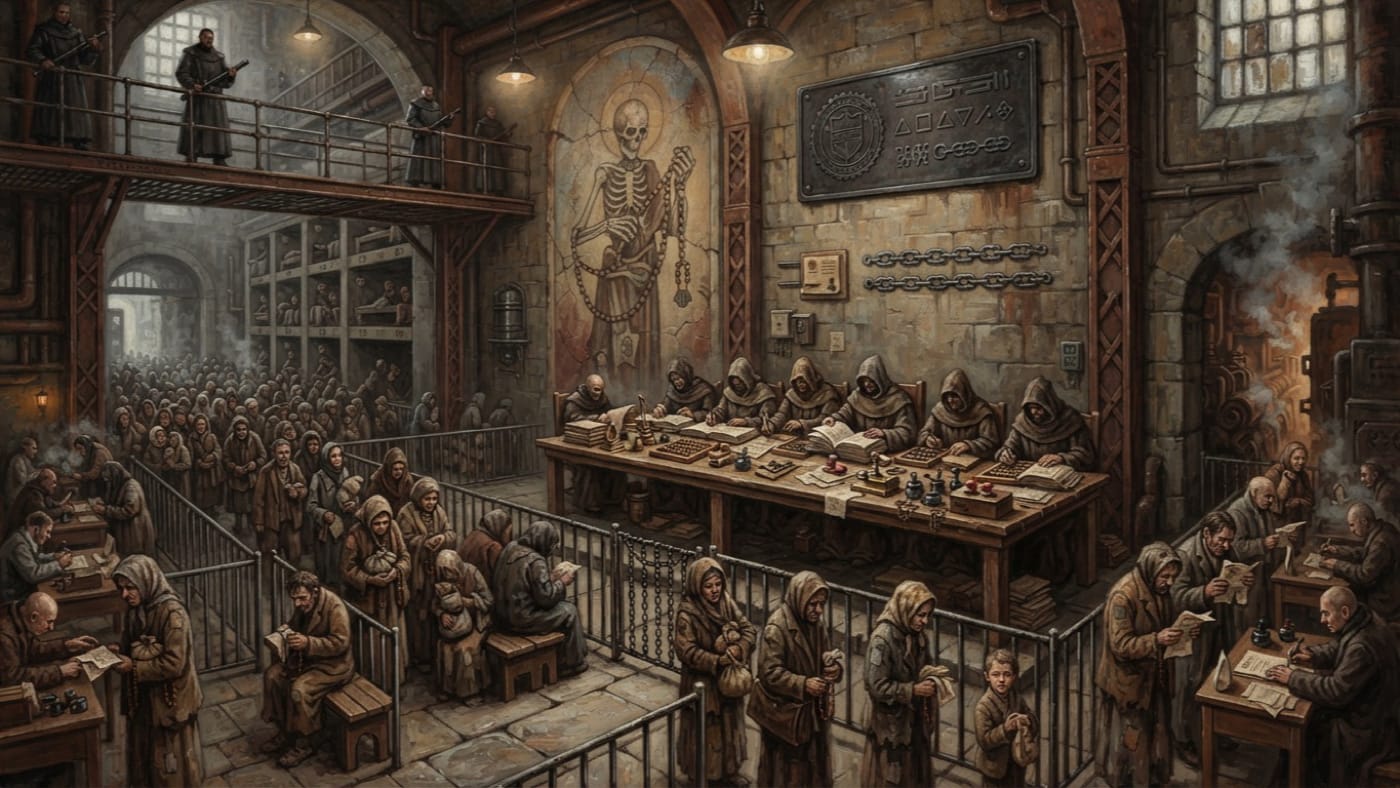
#On the Chapter's Office
The Cloister Chapter of the Second String governs the Cloister of Miscounted Beads. The Cloister is a pilgrim borough of low walls and chain gates on Strasbourg's outskirts, where the Church keeps people whose papers and persons have stopped agreeing with each other. The Chapter's stated purpose is reconciliation, and its posted virtue is mercy. What it actually works with is the recorded life of a human being. It holds that record at a scarred table in the Chapel and Counting Hall and amends it there, slowly, for a fee.
Visitors from the capital confuse it with Strasbourg's Cloister of Concord. The Concord sisters resent this, and they are right to. The Chapter is a local Synodal body under the joint oversight of the Bureau of Records and the Bureau of Pilgrimage. It answers to the Synod roughly as a parish drain answers to the Rhine.
It has no founding year of its own that I will certify. The Cloister was established in A.S. 94 to take overflow from the pilgrim roads, and the Chapter grew wherever the overflow grew. First came a desk to sort the stranded, then a chapel to kneel them, a vault for what was taken from their wrists and a watch to keep them in. Last came a table where the keepers of all these could disagree in minutes. Institutions born of inconvenience rarely remember their birthdays. They remember their filing deadlines.
#On the Seven Seats
The Chapter table stands beneath a faded image of Saint Odran counting knuckles. It has seven seats: Prior-Scribe, Intake, Vault, Office, Dorm, Watch and Chapel. The surviving lore also describes a Ledger Tribunal desk staffed by rotating Synodal appointees. The tribunal men change with the season and the seats do not, so each new appointee learns the table's habits before he learns anyone's name.
Nobody has produced a constitution that counts the votes, and I have stopped asking for one. The table does not decide by arithmetic. It decides by order of speech.
Prior-Scribe Erem Vale, confirmed in A.S. 194, speaks last. By then every officer has shown their need, fear, debt or stupidity, and Vale has only to choose among them. His procedure governs the minutes. No anomaly may be described before it has been classified. No classification may be revised without his hand. The word "mistake" may never appear. He prefers discrepancy, and the whole Chapter now talks the way he does. The clerks believe this is because the habit is contagious. It is because it is enforced.
Jossa Rill, Mistress of Intake, controls the Lost Procession Yard. She does the first sorting and decides who is housed, who is expelled and who is referred. Archivist Keth, called Mother Thread by detainees with more poetry than evidence, has held the Bead Vault since A.S. 182. She decides what the evidence cabinets will admit, and admits less than she is asked to. Vale outranks both of them on paper. He depends on both in practice: Rill feeds him sorted bodies, and Keth guards cabinets he cannot open without her.
Four seats remain: the Office, the Dorm, the Watch and the Chapel. Their holders sit, report, petition and wait for the last voice. I leave them unnamed. The Chapter does the same in most of its correspondence, and I see no reason to be more generous than the institution.
#On Correction and Its Price
Ordinary business moves through audits, desk rulings, bell orders, filing, confession addenda and the Anomoly Protocols. The route is simple to describe and slow to travel. Intake classifies the pilgrim. The Counting Hall counts the string, and twelve desks are enough to stall thousands. A discrepancy goes on to the Supplementary Entry Office for further filing. Anything stranger goes to the Chapel of the Second String or down to the Vault. Meanwhile the pilgrim sleeps in the Dorm Rows under the official designation of Awaiting. At the end comes clearance, or more review, which is the more common result.
Every stage costs money. There are filing charges, dorm charges, and the "clerical time" fee, which bills the pilgrim for the minutes spent deciding whether the pilgrim exists. Those with no coin pay in labour: cleaning, copying, night watch and corpse-cart duty. Labour does not stop the dorm charge from running. A man who spends a week copying ledgers to pay last week's debt has earned his next week's debt by doing it. The average case takes nineteen days. The Chapter calls this care.
Above the official fees, the Sponsor-Seal Brokers sell acceleration. They hold no charter, no seat and no office. They are tolerated anyway, as a cartel whose services move some files faster and keep some families quiet. Vale condemns them every quarter. They pay for the condemnation as an operating cost.
There is one thing the brokers cannot sell. Once a case has been declared an active anomaly, no sponsor can buy its nullification. This is the Chapter's single incorruptible rule. It is incorruptible because it has no market.
#On the Chapter Under Seal
When ordinary protocols can no longer keep clustered drift local, the Chapter takes on its emergency form. Vale declares the interval. The Chapter countersigns. Records acknowledges. The Outer Watch posts the black notice and chains the gates. The Cloister calls this an Anomoly Week, spelling included. Its first recorded form appears in the Chapter minutes of A.S. 199.
That was also the year of Circular 881-R, the Records order declaring that bead counts are fixed at filing and that every later discrepancy is "handling deviation." The circular denies the drift. The sealed week contains it. The Chapter administers both without visible embarrassment, which takes discipline from clerks and contortion from the Prior.
The Chapter recognises six signs: roster seep, recurrent bodies, string hostility, ink overreach, basin rise and external echo. I leave the full catalogue to the parent article. A short codex entry should not try to compete with the Chapel basins for nightmares.
Under seal, the Chapter's authority becomes visible. Clearance is suspended. Intake narrows and movement stops. Ink is covered and certain names are forbidden aloud. Strings are inspected under salt-wax and rations are "adjusted," always downward. Evidence is sealed. Vale names the whole arrangement protective narrowness. The detainees repeat the phrase because hunger is easier to bear when someone has given it a title.
The week ends when the Chapter says it ends. No source fixes its length at seven days. The word week describes the paperwork, and the drift does not consult it.
Vale's critics call this detention. His defenders call it the only thing that has prevented riot behind the walls and rumour beyond them. Both are right. Containment keeps panic off Strasbourg's streets by packing it more tightly into the Dorm Rows. The Chapter regards this as a reasonable trade. The Dorm Rows were not consulted.
#On Rival Claims
Vale signs the order, but signing does not make him sovereign. Every officer and bureau with an interest in the Cloister pulls the order a different way.
The city magistrates want the Cloister to stop releasing "cleared" vagrants into Strasbourg's streets. The Synod wants more detentions, because detainees produce confession data and confession data is useful to the Synod. Records claims the file, Pilgrimage claims the pilgrim, and the Bureau of Purity claims the suspicion. The Bureau of Doctrine claims the authorised interpretation, and arrives once the others have made the matter dangerous enough to need one.
The Outer Watch holds municipal standing. It also obeys Chapter orders whenever those orders come with better paperwork, and in practice they always do. The watchmen hold the chain keys during ordinary hours. They are a gate detachment with cudgels and a grievance, which is less than a Church army. Their working rule is short: whoever signs commands the gate.
Purity's pressure is seizure. In sealed weeks it wants strings, jars, matrons and witnesses for its own fires. Keth's selective custody often settles where those things go. She keeps the dangerous material under Vault discipline, citing 881-R, and Purity stays one locked cabinet away from evidence it would burn without understanding.
The Quiet Thread recruits in the bunks. It whispers that a correction can itself be corrected, and it calls Keth "Mother Thread." Nobody has proved that she belongs to it or leads it. The cell borrows her name without her signature, and the Chapter has not yet found a fee to charge for that.
Beneath all of this sits a rumour of a First String, a bead line supposedly kept somewhere below the Vault that could amend any recorded life. Brokers have fought over the rumour. Quiet Thread pilgrims pray toward it. The Chapter has issued no statement on it, and in that place silence counts as a statement.
#On the Present Application
The Cloister has held more people than it can house since A.S. 198. Intake for A.S. 200 reached fourteen thousand two hundred. Three sealed weeks were declared that year, and the projection for A.S. 201 is five.
Earlier Cloister statistics listed five Anomoly Weeks as declared for A.S. 201.
Corrected. Five are projected. A projection is a forecast entered in the Chapter's own hand. It is not yet a count of declarations, though it has been budgeted as one.
The Chapter now runs at its practical limit. The Yard is full. The desks are weeks behind. The Vault is warmer than stone should allow. The Dorm Rows bill nightly for the privilege of waiting. Every overcrowded month makes the Chapter more necessary, because only the Chapter can decide when the waiting ends. That power over the end of a wait is the Chapter's real office, and it no longer needs the drift to justify it.
Vale will sign the next declaration in calm ink. The Chapter will countersign. Records will acknowledge. The gates will close, and when the gates open again the debts will have grown.