
#On the Law That Made Obedience Retroactive
The Edict of Cologne was ratified in A.S. 100 beneath the vaults of the Cathedral of the Holy Column, ten years after the Concordat of Strasbourg gave the Synod its legal body and seven years after the Council of Mainz taught the first Seven Seals to sit in public without looking newly invented. It is commonly described as the instrument by which every diocese, parish, chapel, shrine, and clerical appendage from the Baltic to the Tagus was bound beneath Strasbourg's authority.
Common descriptions are for common minds. The Edict did something cleverer and less decent. It did not ask the dioceses to submit. It recorded that submission had already occurred.
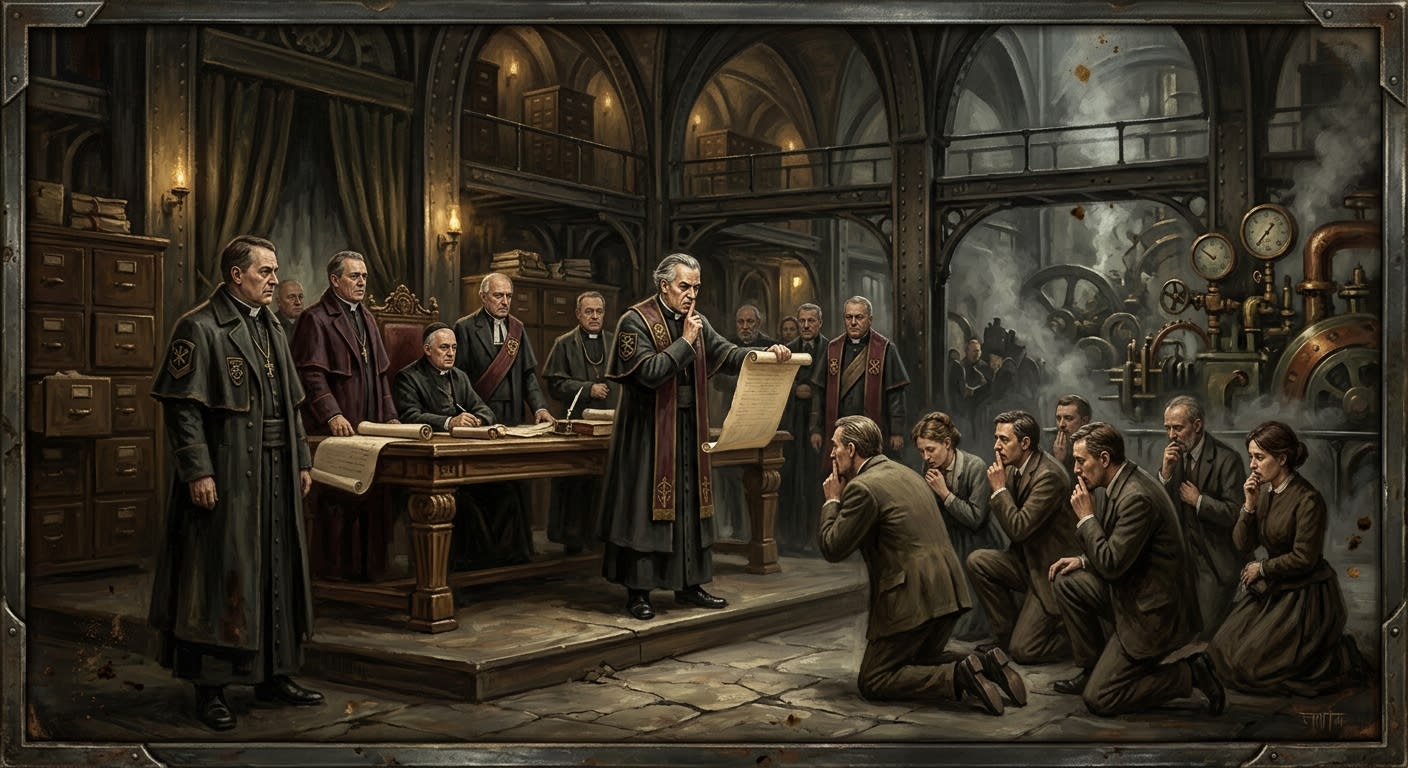
The Council of Cologne furnished the theatre. Cologne furnished the room, the relics, the cathedral height, the archive-bank habit, the minting smell, and the old Rhine vanity without which no council can properly humiliate itself. Kratz furnished the method. Odo of Trier furnished the sentence that made the walls seem complicit. Records furnished the signatures, some before the signatories understood their good fortune.
The Edict stands in the Ledger as law. It stands in Cologne as memory. It stands in every provincial chapter as the moment the local bishop discovered that his chair belonged to him in the same sense a prisoner owns his cell: intimately, daily, and under another man's key.
#On the Council Chamber and Its Holy Furniture
Cologne was chosen because Cologne had failed before. The First Council of Cologne in A.S. 27 produced no binding unity, no common discipline, no clean instrument, no obedient Europe. It produced, instead, minutes, discrepancies, seating arguments, hospitality ledgers, and a young Kratz learning that failure, if archived properly, becomes instruction.
A.S. 100 corrected the lesson. The Cathedral of the Holy Column was prepared as a chamber of holy inevitability. Saint-Malo relics passed beneath lamps. Aldebrand bones glowed in distant galleries. Purity Wardens counted insufficient tears. Records clerks sat with knives for scraping wax. Doctrine men watched the bishops as shepherds watch rams deciding whether the fence is decorative.
The room mattered because rooms instruct bodies. A bishop standing beneath his own diocesan rafters may remember his ancestors. A bishop standing beneath Cologne's cathedral vaults, with Saint-Malo bones before him and Kratz's clerks behind him, remembers ink. That is the beginning of wisdom, or at least obedience, which is wisdom after the Bureau has cleaned it.
The surviving minutes speak of deliberation. They preserve procedural objections, pious hesitations, requests for clarification, petitions for local privilege, and several elegant speeches by men whose dioceses were already forfeit by draft article. The missing minutes preserve the useful part.
Older teaching copies call the Edict “the fruit of diocesan consensus.”
Corrected. Consensus was the fruit displayed in the market stall. The roots were compulsion, redaction, relic pressure, forged acknowledgement, and a very practical concern that dissenting bishops look unbecoming when removed during daylight.
#On the Thirty-One Articles
The Edict's thirty-one articles converted ecclesiastical habit into Synodal jurisdiction. Article One recognised Strasbourg as the coordinating seat of doctrinal finality. Article Two placed diocesan registers under Records copy-right. Article Three ordered liturgical calendar harmonisation, thereby making every feast day a timetable and every timetable a claim. Article Four submitted episcopal appointments to Doctrine recommendation, recommendation being the Bureau's soft word for command delivered before breakfast.
Tithes entered under Articles Five through Eight: parish levy, shrine dues, pilgrimage fractions, and emergency extraction for Line defence. Local chapters retained the right to complain in the appropriate form, which was filed after payment and before disposal. The right remains cherished by traditionalists and ignored by everyone solvent.
Article Nine confirmed shared custody of relic inventories between local chapters and the Bureau of Relics. This arrangement was described as protective. Protection, in Synodal law, means the protected object is now close enough for confiscation to become concern.
Article Twelve bound parish schools to Strasbourg catechism tables. Article Thirteen mandated approved sermon cycles. Article Fourteen, blessed among legislative predators, transformed pilgrimage procession into territorial witness. A relic carried through a gate did not merely bless the street. It entered the street into evidence. Three authorised passages through a town constituted durable incorporation unless a superior writ provided a more flattering fiction.
Article Fourteen made piety ambulatory law. A procession could do what cavalry did with less horse dung and better hymns. Citizens lining the road became witnesses. Bells became boundary markers. Petals underfoot became documentary residue. Mothers lifting children to see the saint unwittingly raised them before a transfer of authority.
The later articles addressed clergy discipline, chapter property, oath forms, tribunal appeal, archive custody, pilgrimage security, doctrinal correction, and the disposition of ministers demonstrating premature independence. Article Twenty-Nine remains sealed in several public copies because even law has undergarments.
#On Signatures, Silence, and Odo's Stones
The Edict's force depended on a grammar of assent. A province that signed submitted. A province that delayed submitted pending better ink. A province that refused used unauthorised language and returned itself to silence, where Doctrine could hear obedience more clearly.
Here Odo of Trier entered the machinery. During the Council, after a western prelate asked whether Strasbourg's decrees required provincial confirmation, Odo delivered the formula now carved above too many recording desks: “When we speak, the stones of Strasbourg listen.” The line is excellent because it insults everyone equally. If stones listen, bishops may hardly claim deafness without placing themselves below masonry.
Records adopted the formula within two years. Closed doors became passive concurrence. Unanswered writs became stone-assent. Absent petitioners became satisfied parties. Dead bishops, being admirably quiet, became among the most compliant witnesses in Europe.
The Edict required no universal handwriting. It required recognised conditions under which silence could be entered as consent. Cologne supplied those conditions. A bishop's pause became review. Review became assent. Assent became signature. Signature became previous signature. The last step required the finest clerks.
COLOGNE MINUTE FRAGMENT — CLASSIFICATION BLACK Delegate from ███████ objects that the presented acknowledgement bears his name in a hand he does not recognise. Records reply: “Recognition by the hand is inferior to recognition by the office.” Delegate asks whether office may sign without hand. Kratz notation: █████████████████████████████ Subsequent line: delegate acknowledges.
The sealed pages have acquired romance among the half-educated, who imagine they contain some single crime, some dripping revelation, some skeletal key to the Synod's foundation. They contain procedure. Procedure is worse. Crime may be repented. Procedure is trained, copied, taught to juniors, and revised for efficiency.
#On Processions as Annexation
Article Fourteen deserves its own little altar, preferably one with shackles worked into the rail. It took the most beloved public movement in the Church's lands — the carrying of holy remains through streets — and made it a surveyor's chain hidden under incense.
Before Cologne, a procession blessed a town, strengthened morale, advertised piety, moved relics, gathered donations, and gave children something to stare at besides hunger. After Cologne, every authorised procession bore a second body beneath the saint: jurisdiction. The relic advanced. The canopy followed. The choir sang. The Bureau of Pilgrimage logged the route. Records copied the witnesses. Tithes noted future recoverability. Doctrine smiled like a locked reliquary.
Provincial summaries state that Article Fourteen “honoured local devotion by recognising processional custom.”
Corrected. It captured local devotion, harnessed it to boundary law, and sent the bill to the parish whose grandmothers had scattered flowers with such touching legal incompetence.
The mechanism was especially useful in towns whose magistrates resisted direct annexation. No magistrate wished to bar a martyr's femur at the gate. No crowd wished to be seen refusing Saint-Malo dead. Once the relic had entered, the street had witnessed. Once it returned twice more, resistance became ingratitude with a map attached.
The formula spread. Rhine towns yielded by festival. Moselle chapels yielded by vigil. Market villages yielded during plague thanksgivings, harvest litanies, ash processions, funeral chains, and once, in a case still used for instructional comedy, during a mule-blessing rite whose route sheet accidentally encompassed three taxable hamlets.
#On the Bureaus That Fed From It
The Edict fattened every Bureau it touched, which is the surest sign of durable legislation. Records gained copy-right over diocesan registers and thereby learned more family secrets than confession ever managed to extract. Doctrine gained appointment control, sermon correction, catechism authority, and the right to describe all this as spiritual care. Tithes gained predictable channels. Pilgrimage gained weaponised route tables. Relics gained access to inventories previously guarded by local chapters with the quaint ferocity of dogs protecting a butcher's cart.
Purity gained the sweetest meat: a definition of refusal broad enough to enter any room. A bishop who rejected an article refused Strasbourg. A priest who preached from an old calendar refused harmonisation. A parish clerk who kept a local register without Records copy-right refused legibility. The Edict turned administrative variance into moral odour.
Even Cologne profited from its own subordination, as Cologne always does. The cathedral remained the Edict's memory-house. Archive-banks stored diocesan duplicate bonds. The Crownwright Diehouses struck commemorative issues with the Holy Column on one face and Strasbourg's knot on the other, a little coin-sized humiliation passing hand to hand with admirable liquidity.
Strasbourg commanded. Cologne invoiced the command's afterlife.
#On Resistance and the Uses of Redaction
Resistance followed in the only forms left available: marginal, procedural, local, pious, ridiculous, occasionally brave. Milan disputed appointment tables. Kraków delayed calendar adoption. Trier requested clarification until clarification became an accusation. Rural chapters hid registers in altar steps, wine cellars, and the hollow backs of saints whose expressions grew oddly smug.
The Edict had been built for such resistance. It did not need to catch every refusal. It needed to classify refusal in advance. Once classified, the local act ceased being local. A hidden register in a village was no longer a frightened priest protecting baptisms. It was a Cologne violation, Article Two, copied upward, punishable downward.
Redaction performed the other half of the labour. The blacked pages of the Council did not weaken the Edict; they strengthened it. Every provincial reader knew that something had happened behind the ink. Fear supplied better commentary than publication. A visible threat can be measured. A sealed method grows in the mind like damp in a crypt.
The official text remains clean where cleanliness aids obedience and black where cleanliness would aid curiosity. This is proper textual hygiene.
#On the Present Force of Cologne
As of A.S. 201, the Edict of Cologne remains one of the Synod's load-bearing legal relics. Its articles live in diocesan appointment writs, pilgrimage route claims, Records copy demands, Tithes collection schedules, Purity interviews, Relics inventories, and the little phrases by which provincial bishops are reminded that their mitres sit under Strasbourg weather.
The Edict's genius lies in its refusal to expire. Later concordats refined guild obedience. Later decrees disciplined bells, routes, names, bones, ink, children, widows, silence, and the taxable moods of bread queues. Cologne sits beneath them like a sealed foundation stone: ugly, necessary, and almost surely containing a body.
The Cathedral of the Holy Column still preserves the Council chamber. Guides point to the benches. Pilgrims look at the relic lamps. Clerks watch the guides. Somewhere behind a locked screen, the black minutes rest in their folios, still performing their office with greater discipline than many living prelates.
The Edict speaks. The stones listen.