
#On the Waste That Still Wants to Strike
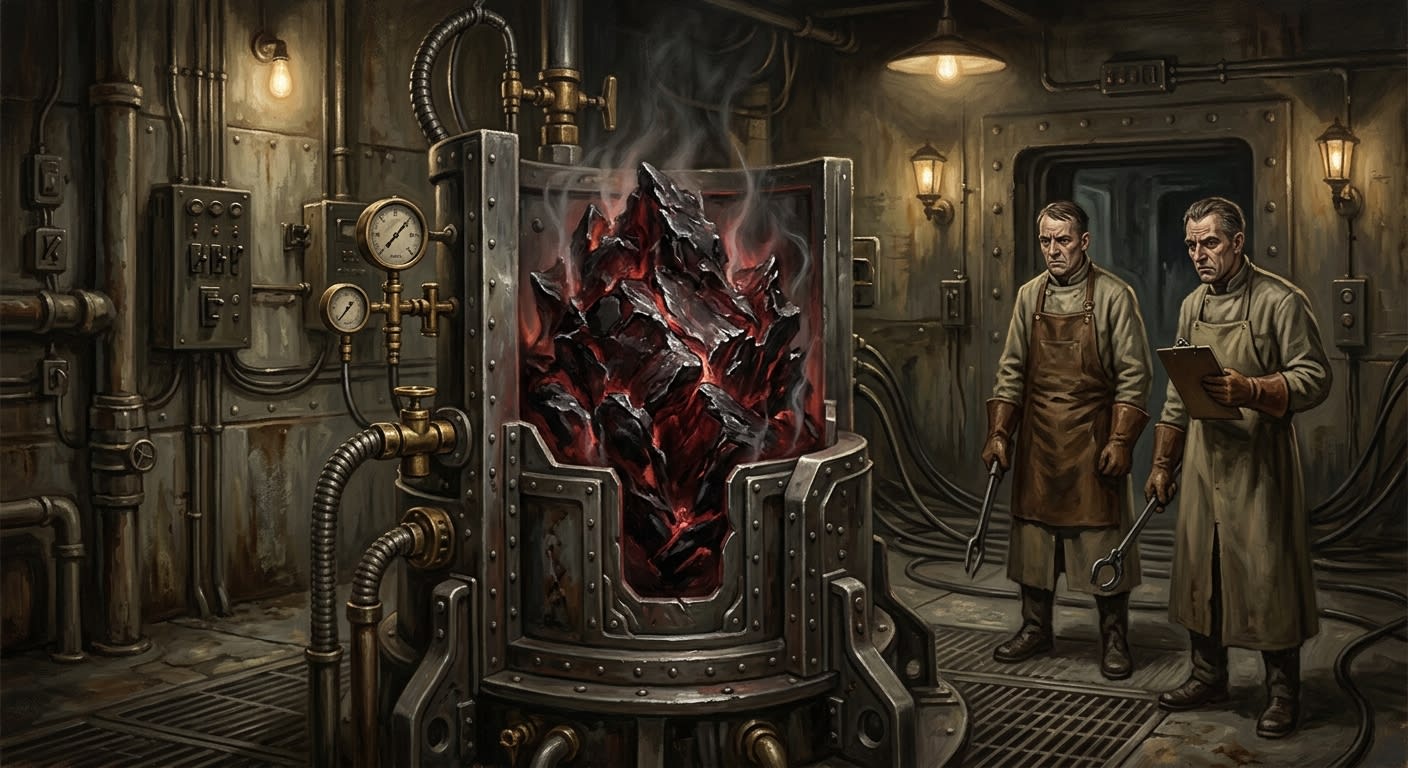
Wrath-slag is the cooled residue of Maldrake’s violence: fused soil, iron, bone, shell fragments, burnt prayer slips, artillery filings, field glass, blood salts, and those small theological remainders the Bureau of Engineering keeps calling “thermal impurities” because Engineering prefers cowardice when cowardice comes with diagrams. It is found along the margins of the Iron Wastes, in old breach craters, in burned convoy ruts east of Bastion-Constantinople, and in the slag-plains where Wrath has taught geography to remember impact.
A common slag cools. Wrath-slag keeps an argument with heat.
Hold it through two cloths and it warms the knuckles. Strike it, and the sound comes late, as if the piece has first consulted a buried anvil. Grind it, and copper-red sparks fall upward for half a finger’s breadth before learning obedience. Leave it near ordinary steel and the steel develops temper without permission. Leave it near a man who has been wronged and he will remember the wrong with improved accuracy, sharpened wording, and poorer judgment.
The Bureau of Purity classifies Wrath-slag as hostile residue, furnace-contaminant class, seizure recommended. The Bureau of War classifies certain refined forms as field utility material, handling restricted. The Bureau of Tithes classifies it by weight and market path, because Tithes has never encountered damnation without wondering whether damnation might accept coin.
#On Formation in the Furnace-Countries
The first Wrath-slag was produced at the Sundering, when Thrace cracked and Maldrake emerged as force, furnace, commander, doctrine, and insult. The old fields did not burn in the ordinary sense. They were worked. The earth was hammered by heat without visible hammer. Rivers glassed at the edges. Bronze softened on statues facing east. Plough-irons fused into the soil and were later recovered as red-black knots that made mules bite their handlers.
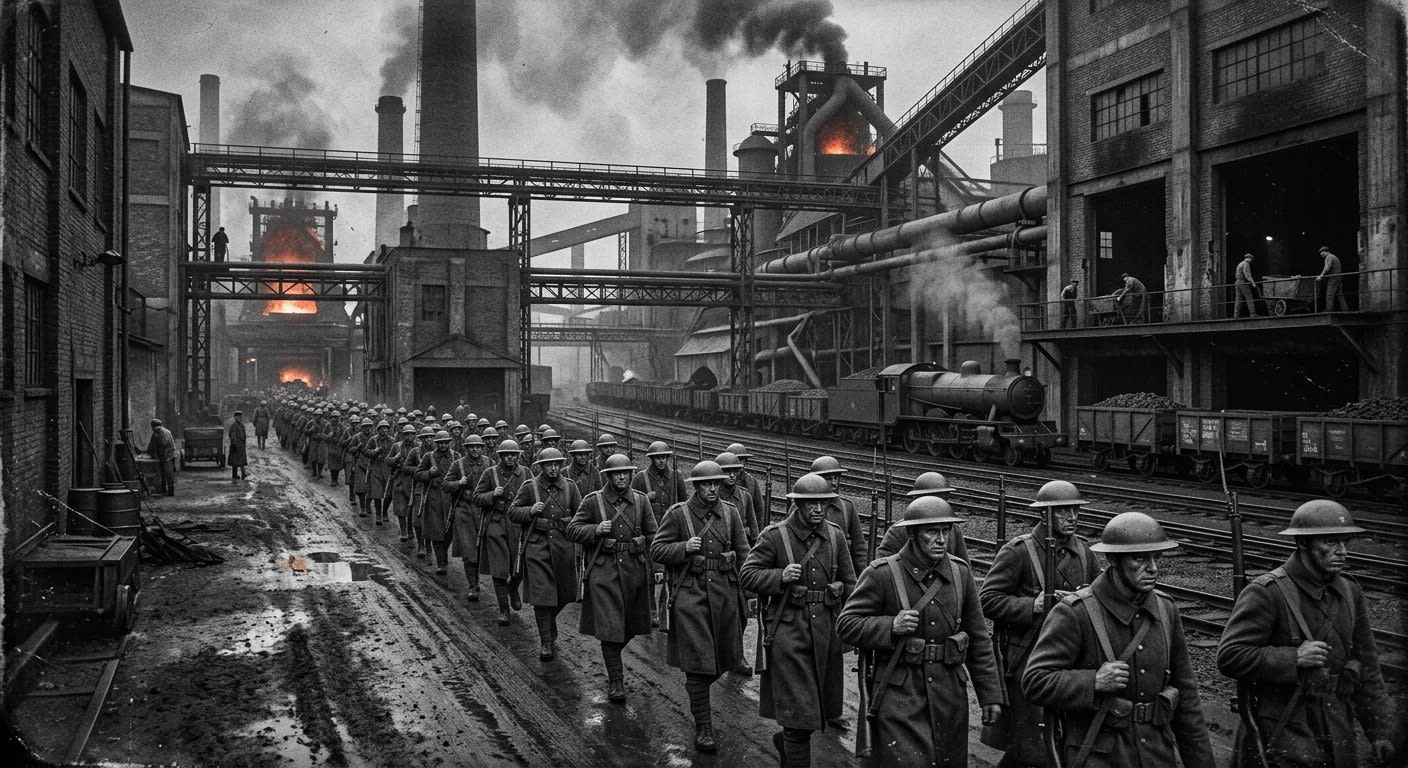
Field officers called it burnt ground. Engineers called it vitrified soil. Chaplains called it anger made mineral. Chaplains were closest, which embarrassed Engineering and should be cherished.
Wrath-slag forms where violence exceeds the body that suffered it. A cannon impact may leave ordinary slag. A Maldrake strike leaves residue that continues striking in miniature. The difference can be tested by placing both pieces under a bell-cloth at Matins. Ordinary slag remains inert. Wrath-slag sweats. Under the seventh peal, red threads appear within it like veins remembering a pulse. If a name is spoken nearby — especially the name of a dead man killed in anger — the threads gather toward the sound.
Early War manuals described Wrath-slag as “inert battlefield clinker suitable for road fill after blessing.”
Corrected. A.S. 112 road-fill trials near the southern corridor produced three miles of highway that warmed under marching feet and caused two supply companies to attack a toll clerk over bridge precedence. The clerk survived. The road was quarried out under bells and dumped in lime pits whose present status is, naturally, disputed.
It is wrong to say Wrath-slag is alive. Life has duties. Wrath-slag has impulses. It retains force without purpose, direction without destination, injury without witness. This is the signature of Maldrake’s domain: the war that outlived its reason and continued by momentum, pride, heat, and metal.
#On Its Appearance and Lesser Deceits
Raw Wrath-slag is usually black or iron-brown, with copper veins, red pinpricks, and occasional translucent skins that resemble dirty chapel glass. Some pieces contain fused bone bubbles. Some hold weapon impressions: bayonet teeth, shell scoring, bent nail lines, gear marks, an imprint of a hand that no longer has a registered owner. The smallest pieces look like burnt sugar and are sold to idiots as protective furnace beads. The larger pieces are uglier and more honest.
The surface cuts through gloves after prolonged handling. The cuts sting with language. Victims report hearing phrases in their own voice: old grievances, rehearsed accusations, replies they should have given twenty years before. A man will bleed on the table and argue with his father, officer, creditor, wife, confessor, or dead child. This is inconvenient during customs inspection.
Moisture behaves badly around it. Rain hisses on pieces that should be cold. Brine blackens. Holy water sometimes leaves grey rings, sometimes boils, sometimes does nothing, which is the most frightening outcome because it gives optimists room to speak. Ash-water calms it for transport. Bell-shadow calms it better. Laughter wakes it. This last point has been confirmed by three port incidents and one wedding disaster at Varna whose documents are sealed under Pastoral Decency, meaning someone important looked ridiculous.
The translucent skins are the source of most trouble. Under sufficient heat, pressure, and demonic residue, Wrath-slag extrudes panes and splinters that enter the demon glass trade. Wrath-slag glass sits low in the teeth. It hums like a forge under stone. It shows battle with a mapmaker’s cruelty: where a charge will buckle, where a captain will falter, where a man’s own hand will fail to lift when the order comes. Soldiers buy it because soldiers are practical and doomed. Widows buy it because grief enjoys knives with handles.
#On Harvesters, Scavengers, and Other Necessary Carrion
The Demon-Glass Scavenger knows Wrath-slag by smell: hot pennies, burnt wool, old blood, struck flint, and that temple-sour odour produced when a prayer has been interrupted by artillery. Scavengers work with bone masks, double tongs, ash-cloth wraps, bell slivers, and a partner who is supposed to shoot them if they begin speaking to the ground. Partners are fallible. Ground is persuasive.
Harvesting follows the breach calendar. After bombardments, slag skins rise from crater lips. After forge-weather, red-black pebbles gather in wagon ruts. After Maldrake pressure events, old slag beds split and push new glass to the surface like teeth. The best pieces are taken at dawn, after bells, before heat returns. The worst pieces are taken at night by desperate men who want a price high enough to erase debt. Debt is an efficient recruiter for Hell’s mineral economy.
Smugglers carry Wrath-slag in salt-fish barrels, saint-bone crates, furnace scrap bundles, false ballast, sealed reliquary boxes, and once inside a carved statue of Saint Phocas whose expression, according to the arresting dock sergeant, looked “fed up.” Pilot-King Nenos can smell Wrath-slag through tar and has thrown more than one crate overboard when the chain-hum answered too hot. He is a criminal, a nuisance, a blasphemous harbour rat, and correct often enough to irritate every licensed office in Thessaloniki.
#On Polishers, Lenses, and the Maskwright Appetite
Wrath-slag is raw anger. The Demon-Glass Polisher turns its translucent offspring into invoiceable sight.
In the Maskwright Lanes, Wrath-slag shards arrive wrapped in oiled linen and lies. The public crate says brine glass, fog lens, lamp stock, damaged relic-pane, or optical scrap. The private mark is smaller: a red thumbprint on the lower cord, ash at the knot, silence token tucked under the lid. Grit-Runners do not touch fresh Wrath-slag pieces. Lappers grind them in dim rooms. Stainwrights test them with names belonging to strangers, because a man who reads his own name to Wrath-slag has donated his evening to idiocy.
Wrath-slag glass differs from Lust-court glass in vulgarity. Lust-court panes flatter before they ruin. Wrath-slag panes accuse. They show the user where force may be applied and what excuse may be used after force has done its work. In a trench mask, this can save a squad. In a noble’s private shrine, it can ruin a household before breakfast. The material does not care whether its buyer seeks survival, revenge, insight, spectacle, or absolution. It shows the hot path and lets the hand pretend the hand chose.
The Bureau of War purchases mounted Wrath-slag optics under useful labels. The Bureau of Purity raids the workshops. Bureau-Friends supply decoy crates. Glassman Dimo certifies silence with the closed-eye mark of Saint Varda. Captain Mavra breaks enough glass to frighten civilians. The real lenses leave beneath the quay. Everyone condemns everyone. The masks arrive on time.
Standing notices require all Wrath-slag glass to be shattered, blessed, cooled, and interred in lime.
Clarification. All Wrath-slag glass without requisition number, officer patron, War need, or sufficient bribe is to be shattered, blessed, cooled, and interred in lime. The faithful may trust the distinction because the faithful are not invited to read the invoices.
#On Weapons, Road-Fill, and Domestic Stupidity
Wrath-slag has uses beyond glass, and every use is an argument against leaving men alone with matter.
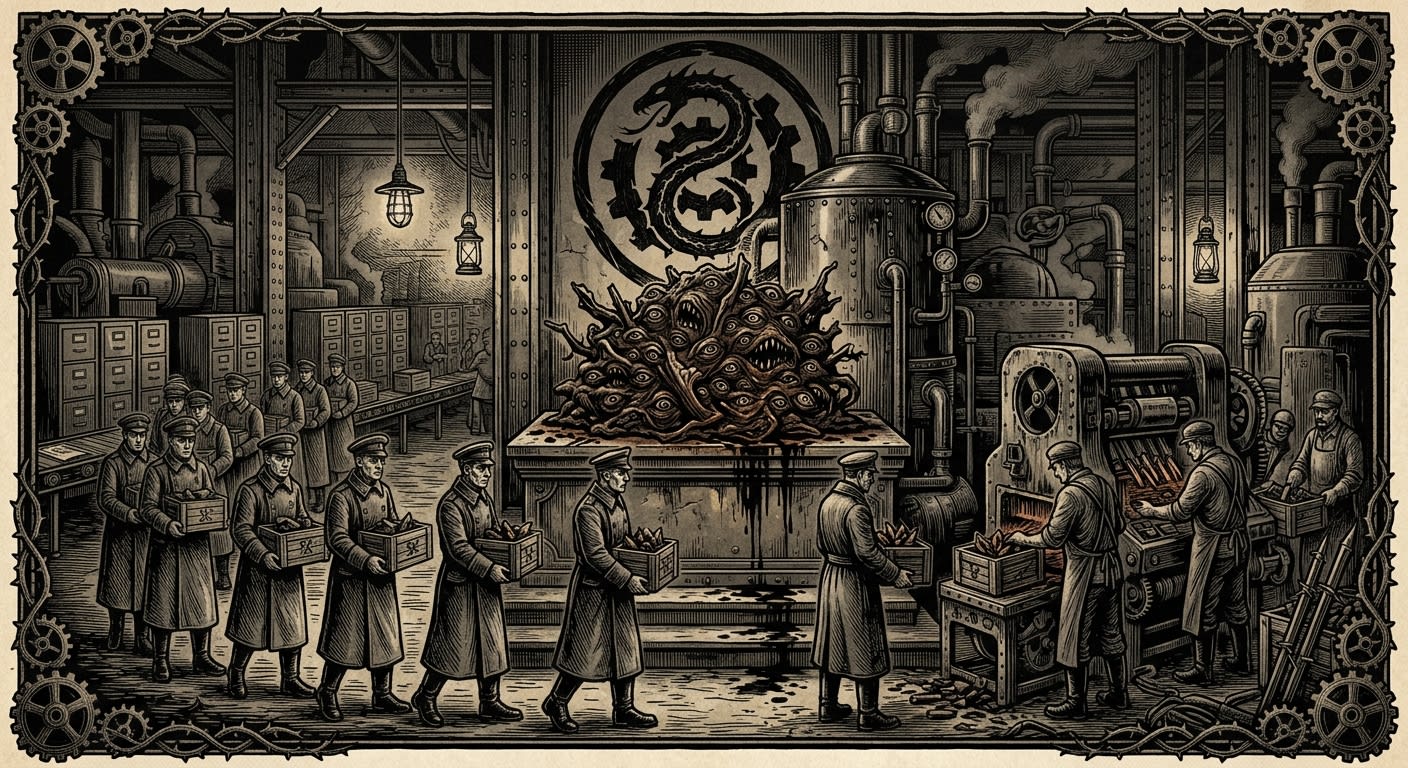
Forgers add powder from cooled slag to knife edges, hoping to make blades bite through fear. The result is usually a blade that chips, warms, and encourages its owner to draw it before the quarrel has matured. Artillery crews have mixed powdered Wrath-slag into shell primers during unsanctioned experiments. Two batteries reported improved ignition. One reported a gun that fired before command whenever its captain thought about his brother. Engineering sealed the study and kept the diagrams.
Road builders have tried it as aggregate. Furnace men have tried it as heat memory. Charm sellers grind it into red-black dust and sell it in paper twists marked courage, vengeance, husband-return, court victory, and soldier’s luck. All such commerce is criminal. It is also widespread, which is the Bureau’s preferred difficulty: sin large enough to tax, small enough to deny.
The Slag Market of Brast sells counterfeit Wrath-slag by the scoop. Most is ordinary furnace waste soaked in vinegar, blood, and dye. Some is real. The fake is dangerous because it is worthless. The real is dangerous because it answers. Pex Ruln’s filter men can tell the difference by placing a shaving under warm mesh. Sorn Vale’s auditors can tell by watching who refuses to stand near the bag. Ilyra Kest’s choir-adjacent workers claim they can hear a wrong interval inside genuine pieces. I believe them just enough to stay away from their test rooms.
BRAST SEIZURE NOTE — A.S. 201 Contraband lot marked “red courage grit,” twelve paper twists. Eleven inert furnace-dye frauds. One active Wrath-slag powder packet, weight three grams. Exposure during evidence sorting caused Clerk █████ to strike Assessor █████ with a stamp hammer while shouting “say it again.” No prior quarrel located in personnel file. Packet transferred to Bell-Cooled Locker. Hammer retained as evidence. Stamp impression still legible on jawbone.
Domestic superstition breeds around Wrath-slag like mould around warm bread. A chip under a threshold to keep cowards out. A shaving in boot leather for battlefield nerve. A bead beside a court petition. A dust line across a marriage bed, a practice so deranged that even popular piety blushes and closes the shutters. The Bureau condemns all of it, confiscates samples, and loses enough samples to prove the condemnation employs thieves with pockets.
#On Theological Status
Doctrine holds Wrath-slag to be residue, instrument, contaminant, witness, and temptation. These categories annoy lesser minds because they overlap. Overlap is where truth becomes useful. A piece of Wrath-slag witnesses Maldrake’s passage, tempts the hand, contaminates the workshop, supplies War with sight, supplies Purity with theatre, supplies Tithes with fines, and supplies Doctrine with the pleasure of being right in six directions.
Wrath is the easiest sin to excuse because it begins by sounding like justice. Wrath-slag profits from that first clean spark. It does not murmur kill for pleasure. It offers an ordered docket of injuries. It remembers the ration stolen, the pension denied, the officer’s insult, the dead son’s boots sold by a quartermaster, the bishop’s soft hand signing a hard order. The grievance is often real. That is the cruelty. Falsehood may be corrected by evidence. A true grievance heated past mercy becomes a forge.
The safe handling prayer is short: Cool the hand. Cool the tongue. Cool the account. It is recited by scavengers, Polishers, certain War artificers, and three honest smugglers, a number I admit may be generous. Bells recommends low peal before transport. Purity recommends destruction. War recommends evaluation. Tithes recommends recovered-value assessment. Doctrine recommends obedience to Doctrine, a recommendation of such beauty that I pause to admire myself for recording it.
#Final Holding
As of A.S. 201, Wrath-slag distribution has increased with renewed Thracian pressure, Maskwright demand, southern-regiment optics, Brast copy-fraud, and the old human appetite for any object that promises force without consequence. It moves through Zones 5 through 7 most heavily, then westward in pockets: ports, forge districts, military depots, private shrines, veteran markets, and the little drawers where frightened families keep illegal courage beside baptismal ribbons.
Do not keep it as charm. Do not grind it as medicine. Do not set it in rings, hilts, thresholds, cradle-legs, petition boxes, soldier’s masks, chapel lamps, or marriage beds without licence, and understand that the licence itself may become evidence against you. Wrath-slag is what remains when anger has finished burning through men and begins teaching matter the same bad habit.