
#On the Northern Province
"Past the Pregel there is no further. There is only more." — Pencilled on the back of a Lake Gate watch-roster, undated
East Prussia is where the Sagittal Line runs out of land. The Line descends from here to the Bosphorus by way of seven bastions: Königsberg, Brest, Przemyśl, Sibiu, Irongate, Shipka, Constantinople. Every schoolchild in Strasbourg learns to recite them from north to south, so every schoolchild in Strasbourg begins with the cold one.
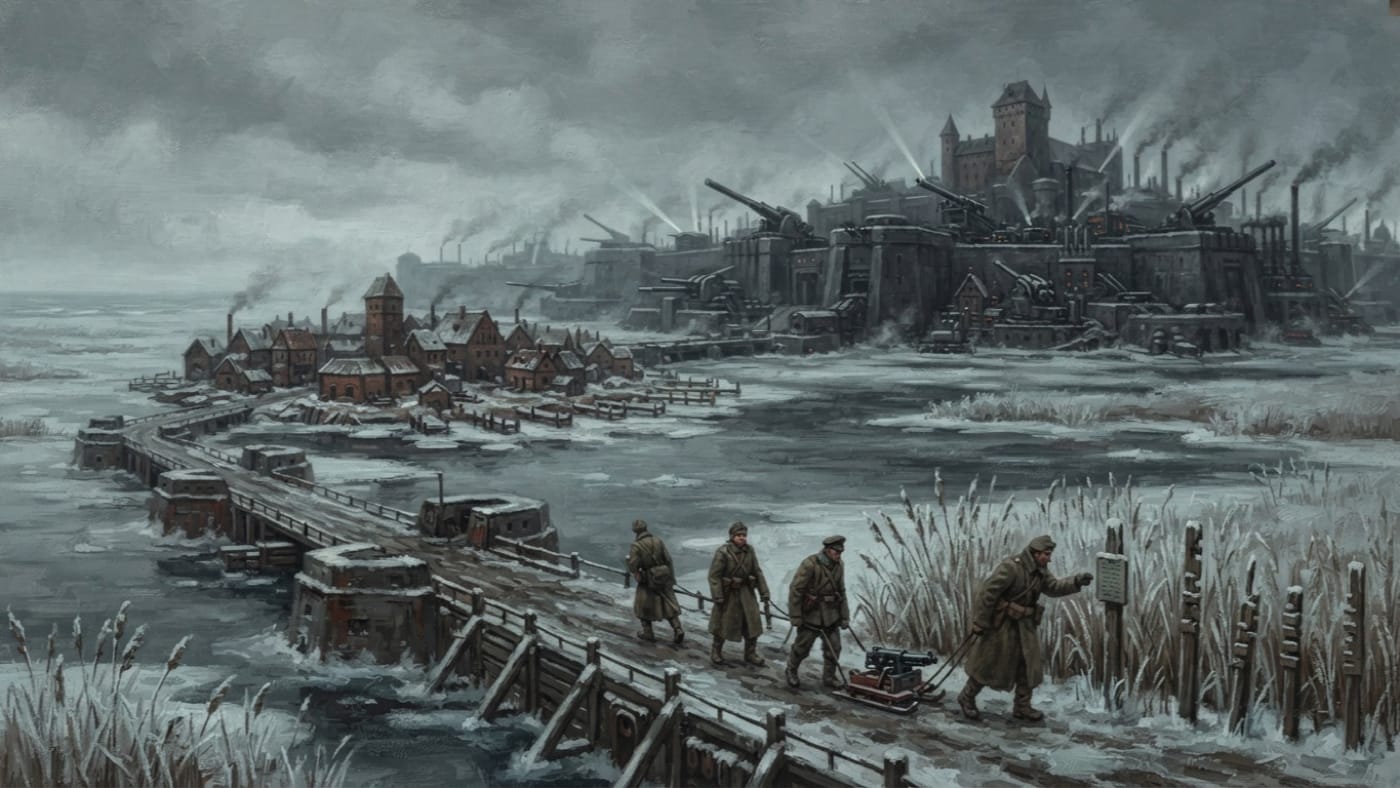
Königsberg sits at the mouth of the Pregel on the Baltic shore. It was a merchant port, a university seat and a Teutonic castle long before Bastion-Königsberg made it the northern anchor of the whole apparatus. South of it the defences rely on lake and marsh until the country flattens toward Bastion-Brest. That is the region's military meaning, and the Bureau of War would prefer that it had no other.
It has others. The maps fold three things together. There is East Prussia the region: a coast, a river mouth, a lake district, and villages and cart-tracks older than any of us. There is Königsberg the fortress, which is a city with guns in it. And there is the territory the Church's administration can actually reach on a given Tuesday in February. That territory is smaller than the first and larger than the second. It is recorded nowhere, because no clerk has been brave enough to draw it.
#On the Lakes and the Ice
To the east and southeast of the bastion lies the Masurian country. Lake opens into lake, with marsh between them, reed-beds taller than a sergeant, and drowned forest whose trunks go down into black water and stay there. The Bureau of Engineering counts it as the outer defence of the northern Line. It has not counted the lakes, or at least not to any total I am willing to sign.
In the warm months the maze does its work honestly. An army in column cannot keep its order through reed and sump. Wagons founder and guns sink to the axle. A battalion that leaves dry ground in the morning arrives at evening as a list of men looking for each other. The same water confines the defenders. Patrols keep to known channels, villages keep to their islands and causeways, and nobody in the lake district goes anywhere quickly.
Winter rewrites the ledger. Ice lays crossing surfaces where there were none, and the doctrine of the Lake Gate must be turned over with the season like a mattress. The ice is uneven. Springs rise beneath it and reed-margins rot it, so a surface that carried a sledge at dawn will take a man to the waist by afternoon. The same cold freezes the harbour, stiffens the grease in gun-breeches, splits boots, and kills sentries who were careless about sleep. The garrison counts winter as a second enemy that occasionally helps.
The Church sends the Masurian Watchers into this. They are light infantry recruited from the lake communities absorbed into frontier service, men who learned the water before they learned the catechism. They find their way by reed pattern, by bird call, and by notched stakes driven into the shallows according to a system the Bureau of Records has never managed to transcribe. Lake-Captain Kaspar Dreyse commands them. He is proof that the northern defence keeps its most necessary knowledge in local heads, where Strasbourg's cabinets cannot file it. The Bureau of Purity has examined that knowledge repeatedly. Each time it has declined to call it anything worse than knowledge.
#On the Requisition
The Sundering came on 1 November A.S. 45, or 1755 by the old reckoning. The Church that emerged afterward did not take the continent at once. Its hold spread unevenly, lost ground in places, and took two decades to learn where it could stand. By about A.S. 65–68 there was a Line that could be defended, though nobody pretended it was finished. Königsberg was requisitioned in that season, around A.S. 67 (1777 CE), by the provisional frontier authority of the emerging Church administration. Its offices issued billets and pressed lake-men into watch service a generation before anyone wrote them a constitution.
The villages were already there, and so were the fishing households, the merchant quarter and the castle. The requisition added fortification, garrison and paperwork, in roughly that order of arrival and the reverse order of durability.
Königsberg's great rebuilding belongs to a later administration. It ran from A.S. 92 to 110, after the Concordat of Strasbourg, and the Northern Carillon was cast between A.S. 97 and 107. Those are works of a city. In the wider region, roads were mended where the guns needed them and left alone where they did not. The present Bell Codex was ratified in A.S. 115, and the Carillon's founders must not be credited with obeying a standard nobody had yet written. They obeyed the one in front of them, which was the cold.
"The Synod requisitioned it in the first years of the Line's construction, approximately A.S. 67."
That is the reading in the Codex entry on Bastion-Königsberg, and its subject is wrong. There was no Synod in A.S. 67. The formal Synod was constituted by the Concordat of Strasbourg in A.S. 90 / 1800 CE, twenty-three years after the requisition, which was carried out by the provisional frontier authority of the emerging Church administration. Wherever the Codex calls earlier bodies "Synodal," it speaks in retrospect, as the Synod habitually does about its own childhood.
#On Those Who Supply the Wall
A bastion is fed by people who never appear on its muster. In East Prussia they include fishing families on the lakes and the coast, and refugees from the eastern provinces who reached the Baltic and found nowhere further to go. There are sutlers, carters and harbour labourers, and washerwomen paid in ration tokens. There are lake-village sons who became Watchers because the recruiting officer arrived before any other employer did. Inside Königsberg the civilians crowd into the Warrens, between the castle and the harbour. Fishermen who refused evacuation live there wall to wall with merchants who calculated that a siege economy pays. The Warrens are one city's quarter. This Codex will not inflate them into a census of the region.
Supply depends on the ice. While the harbour is open, cargo comes by sea: grain and stores through Hamburg, munitions and orders out of Kanzleiburg, and drafts through Warsaw. Replacement bell components come from the foundries of Essen, and the Bureau of Bells ships them with more ceremony than it gives to food. Once the harbour freezes, everything comes overland through the Polish lowlands along the Northern Corridor. That road is slower and wetter, and every axle on it is exposed to mud, snow and requisition by whoever is hungrier further along. The ice that closes the harbour also opens the lakes. The northern frontier is supplied on that contradiction every winter.
The paperwork follows the cargo. Fish taken from a requisitioned lake are tithed. A refugee who wishes to stay in the Warrens is registered by the Bureau of Passage, which ensures that he cannot leave without a stamp. A Watcher's mother receives a pension slip in a script she cannot read, countersigned by an office she will never visit. That is the administration of East Prussia as it actually exists: no governor, a great many desks, and a great deal of wet rope.
#On the Northern Water
"Scandinavia prays. Königsberg prays. They do not pray to the same schedule." — Bureau of Bells, Northern Correspondence File, A.S. 197
The Fractured North lies across the Baltic. By every account I trust, its fjord communities are faithful. They are also governed by clan councils and household enforcement, they keep their own bells and hymn-cycles, and they answer Strasbourg's letters at a pace set by the sea. Devotion and submission are separate entries in the Ledger, and the Bureau of Doctrine finds the distinction tiresome. The two authorities meet at Königsberg, where a Strasbourg carillon faces a coast of older bells. Every week the harbour clerks must decide whether a northern boat is a parishioner, a neighbour or a problem.
Then there is the other thing on the water.
The Grey presses on the bastion from the northeastern Baltic approaches. Documents that prefer capital letters to conclusions designate it THE UNNAMED, or the Host Without Name. Nobody knows what it is or what it wants, whether it is one thing or many, or where it began. Garrison reports describe grey fog that keeps no company with the wind, and faces in that fog. The same reports state that the consecrated countermeasures of the Carillon and its choir have not driven it off, and that hymns have been sung back. These are reported observations. The classification has been pending since about A.S. 190, and I am not authorized to close a file the Bureau prefers to keep open. Northern tradition holds that the Grey is older than the Sundering. I report that as tradition.
The geography is the predicament. The Lake Gate and the Masurian defences were built against an enemy crossing from the east by land, as a sensible enemy would, and the Bureau of Engineering was paid to expect one. The Grey comes from the sea side instead.
Further south, Brest faces a separate pressure: the Nameless Tide. Anyone who merges the two into a single northern army, or pins either one on a Sin-General, will get this volume back with corrections in red. The Northern Theater holds two unnamed things and has a name for neither.
#On the Present Condition
East Prussia is held wherever it is held. The bastion stands and the Watchers walk the stakes. The lake villages fish, and the Warrens trade, quarrel and bear children. The harbour opens and shuts with the ice. The Grey has made no documented breach of the walls, and no conventional assault is on record. The Bureau of War reports this as stability. The exit interviews from the Sea Wall are sealed, which is a report of a different kind.
Supply is still seasonal. Jurisdiction across the water is still a matter of correspondence. The classification is still pending. How far the Church reaches into the lakes on a winter night is known to Lake-Captain Dreyse and to nobody whose signature carries authority.