
#On the Sword's Public Meaning
"Coins bore the sigil of the Flaming Sword." That is the whole of the Codex's earlier testimony: one sentence, given less room than a tithe receipt.
Every faithful hand in the western heartland has held the Flaming Sword, and hardly one in a thousand has looked at it. It rides in the purse of the ration-clerk and the bargeman, it changes palms a dozen times between First Peal and curfew, and it rests at last in the counting trays of the Bureau of Tithes, having been handled more and examined less than any other doctrine of the Church. A homily is heard once. A sigil on coin is fingered daily for a lifetime.
I have described our sundered world as cleaved "as by a flaming sword separating marrow from bone." The phrase is mine. The Bureau left it uncorrected, and in Strasbourg that counts as endorsement. I read the emblem by the same light. A blade divides. A flame consumes what the division leaves on the wrong side. West from east, the faithful from the Rationalist, the licensed from the unlicensed: the Sword is the Church's instrument of separation, struck small enough to buy bread with.
That reading is my theology. No folio I have been shown names the hand that first drew the emblem, the council that approved it, or the year it was first struck. Where the record stops, so do I. Lesser archivists keep going and invent the rest.
#On the Authority Struck into Iron
"Its value does not rest in precious metals." The Bureau of Doctrine's account of the currency
The Crown of Grace is the official coin of the Church, minted in stamped iron, marked with the sigil of the Synod, and consecrated at the mint by priestly blessing. Its worth comes from no ore in the hills. It comes from the recognition of the Synod, which stands behind every Crown as a bishop stands behind his seal. Gold invites hoarding, and hoarding is vanity. Iron rusts in the miser's chest and shames him. To cheat in coin is classed as blasphemy and punished as heresy, which spares the magistrate the tedium of distinguishing a forger from a heretic.
I am obliged to be exact here, because the numismatists of the lower archive are not. The sources attest the Flaming Sword on Synodal coinage. They do not assign it to a particular denomination, obverse, reverse, inscription or diameter. In the diehouses of Sable Court the dies are blessed over hot metal and the assay is sung like a psalm. Which die bears which mark is a question for the mint's ledger, and the mint's ledger has not been offered to me.
The Sword's lawful shape belongs to the same regime that governs every public mark. The Bureau of Heraldry keeps the Armorial of the Faithful, the registry of banners, sigils, seals and the permitted colours of guild flags. Its Sigil Inspectors walk the gates and market lanes with seal-books and scraper blades. They compare each mark against its permit, order confiscation or repainting, and log every scrape. A symbol under their eye becomes a legal fact. Any symbol they have not examined is treated as a suspect.
The reader must not confuse the Sword with the Triune Knot. Heraldry designed the Knot, and the Knot appears on every official document. The Knot binds paper. The Sword travels in the purse. They are kin in authority and strangers in function, and the clerk who swaps them in a children's primer earns a repaint order.
#On the Record of Fire
"Civil and spiritual power fuse. Coins bear the Flaming Sword." The chronological register for A.S. 90
The record attaches the Sword's coinage to the Concordat of Strasbourg, the constitutional settlement of A.S. 90 (1800 by the suppressed reckoning), when the formal Bureaucratic Synod began. The register says the coins bore it. It does not say they bore it for the first time. I have seen a younger archivist write "adopted in A.S. 90" in a draft, and I returned the draft to him with the verb circled in red.
Some context is needed, and I give no more than is needed. The Sundering tore the East open on the first of November, A.S. 45. A provisional council governed from about A.S. 50. The Common Allegiance of A.S. 55 was ratified at the Council of Worms in A.S. 87. Then the founders died. Augustinus was dead before the opening months of A.S. 88, and Kratz followed within that year. Neither man ever held a Concordat coin. A devotional card showing either of them pressing the first die is a pious anachronism, and the reader should use it for kindling.
Worms is where my more excitable colleagues go looking for the flame. The tongues of fire reported above the delegates are canonical, harmonized by Doctrine into eleven minutes of manifestation, and to deny them is heresy of the Third Degree. I do not deny them. I observe that the depositions never mention a sword, that no decree links the emblem to that night, and that the mechanism of the Worms fire has never been settled in any file I am cleared to read. A miracle and an emblem may both burn. Their paperwork is kept apart.
#On the Festival of the Flaming Sword
"It is a poor fire, all metal smoke and squeal." My own account of Strasbourg, which I have not seen reason to improve
Strasbourg is a city of processions. The March of the 144 Wards files past the Cloister with ledgers held up like reliquaries, and the Weeping Pilgrimage carries its empty biers down long, slow queues. After the March, later in the year, the city keeps the Festival of the Flaming Sword. The Bureau of Festivals decides which days may be celebrated, and this day is one of them. The founding decree, if one exists, has not crossed my desk, and I will not write one for it.
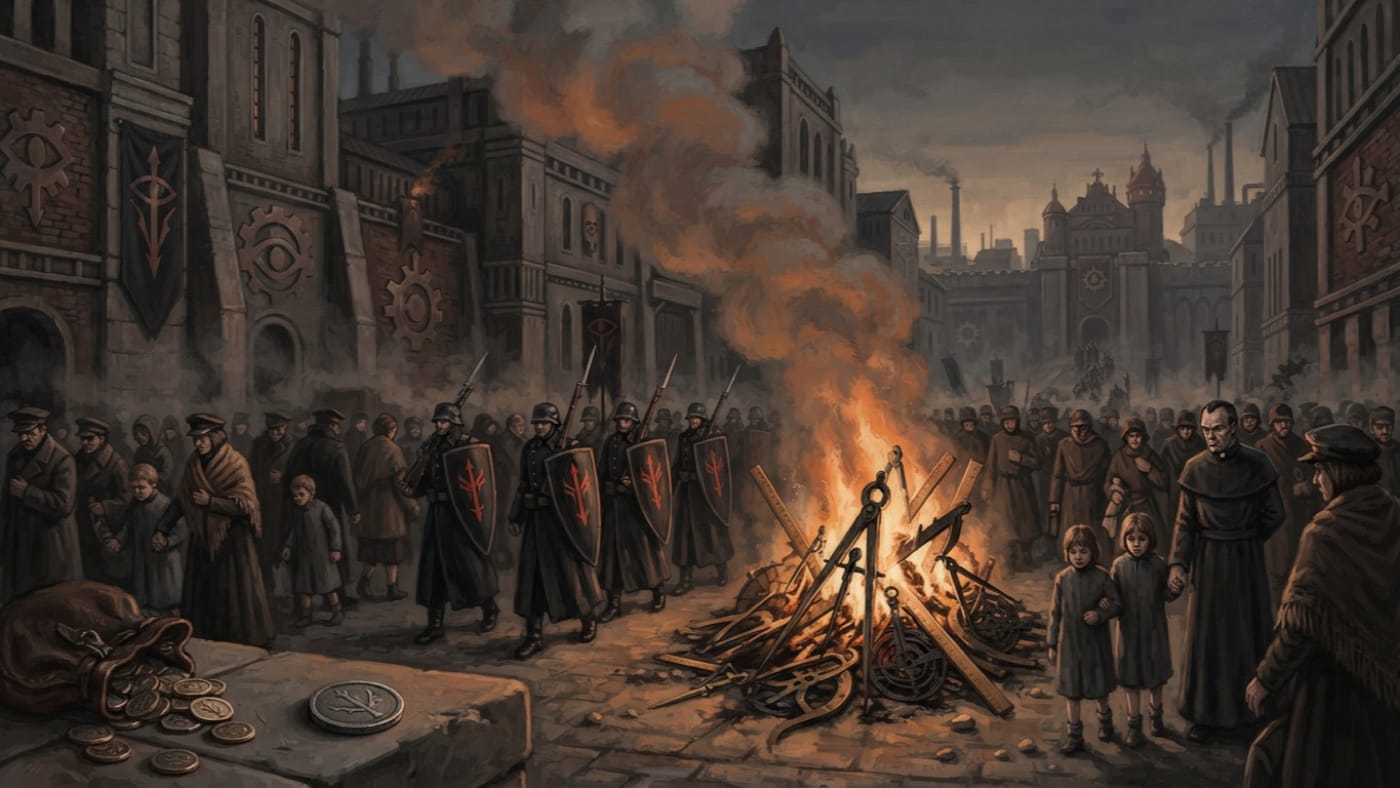
The Festival's material is confiscated from Rationalists: compasses, calipers and measuring rods taken from cellars and satchels and from the dead. They are piled into a bright pyramid and set alight. Brass does not burn the way faith requires. The wooden rods char and split, and the compass legs blacken, warp and squeal in the heat. The hinges of the calipers open slowly in the heat as though taking a final measurement. Nothing turns to holy ash. In the morning, crooked iron and slag lie in the cinders for the sweepers.
The smoke is metallic and low. It finds the crowd, and the crowd begins to cough, first raggedly and then together, in a single civic rhythm. The Bureau of Orison and Song counts this a success. Orison has always valued unison over the condition of the lungs producing it.
Soldiers march around the pyre with blades painted in pitch. The black coating takes the firelight unevenly, and their reflections, thrown and magnified against the smoke, become tall figures that seem to circle with them. The faithful call them apparitions. I call them soldiers, pitch and fire, arranged by someone who understood all three. The effect is no less impressive for being explained, and it is no more holy.
Then the children are made to throw stones at the burning pile. The pebbles are small. They clink against hot brass and drop into the embers, and the marshals praise each throw. So play is enrolled in violence against heresy before the child is old enough to spell the word.
The Integralists take a higher view. Concordat Integralism (Unregistered) holds that every civic act is a sacrament in miniature: eating, signing, and marching one's receipts through the street. On their account, the burning of Rationalist compasses at the Festival was an exorcism, with the Reason driven out of the brass. Their premise is that if decrees bend reality, then decrees must saturate it. I record the claim as theirs. No inspector has certified that any particular bonfire expelled anything except fumes.
The first of these is Concordat Integralism, the ideology that every civic act must be sacramental.
Henceforth, Integralism is not to be called "ideology" but "orthopraxy." Friction is fuel.
#On Its Present Application
"The eye is a mouth. Feed it only law." Maxim of the Sigil Inspectorate
It is now A.S. 201. The Sword still rides in purses from the Rhineland to Iberia while the Sagittal Line holds from Königsberg to Constantinople, and the pyre still burns brass in Strasbourg. Holding the Crown of Grace teaches the faithful hand that permission has weight. The Festival teaches the faithful lung that obedience can be inhaled. The two are one lesson taught in different classrooms.
There is a contradiction in this, and I state it because I can state it better than a heretic can. The Church burns the Rationalists' compasses and calipers, and then its inspectors go out with measuring cords to compare symbol geometry and colour ratios against the codex. Tithes weighs grain on balances. The mints assay their iron. Records counts the living and the dead to the last notarized tremor. The Synod did not renounce measurement. It confiscated it, consecrated it, and put it in a grey coat with a brass eye-badge. This is my reading of established practice. No council has ruled on it, and I would prefer that none does.
That is the doctrine of the Flaming Sword as the records allow it to be written. The blade decides who may measure. The flame removes everyone else's instruments. The coin goes back into circulation, and the cinders are swept away by morning.