
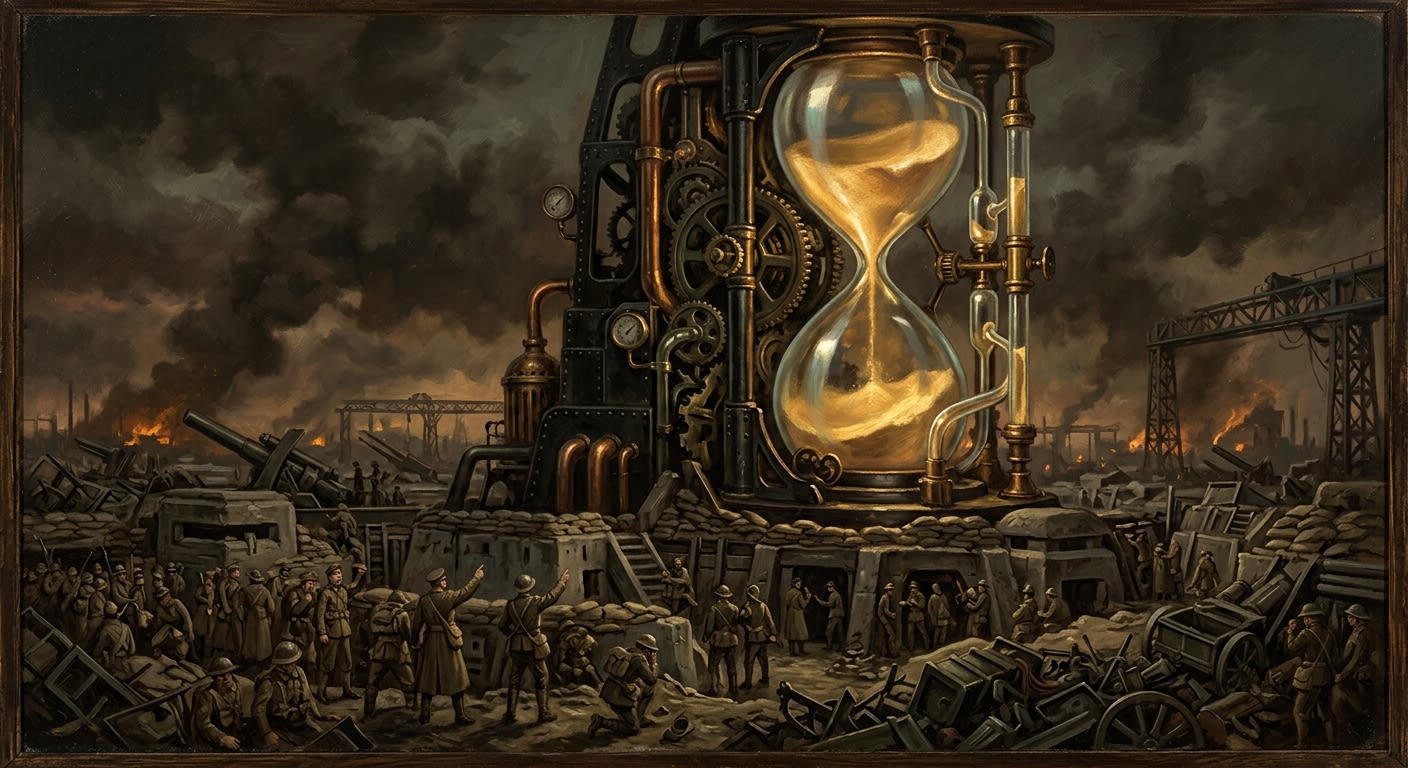
#On the Engine That Lent Its Name to a Bureau
The Hourglass Monolith is the only weapon in the Enemy's arsenal from which the Synod has borrowed a department name.
This should shame someone. Naturally, it has instead produced stationery.
The Bureau of the Hourglass was constituted in A.S. 134, per Bureau of War Standing Order, because Syrion the Languid Dreamer had taught the southern front that clocks could sin. Its name derives from the Monolith: a colossal Syrionic war-engine, sighted twice by War observers, measured never, and discussed in tones usually reserved for relic theft, plague arithmetic, and bishops found alive in their own tombs. The Bureau took the Enemy's image, sealed it, stamped it, and made an office of it. This is the Synod's native genius. We steal terror from Hell and return it as paperwork.
The Monolith appears, in surviving testimony, as a vertical mass seen through fog: black, narrow at the waist, swollen above and below, as if two towers had been joined mouth to mouth and taught to drink duration. No witness agrees on its height. One field glass report from the Shipka eastern watch puts it at thirty men. Another from the Drava drag sector places its crown above the fog ceiling. A third, recovered from a dead lieutenant's notebook, says only: it was taller than the hour in which I saw it. This is atrocious measurement and excellent witness.
#On Its Shape and the Failure of Distance
The Monolith is never seen in clean air. Syrion does not grant clean air; he grants varieties of grey, some wetter than others, all hostile to certainty. Reports place the structure in the Vales of Stagnance, on the Shipka approaches, and once beyond a marsh ridge that three maps identify in three mutually excommunicated locations. It may move. It may be moved. It may stand in one place while the front is dragged around it. The distinction matters to engineers and nobody else.
Its surface is described as dark glass, old stone, wet iron, bone polished by handling, and “the inside of a closed eye.” The Bureau of Engineering, upon receiving these descriptions, requested a sample. The request was entered under Hope, Misplaced, Field Grade.
The form narrows at its middle, where witnesses describe a constriction or throat. Pale sand, ash, or light passes through that throat in one direction. No witness agrees whether it falls downward or upward. One Hourglass marginal note, suppressed for morale, proposes that the flow runs from later to earlier and that the eye only mistakes this for descent because the eye is built by Providence for a less depraved universe.
The Monolith's surrounding fog is still. That word has been abused by soldiers, poets, chaplains, and exhausted adjutants, so let the Codex correct it: stillness, in this case, is active. Smoke hangs without curling. Rain beads midfall. Rifle flashes remain visible after the shot should have spent itself. Men within the outer edge report hearing their own previous breaths arrive late, as though the body had become a badly managed telegraph office.
#On the First Confirmed Sighting
The first accepted sighting belongs to the Shipka marsh record, sealed after the A.S. 130–134 timing complaints that later birthed the Hourglass Bureau. The precise year remains disputed because the sighting file contains three dates, two overwritten bell-times, and one page on which the ink appears to have aged more than the paper.
A patrol sent to inspect a drift in the dawn bell found the eastern reed road empty. The road remained empty for eleven minutes. During the twelfth minute, every man in the patrol was seen from the bastion wall standing in place, weapons held at ready, heads tilted as if listening to a superior officer. The patrol itself later insisted it had continued walking. The wall observers insisted it had not moved. The bell registrar recorded both accounts, which is the bureaucratic method of admitting that reality has become inconvenient.
At the far fog line, a vertical shape appeared. The witnesses described the hourglass waist, the black sides, the pale flow through the throat. The bastion's seventh bell sounded without being struck. The patrol did not answer recall.
Early field notice described the incident as “mass hesitation under fog pressure.”
Corrected by the founding Hourglass survey. Hesitation occurs inside a man. The patrol's pulse rates, boot positions, weapon angles, and breath condensation were preserved in external sequence while local duration failed around them. They were not hesitating. They were being held.
When the fog retreated, the patrol returned with four missing minutes by its own watches and two missing hours by the bastion clock. One private had aged enough for grey to appear at his temples. One corporal had lost the memory of his mother's name and gained the memory of a song no one in his village knew. The lieutenant filed a report whose final sentence reads: The object did not approach; the time between us emptied.
He was promoted for clarity. Then he shot himself during a calendar audit.
#On Its Action
The Hourglass Monolith does not kill in the honest manner of Maldrake's engines, nor in the generous manner of Kargath's famine, which at least tells the stomach what is happening. The Monolith removes the interval in which action may occur.
A soldier sees the object. A command is given. Between command and obedience lies a small country of duration: hear, understand, choose, move. The Monolith occupies that country. Orders arrive as museum pieces. Muscles receive authority after the hour has passed. Rifles remain shouldered while the enemy drifts by. Artillery crews stand with lanyards in hand, preserved at the instant before usefulness. Battalions become statues, alive enough to be shamed, inert enough to be counted as terrain.
This is why the Monolith is worse than the Slumber-Hulk in one respect, though Doctrine dislikes the comparison. A Slumber-Hulk brings a stillness envelope with it, a heavy radius that can be charted, resisted, and, once in A.S. 194, turned aside by fire and hymnal counter-rhythm. The Monolith alters the field before the field admits alteration. It does not slow an army so much as steal the moment when the army would have become an army.
#On the Second Sighting and the Men Who Returned
The second confirmed sighting occurred in a Drag Corridor east of Shipka, during a punitive reconnaissance whose purpose was to prove that punitive reconnaissance remains a magnificent way of punishing reconnaissance officers. The unit entered under bell tether, chronometer seal, and buddy discipline. It emerged in fragments across three days.
Seven men came out first, convinced they had marched for one afternoon. Their ration tins were rusted shut. Their boots had rotted at the seams. Their faces were unaged. They carried a field sketch of a black hourglass tower standing behind a rank of Grey Heralds, who appeared in the drawing as blank figures offering chairs.
Nine men came out second, aged by twenty years and furious at the first seven for abandoning them “last week.” They had seen no tower. They had seen its shadow on fog. The shadow, they said, contained moving sand and the shadows of men falling upward.
The captain came out third. He had no pulse for forty-seven seconds after recovery and objected to being revived on the grounds that he had not yet finished giving the order to withdraw. His written deposition repeats one phrase in six different hands: The middle was hungry.
Recovered Bell-Tether Log, Drag Corridor S-12: Minute 0: entry. Minute 4: bell tone delayed. Minute 4: bell tone delayed. Minute 4: bell tone delayed. Minute █: tether slack inside sealed reel. Minute █: men visible ahead, standing behind themselves. Minute █████████: Monolith profile inferred. Do not draw throat. Do not draw throat. Do not draw throat.
The Bureau of War classified the unit's loss as acceptable. The Bureau of the Hourglass classified the data as insufficient. The Bureau of Doctrine classified the sketch as devotional contamination and burned the original after copying it nine times for sealed study. One cannot accuse Doctrine of inconsistency. One can, with pleasure, accuse it of theatre.
#On Monolith and Bureau
The Bureau named for the Monolith has never measured the Monolith. This fact humiliates its adepts, irritates its enemies, and delights the Bureau of Records, which enjoys nothing so much as a title that records an absence.
The Hourglass adepts have measured the Monolith's effects: time-drag in adjacent corridors, bell-lag, command echo, local ageing, memory loss, stalled rain, repeated seconds, impossible watch agreement. They have built taxonomy around what the object does to everything except itself. Class I Deceleration. Class II Disturbance. Class III Stillness Field. Class IV sealed under Doctrine's Standing Order 7-A, the little black box where fear goes to wear a proper hat.
Whether the Monolith is Class IV remains unprinted. The glyph appears beside it in two internal tables, both partially burned, one annotated by a hand that wrote with the pressure of someone trying not to tremble.
Adept Meryth Vesk at Station Two has argued, through channels no one in Strasbourg admits receiving, that the Monolith exceeds Syrionic habit. Her basis is comparative: the Slumber-Hulk produces stillness; the Monolith produces extraction. Syrion decelerates. The Monolith appears to remove. Removed time goes somewhere. The phrase recurs in Hourglass marginalia like a rat behind the wall: elsewhere, elsewhere, elsewhere.
Training cards formerly described the Hourglass Monolith as “Syrion's chief slowing engine.”
Revised. “Slowing” is comfort-language. The Monolith's signature includes seizure, extraction, repetition, and interval collapse. A slow man can still act badly. A man whose acting-moment has been removed can only decorate the battlefield.
#On Countermeasures, Such As They Are
There is no confirmed destruction protocol.
The published countermeasures are acts of disciplined desperation: irregular bell patterns, scattered formation, forced speech, stimulant administration, paired movement, refusal to hold rank alignment, no prolonged observation through fixed optics, no chairs in forward dugouts, no written clocks facing east, no sand timers in Shipka sector chapels. The last rule was mocked until a chapel verger found every glass in the sacristy running upward during fog pressure. Mockery ceased. The verger did not.
The Bureau of Bells insists that broken rhythm can keep a unit from locking into the Monolith's interval. The Bureau of War insists dispersal prevents whole companies from being seized in a single command-lapse. The Bureau of Doctrine insists prayer remains effective. The Bureau of the Hourglass has logged all three claims and written, in the margin of one sealed report, duration of effectiveness unknown. That is the closest the Bureau comes to laughter.
#On the Theological Injury
The Monolith offends Doctrine because it treats time as material.
The Creator made time. The Synod orders time. Bells divide it, ledgers date it, fasts sanctify it, courts sentence men within it, and the Bureaucratic Synod pretends, with the serene lunacy of government, that a stamped hour is more obedient than an unstamped one. The Monolith puts its black throat in the fog and drinks the hour anyway.
This is blasphemy of a special order. A demon that kills the body leaves the calendar intact. A demon that corrupts the will leaves the bell schedule standing. The Monolith reaches into the little jurisdiction between intention and act, confiscates it, and leaves behind men who meant to obey and never received the mercy of failure.
Syrion waits at the edge of all exertion. The Hourglass Monolith is his altar, his engine, his accusation. It says the war may be lost between the order and the lifted hand. It says the Synod's courage may remain perfect and still arrive late. It says the Ledger may record a command that no longer has a second in which to become flesh.