
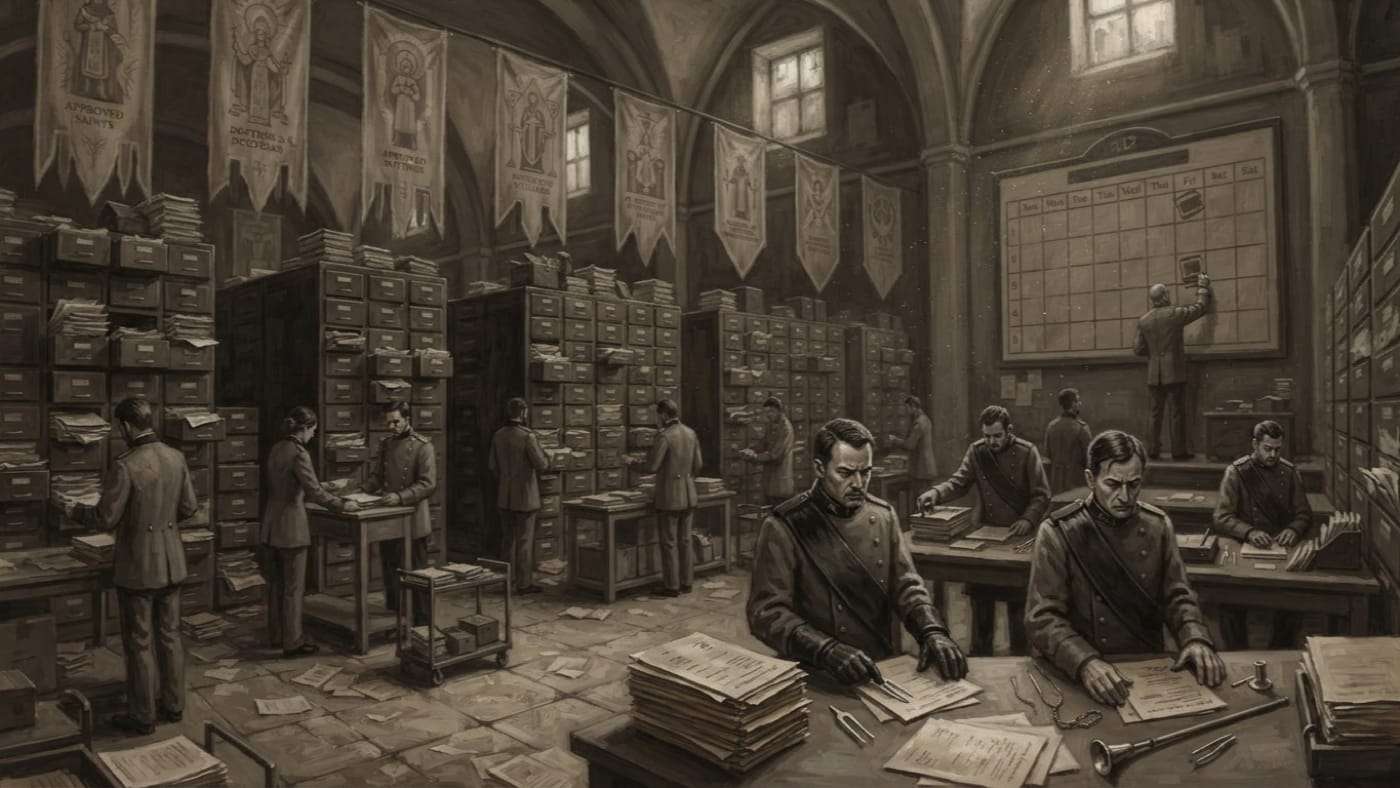
#On the Hall and Its Situation
"Rejoice by permission."
The Hall of Prescribed Joy is the main hall of the Bureau of Festivals in Strasbourg, the capital of the Synod. Nowhere else in the dominion of the Church can a garland be refused on procedural grounds. The Hall covers eleven hundred square metres. Filing cabinets take up most of the floor. The festival banners of the approved calendar hang above them, so each drawer of pending applications sits under a feast it may one day be allowed to join.
The rest of the floor goes to the permit tables, where Chorus-Masters sit in their sashes, and to the calendar, which a clerk stamps. The clerk stamps all day. Banners above, paper below and a stamp in the middle: that is the whole of the Hall, and it is enough.
The registers I am permitted to consult do not give the building's architect, its patron, the year its doors first opened or the street they open onto. The Bureau's own origins are better kept, and the Bureau has a habit of letting its dates stand in for the Hall's. They do not belong to the Hall. A seal is not a roof. Whoever built the Hall built it for an institution that already existed, and whoever furnished it furnished it for business.
The Bureau of Festivals arose "in the years following the Concordat of Strasbourg," when the young Synod faced despair behind the raw earthworks of the Line.
The Bureau's founding comes before the Concordat by a generation. A priest declared the Feast of the Unbroken Wall in the ruins of Cologne in A.S. 52 (1762 CE). Augustinus brought festival governance into the Charter of Prescribed Observance in A.S. 58 (1768 CE). The Bureau received its seal and budget in A.S. 72 (1782 CE). These were acts of the growing Church administration. The formal Synod began with the Concordat of Strasbourg in A.S. 90 (1800 CE), after both founders had died. No record connects either founder with this Hall, and the Bureau will stop implying one.
#On Permits and Prescribed Ornament
"One chorus, one creed."
The Bureau has approved thirty-seven varieties of garland. I do not claim that all thirty-seven hang in the Hall at once. I claim only that someone in the Hall knows which they are, and that a garland outside the list counts as evidence. A parish that dresses its shrine in an unlisted green has not decorated. It has filed an application without a form, and the application will be refused.
The ordinary course of business goes like this. An application arrives from a parish, a guild, a garrison or a district Chorus-Master. It names the observance, the day, the route, the hymns, the costumes, and the play if there is one. A clerk first checks it against the calendar, because every day of the year already belongs to a saint, a doctrine or a period of reflective stillness, and a new festival must displace one or squeeze in beside it. Next it goes to the permit tables, where its words are read against the approved scripts and its ornament against the list. Then it goes into a cabinet to wait for the opinions of other Bureaus.
Most celebrations spend their lives in the cabinet.
The permit backlog has not cleared since A.S. 155. That makes forty-six years. Some applications in those drawers were filed by petitioners who have since been entered in the Great Ledger in a different column, and their feasts are still pending. The Bureau does not withdraw an application because its author has died. Death is not one of the listed grounds for withdrawal.
#On the Officers and Their Measures
"Laughter is a loan; repay it in obedience."
The Chorus-Masters come to the permit tables with ink on their hands, and most wear gloves to hide it. A Chorus-Master's real work happens elsewhere: in bastion plazas, on pilgrim festival grounds, at the morale shows behind the trenchline. The Hall licenses that work beforehand and accounts for it afterwards. At the table, the permit sash, the throat-chain token, the tuning fork, the conducting rod and the cue bell are not instruments. They are credentials, laid out beside the approved script like a prisoner's effects on a magistrate's desk.
The Festival Conservatory of Strasbourg trains them to convert celebration into compliance. It trains forty a year. The Bureau requires sixty. Provisional licensees, Chorus-Masters in everything but certification, fill the other twenty seats, and you can pick them out at the tables because they read their own applications twice.
Every ovation they license is checked against the Prescribed Ovation Index, which runs to four hundred entries. A patriotic hymn in a bastion garrison earns fourteen seconds of applause. An approved comedic interlude earns seven: palms only, no stamping. I have watched a Chorus-Master at a permit table count the seven seconds under his breath with his hands flat on the wood, and stop at six out of caution.
The corps has its parties, and the tables show it. A Pure Conductor's application is short. It reproduces the approved script word for word and asks for nothing the script does not contain. A Mercy Maestro's application is longer because it argues. It asks for an extra refrain on account of a bad harvest, or a verse restored because the district has buried many men this year. The clerks call these submissions "annotated." The Bureau of Doctrine calls them worse.
The Pageant Captains file different paper. Their applications come with route sketches, barricade placements, float manifests and the weight of the confetti to be deployed. Confetti is licensed by weight, swept up afterwards and weighed again, so that none is diverted to celebrations nobody approved. The Hall keeps both weights on file.
The Attendance Auditors file last. They work in pairs in the field, with slates, counting frames and Bureau Standard 12-F, which assigns numerical values to smiling, cheering, weeping, kneeling and thirty-seven other observable behaviours. Their totals are graded against the Joy Compliance Index. Four points separate "Insufficient in Zeal" from "Excessive in Spontaneous Emotion." The first means remedial action. The second means the Bureau of Purity is notified. Whole parishes have lived out a feast day inside those four points without knowing they were there.
#On the Disputes That Reach Strasbourg
"No unscheduled encore."
No festival in the Church's dominion belongs to the Bureau of Festivals alone, and the cabinets show this better than any treatise could. The Bureau of Doctrine approves the content. The Bureau of Bells governs peals and timing, and it guards its schedule like a relic. The Bureau of Orison and Song licenses the hymns. The Bureau of Rites certifies the fasting requirements. The Bureau of Tithes examines the cost of every banner and every gram of confetti. The Bureau of Records keeps the names and the attendance. The Bureau of Purity receives the reports of deviation and supplies the men who act on them.
Each objection arrives under its own seal and is filed with the application it ruins. A harvest festival may clear Doctrine and fail the Bells, be rescheduled and land on a fast, then be rescheduled again and exceed its budget. At present six jurisdictional disputes are running at once. The Bureau calls this ordinary, and it is ordinary.
The Bureau's caution is not abstract. Its rules carry its history. Since the Heresy of Siena in A.S. 141, every harvest dance must end with a reading from the Catechism. In A.S. 153 the taverns of Seville kept singing for an hour past curfew, and the Laugh Riots taught the Bureau that excess measured only in volume and duration can still end in the taking of tongues. In A.S. 170 masked celebrants at Lyon used the anonymity of the festival for pamphlets and assault. After the Tumults of Lyon, carnival masks were banned in three provinces, and they are still banned. The applications in the Hall are written by people who know all of this. They ask for less than they want, because asking for more has been entered in the record as a symptom.
The Procession of the Triune Hearth has set out from Strasbourg every tenth year since A.S. 175. It employs four thousand participants, and every one of them receives a script. Every script needs an approval. I will leave the reader to imagine the drawers.
#On the Present Condition
"Gaudete cum mensura."
The Bureau's figures for A.S. 201 apply to the whole Bureau. They say nothing about the Hall's staff or the traffic across its floor, but every one of them reaches the Hall eventually as paper. There are three hundred and eighty-seven approved observances. Forty-one require attendance. Nineteen overlap fasting days set by the Bureau of Rites, so the celebrants are forbidden to eat. Seven fall on days the Bureau of Bells has reserved for acoustic maintenance, so the bells do not ring. Four thousand six hundred licensed personnel carry the calendar into the provinces, and the calendar returns to Strasbourg as reports, protests, attendance totals and further applications. The backlog has not cleared since A.S. 155, and nobody in the Hall expects it to.
I have spent many afternoons in this room, and I will record what I saw. The clerk at the calendar handles a stamp worn smooth at the grip, and every impression is the same impression. Each Chorus-Master at the tables carries a tuning fork to prove that the harmonies are safe and a cue bell to stop a chant before it turns into something real. The Auditors' slates score a widow's tears by category and duration. The garlands are approved and the banners are approved. When a feast finally reaches its parish, the joy inside it has been reviewed by seven Bureaus and amended by most of them.
What the Hall cannot do is tell whether any of that joy is felt. There is no column for it. Bureau Standard 12-F scores the smile and does not ask about the face behind it. I have heard the question put to senior officers of the Bureau, and the answer is always the same: the measurement is correct. It is.
The Hall of Prescribed Joy is well staffed with officers, cabinets and drawers, and it is behind on its work. It administers celebration with great competence and receives very little of it in return. I find the Hall in good order and recommend no reform. Any reform would need an application.