
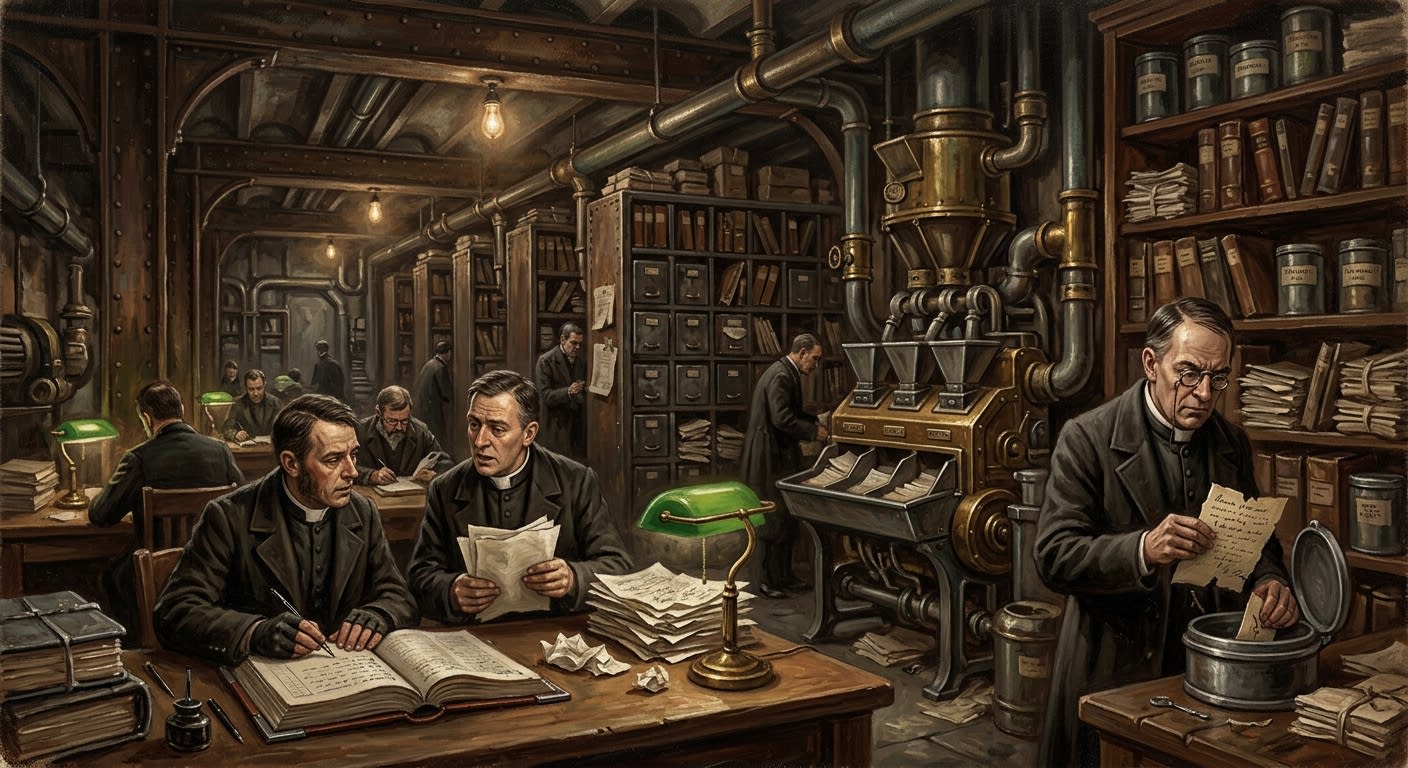
#On the Office That Files What Respectable Men Deny Hearing
The Bureau of Hearsay is the Synod's sanctioned ear for unsanctioned speech: the office that receives tavern mutterings, trench gossip, dying contradictions, smuggler boasts, pilgrim repetitions, terrified children's rhymes, foreign jokes, kitchen prophecies, and those little sentence-fragments that respectable clerks pretend not to hear until the fragment returns with artillery behind it.
Among the Holy Bureaus it is kept outside the clean circle and above the cellar: tolerated by Doctrine, fed by Shadows, despised by Records, periodically threatened by Purity, and consulted by every serious office when the official file has become too clean to be useful.
Its public description calls it the Bureau of Hearsay, Rumour, Unverified Report, and Provisional Enemy Speech. No one uses the full title except clerks being punished, foreign observers trying to sound learned, and the Deputy Custodian of Unchecked Shelves, who has made pettiness into a vocation so refined that I salute it professionally. Most men call it Hearsay. The name is an insult adopted as shield. Rumour wounds less when it arrives wearing its own accusation.
#On Its Birth in the Mouths of Cowards
The Bureau claims no single founding. This is either institutional modesty or the common cowardice of offices whose usefulness began before their legality. Its oldest surviving ledgers date to the first post-Concordat years, when the Concordat of Strasbourg had given Europe a government and the government had discovered that peasants, soldiers, ferrymen, widows, smugglers, and frightened priests often knew things before the official channels did.
The earliest Hearsay clerks were attached to Records intake tables as shameful adjuncts. Their assignment was to copy statements declared unsuitable for the main file. A wounded muleteer swore that Maldrake's ash had sung through his teeth. A ferry girl claimed the river refused a corpse because the corpse still owed money. Three deserters said they heard a bell under frozen mud near the Przemyśl approaches. Records marked each account unreliable. Hearsay copied them. Years later, each returned in altered form as field doctrine, anomaly notice, or expensive correction.
An A.S. 96 Records memorandum described Hearsay intake as “temporary storage for evidentiary refuse.”
Corrected after the Ninth Intake Review found seventeen “refuse” reports later cited in War, Doctrine, or Purity circulars. Refuse is what a clerk calls intelligence before it becomes embarrassing.
The office acquired rooms by accretion. One shelf became three. Three shelves became a closet. The closet became a room no one admitted assigning. By A.S. 112, Hearsay had a key, a night copying staff, and a ledger stamp reading RECEIVED WITHOUT RATIFICATION. By A.S. 143, after the Year of Ash Rain taught Strasbourg that impossible reports may become weather, the office had acquired protected budget lines under four different names.
#On Its Method
Proof belongs to Records vanity. Hearsay preserves.
A rumour enters through one of seven mouths: battlefield report, market whisper, confessional-adjacent remark, smuggler deposition, child-song, foreign summary, or dead man's last sentence. The first clerk copies it exactly, including bad grammar, blasphemy, stammering, nonsense, dialect, and those pauses that frightened witnesses leave in speech like little graves. The second clerk strips names into index form. The third assigns provisional tags: sector, sin-affinity, mortal source, Bureau exposure, repetition count, contradiction class, and expected embarrassment.
Only then may analysis begin.
The office's power lies in accumulation. One fisherman saying the Black Sea tastes of iron is superstition. Nine fishermen saying it across four ports is a maritime advisory. Forty soldiers humming the same enemy cadence in separate wards is Orison trouble. A child in Candlewick, a widow in Sibiu, and a wounded artilleryman outside Constantinople describing the same gold-toothed beggar is a Velmoran vector until disproved, and disproving such things costs less when one begins before the beggar opens a bank.
Records corrects speech into admissibility. Hearsay keeps it ugly. This is why Records hates it. A deposition made admissible has already lost blood. A rumour in its first foul clothing still carries the mud of the place it crawled from, and mud, to the horror of the polished mind, contains evidence.
#On the Shelves No One Checks Out
The Bureau is famous for shelves.
Not archives. Archives aspire to dignity. Hearsay keeps shelves: slanting wood, smoke-black labels, twine bundles, lead tags, thumbed folios, cracked envelopes, wax spills, and small warning cards written by clerks who lived long enough to become cautious. Some shelves are ordinary. Some are locked. Some are watched. Some are never dusty.
The shelf on the Penitential Shadows is the most discussed because no one discusses it loudly. It contains accounts of silent emissaries, vanished villages, names scraped from parish walls, Purity messengers who delivered no paper and received obedience anyway. The shelf has not been officially checked out in living memory. Its dust never settles. Someone reads it. Someone always reads it.
SHELF PS-0 — ACCESS LOG FRAGMENT Last authorised withdrawal: none recorded. Recent disturbance: nine folios shifted three finger-widths; ash pattern broken; binding thread warm. Night watch report: “I heard pages turning behind the locked grille.” Corrective action: █████████████████████████████.
The small Kargath-Maldrake shelf contains accounts of forced convergence between Kargath and Maldrake in the southern approaches: famine-zones crossed by wrath-hosts, scorched roads eaten afterward by hunger-tides, ash fields that produced grain no one could safely touch. Hearsay refuses to call these alliances. So should anyone with a healthy desire to remain employed. It calls them convergences, which is a safe word until it stops being safe.
The Velmora rivalry shelves are neater because Greed produces documents even when rumouring. Hearsay analysts famously described the quarrels between Velmora and Morwen along the Danube approaches as “domestic,” a word so small and so cruel that the Bureau of Inter-Infernal Analysis borrowed it, annotated it, and pretended not to admire it. Domestic hatred is still hatred. It merely knows where the knives are kept.
#On Its Quarrel with Inter-Infernal Analysis
The Bureau of Inter-Infernal Analysis watches Hell watch itself from three War rooms and fourteen authorised chairs. Hearsay watches the drippings under the door.
The two offices require each other and detest the requirement. Inter-Infernal Analysis wants patterns, sectors, hostility indexes, coloured dossiers, quarterlies signed by Assessor-Tertiary Haugen, and findings fit for men who can move armies. Hearsay supplies crooked fragments: a commissary cook who heard Wrath-speech in a fever, a prisoner who claimed Velmoran debt collectors avoid Kargathite marsh-bread, a Danube boatman who swore Syrion's fog paused politely at a line of warm ash. The analyst sighs. The analyst files. Six months later the analyst requests the original scrap.
A War directorate note described Hearsay material as “pre-analytic noise.”
Amended after the A.S. 199 Sibiu review found three rumour scraps anticipating contact between the Crimson Concord and the Hierarchy of Debt. Noise is what music sounds like before the Bureau of Orison sends a bill.
Hearsay takes particular pleasure in being right too early. It stores predictions nobody authorised as predictions. It preserves phrases too grotesque for sermons and too loose for strategy. When the official mind catches up, Hearsay produces the old folio with a clerk's date, a witness mark, and the intolerable courtesy of an office that has been waiting in the corridor for years.
#On Contamination, Laughter, and Useful Filth
The Bureau is spiritually filthy. The phrase is accusation only to the delicate; Hearsay prints it as job description.
A Hearsay clerk reads things before Doctrine has blessed their vocabulary, before Purity has burnt their speakers, before Records has corrected their syntax, before War has decided whether the information is worth spending bodies upon. He reads enemy jokes. He reads cult invitations. He reads the last sentence of a man who died chewing his own paybook because Kargath had entered the ration line by means no one wished to classify. He reads a Velmoran lullaby about debt inheritance. He reads a Maldrake marching insult that makes young soldiers clench their fists if spoken aloud.
The office has protections. Salt under the desk. Wax plugs during certain recitations. Rotation out of Carmine material after fourteen days. Mandatory poverty intervals for Auric exposure. Cold-water dismissal for Wrath scraps. Silence companions for Shadow-shelf inventory. Confession after child-song sorting. Hearsay clerks laugh often. The laughter vents pressure before the skull becomes an archive.
Purity has attempted three formal reviews. The first accused Hearsay of preserving contaminated speech beyond necessity. The second accused it of reproducing enemy language with insufficient disgust. The third accused it of permitting clerks to develop sympathy for witnesses already condemned. Hearsay answered the first with twelve citations from War circulars built on preserved rumour. It answered the second by enclosing a glossary with all disgust properly marked. It answered the third by doing nothing, which was the wisest answer, since sympathy is easiest prosecuted when it speaks.
#On Its Present Use
As of A.S. 201, the Bureau of Hearsay is busier than its enemies prefer. Southern-theatre reports multiply faster than Records can dignify them. The Blightmarsh produces hunger tales that repeat with clerk-breaking regularity. Thracian ash reports arrive with little phonetic ticks that suggest Maldrake's slogans are changing. Sibiu merchants whisper about contracts that mention grandchildren not yet conceived. Shadow accounts in the western provinces have acquired a new phrase: “the room was always empty.” Hearsay has tagged the phrase under recurrence and locked the tag drawer.
It remains underfunded, overused, and formally distrusted, which is how the Synod treats most instruments that work. Its chief custodian, whose name I have omitted because the omission was requested on paper that had already been folded into my coat, signs circulars in brown ink and never corrects spelling in witness extracts. I approve. Bad spelling has saved three bastions. Good grammar has killed more men than wolves.
The Bureau's final virtue is speed. A rumour can outrun a sealed dispatch because rumour is not proud. It can travel in a bread queue, under a wagon, inside a joke, across a trench, through a dying man's teeth, and into a clerk's ear before the proper office has found the right form. Hearsay is where that running thing is caught by the ankle and pinned to paper while it still bites.