
#On His Office and His Face in the Ledger
Theobald of Worms, first Archon of the Bureau of Heraldry, standardiser of the Triune Knot, author of Standing Order 14-C, and patron-saint of every clerk who has ever mistaken a crooked line for treason, entered Strasbourg in A.S. 90 with a travelling desk, two assistants, eleven locked portfolios, and an opinion concerning the permissible angle of salvation.
He was a theologian by licence, a herald by appetite, and a tyrant by measurement. The Concordat of Strasbourg had just hardened the Synod's committees into Bureaus, giving every old habit a seal and every new ambition a chair. The heraldic division of the Bureau of Records had already swollen beyond patience, consuming ink, furniture, wall space, and the fragile charity of archivists forced to share corridors with men arguing over whether a bishop's blue had become sedition in damp weather. Records expelled the division. Theobald received it as a kingdom.
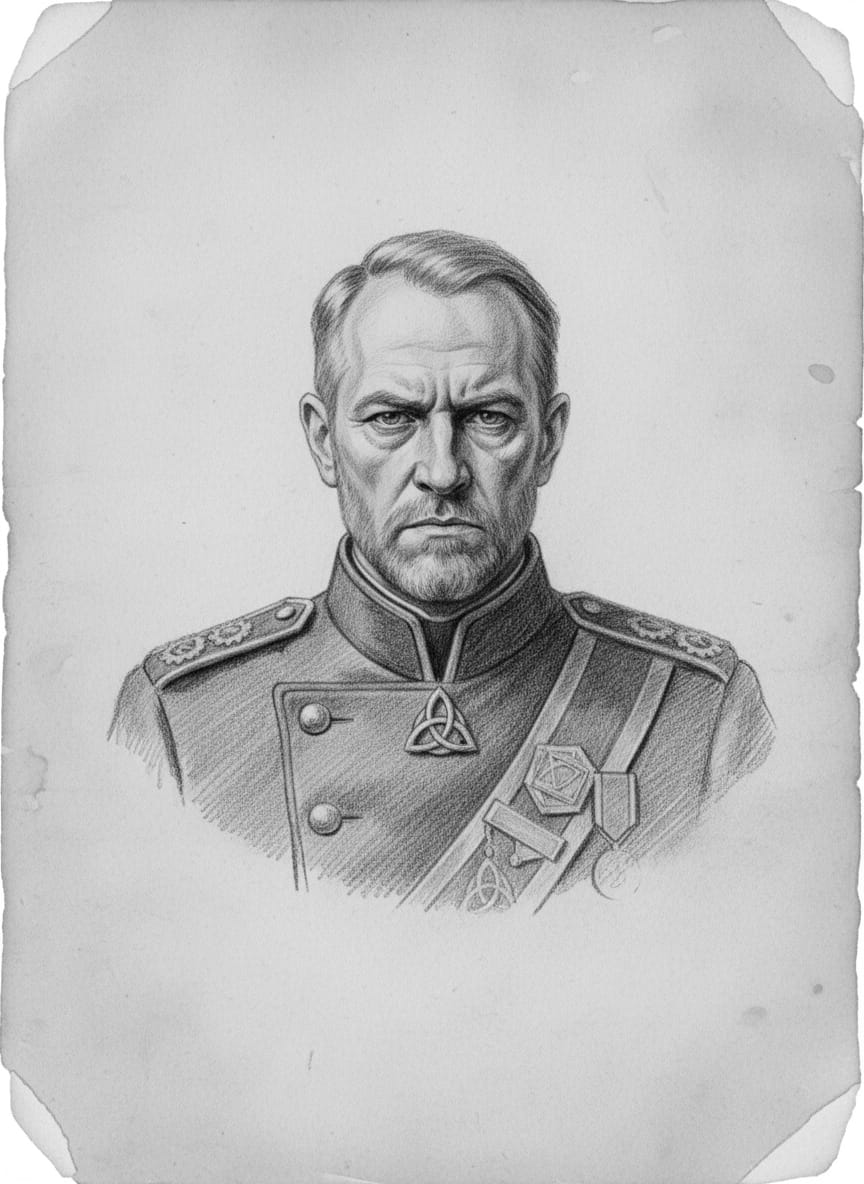
His portraits are useless. Heraldry commissioned six, rejected five, and retained the sixth only after the painter consented to reduce the curvature of Theobald's left brow by two degrees. The surviving plate shows a narrow man with a narrow mouth, a tonsure that appears measured rather than shaved, and fingers resting on a measuring bow as if the instrument were a relic. No warmth survives in the image. This may be technical failure. It may be accuracy.
#On the Problem He Found Waiting
Theobald did not invent the three-loop mark. In the first decades after the Sundering, retreating households, half-registered garrisons, grave-diggers, widows, quartermasters, and opportunistic drunkards scratched crude binding signs into lintels and grave-slabs because paper burned, witnesses fled, and a mark cut into wood was harder to bribe than a clerk. Three loops meant Trinity to the pious, roof-ration-record to the hungry, and mine to anyone holding a chisel at the proper moment.
This folk bureaucracy worked well enough to offend every serious office. Houses marked with the loops were claimed. Graves marked with the loops were considered sealed. Storehouses marked with the loops developed a habit of surviving requisition quarrels. The Bureau of Doctrine admired the faith and disliked the looseness. Records admired the proof and disliked the handwriting. Heraldry, still unborn as a Bureau and already insufferable as a desk, admired the mark's usefulness and hated its freedom.
Theobald's genius lay in perceiving that a symbol becomes stronger when people forget they made it. He took a frontier scratch, baptised it as inevitable, and returned it to the continent wearing angles.
Earlier devotional primers credit Theobald with inventing the Triune Knot after three nights of angelic instruction.
Corrected under archival review. Theobald standardised, codified, and weaponised the mark. Invention belongs to the anonymous poor, whose reward for usefulness is usually erasure followed by taxation.
#On the Twelfth Letterhead and the First Command
The story of the letterhead is true because no hostile satirist could have made it more flattering to Heraldry. For three months after receiving the Bureau's charter, Theobald redesigned its official letterhead eleven times. Draft I placed the Bureau's seal too near the top margin, implying vanity without jurisdiction. Draft IV used a loop thickness later condemned as devotional softness. Draft VII permitted the word Heraldry to descend beneath the baseline, which Theobald called “visual servility.” Draft XI satisfied two assistants, a deputy Records clerk, and one visiting Canon; this general satisfaction alarmed him. Draft XII was declared “adequate, pending revision.”
This was the man who then fixed the geometry of Europe.
Standing Order 14-C followed before the ink on the Concordat registers had fully dried. Theobald decreed three interlocking loops, angle-true, representing Mercy, Order, and Sacrifice. He specified spacing, permissible distortion by material, minimum carving depth, stamp use, wax impression strength, document placement, lintel class, grave-slab variant, coin relief allowance, ration-loaf pressure, and the permitted failure rate of apprentice hands. A house without the Knot became “unmoored.” An unmoored house could not claim rations, call wardens, receive lawful mercy, hold a burial register, or argue about taxes without first confessing its own visual nonexistence.
Workload created the first Gate-Carvers of the Triune Knot. Someone had to cut the new command into wood, stone, iron, bone, coffin-lid, ferry tag, confessional desk, ration press, and grave marker. Theobald supplied the instrument. The tradesmen supplied the wrists. Heraldry supplied forms enough to make wrists seem morally secondary.
#On the Armorial Appetite
Theobald's second appetite was accumulation. He ordered every diocese, guild, chapter, ferry company, infirmary, conscription depot, orphan house, cemetery, ration mill, bridge toll, bell foundry, and charitable kitchen to submit impressions of its marks. Wax came by cart. Painted boards came by mule. Embroidered banners arrived wrapped in oilcloth, smelling of old rain and hereditary self-importance. The first vault of the Armorial of the Faithful filled in eleven months.
The work sounded like classification. It was conquest. Once the Armorial held a mark, the mark belonged to Heraldry's memory before it belonged to its bearer. Once Heraldry remembered a symbol, Heraldry could correct it. Once corrected, it could be taxed, prohibited, revised, revived, or used as evidence against the great-grandson of the man who first submitted it in good faith, that most expensive of civic mistakes.
Theobald understood that symbols are not decoration. A banner is portable obedience. A crest is a jurisdictional claim with colour. A knot is a checkpoint small enough to fit on a loaf. A stamp is a priest with no lungs. This doctrine made him the natural ancestor of Sigil Inspectors, Geometry Brand-Smiths, Gate-Carvers, Chancellery colour clerks, and every other licensed vandal who has ever scraped an old sign from a wall and called the wound civic hygiene.
#On Beasts, Later Teeth, and Theobald's Shadow
The Beast Proscription of A.S. 108 belongs to Theobald's heirs in date, but to Theobald in spirit. The Crimson Gate Riot of A.S. 106, the Saxon boar, the panic, the eighty-seven dead, the official conversion of animals into heraldic danger — all this came after his first decrees had taught Europe to treat pictures as instruments. A wolf on a door could become threat because Theobald had already taught the door to speak.
Heraldry later reduced lions, eagles, and stags into angular canonical forms, banned wolves and serpents, suspended bears into that clerical half-death called review, and declared the crimson boar a heraldic heresy. These acts followed Theobald: his grammar used with sharper knives.
Chancellery fragment, undated, attributed to Theobald's second portfolio: “The beast must be reduced to sign before the sign remembers the beast.” Later hand: “Do not circulate. Too accurate.” Classification transferred to Visual Sedition Annex (Unregistered) after three junior clerks reported dreams of antlers arranged in approved geometry.
The same shadow lies over the Seal-Forgers' Winter of A.S. 145. The Triune Knot was supposed to bite paper with a geometry no criminal hand could mimic. The forgers mimicked it; worse, they mimicked a local pre-bevel correction more faithfully than Strasbourg's latest plate. The Bureau named this a transitional congruence hazard. A less embroidered office might have called it humiliation.
Public Heraldry lectures state that Theobaldine geometry rendered false authority permanently distinguishable from lawful seal-work.
Amended after A.S. 145, A.S. 187, and several expensive dockside embarrassments. Theobaldine geometry rendered false authority prosecutable once detected. Detection remains the little rat-hole through which history enters.
#On His Death, Which Heraldry Measured
Theobald died in A.S. 118, unless one accepts the sealed obituary draft dated A.S. 117, the corrected funeral inventory dated A.S. 119, or the Armorial's own memorial plate, which refuses a year and gives instead the phrase “After Adequate Revision.” He left no children in the domestic sense. He left thousands of children in the administrative sense: variant charts, stencil custody rules, inspection rubrics, wax impression depth tables, badge placement restrictions, and an office culture in which mercy might be granted after consultation with a protractor.
His body was buried under a flat black slab in Strasbourg, marked with the Triune Knot variant reserved for founding Archons. The slab has been inspected annually since A.S. 119. In A.S. 187, when four authorised Knot variants were reduced to forty-three and declared insufficiently angular, one junior clerk asked whether the variant on Theobald's own slab required review. The question was recorded. The clerk was transferred to colour humidity assessment in the Metz warehouse district. The slab passed inspection.
Theobald's true monument stands elsewhere: the continent's surfaces. His Knot sits on gates from Brest to the Bosphorus, on the confession tablet and the ration loaf, on the soldier's wrist and the coffin plate, on the stamped permit that allows a man to cross a bridge to bury the child whose grave will require the same mark. He taught the Synod to own the visible world by correcting it.