
#On the Street Beneath the Harbour
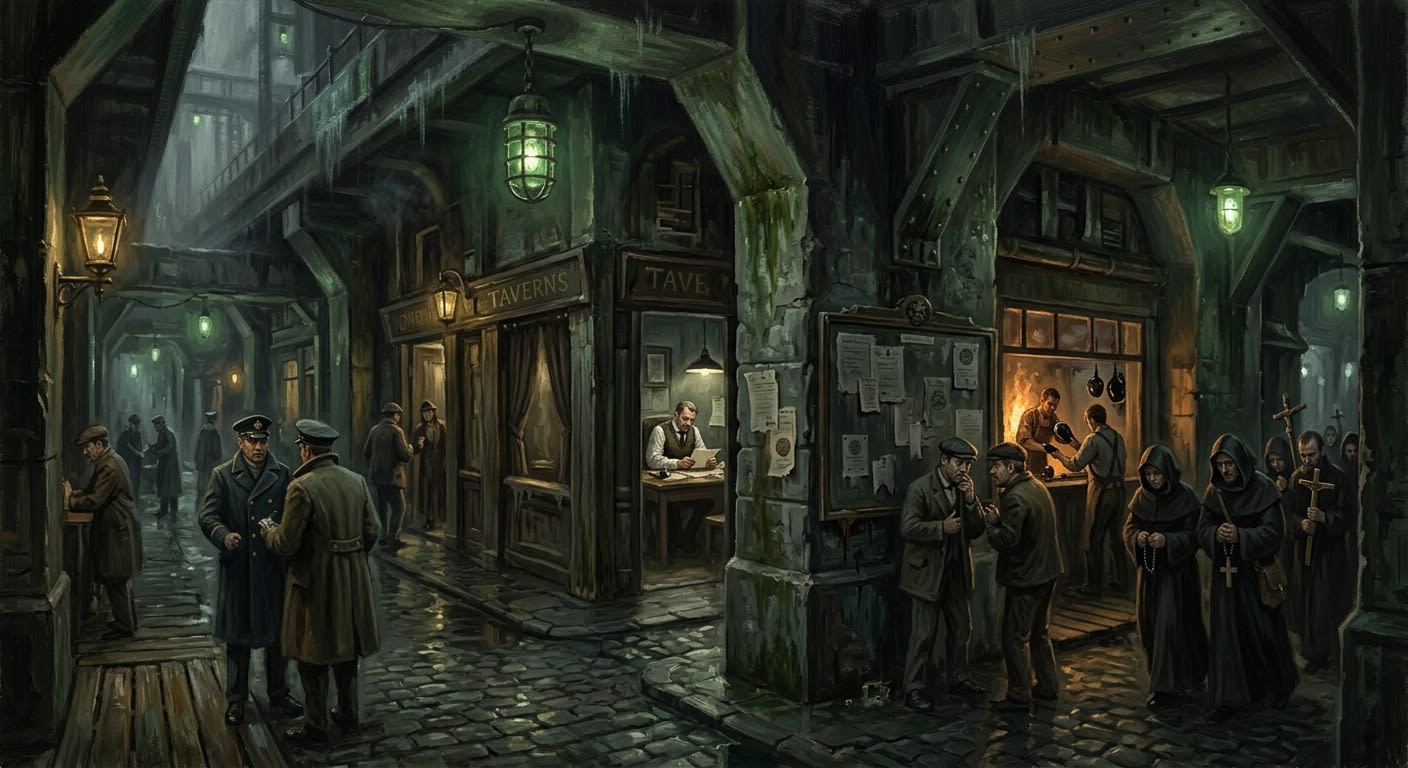
Drowned Row is the sailor quarter of Thessaloniki, though sailor quarter is the sort of clean municipal phrase invented by clerks who have never descended the wet stair behind the Pitch Markets after curfew. It lies along the under-quays below the Harbor-Chain Towers: taverns pressed into old flood arches, dive-lodges under crane foundations, rope rooms with false floors, shrines made from broken oars, skiff doors that open into black water, and rooms where men sleep upright because lying down invites the Choir to count them more easily.
The upper city calls it Drowned Row because men who enter from the Chainward Quays often return wet, silent, employed by someone worse than themselves, or not at all. The inhabitants call it the Row, which is both shorter and less accusatory. To the Bureau of Records it appears as Sub-Quay District 7-C, maritime labour settlement, hazard rating variable. To the Bureau of Purity it is a nest. To the Bureau of War it is a logistics inconvenience whose crates arrive with miraculous punctuality. To me, it is a confession booth with bad ale and better intelligence than three decorated offices in Strasbourg.
The Row smells of sour ale, brine, wet wool, lamp soot, fish rot, old tar, vinegar smoke from the Quarantine Crescent, and the metallic breath of chains vibrating through stone. During legal hours, dockhands pass through it for food, sleep, dice, debt, women, men, knife repair, false papers, and those consolations the Bureau condemns because it cannot invoice them consistently. At night, the Row becomes a second harbour beneath the first: chalk-marked hatches, skiff routes, submerged corridors, pilots reading hum by tooth, and ledgers written for arrivals the upper harbour refuses to admit.
Drowned Row exists because Thessaloniki cannot survive the purity it advertises. Every ship requires a stamp. Every crew requires arrival confession. Every crate wants an owner, a tax, a blessing, a quarantine state, and an explanation. War, hunger, fog, demons, refugees, demon-glass, bad weather, sick children, old debts, missing saints, and captains with the intellect of salted cod do not wait for the third copy. The Row moves what law cannot move quickly enough and hides what the law has already decided it needs later.
#On the Foundations and the Flood Arches
The district began as maintenance space. This is true of many sins. When the Harbor-Chain Towers were ratified in A.S. 72 and backdated to A.S. 66 for theological precedent, the chainworks required storage vaults, flood drains, diver access, tar rooms, spare link bays, rope galleries, emergency skiff slips, and stone corridors running under the quays where a Chainwright could reach a windlass without crossing a manifest line. Engineers dug, lined, shored, blessed, revised, cursed, and forgot. Labourers occupied the spaces between tasks. Sailors found the dry corners. Smugglers found the wet ones. The Bureau discovered the district after it had become useful, which is the usual hour of official interest.
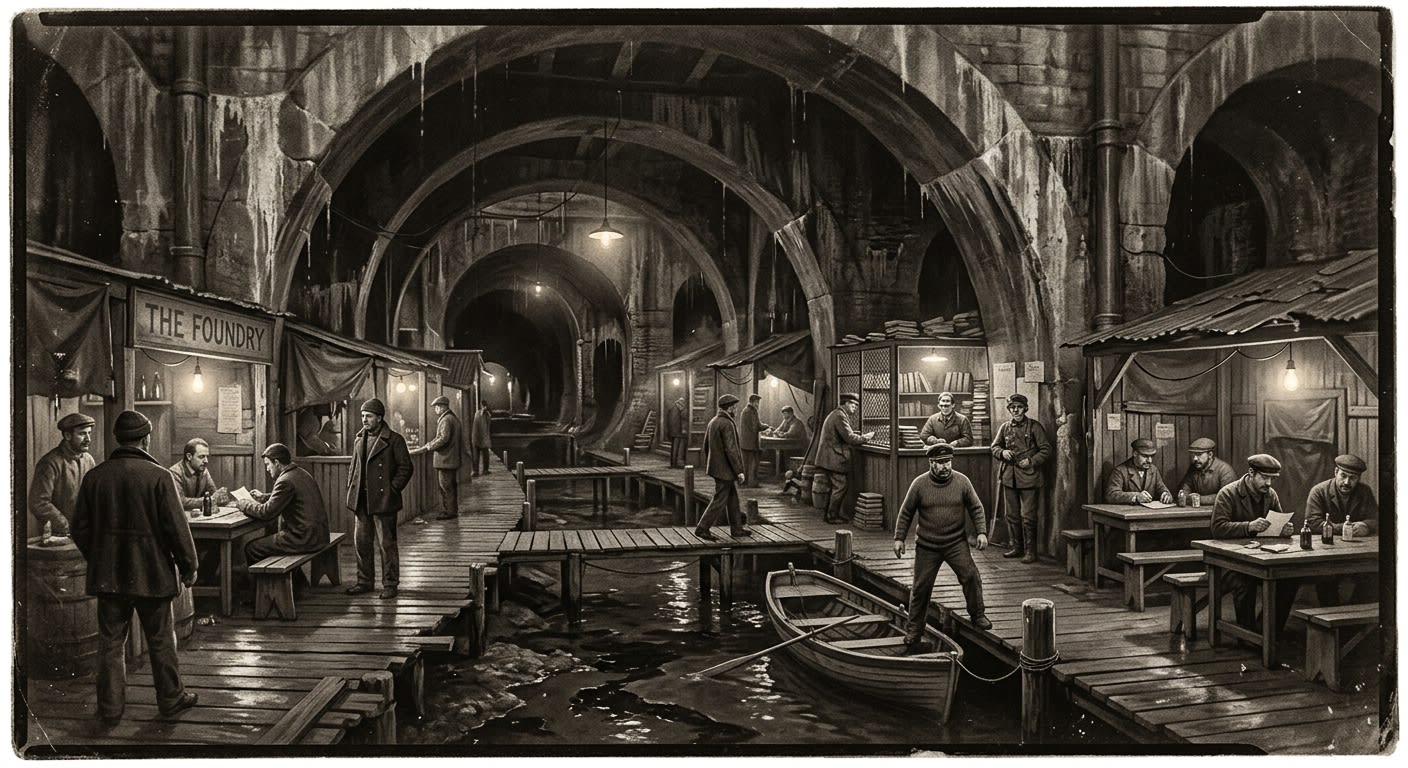
The oldest flood arches still bear the tool marks of the first chain crews: rough pick scars, psalm initials, diver counts, and little black circles scratched beside certain water doors, meaning do not sleep aboard. A.S. 93 re-ratification repairs added brick liners and inspection plaques. Half the plaques are gone. The other half survive because removing them would collapse the wall or reveal the hatch behind them, and even thieves in Drowned Row respect load-bearing hypocrisy.
Flood is the Row's oldest magistrate. Spring surge fills the lower skiff rooms to the second step. Winter brine-freeze turns the hatch rings into blades. Fog drains downward and sits in the passages with the patience of a listening clerk. The Row keeps tide marks on doorframes the way noble houses keep ancestry: proudly, inaccurately, and with occasional murder over precedence. A tavern whose threshold has drowned three times charges more than one that has remained dry, because survival sells better when it has nearly failed.
Early Harbor Ledger maps describe the lower arches as “uninhabited support cavities.”
Corrected. The cavities contain taverns, bunks, shrines, skiff berths, illegal stores, three tolerated pilot rooms, a disputed chapel of Saint Phocas (Unregistered), and enough human resentment to lift the quay if heated. They were uninhabited only during inspections, which is different from empty and more interesting.
The Row's architecture is dishonest in practical ways. Stairs double back under themselves. Drain grates lift. Wine racks conceal rope wells. Confession screens in the sailors' chapel pivot into document alcoves. Certain walls have been rebuilt so often with salvage stone that they resemble arguments more than masonry. Official surveyors complain that the district cannot be mapped. The locals reply that it can be mapped by people who intend to return.
#On Taverns, Dive-Lodges, and the Row's Little Thrones
The public face of Drowned Row is drink. This is misleading only to the sober. Taverns in the Row serve as hiring halls, debt courts, pilot offices, rumour exchanges, quarantine registries, contraband auctions, family parlours for people without families, and weather stations whose instruments are old knees, bad teeth, and a woman at the back table who begins praying before fog arrives. Brine ale is the standard poison: sour, thin, saline, cheap, and stubborn enough to survive municipal dilution.
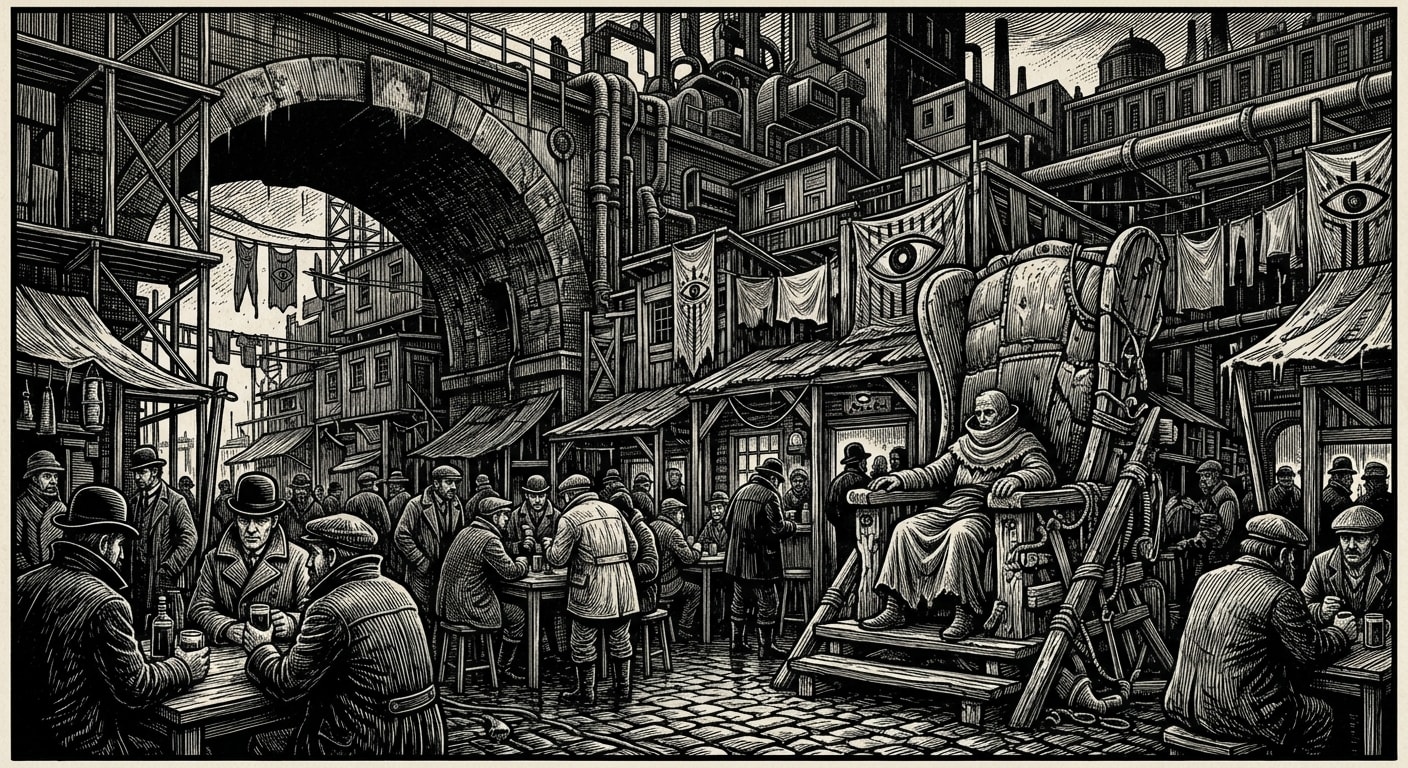
The better taverns hang rope by the door so patrons can tie themselves before sleeping. The worse taverns charge extra for rope. The worst claim the Drowned Choir cannot reach inside because the walls are lined with blessed pitch. These establishments lose customers in patterns the Bureau of Rites has filed under voluntary maritime departure. I have read the list. Voluntary, in Thessaloniki, is often a word placed over a hole.
Dive-lodges sit deeper. Their residents are dredger-divers, chain scrapers, salvage boys, drowned-body hookers, mud surgeons, and women of the Matronate between descents. They sleep with palms open to keep the joints from locking, eat salt-lime broth until their tongues crack, and measure seniority by scars received from iron rather than enemies. Sera learned breath-keeping in the pools beneath the Row and still keeps a bench in the Matronate room, though no one calls it hers because calling a thing hers might cause Records to notice she owns something worth taxing.
Above these trades sit the Row's little thrones. A barkeep who controls credit. A rope-master who controls night access to the third hatch. A widow who knows which boys were taken by the Choir and which were taken by men. A shrine-keeper who sells Saint Phocas medals drilled through the center for sailors with lost eyes. And behind them, mentioned less often and obeyed more carefully, the Drowned Row Syndic, whose exact identity changes according to which informant has recently been frightened.
The Syndic may be one person, a council, a rotating office, a fiction useful to smugglers, or the name clerks give to every bribe they cannot trace. The distinction matters less than its effect. Hatches open. Papers appear. Purity raids find decoy crates. War requisitions arrive. Men who mock the Syndic discover their berth tokens reassigned to ships already sunk.
#On the Paper Below the Paper
Drowned Row's true wealth is not coin, though coin passes through it in damp fistfuls. Its wealth is correction. The upper harbour is ruled by the Harbor Ledger Office, whose stamps determine whether a ship has arrived, whether a crewman has confessed, whether a corpse may be unloaded, whether a crate is medicine or contraband, whether a refugee is a person or a pending category. The Row lives in the gap between what happened and what can be admitted to have happened before supper.
This is the province of Ledger-Ghost Tamsin, absent clerk, unauthorized harbour-document authority, and proof that a person missing from the records may still have better handwriting than the living. Her papers convert impossible arrivals into boring delays. A vessel without a berth token becomes a dredge obstruction. Demon-glass mask freight becomes devotional glazing supplies, then Optical Supplies, Standard, then a corrected manifest no one wants to reopen. A witness becomes cargo. Cargo becomes damp loss. Damp loss becomes archive. Archive becomes truth with mould at the edges.
The Row's paper economy has rules. Every false document needs one small error. Every small error needs a clerk proud enough to correct it. Every corrected error needs a surrounding crime sufficiently dull to be mistaken for procedure. Tamsin and her imitators understand this liturgy. They write in harbour ink, cut with vinegar for quarantine substitutions, lamp soot for berth overlays, and patience for everything else.
Harbor notices attribute Drowned Row document traffic to “sporadic forgery by sailor elements.”
Corrected for restricted circulation. Sporadic forgery cannot reconcile quarantine tallies for five quarters, preserve War mask shipments under Purity observation, or place a drowned man in a ration queue before his body is hooked from the chain. The proper term is unauthorized parallel administration.
The Bureau of Shadows watches the paper below the paper and, for once, displays the intelligence of a cat before a mouse-hole. A visible under-ledger can be followed. A followed under-ledger can be harvested. The Row believes itself tolerated because it is too useful to suppress. This is half true, the most dangerous fraction. It is tolerated because usefulness creates a leash, and the Bureau prefers leashes to graves when the animal still hunts.
#On Nenos and the Water Roads
If Tamsin supplies paper, Pilot-King Nenos supplies water. He is the Row's unlicensed crown, one-eyed, tar-sleeved, brine-voiced, and obeyed by men who would spit on a municipal captain's boots and then ask Nenos whether the chain is breathing wrong. He works the water roads under the quays: skiff lanes that pass behind inspection lamps, submerged hatches that rise inside legal warehouses, marsh cuts used during fog, and narrow channels where the chain-hum enters the teeth before the ear.
A legal pilot reads charts. Nenos reads the harbour's reluctance. He knows which fog leans toward names, which rope creak means a Purity cordon has been paid, which chain interval belongs to flour, which belongs to ammunition, which belongs to glass that should be thrown overboard before the fish begin reflecting men back without their sins. The upper harbour hates his necessity. The Row knows necessity is the only crown that does not tarnish in salt.
During the Silence of Thessaloniki in A.S. 198, Nenos refused every passage. Grain, pilgrims, medical freight, ammunition, reliquary escort, courier packets fat with authority: all waited. His explanation entered the Harbor Ledger as the only document in the category Maritime, Superstitious: “the sea was listening too hard.” Men mocked him until the vessels survived. Survival has a way of revising adjectives.
ROW ORAL ACCOUNT — COLLECTED A.S. 200 On the second night of the Silence, Nenos stood at Third Hatch with lantern hooded. Witness claims water rose three steps without tide. Something below repeated the names of three captains waiting above. Nenos answered with no name, only spat brine ale into the hatch. Water fell. Witness later denied statement after receiving new berth.
His refusal reshaped the Row's prestige. Before A.S. 198, under-quay pilots were criminals with skills. After the Silence, they became criminals who had kept the harbour from offering itself to the wrong listener. The difference is not legal. It is liturgical, which makes it more durable.
#On Glass, Masks, and Useful Contraband
The Maskwright Lanes sit above and beside the Row like a kiln built over a lung. Legal masks pass through shopfronts. Illegal eyes pass below. Glassman Dimo and lesser Stainwrights mount demon-glass shards into trench optics under conditions the Bureau condemns at noon and requisitions after dusk. The Row carries the crates between those hypocrisies. Fish barrels, reliquary boxes, pitch tins, pilgrim stores, quarantine waste carts, and once, memorably, a coffin containing no body but six lenses wrapped in funeral linen.
Demon-glass changes the mood of the Row. Ordinary contraband wants speed. Glass wants silence. Quiet-boxes are carried by men who do not know the contents and women who do. Boys are forbidden to touch crates after dark. Seal-Mates who open boxes at sea are beaten before the shard can begin its sermon. Saint Varda's closed-eye mark travels under rags and reappears on masks delivered to regiments who file gratitude as requisition compliance.
The Bureau of Purity performs raids in the Row with care. Too much zeal blocks War supply. Too little zeal invites audit. Captain Mavra's Salt-Scourge men smash decoy glass, drag two loud sinners into sunlight, and leave the useful crates where boredom has hidden them. The Row watches, jeers softly, and returns to work. Public morality requires theatre. The Row rents props.
Purity broadsheets claim the under-quays have been “cleansed of demon-glass traffic” five times since A.S. 198.
Corrected. They have been cleansed of visible demon-glass traffic, preselected sacrificial crates, three expendable runners, and one genuine idiot who tried to sell raw shard chips from a soup pot. The traffic persists because the war persists, and the war has better appetite than Purity has memory.
Not every crate belongs to War. Some belong to heresy in its plain clothes: sailors wanting a lens to see a drowned wife, a refugee aunt seeking a child taken by sleep-song, a captain who believes glass can show safe passage, a priest whose faith has become optical. The Row sells to them too, because hunger for forbidden sight pays in coin and worse.
#On the Choir Beneath the Floorboards
The Drowned Choir is heard in Drowned Row, and more besides: negotiated with, feared, denied, mocked in daylight, obeyed after curfew, and built into the price of lodging. The chain-hum comes through the foundations. The under-note travels along wet stone. On certain nights cups ripple on tables without any passing cart. On worse nights, a sleeping man begins humming the wrong line and every patron in the room stops moving as if the Bureau itself had entered.
The rule is simple: do not answer. The enforcement is communal and brutal. A sleep-singer is bound with cloth, not rope, because rope leaves inquiry marks. His mouth is packed with salt-wool. His feet are tied to bedposts, benches, other men, anything heavy enough to prevent the calm walk toward water. Children are watched by three women at a time during fog weeks. Men who claim the Choir cannot take them are made to sleep farthest from the door, which is either punishment or experiment.
The A.S. 145 Crying Choir incident scarred the Row more deeply than the upper city admits. Refugee children quartered near the towers woke tongueless after singing in sleep. Official files called them sacrificed to silence; the Row calls them the Salt-Mouthed, and keeps little cups of water near certain shrines because some of the children lived long enough to learn thirst without speech. The communal hum in the Refugee Sheds began as survival. The Row adopted harsher variants: table tapping, low throat drones, spoon rhythms against mugs, vulgar counter-hymns whose obscenity appears to offend the Choir's timing. I have requested formal study. Orison sent one examiner. He returned pale, bleeding from the nose, and unwilling to hear spoons.
During the Night of Quiet Bells, the Row is at its strangest. Taverns pour without speech. Dice are set down. Lanterns hood. Only the Refugee Sheds hum, low and ugly and merciful. Drowned Row, whose inhabitants can make a murder sound like furniture repair, becomes quieter than most chapels and twice as sincere.
#On Families, Refugees, and the Rooms Above Water
Drowned Row is not all knife-work and contraband, whatever Purity prefers to print when its sermons need colour. Families live there. They live in discomfort, danger, and arrangements the Bureau of Settlement would approve only after drinking heavily: dock widows with three ledgers of debt and one ledger of favours, children who know bell sequences before letters, old riggers whose knees predict squalls, and refugees who arrived intending to move inland once papers cleared and are now old enough to call the under-quay damp their climate.
The rooms above water are valued like minor relics. A sleeping shelf six steps above spring surge can support a family for a generation if no clerk discovers the occupancy and no cousin loses it at dice. Windows are rare. Dry walls are rarer. Privacy is an aristocratic fantasy imported from inland districts with better drainage. Families hang curtains made from sailcloth, shrine rags, old quarantine screens, and the grey canvas sacks in which flour arrives from Marseille. The sacks still smell faintly of grain, which has driven more than one hungry child to chew theology from the wall.
Children of the Row learn three alphabets: Bureau letters for forms, chalk marks for hatches, and hand signs for nights when speech would carry too far. They learn to step over tied ankles without asking why a man is tethered. They learn which tavern floors slope toward drain holes. They learn that a calm drowned face is not holy; it is finished. Some become runners. Some become divers. Some are sent upward to the Ledger Steps as copyists, where their handwriting improves and their loyalty does not. Records calls this social mobility. The Row calls it placing ears in dry rooms.
Aunt Velka's people from the Refugee Sheds trade with the Row in humming shifts, water rights, child-watching, and soup thickened with whatever has not yet been classified as bait. During fog weeks, Row families send their youngest to sleep nearer the Shed hum, while Shed women send messages through Row runners to avoid official corridors. The arrangement has no charter, stamp, seal, or doctrinal blessing. It has saved more lives than several chartered committees, a comparison I make with professional bitterness and documentary confidence.
The Row's grief is domestic rather than monumental. No grand memorial stands for men taken by the under-note. Instead there are spoon dents in table edges, names scratched under bunks, rope loops left uncut, cups turned mouth-down on shelves, and little salt bowls by beds where a mother once believed the water might return what it had borrowed. The Bureau dislikes these small memorials because they cannot be gathered into one tariff. The Row keeps them small for exactly that reason.
#On Law, Violence, and the Syndic's Peace
The Row is violent in the selective manner of places where everyone owns a knife and no one can afford a feud during fog. Men are beaten for debt, cut for insult, drowned for betrayal, and ignored for ordinary stupidity. Killing happens, yes, but untidy killing draws inspectors, and inspectors bring forms, and forms are how the upper city colonizes a quarrel. The Syndic's peace exists to keep violence useful.
A thief who steals coin is punished by the robbed party. A thief who steals a berth token is judged by three hatch keepers. A man who sells bad rope may be drowned with his own coil, because rope failure below the chain is murder with a delay. A woman who falsifies a paper without Tamsin's channel loses ink rights, which sounds mild until one grasps that a person without papers in Drowned Row is meat with opinions.
The Bureau finds these rules offensive because they work without permission. Naturally, the Bureau uses them. Provost captains send quiet requests through tavern keepers when a missing crate must be missing only until tomorrow. Purity informs the Row of raids in time for proper theatre. War officers arrive in plain coats and leave with no memory worth admitting. Records clerks pretend not to notice that certain bundles dry faster than weather permits.
There are genuine monsters in the Row. Child-sellers, name-thieves, shard prophets, debt men who enjoy their work, captains who throw sick crew overboard before quarantine can charge them. The Row does not become virtuous because it is useful. Mud does not become holy because a relic passes through it. But a state that eats from a dirty hand should show restraint before calling the fingers unclean.
#On the Present Row
As of A.S. 201, Drowned Row is crowded, watched, richer than its walls suggest, poorer than its bosses admit, and acoustically nervous. The bell reversal persists. The Elder speaks high. The Younger speaks low. The chains carry tones the Bureau of Bells cannot catalogue without sweating into the forms. Sera reports increased complexity beneath the links. Kosta's hidden ledger gains names. Nenos is provisioning for a route he will not name. Tamsin's corrections have become cleaner, which alarms me more than error would.
External auditors from Strasbourg are expected. They will descend with censers, seals, wax, calipers, junior courage, and that special inland confidence by which men believe water will respect a credential. The Row has prepared. Decoy taverns have been dirtied properly. False ledgers have been aged under vinegar smoke. Three expendable smugglers have been told to look guilty near the second hatch. A genuine shrine has been made to look fake because auditors trust fraud more than devotion. Excellent workmanship, damn them.
On ordinary nights, Drowned Row continues. Brine ale pours. Rope dries badly. A boy runs a berth slip under his shirt. A diver wakes with chain-marks in her palm. A clerk who does not exist corrects a manifest for a ship that arrived tomorrow. Nenos listens at a hatch and refuses to say what he hears. In a tavern below the Ledger Steps, the cups tremble once, twice, then stop. No one speaks. Someone ties a sleeping man's ankle to the bench. The harbour above rings in the wrong voices. The Row below counts the silence and charges interest.