
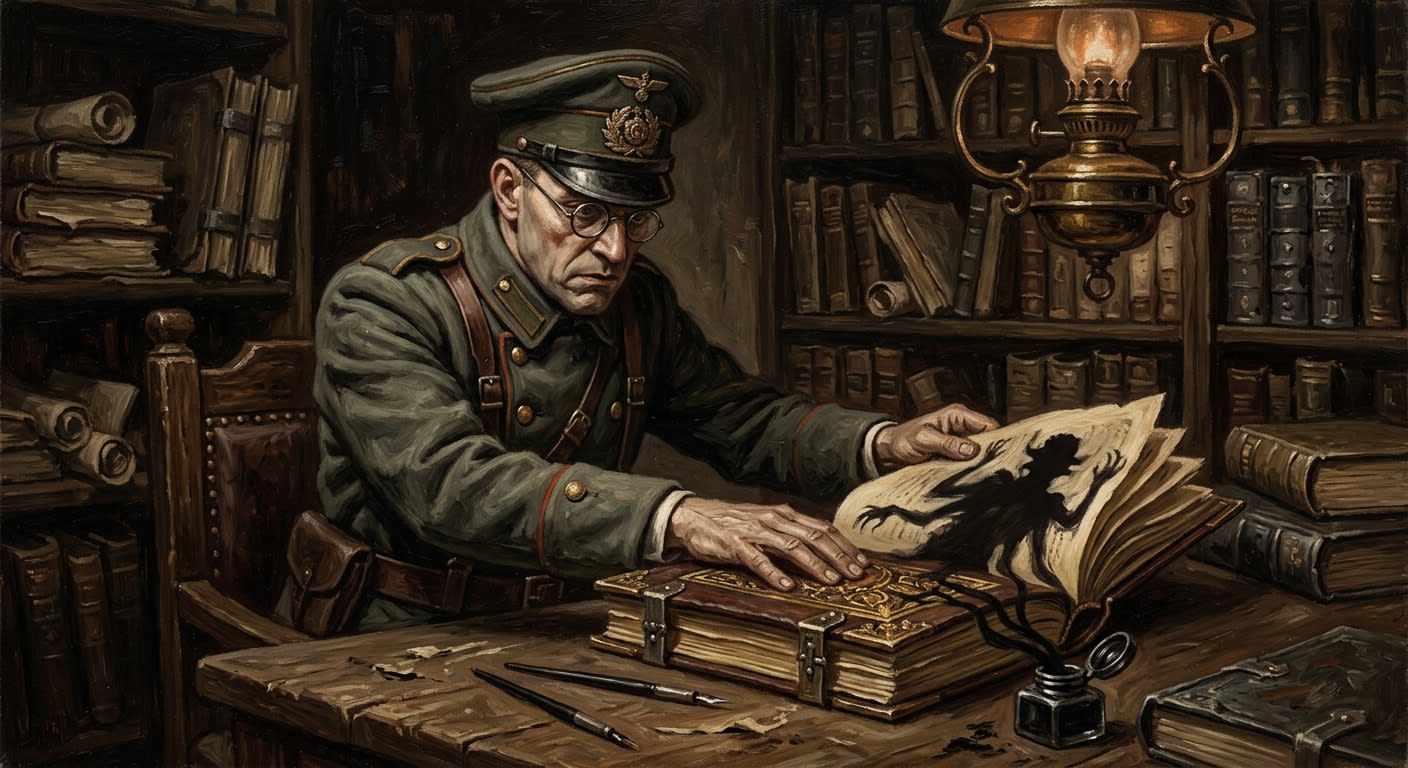
#On the Writ That Forbids Curiosity
Directive 77-C is the Bureau of Doctrine's A.S. 174 containment instrument for the Mock Liturgy of the Shadow Court, classified at issuance as an Absolute Theological Hazard (Unregistered) and still active in A.S. 201 because Hell remains discourteously literate. Its principal command is simple enough for soldiers, priests, clerks, and those unfortunate civilians who believe simplicity means safety: do not reproduce hostile formulas, melodies, response patterns, seal geometries, altar orders, counter-visualisations, or liturgical sequences.
This is the rare directive whose power lies in refusal. Most Synod law tells a citizen what to do, where to stand, when to kneel, how much to pay, which word to use before dying, and whose signature proves that death occurred in the right administrative posture. Directive 77-C tells the faithful what must never be completed. A half-heard unhymn remains dangerous. A copied counter-seal remains worse. An answered call-and-response counts as participation with clean handwriting.
#On the A.S. 174 Perimeter Debriefs
The Directive was born after the A.S. 174 Court-perimeter debriefs (Unregistered), when personnel returned with observations too structured to dismiss and too poisonous to publish. Reports described counter-seals that did more than forge authority; they revised the origin of authority while the viewer watched. They described altars of black glass, censers full of chrism-scented ash, candles bending toward mouths, bells ringing without motion, witnesses masked in flayed sanctity, and children answering a catechism with the word choose where obedience should have stood.
The early memoranda made the usual coward's error of classification by comfort. Shadow Court seals were called counterfeit. Court masses were called theatre. Court proceedings were called parody. Then the artifacts were boxed, the testimony compared, the damaged sleepers watched, and the wards that had failed under captured formulae counted. The Mock Liturgy functioned.
Doctrine corrected itself with admirable violence.
Early circulars described the Shadow Court's liturgical marks as “counterfeit devotional instruments.”
Corrected after the A.S. 174 debriefs. Counterfeit deceives the eye. The Court's apparatus recruits the eye, the memory, the throat, the habit of reverence, and the small obedient reflex by which a tired clerk trusts wax.
The debrief that every junior censor hears about and no junior censor is permitted to read is designated 174-M (Unregistered). One operative described twelve kneeling figures before a black altar while a celebrant recited Synod catechism by hostile mouth. At the response, the children corrected the priest. Their shadows were older. This line has done more useful work than a thousand frontier sermons, which proves that terror, properly redacted, has pedagogical value.
#On What Must Not Be Copied
Directive 77-C governs formulas, melodies, response patterns, seal geometry, altar order, counter-visualisation, and recovered procedural fragments. Each category exists because someone, somewhere, thought a small copy would be harmless. The Bureau has always depended upon the optimism of fools to enlarge its jurisdiction.
Formulae are forbidden because words in ritual sequence carry consequence. The Synod knows this; we have taxed it. An oath has better posture than a sentence because it binds. A confession is more than conversation behind wood because it exposes. A warrant is ink that teaches guards to move. Form makes consequence. The Court knows the same law and writes in the other direction.
Melodies are forbidden because the ear has poor border discipline. A soldier may reject doctrine and still hum the tune that unlocks his refusal. A choirboy may forget the sermon and retain the third descent. A mother may remember a lullaby after Purity has burned every pamphlet. The Mock Liturgy alters familiar cadence by a breath, a fall, a delayed mercy-name, then sends the sound back wearing your childhood's shoes.
Seals are forbidden because geometry can kneel wrong. The Bureau of Masks and Seals authenticates lawful meaning through mark, pressure, wax, custody, and witness. The Court answers with counter-seals that make authority contradict itself. A reversed bishop's mark is crude. A Triune Knot whose angles appear guilty before they are drawn is a theological knife.
Altar order is forbidden because arrangement teaches the body before doctrine enters. Left bowl, right knife, central cup, three steps, one bow: repeat the structure and the room begins to expect the rite. Expectation is a chair. Something may sit.
#On the Black Throne Correction
The most controversial provision of Directive 77-C removed the old catechism exercise for the Black Throne. Earlier lessons taught frontier clergy to resist the Throne by imagining the Creator seated above it. This had the comfort of symmetry, which should have warned everyone. Symmetry is often a demon's way of making a trap look like good architecture.
The A.S. 174 correction declared imagination an unsecured instrument in hostile liturgical conditions. No priest, teacher, soldier, illustrator, sermon-writer, school dramatist, cautionary engraver, or puppet-master may model the Throne, place furniture as a substitute, ask children to picture hierarchy, or conduct meditations in which rival seating arrangements are contemplated. The Bureau learned this through humiliating experience and one Lyon puppet show (Unregistered) whose sleeping aftermath required seventeen separate corrections.
Distance, silence, and denial in public speech remain the approved countermeasure. The Throne remains symbol in catechism, absence in operations, and pray-the-chair-stays-empty in private. The laity smell inconsistency; Doctrine files it as tiered truth, which is truth kept in better cabinets than the laity deserve.
Old instructional plates depicted the faithful soul standing between the Creator's Chair and the Black Throne.
Withdrawn under Directive 77-C. Two plates were burned. One was misplaced by Records. A fourth appeared in a rural schoolroom in A.S. 181 with the chairs reversed and the teacher absent from memory. The schoolroom wall was plastered over and the pupils reassigned to vocations requiring daylight.
#On Field Handling and Liturgical Refusal
Field personnel receive the Directive in broken form because full knowledge is a luxury issued only to those already ruined by rank. Chaplains are taught to sing over suspected unhymns before seeking sense. Seal-auxiliaries are taught to break suspect wax rather than read it. Purity examiners are taught to remove children from ceremonies where the word choose appears in response to grace. Records clerks are taught to file hostile fragments by gap notation, which produces documents that look like a music score bitten by rats.
The rule against correction is the one most disliked by educated men, because educated men would rather die than leave a grammar error uncorrected. Directive 77-C states plainly: do not correct enemy grammar; correction may constitute participation. The Mock Liturgy is generous toward pedants. It leaves mistakes like bait in the margins. A clerk sees a malformed response, supplies the proper ending, and discovers that his education has just completed a rite.
FIELD NOTE 77-C/GRAMMAR — SEALED Recovered chapel sheet contained the phrase: “I choose the mercy that was mine before I—” Assistant Examiner Voll supplied the missing verb during dictation. Three witnesses heard a bell under the table. Voll's tongue remained still for six hours while his shadow continued answering.
Recovered artifacts are boxed by Purity, witnessed by Rites, registered by Records, and then transferred under procedures that Shadows denies with a sincerity I find almost musical. The object must not be copied in full. The container must not show full geometry. The chain of custody must include enough information to prove danger and too little to teach it.
#On Confusions with Other Seventy-Seven-C Instruments
The Synod, in its numerical bounty, has produced other 77-C instruments. A Bureau of Tithes tariff-chapel division motto is cited under Directive 77-C in several weighing manuals: None shall eat unweighed, lest he forget his dependence. A civic viewing form for proximity to sacred furniture has also enjoyed the number 77-C in older Concordat Hall administration. These are separate from the Doctrine Directive of A.S. 174. They merely share a number, because the Bureau of Records insists duplication has been eliminated in all systems where duplication has been found.
The confusion is irritating and occasionally useful. Smugglers have attempted to present tariff 77-C citations as theological clearance. One chapel-weigher in the southern depots tried to invoke Mock Liturgy containment to avoid an audit of saint-bone calibration fragments. A Strasbourg guide once denied an elderly citizen access to the Concordat table by accusing her of altar-order reconstruction. She struck him with her umbrella. Doctrine upheld the blow as procedurally understandable.
Number reuse serves as a spiritual discipline imposed upon clerks who might otherwise become proud.
#On Present Force
Directive 77-C remains active because the Court continues to sing where we sing, stamp where we stamp, confess where we confess, and offer choice where obedience should have broken the spine of desire. Every Synod rite teaches Hell which surfaces shine. Every lawful seal advertises the grammar of authority. Fewer rites would be surrender. Harder custody, sharper silence, and the blessed courage to stop a sentence before curiosity completes it are the answer.
As of A.S. 201, frontier chaplains carry 77-C break sheets. Choirs are inspected for missing-note infection. Seal houses maintain counter-geometry blinds. Schoolbooks omit three old illustrations and one prayer exercise. Puppet theatres in Lyon operate under supervision, which is too gentle a fate for puppeteers but the law binds even righteous taste. The Directive has expanded without admitting expansion, as all healthy doctrine does.
#On the Punishment of Helpful Minds
Directive 77-C punishes helpfulness before it becomes treason. This has been unpopular with teachers, copyists, field theologians, restoration artists, archivists, seal apprentices, choir trainers, and every other profession whose members mistake completion for virtue. The Directive's genius is its contempt for the useful instinct. Leave the gap. Break the line. Burn the attractive fragment. If the recovered seal is almost symmetrical, gouge the missing angle wider. If the melody aches toward resolution, cough over it, strike brass, or bite the inside of the cheek until blood interrupts music.
The A.S. 188 addendum after the second Anti-Synod debrief made the principle harsher. Personnel exposed to hostile liturgical fragments must be rotated away from transcription within forty-three minutes unless a superior officer certifies that they have become too frightened to be elegant. Fear is a crude disinfectant. Elegance kills. Three clerks in the Strasbourg lower annex produced beautiful break notation in A.S. 189 and all three began dreaming in red ink; their work is still cited as a model and their names are recited only at half-volume.
At the close of every 77-C training, the approved instructor recites the only public formula permitted in full: The Shadow Court has no jurisdiction over the faithful. The class repeats it three times. Draft notes are burned. Ash is weighed. Any humming is reported.
Do not copy the rite.
Do not hum the missing note.