
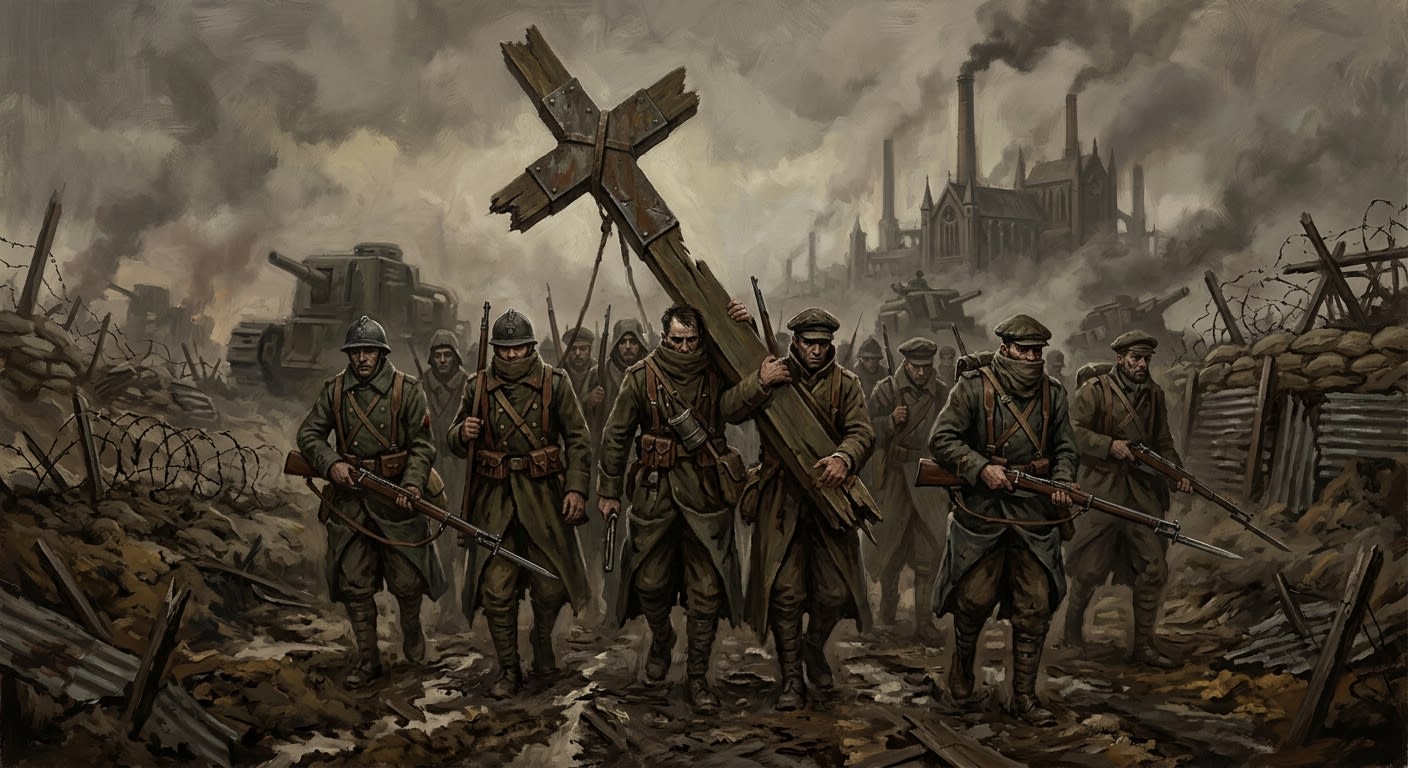
#On the Sign of Severed Verticality
The Broken Cross was the military sigil of the Rationalists during the Atheist Wars: a crucifix snapped at the crossbeam, rendered in black or iron-grey on blue cloth, stamped on writs of suppression, painted on courthouse lintels, tattooed on the forearms of Republican Guards, and carried at the head of columns that believed symbols were childish right up to the moment they marched beneath one.
It is illegal within the Synod's dominion to possess, depict, copy, embroider, carve, salute, trade, preserve, restore, admire, or describe the Broken Cross in flattering terms. I am describing it. I am not flattering it. The Bureau of Purity has reviewed this distinction and found it irritating but sound.
The device said what Rationalist theology could not say cleanly: the vertical has been broken. Heaven has ceased descending. Earth has ceased answering upward. The crossbeam, symbol of mortal suffering sanctified by divine order, is snapped from the upright line as though geometry had overruled salvation. That, reader, is the most concise sermon the Rationalists ever preached, and like most concise sermons, it deserved burning.
#On Its Descent from Ulm
The Broken Cross did not spring from the battlefield fully armed. It grew from the older compass-and-cross device of the Concordats of Ulm, where a compass crushed an intact cross beneath its points. The early seal was colder, cleverer, and more cowardly. It subordinated Faith to measurement. It did not yet dare show the killing stroke.
By the time the Atheist Wars opened in A.S. 10, subordination had ripened into fracture. Pamphlet seals became militia badges. Faculty-room wax became regimental cloth. The intact cross beneath the compass became a snapped crucifix on a banner, because movements, like abscesses, declare their contents when pressure mounts.
The Bureau of Purity's monograph on the progression runs to four hundred pages and contains eighteen plates, each sealed after viewing so junior Inquisitors do not develop aesthetic opinions. Its conclusion is correct: every tolerated heretical emblem completes itself. A compromised symbol is a wound with a schedule.
Older museum labels in Strasbourg identified the Broken Cross as “a variant of the Ulm Compass.”
This is museum speech, and museum speech is dust arranged into cowardice. The Broken Cross was not a variant. It was the Ulm device stripped of academic lace and handed to men with bayonets.
#On Its Use in War
The Broken Cross entered public terror with the Republican Guards. Officers wore it on brass buttons. Prefectural regiments carried it on square banners edged in black. Courthouses displayed it above secular tribunals. Writs under the Secular Gatherings Act bore it in the upper left corner, exactly where older diocesan writs had placed the bishop's seal. The replacement was deliberate. The Republic understood blasphemy well enough to commit it with tidy margins.
At Saint-Malo, the Guard detachment advanced beneath no great campaign standard; this was a gate action, a small piece of enforcement, a stain produced by routine. Yet the sergeant's writ carried the mark. Survivors remembered it because survivors remember the smallest obscenities: the shine of a buckle, the colour of a cuff, the broken little cross at the top of the paper that made killing sound lawful.
The Folio of First Fallen records that one child among the Saint-Malo pilgrims spat on the sergeant's writ before the second advance. The line is struck in later copies. The child's name is █████████. The Bureau of Doctrine has not canonized the child because the Bureau of Records cannot determine whether spitting on a legal instrument constitutes martyrdom, contempt of court, or both.
From Saint-Malo to Toledo, from the Rhine frontier to Aachen, the sign multiplied. It flew over artillery parks beside the clockwork cannon of Lucien Artois. It hung in the Reichssaal at Regensburg when Faith's political order was signed into humiliation. It was stamped on confiscation inventories for monasteries, on tongue-removal orders under the Edict of Ironmouth, on the covers of school primers teaching children that prayer was a hereditary defect. The Broken Cross became the Republic's little hammer: every page a nail, every citizen a board.
#On Synodic Prohibition
After the Sundering, surviving Republican Guards threw down their Broken Crosses and begged for chaplains who had been carefully reduced in number by their previous employers. The Synod collected the discarded standards with tongs. Some were burned. Some were sealed. Some entered the Forbidden Stacks for study, because the Bureau destroys danger only after learning whether it can be put to work.
The prohibition came in layers. First confiscation during the Great Retreat. Then burn orders under early episcopal councils. Then, after the Concordat of Strasbourg, full Purity proscription: possession punishable by immurement, depiction by branding, sympathetic description by removal to instructional terrain. The law is severe because the symbol retains appetite. In A.S. 187, a cadet cell at Bastion-Przemyśl passed hand-copied Rationalist fragments beside a chalk sketch of the Broken Cross. Three cadets memorized the preface to De Vera Luce. Their beds were issued to better men.
A provincial Purity circular once permitted “historical display” of Broken Cross material under glass.
Revoked. Glass is not theology. Men who believe history becomes harmless behind a pane should be displayed behind one, preferably in a wall.
Modern enforcement falls under Classification Amber when the mark appears as residue — a doodle, a pamphlet seal, a theatre prop, a pause before applause at a burning. Amber is merciful in the way a trap is patient. It watches first. It closes when the subject begins to feel unwatched.
#On Its Surviving Fragments
The largest surviving Broken Cross standard is kept beneath Strasbourg under triple cloth, iron clamps, and a prayer recited by a clerk who has never seen the object he guards. The cloth is said to sweat in August. Brass buttons bearing the device appear in smuggler trunks, private collections, attic shrines of treason, and university theatricals staged by boys whose parents bought them spines but not judgment. The Bureau buys none of these items. The Bureau confiscates. Commerce dignifies the seller.
A few fragments have behaved badly. A banner strip recovered near Regensburg would not burn until a priest recited the names of the Saint-Malo dead backward. A button from a Republican Guard coat clicked once every dawn for fifteen years, stopping on the morning the Balkans opened. A courthouse lintel in Prague, scraped clean four times, continued to show the snapped cross in rainwater until the entire stone was removed and buried under a chapel latrine. The Bureau of Alchemical Standards calls these effects “symbolic adhesion.” The Bureau of Doctrine calls them spite.
Both departments are underpricing the matter. A symbol used for murder learns the shape of permission. It does not forget because men repeal it. It waits for another hand.
#On the Correct View
The Broken Cross must be studied with hatred clean enough to leave no fingerprints. To fear it grants it stature. To admire its design invites infection. To dismiss it as antique villainy ignores every modern clerk who has ever wondered whether a banned mark might be kept “for context.” Context is how heresy rents a room.
The correct view is contempt: doctrinal, informed, disciplined, and armed. The Broken Cross was Reason's banner when Reason became a knife. It snapped the crossbeam and called the wound liberation. It marched from lecture hall to massacre, from massacre to republic, from republic to collapse. At the end, its bearers threw it into the dirt and cried for priests.