

#On the Cask Under Neutral Cloth
Compiled A.S. 201 / 1911 CE, under Operational Amber, from published House, Registry and survey accounts. The date belongs to this compilation. The salts are older and have never produced a birthday I could certify.
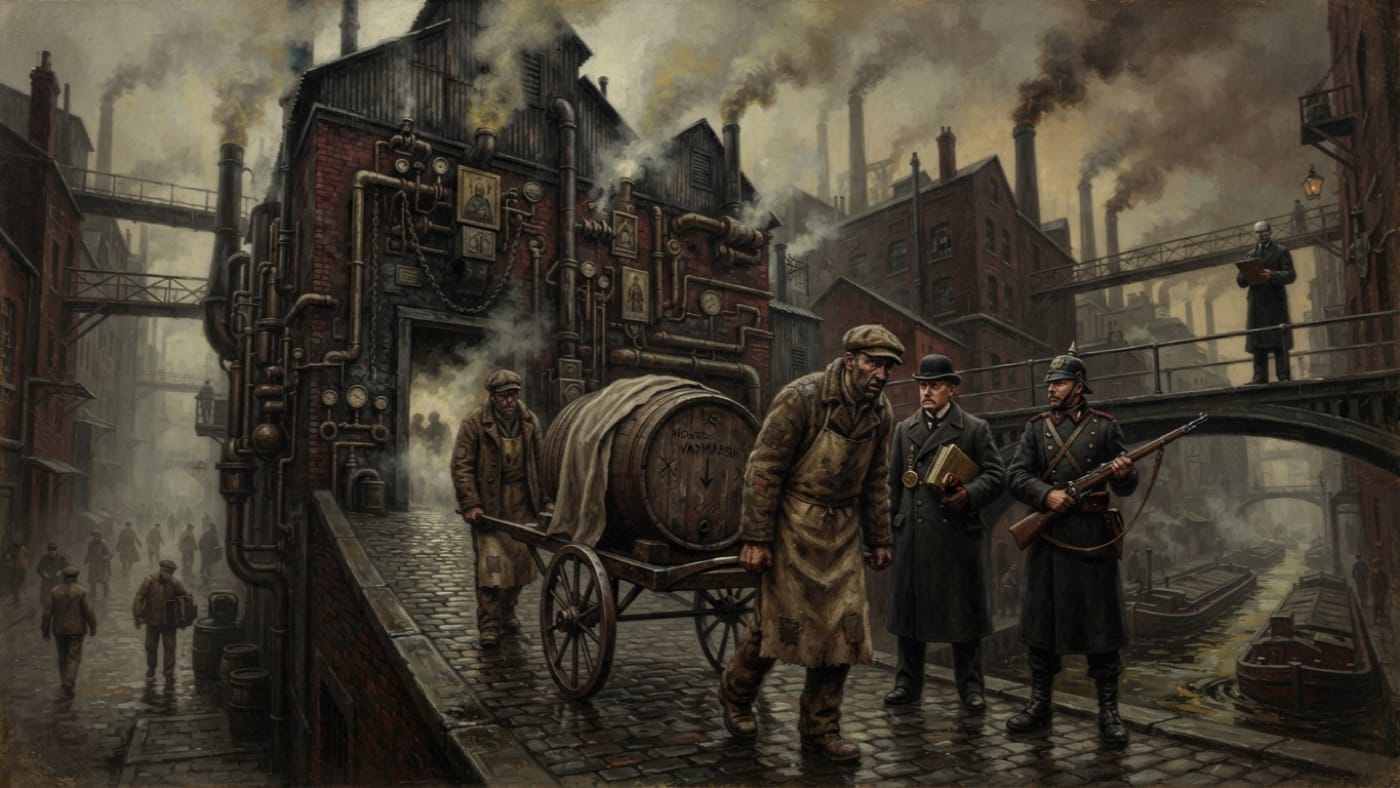
A cask is leaving a salt loft on Vatmarsh Row. Two witnesses walk beside it, and a sample rides with it under neutral cloth. It is an ugly object. The staves are damp. Some of the scratches on the lid are official and some are not, and the runner carrying it has a cough that a House clerk would enter as productive irritation. Downstream, a conscription order, a burial permit and a grain levy are all waiting on what this cask holds. They have no idea. Paper rarely knows whom it owes.
This survey concerns the contents: the mordant salts of House Vatmarsh, which the Codex files among relics. I accept the classification on my own definition. A relic is any object whose loss the Synod would notice sooner than the death of the person carrying it. The salts qualify, and so, unfortunately for him, does the runner.
#On What the Salt Is, and What It Is Not
Pigment gives colour. The salt makes the colour stay. Most of Candlewick's politics happens between those two facts, and most citizens cannot tell them apart.
The Row recognises four trades where outsiders see one thing called ink. Pigments and dye-bases supply the shade. Mordant salts bite: the published accounts have them taking hold in fibre, paper, vellum and prepared wax, so that colour survives damp, travel, handling, argument and time. Fixing agents are the wider family the salts belong to, and the family includes members that are not salts. The House trade list names the two separately, and Vatmarsh clerks will correct you sharply if you merge them. Ink-stabilising washes come later in the work and are kept under their own sealed formulae. House Vatmarsh sells all four. A requisition that confuses them is an ordinary mistake and a costly one, because the Row bills for the category the clerk wrote down, whatever he meant.
I will not print what the salts are made of, in what proportions, or at what heat. The recipes are kept in the black salt book in the recipe chapels, in the custody of the Vatmarsh Matriarch, and her authority rests on the fact that nobody else holds them. I have smelled the Row: vinegar, metal salts, wet wool, hot brine. That is a list of smells. Anyone who tries to build a formula out of this paragraph has earned whatever vat he falls into.
Fixed ink is more likely to hold. That is all it is. The House sells the likelihood and charges for a certainty.
#On Custody, From Loft to Lock
The custody chain begins with something the House would rather not stencil on its casks. The Palatinate's import lists include mordant salts, alongside tallow, beeswax, linen, die metals and coal. My ledgers do not say where the salts come from, who sells them, or which of the city's entrances they use. Even the Mordant Gates, which owe the salt their name, keep no record dividing the traffic between road and canal.
An earlier draft of this survey stated that House Vatmarsh "draws its salts from the marsh beneath its own vats."
Corrected. The Palatinate import lists name mordant salts as an import. The House controls the stock once it is inside the Row, and it controls the recipes that make the stock useful. No record I hold gives it control of the ground the salt came from. The marsh supplied the metaphor and nothing more.
Inside the Row the salt stays in guarded lofts until it is called to the vats and the washes. It leaves as finished stock in casks marked with origin, dye lot, stirrer oath, fixing agent and House scratch. Some of the scratches are written for the workers rather than the Registry. A notch angled downward means the salt loft was damp. A pin-prick next to the batch number means do not stand near the cask after it is opened. The Registry has banned private marks four times. Each time, spoilage went up until the ban lapsed.
Downstream, Bottle Quay draws the ink into glass, stoppers and waxes it, and loads it for the canals. The Chromatic Registry certifies which shades are lawful. The Seal Locks control passage out of the city. I list these stages in order because the Bureau thinks in order. Whether a particular cask went through each of them in that sequence is a question for its manifest, and in Candlewick manifests have been known to fade.
The Registry inspects the House and depends on it, and it resents both. The Records Annex wants more than either. The Bureau of Records has asked for single-source ink control, which in practice would mean someone in Records holding a copy of the black salt book. The Matriarch has answered with the courtesy of a woman who owns the only one.
#On the Hands That Carry It
The custody chain is made of people: dye stirrers, mordant runners, salt skimmers, vat-scrapers, mask stitchers and canal loaders. Each moves the salt a few yards and takes a little of the cost home.
Candlewick's own list of what kills its workers includes vat burns, chemical poisoning and lung rot from dye dust. The workers call a vat burn a mordant kiss, and the ones who use the phrase have usually had several. The Lungward Sisters record exposure by shade whenever they are allowed in. Their infirmaries in Lungward smell of camphor and boiled cloth, and outside them a mask market does steady business. Workers' masks are replaced weekly if the House accounts approve. Their lungs are not replaced at all. The Matriarch attends Compact sessions in a gauze mask tinted the colour of dry bone, and nobody has ever asked how often hers is changed.
I cannot tell you which of these injuries comes from the salts and which from the dye dust, the vinegar or the heat of the vats. No physician has been allowed close enough to find out. The House is content to leave the question open, because a cough without a cause cannot be brought to court.
Children on the Row learn smells before they learn letters. Bitter copper means gloves. Sweet rot means leave the room and do not wait to be told. It is the only part of the salt's literature that the House gives away free.
#On Salt Below the Dikes
The Black Canal workshops cannot make permanence. They have to obtain it. Any real salt that reaches a bench under the dikes got there by theft, diversion or salvage, or because someone with a key was paid to look away. When the bribe is withdrawn, it is usually withdrawn on the morning of a raid. According to the House account, desperate benches stretch the stock they have with canal scrapings, marsh brine and ash-sieved powder. The Black Canal also sells false salts outright, and House factors buy samples of them at night so they can denounce them by day.
What the benches produce goes on sale as fade-proof ink. The workshop survey sorts it into three grades: false, dangerous and effective. The phrase on the label is the seller's claim and proves nothing about the contents.
Scarcity is the House's real weapon, and the Fading Winter showed how it works. According to the published House account, Vatmarsh hoarded salts during and after the crisis while insisting that supply was stable. It then won concessions: slower Registry inspections for House casks, sealed review of private marks, less Provost access to the upper vats, and emergency purchase guarantees for stabilising washes. The Records Annex denies granting any of this. The House denies asking. The shipments started again.
#On Fading and the Quarrel of Causes
In A.S. 143, ash from the Year of Ash Rain drifted west and settled into Candlewick's vats, mortar and water. Since that year, Hungry Ink has altered the words on certain pages while the seal, signature, date, registry shade and fee stamp stay intact. The Bureau of Alchemical Standards recorded a correlation between the ash and the ink. Nobody has recorded a mechanism. Standards' internal correspondence does report that Vatmarsh salts filtered after A.S. 144 showed no visible ash and no fall in cases. That is a fact about one filtration. It explains nothing.
The Ash-Substrate school goes much further. It argues that the mordants did exactly what they are made to do: they fixed, and whatever the ash carried was fixed along with the colour. The school is not recognised, its memoranda carry no names, and Doctrine commissions them anyway. I report its argument as an argument. I do not certify that the salts contain anything except what the House's salt book says they contain, and the House's salt book has never been offered for inspection.
The Fading Winter began in A.S. 199. Documents across the River-belt lost their text and kept their seals and signatures. The Registry declared heresy. Vatmarsh chemists declared mordant failure. The Seal Provosts blamed the canal benches, and the workshop survey records that charge as unproved. Some affected pages showed the black halos of Hungry Ink and others simply went pale, so the relationship between the two afflictions remains unsettled. The published House account says that the House's hoarding accelerated the fading. I report the claim. I do not countersign it.
Pell is still on restricted duty, smelling suspect blanks in the fog. Citizens in the queue ask him what their papers used to say. He tells them to consult their memories, which are still unlicensed.
#On Present Amber
As of this survey, the Row operates under Amber discipline. The salt lofts are guarded. The recipe chapels are sealed after third bell. Cask samples travel with two witnesses. Workers are searched for micro-vials, private marks and any cough that might count as testimony. House Wickwarden wants salt concessions tied to wax quotas. Records still wants the book.