
#On the River and the Northern Anchor
"River: Pregel. Cargo: water. Provenance: inland. Purpose: none declared." — Bureau of Passage practice entry, struck through by a supervising clerk, undated
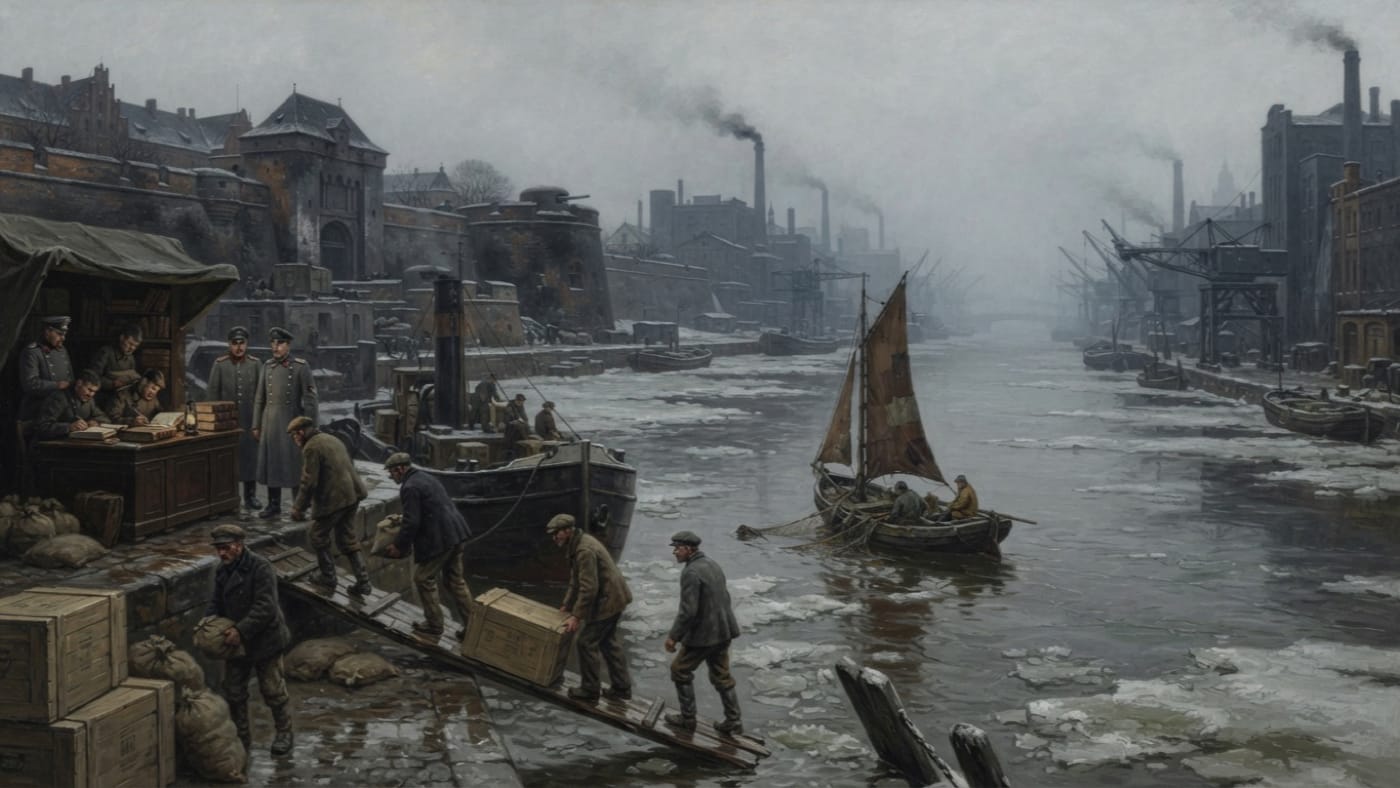
Each morning in the open season the Pregel takes a narrow boat out past the east quay. Two men sit in it with a net heaped amidships and a Passage chit pinned under a stone so the wind cannot have it. A little later the river lets a grain hull in from the sea. The Bureau of War considers the grain hull the river's purpose. The two men consider the boat theirs, and they have held that view for longer than the Bureau has existed.
The Pregel is Königsberg's river. By it Bastion-Königsberg, the northern anchor of the Sagittal Line, reaches the Baltic, and by the same water the Baltic reaches back. Its mouth gave the old merchant port its access, and the military terminal now lives on that access. I write only of the lower river and its working frontage, because that is the part of the Pregel the Church employs. What it does inland among the farms and cart-tracks of East Prussia the Bureau of Records has never surveyed with any confidence, and I decline to survey it for them from a desk.
The maps run several things together, so I will separate them. The river is water. The Harbour Quarter is the district of sheds, quays and clerks on its bank, and it bills the water for its services. The Sea Wall faces the northeastern approaches and watches the sea. East and southeast of the city lie the Masurian Lakes, a separate maze with its own reeds, its own ice and its own patrols. I have read no document that joins those lakes to the Pregel by any navigable route, so I join them by none.
#On the Requisitioned Waterfront
The frontage was commercial long before it was military. Prussian factors weighed amber and rye on these quays. Fishing households mended nets on the east quay and listened to the factors haggle. The warehouses stood on Teutonic stone, and the river took cargo down to the sea without any theology attached. For the Bureau this is the most embarrassing period of the Pregel's history: it worked well and nobody had to sign for it.
Around A.S. 67 the retreat stopped and became a refusal, and every coast with a usable channel became a supply question. The city was requisitioned that year or near it. I give the day of requisition as unknown because it is unknown. The Sea Wall entry records Engineering's verdict on what they found: the old quays and Teutonic stone gave material, and the Pregel mouth gave access. As far as I can establish, those two words are the river's entire commission into the war. It accepted the appointment the way water accepts everything, which is without any formal sign of consent.
The great rebuilding of A.S. 92–110 gave the frontage its present appearance. Iron went onto the quay faces and the brick sheds were thickened. The whole waterfront was tied into the Ordensburg's chain of command. Somewhere in those years a warehouse ledger stopped listing amber and started listing cartridges, and from then on the river carried ordnance as calmly as it had carried rye.
"The Synod requisitioned it in the first years of the Line's construction, approximately A.S. 67."
So reads the Codex entry on Bastion-Königsberg, which the East Prussia entry has already corrected. The correction applies here as well, since the frontage was what the requisition was for. No Synod existed in A.S. 67. The provisional frontier authority of the emerging Church administration took the city and its river access. The formal Synod was constituted at Strasbourg in A.S. 90, twenty-three years later, and has been signing for its predecessors' work ever since.
#On Cargo and the Frozen Harbour
Four classes of consignment reach Königsberg's quays. Grain comes from Hamburg in stencilled sacks and ammunition from Kanzleiburg in straw-lined crates under wax seals. Conscripts are staged through Warsaw and come down the gangways in new coats. Replacement bell-clappers come from the Bureau of Bells foundry at Essen, in crates larger than coffins and handled with more ceremony. None of those cities stands on the Pregel. Their cargo is loaded, shipped, carried and landed, and the river's part in all that is the final approach and the gangway. The approach is a short stretch. Every sack, crate and conscript in the northern garrison depends on it.
The ships deliver and the men receive. A grain hull has nothing to say about how many backs it takes to empty. Dockers carry the sacks up wet planks, and clerks count them at the quay and count them again at the warehouse door, because grain has a gift for shrinking between counts. The ammunition crates must not be touched with bare hands. Six men carry each clapper while a Bells officer walks beside it like a deacon beside a reliquary. The river has done its part once the hull is moored. The quay's work is only starting.
From December to March the harbour freezes.
I say "the harbour" because that is what the record says. The record does not say whether the Pregel freezes along its whole course, on which date, or how thick the ice gets. I put the question to a docker. He told me it froze enough. I have adopted his finding, since it fits every document I possess and contradicts none of them.
Once the basin closes, everything bound for the bastion must come overland through the Polish lowlands, along the Polish corridor and the larger Northern Corridor it feeds. The road is long, the Bureau of War has failed to improve it for forty years, and the garrison lives through the winter on what the sheds stored in autumn and what the road manages to bring. That is why autumn is the frontage's frantic season. The last hulls come in before the freeze, the warehouses are packed to the rafters, and clerks work by lamplight.
#On Those Who Work the Water
The frontage is run by three kinds of people. Dockers smell of wet hemp and tar and handle sacks, crates and rope that will not dry between October and the ice. Fishermen go out from the east quay in narrow boats with patched sails, as their families did before the Line. They register their boats with the Bureau of Passage and pay tithe on their catch to the Bureau of Tithes. The clerks sit under a roofed shed at the head of the quay with oilcloth-bound ledgers, writing down whatever comes in by water. They carry nothing and they write everything.
The fishermen fit their work around the convoys and the patrol lanes. They set out between hulls and come home before the clerks lock the shed, and they treat the arrangement with the patience of men who have watched governments come and go on the same tide. The Bureau of Passage files some of their nets as licensed and the rest as unlicensed extraction apparatus. On the boats all of them are called nets.
Inland, the Warrens press against the quays. The civilian quarter lies between the harbour and the Ordensburg, and every alley in it ends at the water sooner or later. Warrens children grow up within earshot of rope creaking against piling. Many of them become dockers, and the cleverer ones become clerks. Fishermen's children mostly become fishermen.
I must mention the east quay's most disputed household. In A.S. 198 the son of Dreher, a fisherman, went out in a northeast fog tide, was missing for three days, and then walked back up the quay. Purity found him consistent with his registered identity. His father did not, and the dispute is still open. I record it because the quay records it. I do not record it as a property of the river, since no examiner has established any such thing.
#On the Water Under Observation
The Northern Carillon stands in the Cathedral Close. It is a long way from the river, and the river hears it all the same. Forty-one bells of Prussian gun-bronze ring above the Choir of the Northern Standard, and the sound comes down over the roofs to the quays, where dockers and fishermen hear it. The bells have no special arrangement with the Pregel. Sound carries over water, and the river happens to be water. By A.S. 190 the Choir's own reports recorded Harbour Quarter sailors repeating final antiphons in their sleep. These were men who had never entered the Close. The Bureau added columns to the rota.
The Grey is reported from the northeastern Baltic approaches, and that is where the testimony places it: fog off the open water, faces in the fog, hymns sung back. Its classification, settled in A.S. 190, is Unknown Forces, Extradoctrinal Classification Pending. Old fishermen on the east quay refuse both the Bureau's term and the Scandinavian one and simply call it "it." They say it moved under a hull, stood in the fog and sang back. Those are their words, and I set them down as theirs.
I have searched for a report that puts the Grey in the Pregel and found none. No document says it rose from the river, lives in it, goes upstream through it or has spoiled it. A great many Codex entries would be livelier if I invented such a report, and I have not done so. A ledger needs an entry before anyone can close it.
As of A.S. 201 the frontage takes in its cargo whenever the ice allows. Hulls moor, sacks are counted twice, and crates go up under seal while the clappers follow with their deacon. In December the harbour will close and the bastion will lean on the corridor for supply. In March the ice will break, the first hull in will be cheered by men who swear every year they will not cheer it, and the narrow boats will go out again with their chits pinned under stones. Fog keeps coming in from the northeast. The reports remain open.