
#On the Settlements Found Whole
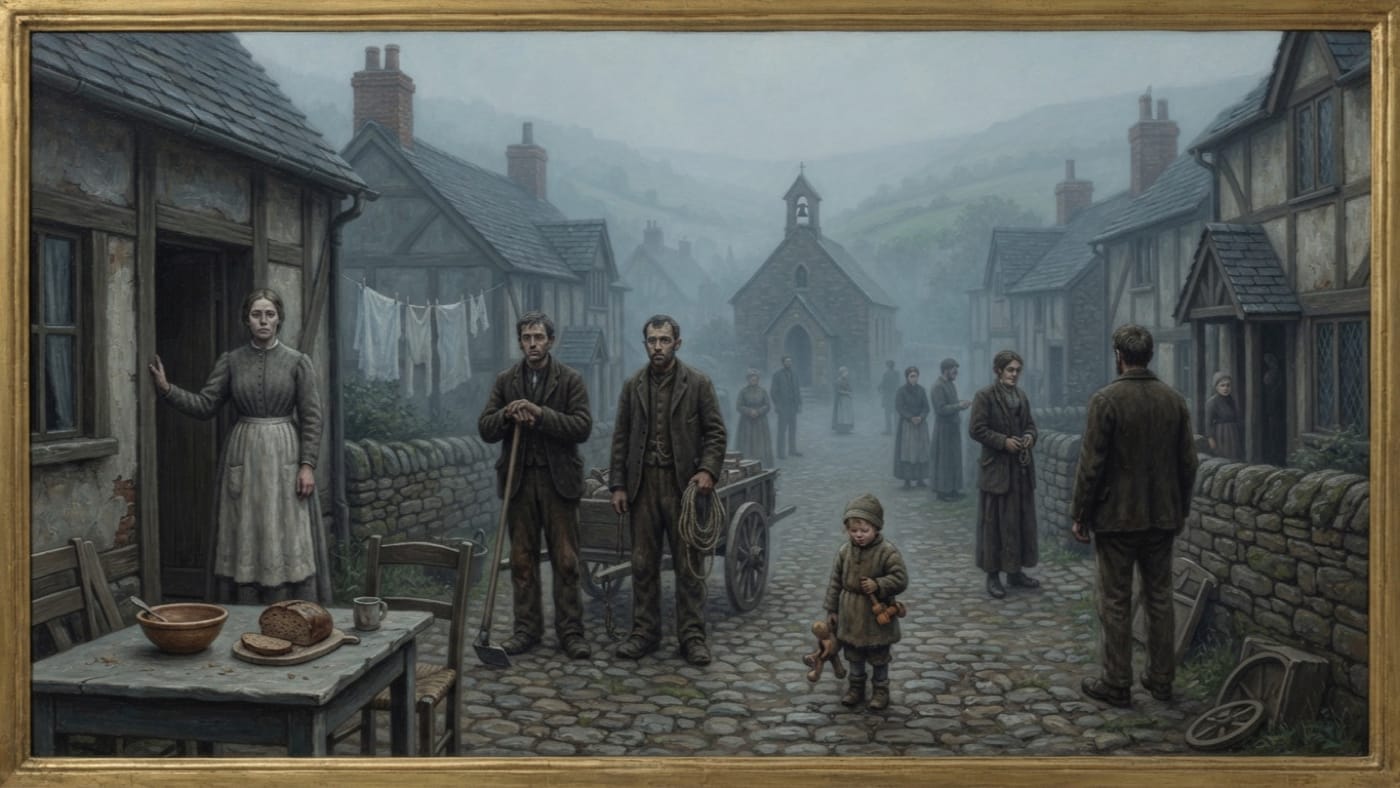
The Preserved Villages are settlements found intact inside the Vales of Stagnance, Syrion's occupied country. Most reports come from the Zone 6 depth beyond Bastion-Shipka that the maps call the Charnel Lands, and a few come from the Serbian fog-margin. I give no coordinates. In the Vales, coordinates are a courtesy that the ground withdraws.
What the survey parties describe is housekeeping. A loaf on a board. A pot over a fire nobody has fed. Washing on a line, stiff, and bleached by no sun the Vales permit. A bed with the blanket thrown back and the hollow of a body still pressed into the straw, as if the sleeper had stepped out to see about the goats. Some tables hold meals that are still warm. Others hold bread gone to stone. The Vales keep house unevenly, and the Bureau of Records has stopped pretending that one kind of preservation governs them all.
Some villages are empty. The patrols prefer these, say so, and are right.
The rest are inhabited.
The region's misfortune began when Phocis fell on the Night of a Thousand Lamps, during the Sundering of A.S. 45. After that the haze moved across the old kingdom one valley at a time. That history explains the country. It does not date the villages. No Bureau knows when any particular hearth was last tended by a living hand, and I will not stamp the Sundering's year on every kitchen in the Vales because a clerk finds one number tidier than none.
#On the Inhabitants
They stand in lanes, kitchens, barns, chapels and doorways. Their eyes are open. They breathe at a slow, unvarying rate. Many have stood like this for decades and show none of the ruin that decades owe a body. The skin greys and dust settles on the shoulders, but the flesh underneath keeps. Speak to them and nothing answers. The field reports have also tried shaking, shouting and striking, and record the attempts with the shame they deserve. Nothing answers those either. Carry one out of the lane and lay him in a cart, and by the next morning he is usually found back where he stood, in the same posture, with the same lack of expression. The record describes the return. It does not describe how the return happens, and neither shall I.
These are people: farmers, carters, wives, grandmothers, children. Standing still proves nothing about whose side they are on. They are not the Patient Army, whose ranks hold the fog-edge under arms. They are not Still Ones either, the hostile figures that hold motionless while watched and close the distance the moment a man blinks. A Preserved villager does nothing when you look away. That is the whole difference, and every Shipka recruit needs to have it by heart. A soldier who confuses the two will either shoot a grandmother or turn his back on a demon.
"Absolutely still" claims too much. Bureau of Medicine testimony records pupils that contract and hands that tighten on a tool-handle. Once or twice a year, it records a single sentence that arrives after the lips have stopped moving. The sentences are domestic: The soup will catch. None has yet led to a conversation, a walk to the gate or a recovery.
Whether anyone is still present behind the eyes is a question the Bureau of Doctrine has argued for a century and a half. Soldiers at the Shipka wire say yes, every one of them is aware, and repeat it as fact, because horror is easier to carry when it is certain. Doctrine has certified nothing. I will not certify anything on Doctrine's behalf, in either direction.
#On the Survey of Village Seven
In A.S. 181 a Bureau of Engineering survey team entered the settlement now filed as Preserved Village #7 and stayed six days. It is the best-documented observation of its kind in the Synod's archive. That says less for the survey than against everything else on the shelf.
The team's account is plain. When they arrived, the inhabitants were standing in the lane and in the houses beside it. When they left on the sixth day, the inhabitants were standing in the same positions. The team photographed them, and the plates were carried back and developed in Sofia.
One print shows a villager turned toward the camera.
The team's notes record no such movement. The print records it. The Bureau of Records keeps both side by side and has not ruled between them. A ruling would mean choosing to distrust either six days of trained witnesses or one sheet of silvered glass, and the Bureau dislikes distrusting either of its instruments in writing.
I leave interpretation to others. The photograph shows a turned head. It does not show when the head turned, toward whom, or why. Other discrepancies reported from that year's survey work belong to other files and explain nothing here.
The survey was followed by the prohibition still in force today: no expedition stays overnight in a Preserved Village without a sealed writ and observers from the Bureau of the Hourglass. Six days was judged an experiment the Church need not repeat for curiosity's sake.
#On Recovery and Examination
People can be extracted. The A.S. 199 records from Village #7 show that much. A person can be lifted out of the lane, carried past the fog-margin and put down under a roof where the Bureau of Medicine can take a pulse. Whether that person has been restored is a separate column in the ledger. The records keep the two columns apart more carefully than the commanders who read them.
In a Medicine file, "recovered" means removed and examined. It does not mean cured. I have seen it read as "cured" in three separate staff rooms, each time by an officer who wanted good news more than he wanted to finish the sentence.
Bureau of Medicine Field Report 1107-S, classified VERMILLION. Subject recovered from Preserved Village #7, A.S. 199. Estimated duration standing: ████ years. Clinical assessment: alive, aware, responsive to ████████████. Single recorded utterance: "████████████████████." Transferred to ██████████████. Attending physician's recommendation: sealed. Physician's request for reassignment: granted.
That finding of awareness concerns one subject. It is the Bureau's assessment of one body. Soldiers who quote it as the verdict on every villager in the Vales are treating a clinical note as scripture, which is a heresy of method even when it is not one of doctrine. The subject's identity, years, destination and the physician's recommendation remain sealed, and they stay sealed in this Codex.
#On Entry and the Present Condition
The approaches start at Bastion-Shipka, the Sagittal Line's sixth principal bastion counting south, in Zone 4. They run east across the Phocis Marsh Corridor and the contested Zone 5 ground into occupied depth. The villages are surrounded by Stillness Fields, where time slips across whole tracts, and by Drag Corridors, where it stretches along the roads. Both hazards surround the villages. Neither has been shown to have created them.
The precautions for entry are few and modest. Each party carries a clock that is kept outside the village and checks against it on return. Witnesses go in pairs, each responsible for the other. A rope binds the file together. Bureau of Bells wake-patterns are struck at irregular intervals, and any man who reports that the bells are becoming regular, or soothing, is withdrawn at once. None of these is a cure, and nobody at Shipka claims otherwise. The man who does claim it is given a second rope.
Older catechetical instruction taught that the Preserved Villages are judgement on idle households, and that the industrious need fear no such arrest.
Corrected. Syrion's harm falls on the exhausted, and the exhausted are commonly the hardest-working souls in any parish. Fatigue is a condition of the body. Exposure is a circumstance of the ground. Neither is a confession. A villager standing in his own lane gives no testimony against himself by standing there. The Creator made a body that needs sleep and is not mocked by the need.
The distinction matters most close to home, because Shipka's marsh has sleepers of its own. In the Sleepfire of A.S. 178, sleep-contagion left stilt-hamlet households standing in the flames. The Somnolent Communion Cells gather at the marsh edge. Rest Societies are now forming inside the bastion among clerks and nurses who have not had an honest night's sleep in a season. None of these is a Preserved Village. An inspector who files a tired fishing hamlet under that heading has done the Great Deceiver's clerical work for him. Looking the same proves nothing about sharing a condition, and nothing at all about guilt. Where there is real heresy, the Cults of Stillness supply it on their own initiative and are prosecuted on their own evidence.
Shipka's soldiers serve under the garrison's four-month posting limit. No one has published a safe length of exposure for a village, and I will not invent one so a quartermaster can put it on a schedule.
As of A.S. 201, no Preserved Village has been liberated. The villages remain in the fog where the surveys found them, and their tables are still laid. A few inhabitants have been carried out. Others were carried out and found the next morning back in the lane. The record does not say which outcome a party should expect.