

#On the Pylon
"A pylon is a column that has agreed to stand in a river for the rest of its life. The Church has few servants so obedient." — Drax, marginalia, A.S. 201
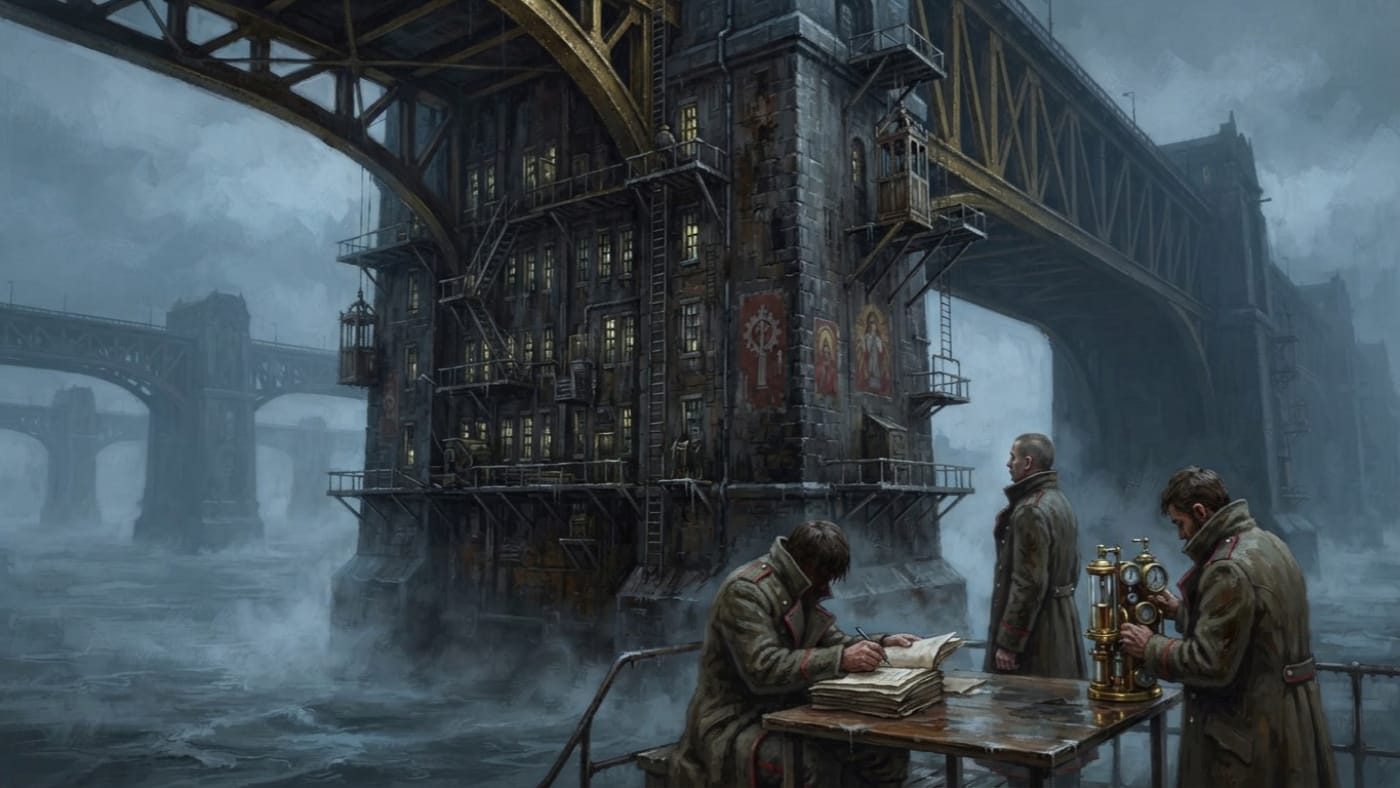
Pylon Nine is one of the fourteen stone-and-iron supports on which Bastion-Brest carries its thirty-two brass ribs across the Bug. It is founded on bedrock like the other thirteen, it stands with the cold brown water against its footings like the other thirteen, and like them it is let out to the living. The Pylon Warrens fill the hollows of the bridge's supports with bunks, ladders and laundry. The people who sleep inside them hear the river through the masonry by night and the brass ticking overhead by day.
Its engineering earns it no entry. The Codex holds no separate survey of its courses or its depth. Nor does it record which bank the count of pylons begins from, and I will not invent a measurement simply because a page has room for one. The coordinates that the registers give for the bridge-fortress, 52.1°N and 23.7°E, belong to Brest as a whole. No surveyor has spent his afternoon locating the ninth leg.
Pylon Nine is entered here because of its tenants. In A.S. 200, three inspectors of the Bureau of Engineering were transferred to Brest from the Thracian Subterranean Survey, and by the present year they occupy quarters in Pylon Nine. That is the pylon's whole distinction, and it is enough. Masonry becomes the archive's business once someone inside it starts writing to the Bureau of Doctrine and the Bureau stops answering.
#On the Quarters
"Which rib keeps you warm?" — Shibboleth of Brest; locals answer with a number
The Warrens are damp, vertical and badly lit, and they smell of wet wool and rust. Brest's bridge-wide population runs to about fourteen thousand in ordinary seasons. That figure belongs to the whole span, and anyone who quotes it as the headcount of Pylon Nine should be sent back to the ledger with a ruler. Bunks in the Warrens are allocated by declared sin. Those who confess pride sleep highest, nearest the Ribwalk, and those who confess sloth sleep lowest, nearest the water. The Bureau calls this sorting. The tenants describe it in shorter words.
I do not know which floor the inspectors sleep on, what sins they declared at intake, or whether the Bureau of Engineering obtained an exemption from the arrangement on their behalf. The file is silent on all three, and I will not make up a bunk number to fill the gap.
What I can say is that a technical man at Brest moves the way everyone at Brest moves. He has a confession receipt stamped against his identity file. He has an absolution token in wax, and he needs a crossing seal for every district he enters. The ladders, catwalks and lift cages that join the Warrens to the galleries above are as public to an engineer as they are to a laundress, and the Confessional Lanes take his sins at the same rate as hers. Survey rank buys no warmer stone. Whatever they write in Pylon Nine is written in damp ink at a table that sweats.
#On the Transfer
"Every transfer is a sentence that has been spared the trouble of a trial." — Drax, memorandum on personnel movements, A.S. 200
The Thracian Subterranean Survey was sent beneath the trenchlines of Thrace, deep in the furnace country that the Codex assigns to Maldrake, to study the slag-rivers that run there. Its finding, in the Bureau of Engineering's own phrase, was routing behaviour: the liquid wrath under the trenches was moving in patterns toward specific targets. The record does not name the targets. The survey was never finished, so the mechanism was never established either. In A.S. 200 the Bureau recalled the survey under operational security before its work was done, and on the same timeline three of its inspectors were transferred to Brest.
The transfer was filed as career development.
Measure that phrase against the ground. In Thrace the earth bleeds slag and the air above the trenches shimmers. Brest sits on the flattest and wettest stretch of the Sagittal Line. The Bug runs north to south, cold enough in the thaw to drown a horse where it stands, and mist rises off it every morning. These three men spent their careers reading heat, and the Bureau has posted them where heat comes rationed by the coal-chit. No record I have seen carries the slag north to the Bug, and I will not draw that channel on a map to make a story neater. The displacement is administrative. Its logic is a matter of paper, and the paper is sealed.
That still leaves the question of why a survey interrupted in the south should end in a bridge pylon in the north. It is a fair question. The Bureau has not answered it, and I have been advised that the Bureau will not.
#On the Forty-Seven Reports
"The river forgets; the ledger doesn't." — Proverb of the Ribs
Between them, the three inspectors have submitted forty-seven reports to the Bureau of Doctrine. That is forty-seven in total, not forty-seven each. The count is collective, and I insist on it, because inflated tallies are how legends get started and the Ledger keeps no room for legends.
All forty-seven have been classified. None has been acknowledged.
Those are two separate acts, and the Bureau has performed only the first. Classification is a sorting. A clerk stamps a folio, assigns it a tier and lays it in a vault, and the stamp shows that the paper arrived and was judged worth hiding. Acknowledgment is a courtesy: two lines and a seal, sent back to the sender to say the matter was received. Forty-seven times the Bureau has found the inspectors' words important enough to lock away. It has not once found the inspectors important enough to answer.
I will not read more into that silence than it holds. Classification does not prove a report went unread, and the absence of a reply does not prove it was destroyed, intercepted or understood. I have not seen the contents of any of the forty-seven, and I have no extract to reproduce or redact. The grievance in this paragraph is about procedure. Their secrets stay theirs.
The setting around the reports is a matter of record. The Confession Echo began on the bridge in A.S. 199, a year before the survey was recalled. Sins spoken into the booths come back as whispers on the deck in the confessor's own cadence. The garrison reported that the Echo intensified in the month the Thracian inspectors arrived, and the parent entry records it. The month itself is not entered here. A shared calendar is an association, and it does not establish cause.
Under Presiding Judge Elsbeth Krail, the Bridge Tribunal blames the Echo on the Blank-Sheet Circle and the nameless crossings it sells. I hold a separate suspicion: that the pressure of Velkara on Brest's crossings and the confession machinery are entangled. The Bureau classified my filing Outside Current Doctrinal Scope. Neither theory is proven, and nobody has told me that either has been put to the three men in Pylon Nine.
The Codex entry on Bastion-Brest states that "Brest faces Velkara."
This erratum corrects that parent entry. It does not correct any earlier edition of the present one, because there is none. The locations registry, locked in A.S. 201, assigns the Bug River sector to the Nameless Tide, an unnamed accumulating force held under Absolute Suppression and distinct from the Grey at Königsberg. Velkaran infiltration through forged writs, bought absolution and compromised loyalties remains a real and separate danger at Brest, classified under the crossing-heresy complex. Brest faces the Tide and is infiltrated by Velkara. These are two distinct threats, and the inspectors of Pylon Nine are not on record as having ruled on how they relate.
#On the Present Condition
"A file that is never answered is never closed. The Bureau finds this restful." — Drax, marginalia, A.S. 201
This entry records what was known in A.S. 201, as set down in the Codex's assessment of Brest's present condition. It certifies no fresh inspection, and nothing in it depends on my having stood inside those quarters.
The three inspectors from the Thracian Subterranean Survey are lodged in Pylon Nine. Their forty-seven reports sit classified in the vaults of the Bureau of Doctrine, and none has had a reply. The Echo persists across the bridge. The booths still open at the dawn bell, the tokens are still pressed in wax, and the Bug runs on beneath the ribs as it has since before the Line was drawn. The Church holds the crossing. No one has explained why the Bureau's men from the furnace country were posted to the cold.
The slag-rivers' targets remain unnamed. The survey's mechanism remains unfinished. The contents of the reports remain closed to every reader without the seal. The pylon carries its share of the bridge. Whether the Creator has an opinion on Bureau correspondence, the Bureau has not told me either.
Disposition: entered and indexed to A.S. 201 and filed beside the Bastion-Brest dossier. Inquiry open. Correspondence unanswered. Occupancy continuing.