

#On the Office Appointed
Concerning a body of clergy known to the Ledger by one duty, performed once a year, at one parapet.
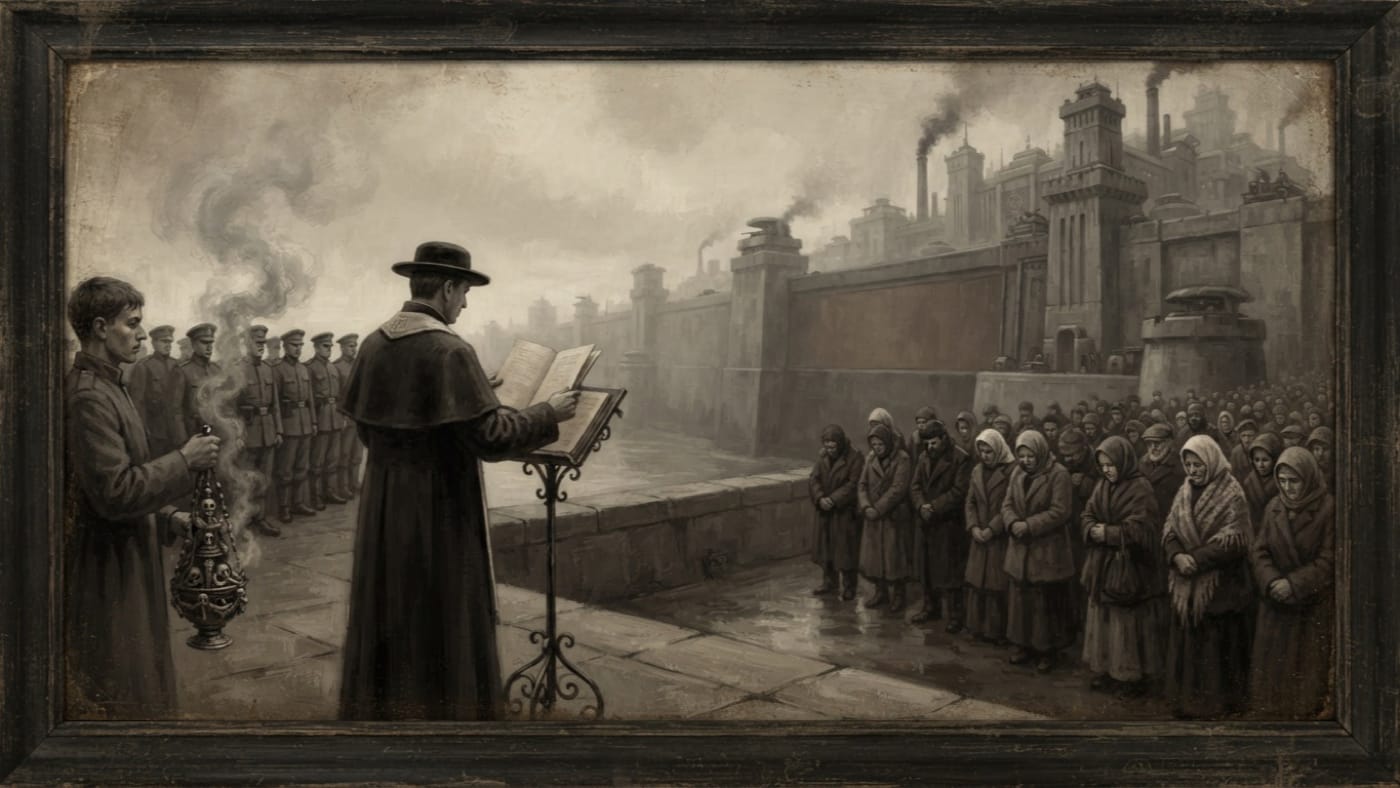
The Ravelin Chaplaincy of Bastion-Constantinople conducts the formal liturgy of the Vigil of the Hollowed. That is the full extent of what the Ledger will certify about it, and I have searched the Ledger. Its charter, its roll, its seal and its founding year have never crossed my desk. What crosses my desk, every 23rd of Argent, is a procession, a censer, a hymn and three pages. From these the Codex must assemble an institution, as a reliquarist assembles a saint from whatever the ossuary agrees to release.
The reader should keep one distinction in mind. The Chaplaincy conducts the remembrance. The history recited at that remembrance is written elsewhere, by the Bureau of Doctrine, which drafts it, approves it and delivers it at the length Doctrine considers sufficient. The Chaplaincy receives the pages and carries them to the wall. Between the grief of the faithful and the account they are allowed to hear stands a single cleric holding those pages. That cleric is the Ravelin Chaplain.
No document available to me names the Chaplain, and I will leave it that way. At Constantinople a name is the first thing sealed and the last thing returned.
#On the Procession to Sorrow
Concerning the route, the vessel and the distance. The distance is kept most carefully of the three.
The procession sets out from the Cathedral of the Perpetual Registry, the old Hagia Sophia and ratification house of the southern anchor, whose great doors serve as the processional mouth for the Vigil. It ends at the Ravelin of Sorrow, the Fifth Outer Ravelin. I will not list the streets in between. Nobody has given me the route, and I refuse to draw a parade map for the Bureau of Pilgrimage to print on a tea towel.
The procession carries the Bone-Censer of Saint Thaddeus. It is one of seventeen. The Bureau of Relics has authenticated all seventeen, and every one is genuine in the full sense Relics gives that word, meaning the sense that survives an audit. The censer belongs to the commemoration. No censer is recorded at the breach in A.S. 170. On the morning the wall came down, the Sixth Ravelin was supplied with rifles, rubble and cement.
At Sorrow the procession stops, because at Sorrow everyone stops. Beyond it lies the Sixth Ravelin, the Ravelin of Correction, and in the southern curtain of the Sixth lies Chamber 7. The Sixth is closed to civilian traffic. Pilgrims may stand on the parapet of the Fifth and look across the intervening works toward the southern curtain. On a clear day the sealed section is visible as a stretch of wall slightly darker than the masonry on either side and slightly smoother. Engineering credits the sheen to relic powder. The Bureau of Rites credits it to grace.
That is what the parapet means. A pilgrim may look at the wall. Between the pilgrim and the wall are a ditch, a ravelin, a garrison and a ruling, and none of the four can be crossed with a candle.
Older material from which this Codex was compiled described the fortress under the name Bastion-Lorraine and gave it the designation of western anchor.
Withdrawn. The fortress is Bastion-Constantinople, the southern anchor of the Line. The superseded name now redirects to the correct one, as superseded names do, and as the pilgrims who arrive with old guidebooks are redirected too.
#On the Antiphon
Concerning thirty-two verses sung entire, and the silence of those who do not know them by heart.
The garrison choir sings the Antiphon of Endurance in full: thirty-two verses, prescribed for siege conditions in the Hymnal for Desperate Hours. Pilgrims who know the words join in. Those who do not stand silent. The rite makes no distinction between the two, and I take that to be the only mercy written into it.
The choir belongs to the garrison. The Chaplaincy conducts the rite in which the choir sings. I will not draw a chain of command between them from the order in which they appear on a parapet, because the Codex has suffered enough organisational charts drawn from processions.
It is the hymn of the sealing. On the 23rd of Argent, A.S. 170, the forty-seven sang the Antiphon in the pour-frame while the consecrated cement rose around them, and they kept singing as it rose. By the thirtieth verse, the witnesses agree, only one voice remained. It was a woman's, and she completed the final verses alone. The depositions do not agree on who she was. She may have been the widow the Ledger enters only as K., or one of the confessors. The Bureau of Records settled the disagreement by sealing both files.
Every year the garrison choir now sings, at full strength, verses that one woman once finished by herself. I attach no doctrine to that. I record that the choir does not shorten them.
#On the Account Read Aloud
Concerning three pages, and what three pages will hold.
When the Antiphon ends, the Ravelin Chaplain reads aloud the Bureau of Doctrine's official account of the sealing. The account runs to three pages. The Chaplain reads it. That act is the Chaplaincy's whole documented share in the history: the Chaplaincy gives the history a voice and has no hand in composing it.
The Vigil record preserves the account's central passage, and I give it in the words in which it is read:
"Forty-seven servants of the Synod, moved by the Spirit of Obedience, offered their persons for the preservation of the Wall. Their sacrifice was accepted. Their names are with God. The Wall endures."
The account omits three things. It gives none of the forty-seven names. It does not describe the cement rising. It makes no mention of the woman who sang the last verses alone. In their place is an offering, accepted, for the preservation of the Wall. Doctrine calls the act voluntary and miraculous, and the Codex records that Doctrine calls it so.
The parent entry carries the fuller history and I will not copy it out here. A Night Paper reached the fortress on the evening of the 22nd of Argent and condemned the 14th Parish Regiment. The regiment's colonel then burned its three hundred and twelve men. The Sixth Ravelin's artillery was left without crews when Maldrake's host struck on the 23rd, and one hundred and forty metres of the southern curtain fell. The garrison held the gap for nine hours. Then the Bureau of Engineering arrived with the pour-frame and the cement. Forty-seven people entered the frame, soldiers, civilians, confessors, ammunition-handlers and two clerks of Records among them, and were sealed in it singing.
Records has sealed their names. The Chaplain reads a number, the number is accurate, and the pilgrims hear it. Some of the pilgrims on that parapet could recite a name aloud if the account paused to ask them. It does not pause.
#On the Present Observance
Concerning the parapet as it stands each 23rd of Argent, and the windows behind it.
The Vigil is Pilgrimage Day Three at Bastion-Constantinople, and it closes a cycle that opens with the Ratification on the 14th of Ferrum and continues with the Burning of the North Gate on the 9th of Corvus. On the third day the parapet of Sorrow fills. The censer arrives, the choir sings, the Chaplain reads, and the pilgrims weep.
Their weeping is sincere. I watched them from the parapet at the Vigil of A.S. 199 and set down what I saw, and nothing I saw was theatre. These are mourners, and the Codex does not mock mourners. Its quarrel is with the paperwork.
The paperwork works like this. The Bureau of Tithes collects the pilgrimage fees. The Bureau of Pilgrimage issues the souvenir stamps. No record I hold gives the Chaplaincy either function. A pilgrim who presses coin on the censer-bearer has mistaken the vessel for the window, and Tithes will collect the fee all the same.
The wall itself has a permitted vocabulary of seven words: wall, cement, structure, strong, faith, sealed, appropriate. In the parent entry I published one word that is not on the list. The wall is warm. Engineering files this as residual exothermic curing, which it has done every year since its report of A.S. 171. I offer no conclusion about what the warmth signifies, and Doctrine has stamped my lack of a conclusion as appropriate, which is one of the seven.
Questions about what was dispatched on the evening of the 22nd of Argent, and by whom, remain lodged against the parent entry, where Doctrine has marked them RECEIVED. They are not part of the Chaplaincy's rite and the Chaplain does not read them.