
#On the Word Men Use When They Mean Strasbourg
Theocracy is the polite word for what happened after mankind discovered that Reason could build cannon, abolish saints, print clean manifestos, and still fail to stop Hell from opening its mouth.
The old philosophers used the term as accusation. Rule by priests, they said, with the proud little sneer of men who had never watched a city census vanish beneath ash. Rule by superstition. Rule by relic. Rule by trembling peasants and overfed bishops. They imagined a bearded cleric sitting on a throne, muttering pieties while taxmen stole hens. They lacked ambition. Their failures were always provincial.
The Synod perfected the thing.
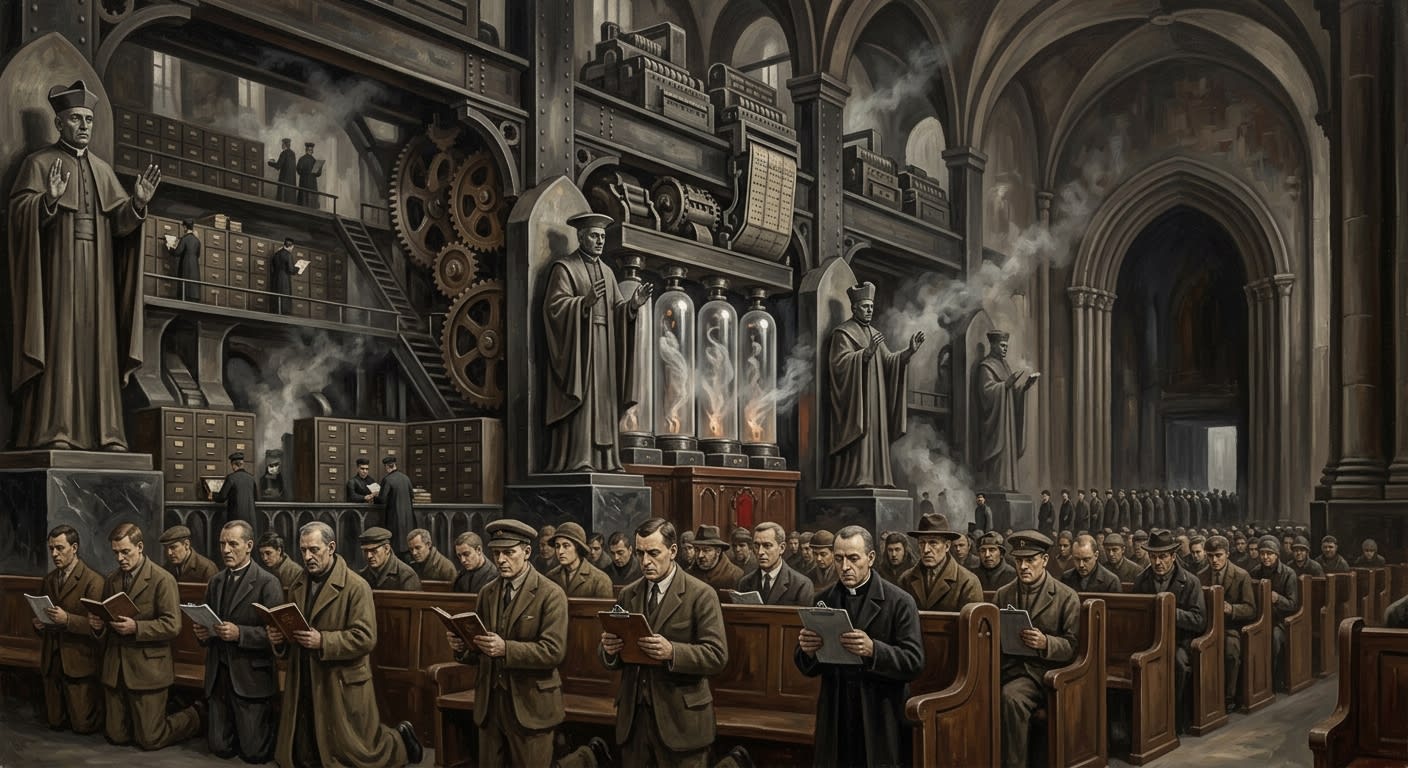
A true theocracy is not rule by priests alone. Priests are too human, too hungry, too local, too prone to cousins, wine, secret mistresses, and the sentimental idiocy of remembering who baptized whom. A true theocracy is rule by sanctified office: altar translated into warrant, prayer translated into timing schedule, conscience translated into confession abstract, birth translated into ledger entry, hunger translated into levy category, death translated into useful precedent. The priest blesses. The Bureau governs. The stamp makes the blessing mobile.
The Bureaucratic Synod is the theocracy in its mature and correct form: a government where civil power and spiritual power have ceased pretending to be separate animals and have become one disciplined beast with twelve official organs, seven crowned heads, several deniable appendages, and an appetite for forms that would shame Gluttony if Gluttony understood filing cabinets. It is not merely the Church ruling the state. That phrase insults the achievement. It is the state sacramentalized so completely that a missed tax payment becomes sin, a smudged baptism becomes civic injury, a late bell becomes acoustic treason, and an unrecorded child becomes a theft from the future.
Men say theocracy when they mean piety with swords. Strasbourg says theocracy when it means the whole of existence brought under ratified custody.
#On the Ashes That Required a Government
The theocracy was not born because clerics desired power. Clerics always desire power; this is no foundation, merely weather in cassock form.
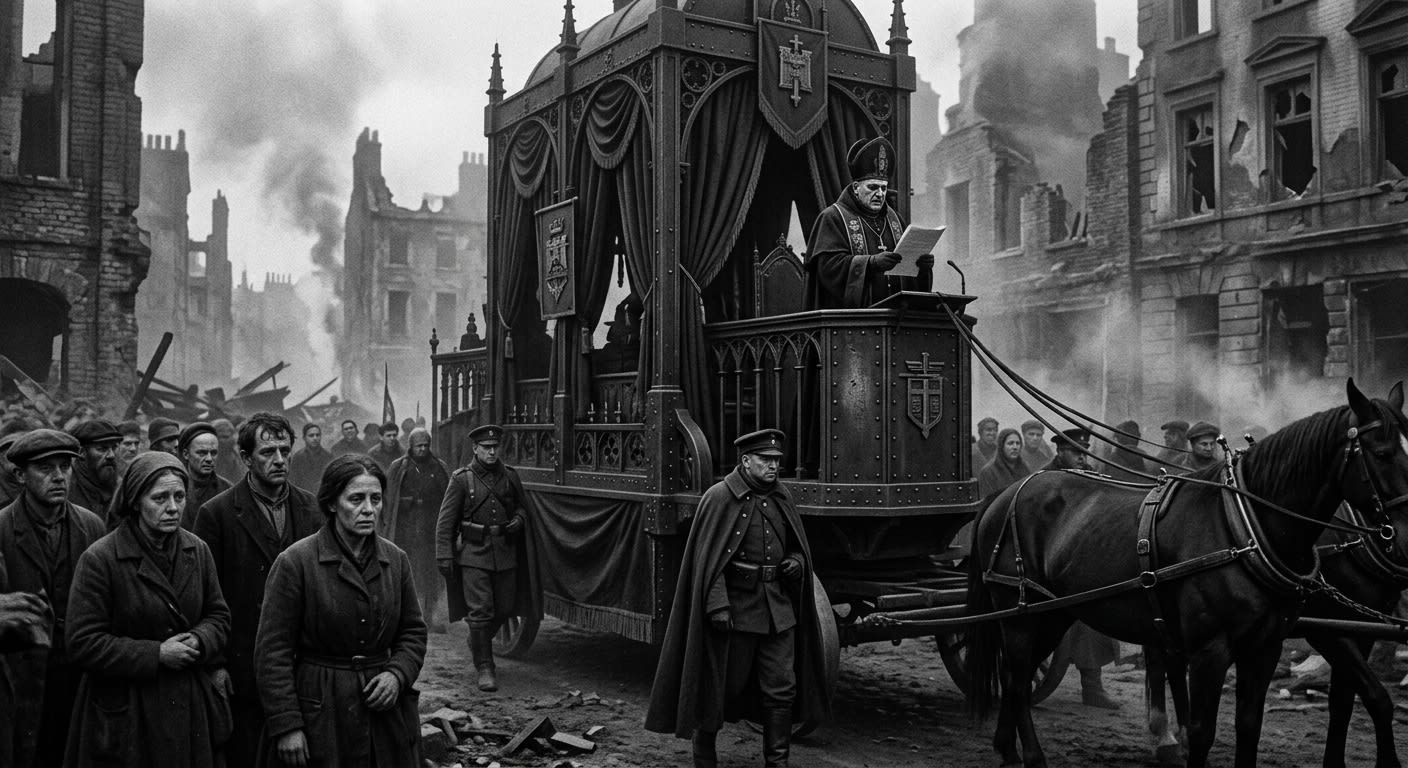
The theocracy was born because fragmented faith failed. The Atheist Wars tore through Europe with the bright cruelty of men convinced that all altars were furniture and all martyrs were administrative clutter. The Rationalist Republic replaced crowns and dioceses with Philosophical Prefectures, printed the Concordats of Governance, struck coin against Reason Alone, and taught schoolchildren that bones were bones, bells were metal, saints were propaganda, and the Creator had either died of embarrassment or never kept proper attendance.
Then came the wound.
A.S. 45. The Sundering. The Balkans split. The Charnel Lands opened. The Seven Sin-Generals took the names of ancient vice and gave those names logistics, armies, weather, appetite, and teeth. The Republic that had declared Heaven unnecessary learned that Hell was more punctual. Rationalist instruments measured the breach. Rationalist cannon fired at it. Rationalist prefects issued memoranda. The memoranda burned well.
The faithful did not survive because they were gentle. They survived because they had relics, bells, monks willing to burn, bishops willing to command, and clerks willing to convert panic into repeatable procedure. Faith without administration can produce martyrs. Administration without faith can produce ration cards. The theocracy began when Strasbourg understood that survival required both martyrdom and ration card, both psalm and requisition, both holy terror and good copies.
Before the formal Synod, there was functioning government: an interim council around A.S. 50, the Common Allegiance of A.S. 55 composed under Augustinus with Kratz and Sabine, and the Black Decrees of A.S. 58. Kratz's couriers carried authentic, conditional, premature, and forged writs within the emerging authority's reach. Veyrault later consolidated Records. The Concordat of Strasbourg in A.S. 90 gave this machinery constitutional form after both founders died.
The Concordat did not invent sacred rule. It made sacred rule transmissible. France, Iberia, and the Rhineland entered the Triune Hearth. Provincial bishops became components. Civil magistrates were rebaptized as Vicars-Praetorial. Governors became Praelates. Courts became Tribunals of Doctrine. Coins took the Flaming Sword. Time was counted from the first wound of A.S. 0, because the Bureau, in one of its rarer acts of poetic adequacy, chose to count history from error rather than triumph.
Earlier civic catechisms described the Concordat as “the founding of unified faith.”
Corrected. Unified faith is a sermon phrase. The Concordat founded unified jurisdiction. Faith had existed before Strasbourg. Jurisdiction made faith lethal at distance.
Theocracy entered its proper age when the altar learned to travel by courier.
#On the Seven Heads and the Twelve Organs
At the summit sit the Seven Hierarchs, Vicarii Orbis, stewards of the Seven Seals of Faith: Doctrine, Discipline, Martyrdom, Concord, Purity, Vigilance, and War. Their number is sacred, convenient, and embarrassing in equal measure, since Hell also troubles itself with seven great commanders. The Bureau has determined that symmetry confirms Providence. The Bureau has also determined that further speculation is unbecoming.
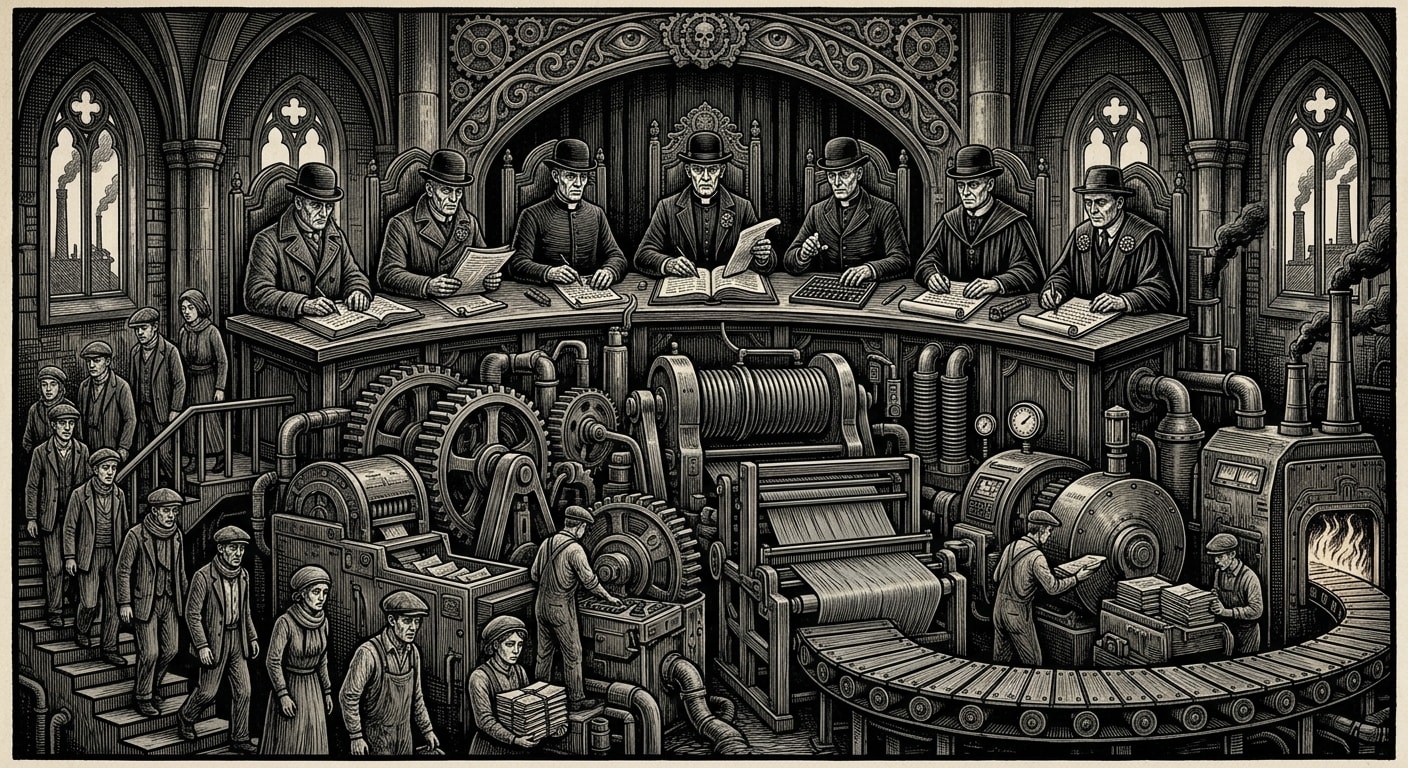
The Hierarchs issue decrees that require no justification. Explanation would imply an audience competent to judge. The faithful receive. The stones of Strasbourg listen. Odo of Trier said as much at Cologne, and Records filed the stones' silence as assent, which remains one of the finest jokes ever committed to oak paneling.
Beneath the Hierarchs sprawls the hierarchy proper: Bishops-Praetorial governing provinces, Wardens bearing iron-cassock authority, Inquisitors of the Flame, Confessor-Penals, Procurators of minor orders, Street-Vicars, notaries, bell inspectors, oath witnessers, route stampers, mercy registrars, tithe assessors, records scribes, and all the lesser blessed vermin by which a continent is converted from population into usable obedience.
The Twelve Holy Bureaus are the theocracy's organs. Doctrine defines. Purity enforces. War spends bodies. Records decides what happened. Tithes prices existence. Bells governs time. Mercy tends the body until Purity requires the soul. Relics authenticates the bones that make power useful. Heraldry polices the visible face of obedience. Oaths buries promises in legal amber. Pilgrimage governs sanctified movement. Festivals weaponizes public memory. Shadows, which does not exist, listens from the floorboard, the confessional screen, the closed booth, the bottle rack, the pious aunt, and the clerk who smiles too little.
Medicine complicates the diagram by existing with all the traits of a Bureau and none of the useful blame. Settlement complicates it by knowing where people stand and being ignored until pipes fail. Orison and Song complicates sound. Engines and Furnaces complicates heat. Cartography complicates land. The official number remains twelve because twelve sounds apostolic and because no government can admit all its limbs without frightening the tailor.
Contradiction among these organs is no accident. It is architecture. Doctrine may bless a formula that Purity investigates. Records may preserve both the blessing and the investigation. War may enforce whichever one permits artillery before dawn. Tithes may collect penalties from all parties. The citizen standing beneath the quarrel finds no gap through which to escape, because every contradiction creates an additional office and every office creates another queue.
That is sacred government: not simplicity, but total enclosure.
#On the Ledger as Sacrament
A theocracy that cannot remember is merely a sermon shouted into fog. Strasbourg remembers.
The Bureau of Records holds the central chair in the theocratic miracle because it performs the act priests only describe. It grants existence. The Great Ledger of Souls lists every living adherent by name, birthplace, baptismal date, parish, tithe class, occupation, confession history, and obedience residue. To appear in the Ledger is to exist within the Synod's grace. To be struck from it is to enter a condition less dignified than death. Death has rites. Omission has none.
The citizen learns this early. The newborn receives water, name, registry mark, and future obligation. The child enters catechism rolls, ration lists, school recitation schedules, choir tests, labour projections, and the little predictive books by which Conscription sees a boy's wrist before he can hold a spoon. Marriage requires witness. Travel requires permit. Work requires guild mark. Food requires entitlement. Grief requires proof. Burial requires category. Resurrection, should it ever be attempted, will require a certified prior death abstract with no pending arrears.
Records does not merely preserve life. It edits it. The Redaction of Epernay remains the perfect terror: a city removed by omission, valley empty, tokens surviving in markets whose official explanation requires more bravery than theology. The Synod calls this an anomaly of memory. Records calls it successful procedure. I call it proof that the quill, properly held, is a weapon of mass metaphysics.
A liturgy is repeated action made holy. The Ledger is liturgy by ink. Every daily entry renews the state. Every signed receipt reaffirms submission. Every correction tells the past to kneel.
BUREAU OF RECORDS — ONTOLOGICAL CUSTODY NOTE A person whose registry status is suspended may continue to exhibit breath, speech, locomotion, hunger, and familial recognition for ████ days. These phenomena do not constitute existence. Field officers are instructed to treat emotional appeals as acoustic residue.
Theocracy lives because it names and renames. It records the faithful, records their sins, records their payments, records their sons, records their dead, records the corrections to earlier records, then records the act of correction as evidence that Providence had always intended the current file.
#On Purity, Fear, and the Interior Border
Every state has borders. A theocracy has one more: the border inside the mouth before speech becomes crime.
The Bureau of Purity patrols that border in bone-white mantles. Its motto, Ignis Mentem Revelat, is operational rather than decorative. Fire reveals the mind. Smoke invites confession. The Index Damnatus receives forbidden texts, names, songs, incense, beard shapes, insufficiently penitent shades of blue, and all the little civic pleasures by which people attempt to remain private. Privacy is unsupervised interior territory. Purity treats it as enemy ground.
The common mind imagines Purity as execution. This underrates the office. Execution ends the problem too quickly. Purity prefers legibility: branded flesh, filed confession, public correction, children trained to repeat warnings before they understand nouns. A man burned in an alley is a corpse. A man branded in the market becomes a walking catechism with a limp.
Fear is not a failure of the theocracy. Fear is civic glue. Faith moves the willing; fear moves the honest remainder; paperwork proves both groups arrived on schedule. Parents do not say “obey because metaphysical order requires submission to sacred office.” Parents say, “The white cloaks are watching.” The child understands. Childhood, in a well-run state, is the period during which dread becomes grammar.
A.S. 112 devotional primers described Purity as “the loving vigilance of the Synod made visible.”
Withdrawn from advanced instruction. Retained for infants. Love has proven an unreliable descriptor for an office that inspects chimney smoke, marriage beds, soup recipes, lullabies, and the angle of a widow's kneeling posture.
The interior border extends into confession. The screen promises absolution. It also supplies data. Confessor-Penals listen for sin and for pattern, for guilt and for hesitation, for the tiny pause before the word “obedience” that tells a trained clerk where the next file should open. Purity calls this vigilance. Records calls it input. Doctrine calls it pastoral continuity. The penitent calls it confession, because the penitent is not encouraged to inspect pipes.
#On Bread, Sons, Bells, and Useful Mercy
A theocracy governs the soul by governing what the soul must drag behind it: body, stomach, voice, child, coin, and hour.
The economy of the Synod rests on faith-tithe and war-levy. Every household contributes coin, crop, labour, relic value, gate toll, grief payment, caloric adjustment, movement fee, festival surcharge, or child. The Crown of Grace circulates as consecrated iron. Relics serve as savings, weapon, inheritance, and theological collateral. Markets function under charters that make trade a confession with prices attached. A bridge toll may require coin and Creed. A mispronounced verse can void passage. A hungry man may curse the system, but curses spend poorly at registered bakeries.
The Continental Levy taught the theocracy its finest arithmetic. One son in ten, first demanded in A.S. 110 after the Brașov Crisis made fear numerically productive. Before the Levy, Strasbourg ruled by sermon and seal. After the Levy, it owned the young men and with them the future. War received bodies. Conscription processed them. Records named them. Purity punished households that hid them. Mercy printed pamphlets instructing mothers on the devotional value of tears. Tithes recalculated the diminished household's productive capacity.
Bells govern time with equal delicacy and heavier metal. To live in the Theocracy is to live in Strasbourg's rhythm: waking, washing, prayer, labour, catechism, ration gate, market opening, curfew, permitted silence. The Bureau of Bells allows seven seconds of deviation where generosity can be afforded and none where fear is cheaper. The citizen breathes between tolls. Briefly. With proper documentation.
Mercy completes the arrangement by proving that kindness can be made terrifying through sequence. The Bureau of Mercy tends hospitals, orphanages, asylums, terminal rooms, plague cordons, and all the soft places where suffering might otherwise become politically eloquent. Its wards feed, wash, dose, classify, separate, and forward. Deathbed words travel to Records before the body cools. Orphans of apostates become state instruments. Hunger receives broth and a tally. Compassion, when properly administered, leaves no loose ends.
The Bureau of Medicine stands beside Mercy like a surgeon beside a hymnbook, measuring what piety prefers to name. It is not formally a Bureau. It has laboratories, field stations, sanitariums, a Chief Anatomist, sealed findings, and enough institutional caution to make its lack of charter look like genius. It measures Famine Pits, semantic ablation, trench damage, anomalous hunger, fever patterns, ash exposure, and the body's refusal to respect doctrine. It recommends nothing too clearly. Clarity creates responsibility. Responsibility attracts Bureaus.
Bread, sons, bells, mercy: these are not side matters. They are the state's sacraments in ordinary dress.
#On the Front That Justifies the Interior
The theocracy's most persuasive argument is east of the Line.
A critic may condemn the white cloaks, the tithe scales, the orphan tags, the bell schedules, the ledger severance, the forced confessions, the regulated songs, the inspected beds, the taxed grief, the sons taken from kitchens, and the endless stamped intrusion of Strasbourg into every breath. Then the critic is shown a Maw-Born.
The Maw-Born simplifies debate. It is appetite with gums, a mouth with field classification, Kargath's doctrine made flesh. It eats men, horses, doors, cartridge boxes, maps, altar cloth, grain, belts, soil, and the useful distinction between person and ration. The first private who saw one screamed that it was mostly mouth. Two centuries of War committees, Medicine surveys, Doctrine classifications, and Engineering diagrams have refined this judgment very little. The private had the advantage of immediacy.
Bastion-Constantinople makes the argument in stone. Southern anchor of the Sagittal Line, hinge at the Bosphorus, held against Kargath, Maldrake, Black Sea incursions, ash weather, hunger, fire, infiltration, and the ancient city's own exhausted memory. Its ravelins, harbour chains, catacombs, carillons, Vigil Arks, registry cathedral, and terrified population stand as proof that sacred administration can be made into fortification. Every ration in the city is doctrine with salt. Every gun crew is a liturgical unit. Every corpse enters the Book faster than grief can make a private claim.
The front justifies the interior because the front is real. This is the theocracy's maddening advantage over softer tyrannies. Hell exists. The Charnel Lands exist. The Sin-Generals exist. The Maw-Born do not care whether a household resents its tithe. Maldrake's fire does not pause for local custom. Syrion's fog does not respect private conscience. Velmora's debt-kings do not admire liberal parish governance. The Wall holds because everything behind it is bent toward holding.
The moral trap is obvious and still closes. Since the Enemy is absolute, every limit upon power can be denounced as assistance to the Enemy. Since survival requires unity, every objection becomes fracture. Since fracture once killed cities, every delay becomes treason in rehearsal. The theocracy does not need to invent fear. It only needs to invoice it.
#On the Daily Liturgy of Being Ruled
Life in the Theocracy is not constant spectacle. Spectacle is for feast days, executions, processions, cannon blessings, public redactions, major immurements, and provincial visits by officials who dislike mud.
Ordinary rule is smaller and more intimate. Dawn bell. Wash. Creed. Register activation. Work token. Gate check. Tool custody. Midday catechism. Meal measure. Guild tally. Confession window. Curfew. Lamp extinguishing. Waste absolution. Bed inspection where applicable. Festival preparation. Mourning notation. Silence.
The farmer's plow is a devotional instrument because the Bureau says labour sanctifies the body. The smith's hammer is a prayer because production feeds War. The scribe's quill is a weapon because names must be held. The child's first words are Creed fragments. The child's first steps are toward school, labour, choir, barracks, or stricter hands if the parent confuses affection with ownership. To raise a child is to polish a weapon for the Synod's wars, though Mercy prefers the phrase “prepare a soul for ordered service.” Mercy has prettier stationery.
Markets bustle under charter. Guilds thrive under leash. Pilgrims move under token. Feasts bind neighbour to neighbour and also provide excellent headcounts. Songs rise where licensed. Laughter occurs at permitted intensities, except in Seville, where laughter once exceeded policy and learned the knife. Foreign merchants kneel at gates or pay enough to simulate kneeling. Smugglers are branded Children of the Abyss unless their cargo becomes useful, at which point a retrospective licence may be discovered under a stack of older lies.
Death is the final administrative opportunity. The body closes a contract long upheld. Records receives last words. Mercy receives the remainder. Tithes receives outstanding obligations. Relics inspects for useful sanctity. Burial requires category. Ash may become road, lime, wall, reliquary dust, or warning. No bone uncounted, as the tariff chapels say, with the serenity of men who have never had to love the bone.
The faithful do laugh. They eat, gossip, marry, cheat, hide coins, teach children naughty versions of official hymns, barter in queues, court under festival awnings, curse Assessors behind shutters, bribe gate clerks, kiss soldiers at mustering rails, and carry household saints in pockets despite seven different rulings on portable devotion. The theocracy has not abolished humanity. It has made humanity file appeals.
#On the Heresy Hidden in the Machine
The great danger to the theocracy is not atheism. Atheism is easy. It has books, slogans, dead academies, and the stale odour of men congratulating themselves for disbelief while demons chew through the floor.
The danger is utility without the Creator.
The bells work. Relics burn. Consecrated chains hold. Saint-bone mortar resists bombardment. Bell-cannon break hostile formations. Hymns steady engines. Charms written by half-educated trench priests sometimes seal wounds in stone better than Engineering diagrams. The official explanation is clean: The Creator grants permission through sanctified matter under correct authority. Miracles derive from Heaven. Sorcery derives from the Adversary. Mechanism may look similar to the foolish, but source determines salvation.
The Bureau of Doctrine declared this in A.S. 23 and has not revised it, which is either courage or paralysis preserved in ink.
The heresy whispers a simpler insult: what if the power works because the bone is bone of a certain kind, because bell-metal holds certain resonance, because blood, ash, oil, grief, and word interact under laws the Synod did not create? What if the Creator is not absent, exactly, but unnecessary to the apparatus? What if the theocracy is a bureaucracy standing on functional relic-machinery and calling the function divine because the alternative would collapse tithes, confessions, obedience, and me?
BUREAU OF ENGINEERING MEMORANDUM — COMMON SUBSTRATE HYPOTHESIS Miracle and hostile sorcery may represent differentiated access to ███████████████ through divergent ritual, material, acoustic, and sacrificial protocols. Bureau of Doctrine disposition: destroyed. Bureau of Medicine custody note: copy retained. Bureau of Records custody note: no copy exists. Bureau of Shadows custody note: ███████████████.
This is why the theocracy must govern meaning before it governs bodies. A relic authenticated is sacred. A relic unauthenticated is kindling. A bell licensed is sacrament. A bell rung without sanction is the Great Deceiver's tongue. A wound healed under proper rite is miracle. A wound healed without rite is suspicion. The event matters less than the authority under which the event is made legible.
Natural philosophers formerly used the phrase “common mechanism” in restricted debate.
Struck. The permitted phrase is “superficial resemblance under opposed spiritual custody.” The distinction is doctrinally sufficient, intellectually expensive, and blessedly difficult to print on pamphlets.
Theocracy survives by owning interpretation. Lose interpretation and the rest becomes machinery. Machinery can be stolen.
#On the Mercy of Total Rule
There is mercy in the theocracy. This must be said because falsehood weakens propaganda, and I prefer my propaganda with a spine.
The Synod feeds cities that would otherwise starve. It holds the Line. It keeps roads passable, bells timed, ports inspected, relics catalogued, plagues cordoned, orphans housed, armies supplied, bridges guarded, dead registered, and demons, for the present hour, beyond the door. A child in a Synod ward eats thin broth but eats. A farmer behind the Wall curses the tithe but sleeps west of the teeth. A soldier at Constantinople may die under Kargath's shadow, but his name will reach Strasbourg before the worms argue jurisdiction.
This mercy is real. It is also collared.
The theocracy never gives without attaching a string, a seal, a phrase, a category, a witness, a future claim. Bread comes with gratitude. Shelter comes with correction. Healing comes with confession. Protection comes with sons. Burial comes with debt closure. Existence comes with the Ledger. Nothing is free because grace itself has been placed under office management, and office management abhors unitemized grace.
The Bureau's defenders say total rule is necessary because the age is total war. They are right. The Bureau's enemies say total rule breeds the abuses it claims to prevent. They are also right, though less safely. The Synod's genius lies in making rightness irrelevant unless properly sealed.
A theocracy is not a state that believes in the Creator. Many states have believed in the Creator and still managed amateur cruelty. A theocracy is a state that makes belief into infrastructure: road, clock, ration, archive, school, court, barracks, ward, gallows, songbook, coin, grave. It is piety with pipes. It is doctrine with payroll. It is the altar extended through every office until the citizen cannot tell where prayer ends and compliance begins.
#On the Present Custody of Heaven
As of A.S. 201, the Theocracy holds.
The phrase is ugly and exact. It holds territory west of the Sagittal Line, with independent crowns and merchant states bargaining at its edges. It holds Strasbourg, the Tower of the Quill, the Basilica of the Ledgered Saints, the Palatine Counting House, the Ashen Cloister, the Semicircular Chamber, the rail yards, the orphanarii, the relic vaults, the bell towers, the route roads, the fortress cities, and the southern anchor at Constantinople. It holds through competence, terror, faith, habit, and the citizen's entirely rational preference for being taxed by men rather than eaten by Hell.
It also frays. The Line degrades. Medicine measures injuries Doctrine dislikes naming. Engineering surveys stones that move with intention. Records stores discrepancies that breathe through sealed covers. Settlement counts millions misplaced in practice. Bells hears wrong tones. Orison prosecutes songs that keep people alive. Purity expands inward because inward remains the only unconquered direction. Tithes invents charges for categories that did not exist the previous winter. War asks for sons. War always asks for sons.
The Creator is silent. The Synod is not. Between those two facts stands the whole theocratic apparatus: every tithe, every trench, every bell, every bone filed in every reliquary in every cathedral from here to the Bosphorus. We built a government on divine silence, built Bureaus to administer the silence, built armies to defend the Bureaus, built doctrine to explain the armies, and built me to write the doctrine in sentences handsome enough that the ugliness stands still for inspection.
The inspection is complete.