

#On the Saying and Its Speakers
"No crossing without naming." — local motto of Bastion-Brest
My entry on Bastion-Brest carries a recurring attribution beneath several of its epigraphs: Proverb of the Ribs. Since that entry circulated, three separate clerks of the Bureau of Records have written to ask where the Proverb is kept, under what register number, and by whose hand it was composed. The Proverb is kept in the mouths of fourteen thousand damp people. It has no register number, and nobody composed it. The singular was a courtesy to the typesetter.
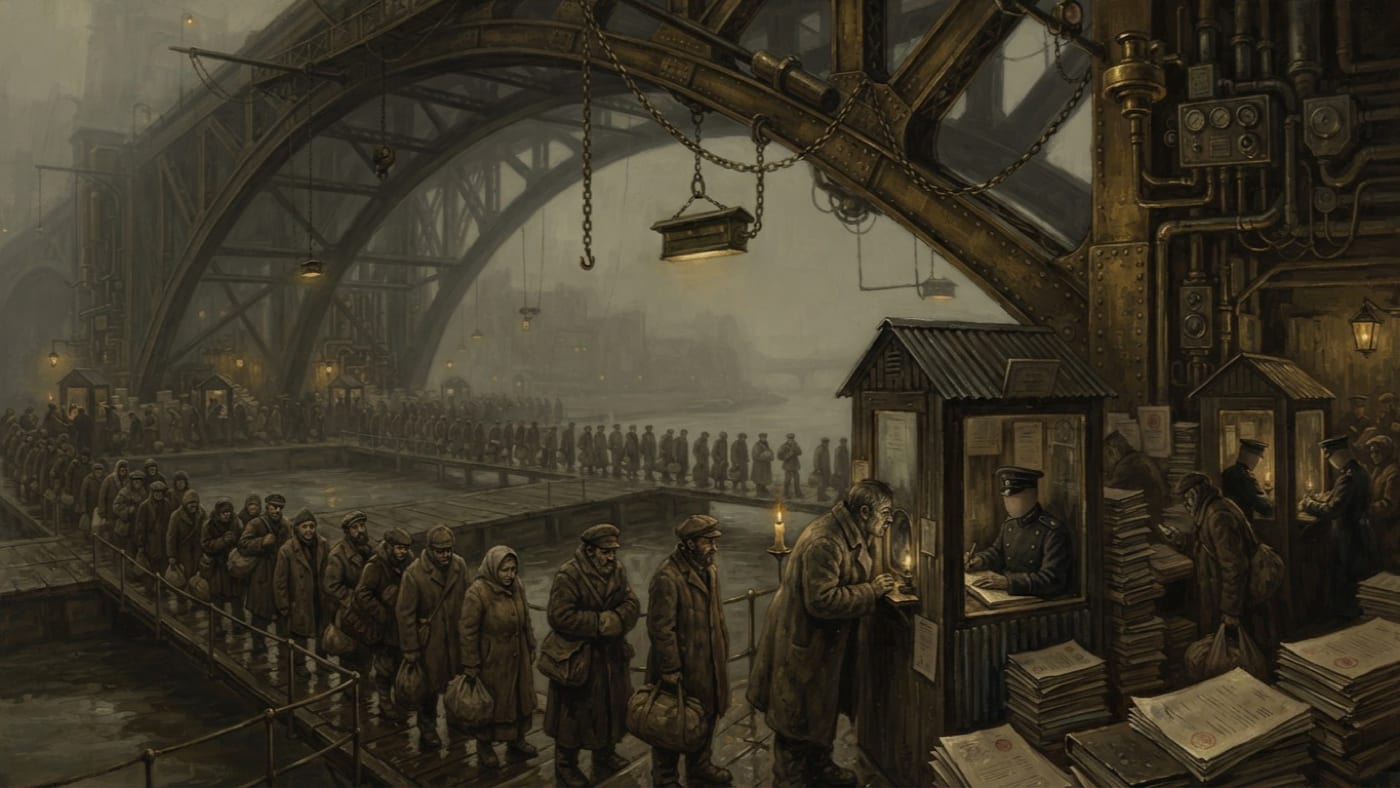
The Ribs are the brass-trussed bridge-fortress over the Bug, the second great bastion counted from the north along the Sagittal Line, below Königsberg and above Przemyśl. Nobody crosses there without confessing, nobody confesses without a scribe writing it down, and the writing decides who eats, who sleeps dry, and who walks to the far bank. In such a place speech is an instrument with a stamp on the end of it, and the residents have shaped their sayings to match.
Sorting them takes care. No crossing without naming is the local motto. Confession keeps the river clean is propaganda, painted and preached. They don't cleanse souls — they sort bodies is its answer, and nobody paints that anywhere. Below these come six short proverbs in common use, one warning about names, and two shibboleths. A clerk who files them together deserves the transfer that follows.
#On Sin and Passage
"No sin, no step." — current at Brest
These four words are the entire crossing regime, worn down to the size of a coin. No statute contains them. They are what the statutes feel like at the ankle.
At Brest every crossing requires a confession receipt stamped against the crosser's identity file. The absolution token, a wax-sealed disc issued when the booth is satisfied, permits movement between districts. A transit seal from the Crossing Bureau certifies that tonight's sin agrees with the sins already on file. Ration stamps attach to the receipt, bunk assignments to the declared category, and work permits to whatever names the applicant has given. And because the Bureau of Doctrine holds that no living soul is without sin, declaring oneself clean is forbidden outright. A man who says he has nothing to confess has not escaped the system. He has entered its penal clauses.
So: no sin, no step. The child who learns it learns that a sin is the price of a step.
"Crossing is a privilege you can confess away."
This one bites the other way. The booths demand a sin, but not just any sin. A confession that does not match the record is a "manifest irregularity," and manifest irregularities go before the Bridge Tribunal in the Absolution Hall. Repeat sins can cost a lane. A grave enough admission costs a great deal more. Telling the whole truth in a Brest booth is therefore a way of handing your passage back to the Seal Office.
The residents' remedy is the safe sin: a minor, consistent, uninteresting offence, offered fluently. Sloth works. So does a short temper with a mule. The safe sin is the toll paid in the smallest coin the booth will accept, and the scribes, who are not fools, accept it.
#On the Ledger and the Mist
"The river forgets; the ledger doesn't." — current at Brest
The Bug is broad, brown, cold, and occupied with its own business. Whatever goes into it goes downstream. The name is a separate matter. It goes into the toll ledger and stays there. Confessions are taken in duplicate: one copy to the crossing file and one to the Tribunal's archive beneath the Absolution Hall. A drowned man's sins outlive his skin by a comfortable margin, and so do a living man's. The clerks have a word for removal from the files without the inconvenience of death, paper-drown, and the residents a curse to match: Fog take your name.
The proverb sets the two keepers side by side and declines to say which is kinder. As a statement about the river it means nothing. As a statement about the ledger it is exact, and the residents act on it every time they choose a safe sin over a true one.
"Mist carries what mouths can't."
The mist under the ribs never lifts. Sound travels in it badly and strangely: a whisper in the Confessional Lanes can carry to the netting, and a shout on the Ribwalk can die three paces off. Booths stand thick along the lanes, and queues wait a breath apart. Some of the scribes sell what they hear. A man known as the Booth Whisperer buys sins in order to sell them back. The bridge's most famous lie, confession here is private, is repeated chiefly by people who have never stood in the queue.
The saying therefore works first as plain instruction. If you would not say it to a scribe, do not say it in the fog. Since A.S. 199 it has acquired a second, darker reading, which belongs to a later section, and I decline to collapse the two. The proverb was in use before anyone heard a confession repeated on the deck.
#On Clean Papers and Unbending Ribs
"A clean pass is a dirty deal." — current at Brest
There are honest clean passes. The West Gatehouse keeps a clean lane for personnel whose files the Bureau of Doctrine has pre-certified, and an officer who uses it lawfully has bought nothing but his rank. Nor does a clean pass claim sinlessness, which remains illegal for colonels too. A clean pass means papers that raise no questions.
The proverb concerns how the ordinary resident comes by such papers. Under the deck, in the moorings, one can buy token-skin (counterfeit absolution), wax guilt (a confession transcript edited after the fact), and sin-scrip, a prewritten confession suited to the buyer's trade and recited in the booth like a psalm learned for an examination. Faster lanes are sold for a fee, and identity corrections come out of the stamp rooms of Seal-Registrar Hett Ruis. Worst of all is the name-trade, in which the price of one crossing is another person. The Bureau of Purity raids the moorings every quarter. The moorings reopen within the week.
When a resident sees a neighbour's papers come back immaculate, then, the resident asks what was paid and who paid it. Sometimes the answer is nothing and nobody, and the proverb is unfair. At Brest it is seldom unfair.
"Ribs don't bend for pity."
The Confessional Lanes run one way. After curfew the Ribwalk becomes single-file truth lanes, with a booth stop every third pylon. The Gun-Cantors keep the authority to fire "safety salvos" into the crossing lanes, and Marshal Vonn decides what counts as an emergency. At the bottom of the bridge's order stand the Queued: people whose papers cannot satisfy the procedure, who freeze in the lanes and are sometimes lost in "processing." Pity is not a recognised input.
The saying is not about the tensile strength of brass. It names everything built on top of it.
#On the Name Best Kept
"Never confess a name you love — the river will take it first." — warning current at Brest
My earlier entry labelled this a Proverb of the Ribs. The bridge's own people call it a superstition when asked, and then keep it. Both labels can stand. It circulates like a proverb and is obeyed like one.
Read with the ledger in mind, it gives sound advice. A name spoken in a booth is written down twice. A written name can be questioned, corrected, traded, or summoned. Debtors at Brest sometimes settle their arrears in name service, which is to say informing. Whoever says a beloved name to a scribe has handed the Crossing Bureau a lever on someone who was safely out of the record. Read this way, "the river" is a polite word for the archive.
That reading no longer satisfies everyone. In A.S. 199, by the Brest account, the Confession Echo began: sins spoken in the booths were reported returning hours or days later as whispers on the deck, in the confessor's own cadence. Candle flames reportedly lean toward the booths. Ink beads on the stamps, and the chaplains have been instructed to call the shapes in the mist condensation. Booth 77 has been sealed. The phenomenon persists in this year of A.S. 201.
Presiding Judge Elsbeth Krail holds that the Echoes answer the nameless crossings manufactured by the Blank-Sheet Circle: confession returning for what confession was denied. That is the Tribunal's theory. My own suspicion connects the Echo to the Velkaran pressure on the crossing, and the Bureau has classified it Outside Current Doctrinal Scope. It remains a suspicion. No authority I have consulted can show that naming a loved person in a booth has ever drowned, taken, or erased that person. No authority can show that it has not. The residents have settled the question in the only way open to them. They do not say the name.
#On Speech Inside the Ribs
"Which rib keeps you warm?" — shibboleth of Brest
A host in the Pylon Warrens offers a guest a warm candle cup and a safe sin to declare. The guest drinks the one, borrows the other, and never asks about the host's true crossing history. A child in the lanes comes of age at a first confession made before a witness, and by then has already mastered the safe sins and the proverbs that explain why they are needed.
Locals answer the shibboleth with a number. An outsider hesitates, or asks which end the count starts from, and is known at once. The second test, Name your sin in five breaths, sorts people the same way. A resident can do it in three. An outsider is still searching for a sin when the scribe's patience runs out.
I asked the rib question at Brest myself, of several residents, and received several numbers. I have recorded none of them as correct. The Bureau of Records has asked which number is the right one, and I have declined to tell it.