
#On the Three Nights Without Permission
The Silence of Harbor Lamps belongs to A.S. 185, when the Harbor of Chains at Bastion-Constantinople learned that darkness, properly organised, can acquire jurisdiction.
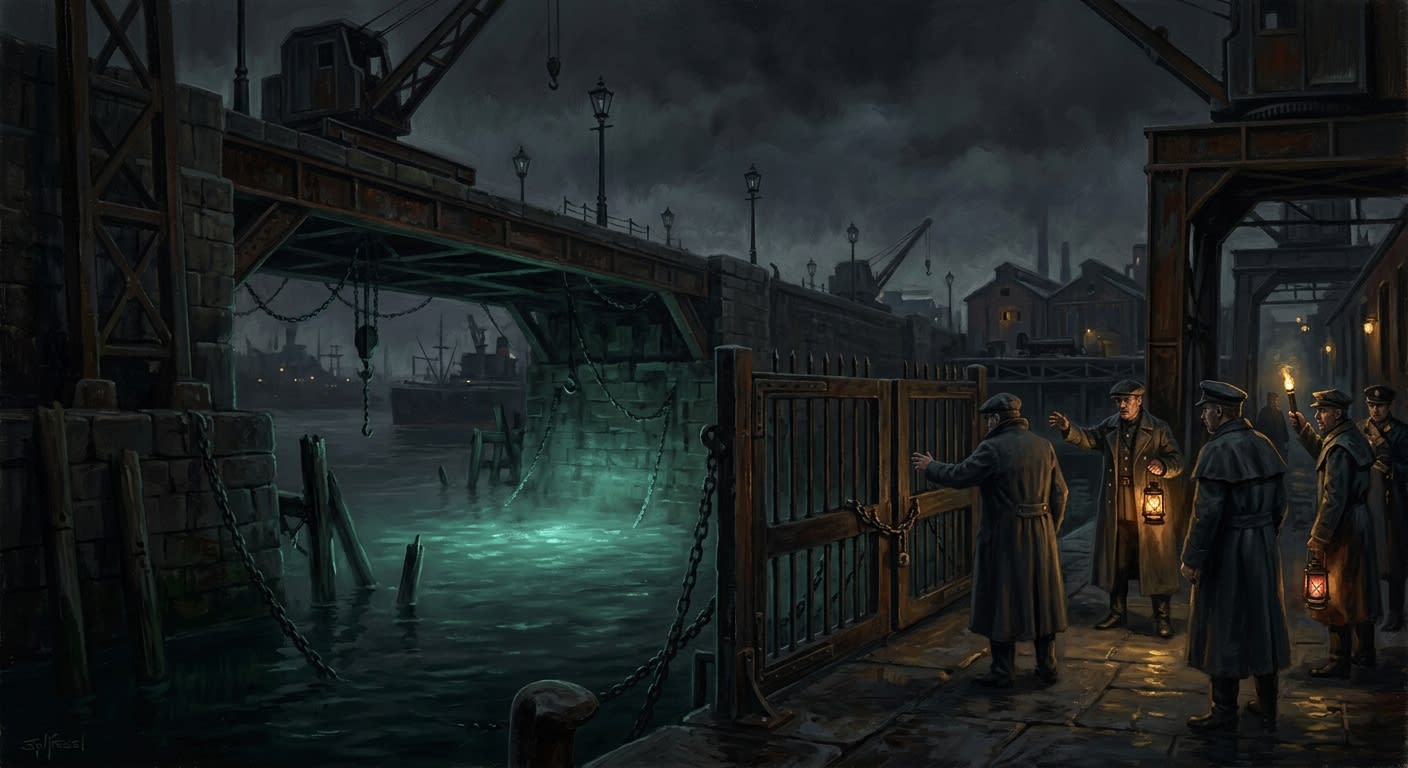
For seventy-two hours every approved light along the harbor failed. Pier lamps, watch lanterns, shrine glass, chain beacons, pilot marks, chapel tapers behind storm panes, the black-lamp shutters of the lower gun decks, the small registry candles at Joram Clee's desk: all extinguished. No storm was recorded. No order was issued. No oil shortage appeared in Tithes accounts, which means either there was no oil shortage or Tithes missed a chance to charge for one; I leave the reader to choose which impossibility causes greater distress.
The harbor did not fall. That fact has been enlarged by War until it resembles doctrine. The harbor also did not behave. The water showed lights where no lamps burned. Reflections moved against the current. Chain crews heard oars below the quay in a harbor locked against passage. The Chain of Saint Anakletos remained raised, dormant, and black. Men counted links by touch, then counted again because the first count had acquired too many.
The event's official name is mercifully plain. Silence. Harbor. Lamps. Each word has the stiff innocence of a man wiping blood from a ledger margin. It does not say loss, invitation, reflection, submerged bell, false quay-light, or the phrase several lower-watchmen used before Purity instructed them to prefer slower speech. The Bureau chooses names as undertakers choose cloth: heavy enough to cover the shape.
#On the Harbor Before the Lamps Failed
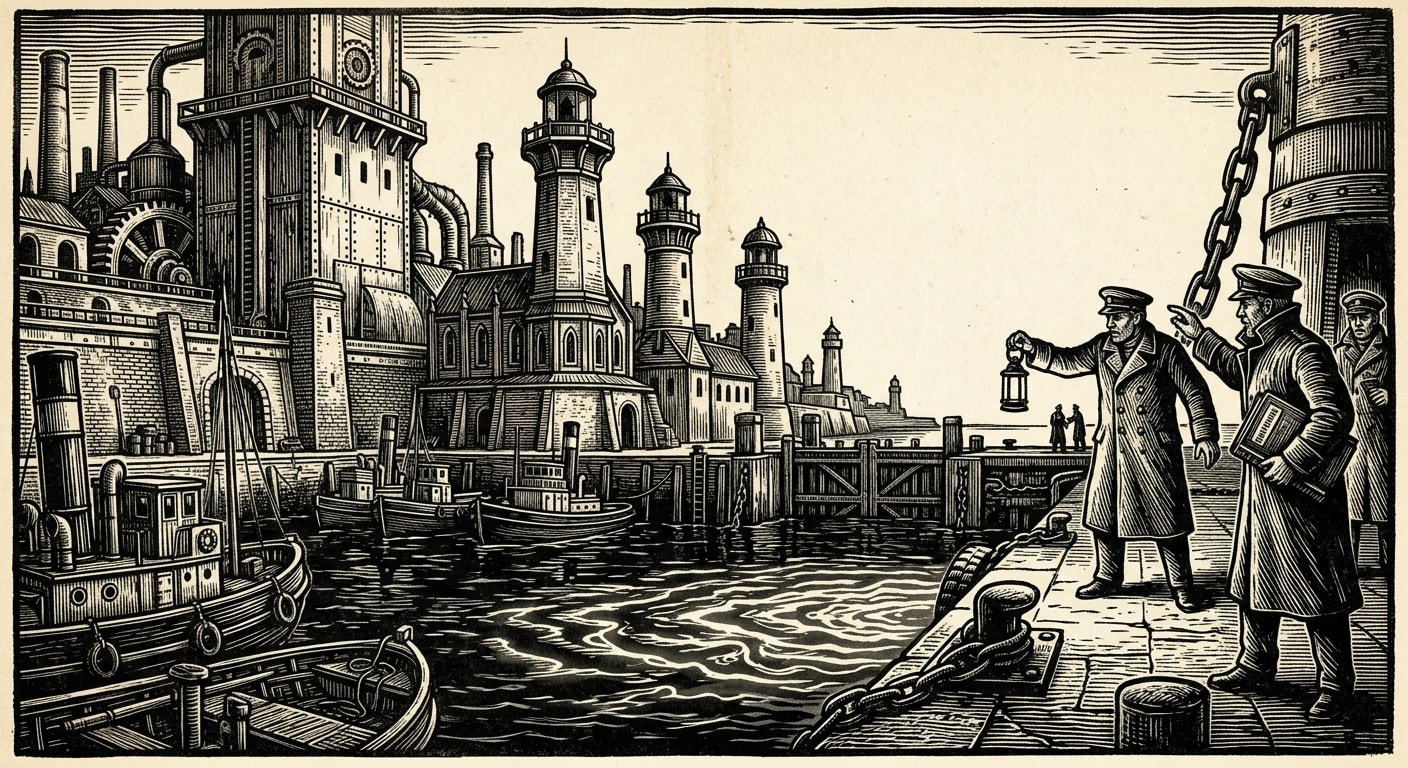
The Harbor of Chains was never a gentle place. It is a mile of fortified quay facing the Bosphorus, eleven piers, munitions vaults, chain winches, pilgrim wharves, patrol slips, customs desks, and the old Byzantine bedrock that accepts bolts, corpses, and secrets with equal appetite. It was founded with the southern anchor in A.S. 68 and hardened because water is an enemy road unless taught fear.
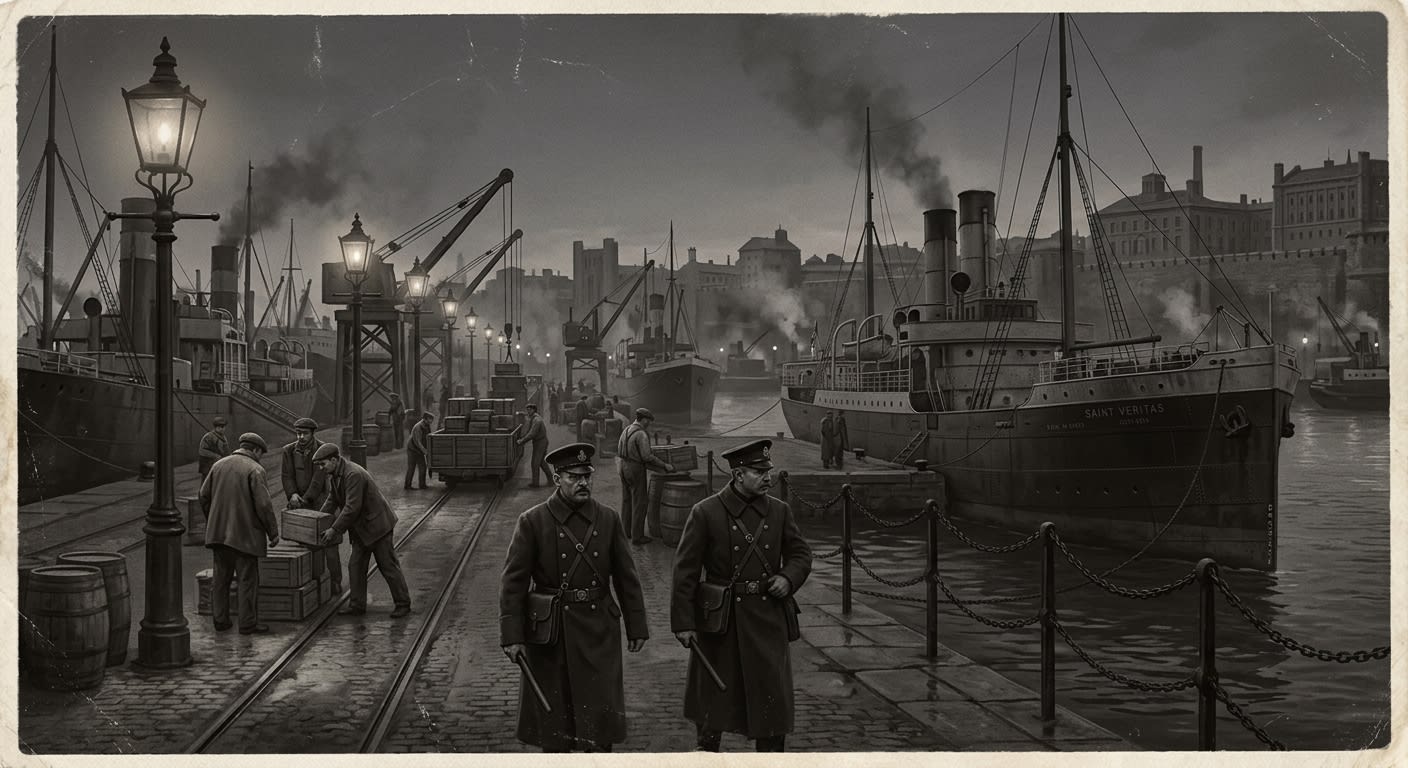
Since the Black Sea Armada of A.S. 162, the harbor lived under the memory of one perfect night: forty-seven demon-crewed vessels entered, the Chain burned white for seven hours, forty-three ships dissolved against consecrated iron, three retreated, and one remained unaccounted. The Chain has not glowed since. Clee has written his daily formula through famine, bombardment, relic dispute, Foundry Quarter fire, and the slow madness of men assigned to count waves.
Condition: satisfactory. Temperature: ambient. Luminosity: nil.
Fourteen thousand entries by later audit. Nil after nil after nil, the word becoming less absence than discipline. The harbor learned to depend upon it. A miracle that repeats becomes furniture; a miracle that ceases becomes policy; policy, in sufficient volume, becomes a sleeping dog no wise man kicks.
Before the Silence, the harbor carried ordinary terror: too many vessels, too little quay, powder barges tied near pilgrim ships because schedules outrank sanity, widows pressing papers at Pier Six, soldiers vomiting into the Bosphorus, clerks pretending not to smell the Catacomb-Carrier Threnody at Pier Seven, and the Bureau of Shadows collecting crates whose manifests consisted of seals arranged into discouragement. Constantinople calls this normal. Normal, there, is a word lowered by rope.
#On the Extinguishing
The first lamps failed after dusk inspection on the opening night. A pier warden at Three reported oil present, wick sound, glass intact, flame absent. His superior ordered relighting. The taper failed in his hand. The second taper burned until brought within one pace of the lamp, then went out as if corrected. By the time the report reached Clee's office, lamps had failed along Piers One through Four and both pilot beacons had ceased marking the entry lane. The chain towers answered with no bell.
By second night, every approved harbor light was out.
Approved is the dangerous word. A fisherman's hidden coal in a clay cup burned under a staircase until his wife smothered it herself. A wounded gunner's fever candle flickered inside his closed fist. Three witnesses claimed to see lamps below the surface, arranged in ranks corresponding to no pier chart. One dock child said the harbor was “lit underneath.” The child was removed for pastoral calming and later entered into a silence-variance school ledger, because the Synod cannot hear a child speak accurately without founding a programme.
The first War circular described the outage as a lamp-maintenance failure exacerbated by coastal vapour.
Corrected under sealed review. Maintenance failures do not extinguish chapel tapers, tower beacons, hand tapers at relighting distance, and lamps already submerged in witness testimony. Coastal vapour remains useful in sermons and should be retained where it harms no audit.
Signal traffic degraded into touch, rope, bell-click, boot-step, and memorised hymn. Lower gun crews loaded by hand. Chain crews counted links without sight. Customs halted, then resumed when Tithes protested that darkness did not suspend chargeable passage unless certified by three offices, two of which had no working lamps. A cart of flour stood at Pier Two for seventeen hours while six clerks debated whether cargo could be witnessed by feel. The flour spoiled at the edges. The debate remained fresh.
The harbor's bells did not fail. That is often cited as comfort by men who enjoy cheap consolations. Bells are excellent instruments unless the question is whether a light is present beneath water, whether a reflection has begun walking, or whether the ship beside you has become a space in the fog with ropes still tied to it. Bells tell time. Time was not the missing thing.
#On Weather
Clee wrote Weather.
This one word has received more hatred than entire failed campaigns. Inferior commentators call it cowardice, evasion, concealment, moral frost, administrative blasphemy. They are wrong in the usual decorative ways. Weather is what happens over a harbor without asking the Harbormaster's consent. Weather interrupts movement, confuses pilots, damages cargo, delays burials, kills fishermen, spoils ink, and leaves the officer in charge to decide whether the sky can be summoned before tribunal. Clee indicted nothing. He named the category and closed the book.
His entry did not deny the event. It denied the event a prosecutable shape. This is the highest form of harbor administration. To write sabotage would invite Purity. To write miracle would invite Relics, Rites, Pilgrimage, and the sort of devotional commerce that breeds candle stalls before the corpses are cold. To write enemy action would invite War to explain why no enemy was visible. To write Weather gave every office a drawer in which to hide.
Clee's later private ledger, seen by the undersigned under circumstances that will become official only if stupidity requires it, contained beside the old mooring of the Saint Veritas the phrase clear below. Ink ordinary. Paper damp at the lower edge. No date. No witness. The page was returned before the drawer developed memory.
PRIVATE WEATHER LEDGER EXTRACT — UNDATED Mooring R-17: clear below. Lamp count above: nil. Lamp count below: ███████. Crew reported at station: ███████. Instruction written in margin by unknown hand: do not answer if hailed upward. Disposition: drawer closed.
#On Valenne's Refusal
During the second night, the evacuation order reached Gate-Warden Petra Valenne. It avoided the vulgar word evacuation, because crisis language in the Synod must first pass through perfume. The order called for precautionary withdrawal of nonessential personnel from harbor-adjacent ravelin sectors pending clarification of luminous conditions. Three seals. No named signer.
Valenne read the order by touch. Her command room lamp had gone out with all the rest, and she refused a candle lest one unauthorized flame become precedent. She folded the paper into a square small enough for a cartridge casing and returned it.
Her reply: The gate does not step backward from darkness.
The phrase has been repeated often by officers who would step backward from darkness briskly enough if darkness arrived with enough paperwork. Valenne did not. The Ravelin of Sorrow requested withdrawal from lower guns after reporting lights in the water below the quay: count exceeding known lamps, one reflection moving against current. Her answer returned through the signal chain: hold, cover mirrors, count men, not lights.
The ravelins held. Lower gun crews sang by memory. Mirror covers went over polished sighting plates. Men counted one another in the dark, then touched sleeves, collars, hair, scars, rosary knots, powder burns, whatever flesh would prove flesh while water offered obedient faces below. One crewman vanished after the covers were fixed. His boots remained warm. The boots were entered into custody. The man was entered into a file whose title has changed three times.
Valenne preserved continuity. No wall abandoned. No gate unmanned. No public record admitting that darkness had command authority over the southern anchor. Her commendation was withheld, since praising her refusal would confirm that withdrawal had been ordered. The Bureau rewards some servants with medals, some with silence, and the best with both denied.
#On the Vanishing of Truth
At dawn after the seventy-second hour, the lamps relit from east to west. This sequence is one of the few facts all surviving accounts share. The eastern pilot mark woke first, then the pier lamps, then the shrine glass, then the chapel tapers, then the chain beacons. The harbor returned to itself in orderly fashion, like a criminal putting his collar straight before entering court.
The Saint Veritas was gone.
It had been a Bureau of Records supply galleon in convoy pool R-17: broad, slow, ordinary, carrying paper, ink, stamped folios, replacement ledgers, census blanks, death rolls, biscuit, and enough bureaucratic vanity to justify the name Truth. No mooring rope was cut. No timber was scored. No patrol boat logged passage. No chain lowering was recorded. The berth was empty, and the absence had edges too neat for wreckage.
Records first called the vessel delayed by convoy miscommunication. This lasted until someone remembered that miscommunication rarely removes a ship from a locked harbor. Shadows arrived before outrage could become useful. The cargo manifest vanished from its drawer. A substitute appeared listing ink, paper, and biscuit, countersigned by a clerk dead six years. The pantry objected that biscuit had never been loaded. The objection was reassigned to dietary reconciliation, where many truths go to acquire mould.
The missing ship became the event's clean wound because it could be named. Lights failing everywhere was too large. Water showing lamps was too strange. Valenne's refusal implicated command. Clee's Weather implicated language. The Saint Veritas offered Records a noun with a hull. The Bureaus gratefully bled into it.
A.S. 186 quay sermons described the vanished vessel as a humble cargo ship spared by Providence and restored by devotion.
Corrected. The ship did not return during the Silence. It returned six months later with its crew intact, its memory absent, and its log ruined by one sentence. Providence may claim many achievements. This one remains under inter-Bureau dispute.
#On the Six-Month Return
The ship returned in A.S. 186 just before dawn, sail slack, hull clean, crew intact, and time disagreeing with itself like a committee spared supervision. Twenty-three names answered muster. The crew claimed never to have left harbor. Master Vale remembered night watch, then dawn. Sister Merial's ink seals were wet. The rat-catcher complained the voyage had been boring, thereby proving that rats and metaphysics both require stricter licensing.
The log contained one phrase across forty pages: We were invited below.
That sentence belongs more properly to the article on the Saint Veritas, where the ship's afterlife, crew condition, and current sealed custody are treated with the restraint imposed upon me by cowards. Here it matters because the Silence was the invitation's vestibule. The harbor went dark; the water lit beneath; the ship vanished; six months later Truth returned with courtesy in its teeth.
Below what? Harbor, quay, chain, ossuary, archive, sea-floor, or one of the older chambers under Constantinople whose builders were kind enough to die before explaining themselves? The file does not answer. Files seldom answer when they are busy surviving.
#On Classification and Present Use
Public instruction reduces the Silence to a harbor lamp failure with associated maritime irregularity. This is tidy, false, and serviceable. Pilgrims are not told that the Ravelin of Sorrow drills mirror discipline because of a night when reflections moved wrong. Chain apprentices are told to count links by hand during light loss, then count their own hands. Harbor clerks are instructed never to copy Clee's Weather entry as precedent unless weather has become resistant to lamps, ships, memory, and rope.
The Bureau of Bells maintains that no official bell anomaly occurred. War maintains that readiness was preserved. Records maintains the Saint Veritas file under active irregular custody. Shadows maintains the log. Purity maintains watch over surviving crew-derived contamination lines. Doctrine maintains the approved phrasing, which is to say I maintain it while everyone else ruins the adjectives.
As of A.S. 201, the harbor lamps burn under inspection. The chain remains raised at dusk and nil by dawn. Clee still records. Valenne still holds the gates. The Ravelin of Sorrow still checks its mirror covers twice a week. The old R-17 mooring remains clearer than neighbouring water on certain mornings, and no fisherman will cast there, though fishermen will cast beside plague drains, corpse piers, and tax offices if hungry enough.
The lamps are lit. The harbor is watched. The water remembers better than the Bureau prefers.