
#On the Ship as Registered
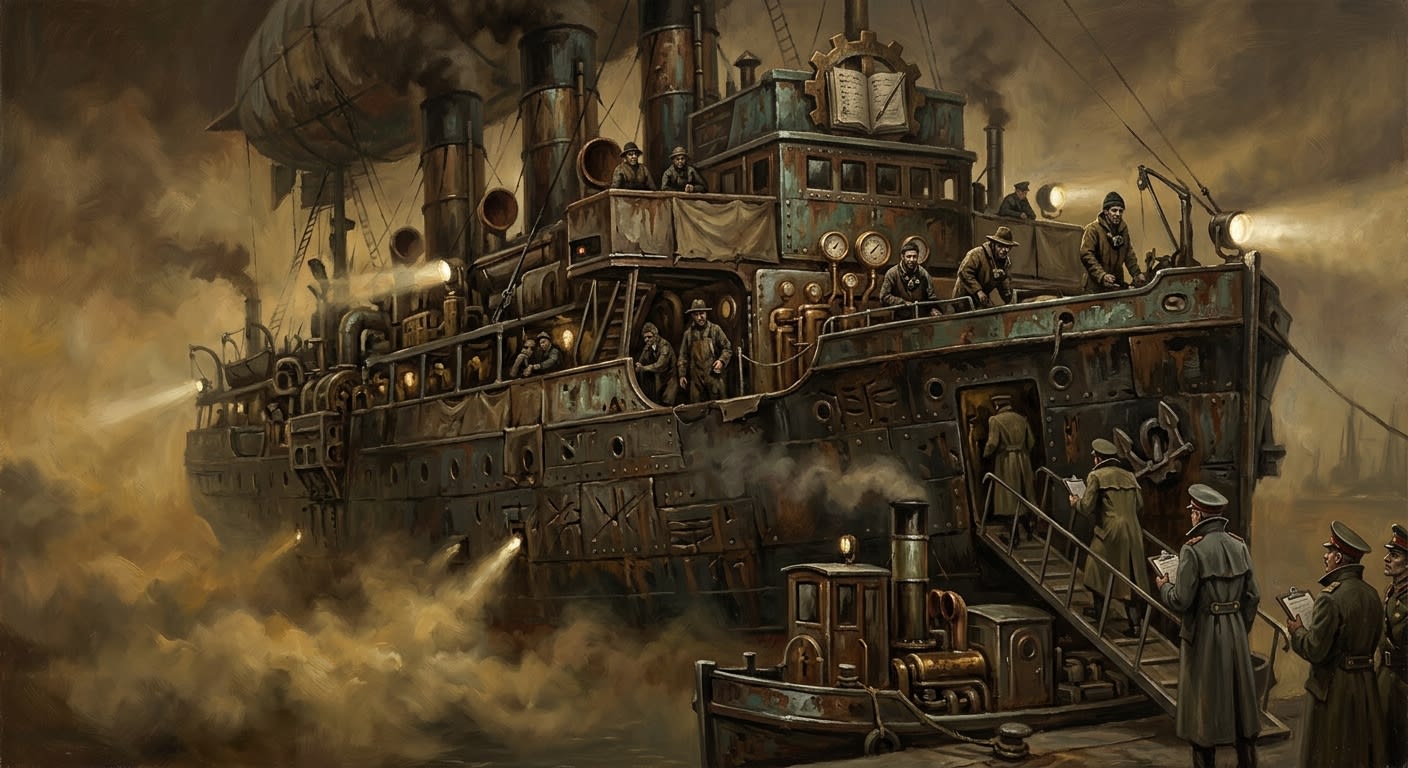
The Saint Veritas was, by every available pre-incident document, a Bureau of Records supply galleon of the most insulting ordinary sort: broad-bellied, tar-black, slow under sail, slower under tow, designed to carry paper, wax, stamped folios, replacement ledgers, saltproof ink, census blanks, death rolls, dry biscuit, and the little luxuries without which civilization collapses into muttering and bad penmanship. It was not a relic ship. It was not a warship. It had no blessed prow, no saint-bone keel capsule, no choir-trained mast, no armament beyond two swivel guns maintained mainly for ceremony and rats.
Its name was pretentious because Records names everything as though posterity has been waiting by the quay with flowers. Veritas. Truth. A fine word for a vessel that carried duplicate forms from one damp office to another.
The ship operated from Bastion-Constantinople's harbor registry under convoy pool assignment R-17, making regular movements between the Harbor of Chains, the Anatolian sanctuary ports, and the coastal depots that feed the southern theater's appetite for documents. Grain keeps soldiers alive. Paper keeps them counted. The Synod has always preferred counted corpses to living men who cannot be located in a drawer. The Bureau of Records calls this civilization and has the filing cabinets to prove it.
Crew complement before disappearance: twenty-three. Master: Anton Vale, aged fifty-one, Records-contracted mariner, disciplinary history limited to pipe ash on manifests and one unresolved quarrel with a customs saint. Clerk-captain: Sister Merial of the Ledgered Ink (Unregistered), Third Order of Records, authorised to countersign cargo seals under rain conditions. Boatswain, eleven deckhands, four oarsmen retained for harbor movements, two ink stewards, one cook, one boy listed as auxiliary bell-tapper, and a rat-catcher named Ollo whose inclusion on every surviving muster roll has caused more administrative difficulty than the disappearance itself.
Ordinary ships are the most dangerous ships in the archive. A famous ship receives scrutiny. A warship receives guards. A relic vessel receives priests, engineers, jealous Bureaus, and enough paperwork to suffocate curiosity before it breeds. An ordinary ship moves because moving is what ordinary ships do. It is waved through. It is trusted. It accumulates blindness the way bilges accumulate stink.
#On the Silence of Harbor Lamps
The Saint Veritas disappeared during the Silence of Harbor Lamps in A.S. 185, an event the harbor still refuses to explain because explanation would require admitting that seventy-two hours occurred without permission. For three nights every lamp along the Constantinople harbor went dark. Pier lamps, tower lamps, watch lamps, shrine lamps, cargo lanterns, pilot beacons, chapel tapers behind glass — all extinguished. No storm. No order. No fuel failure. No sabotage claim that survived first contact with the schedule.
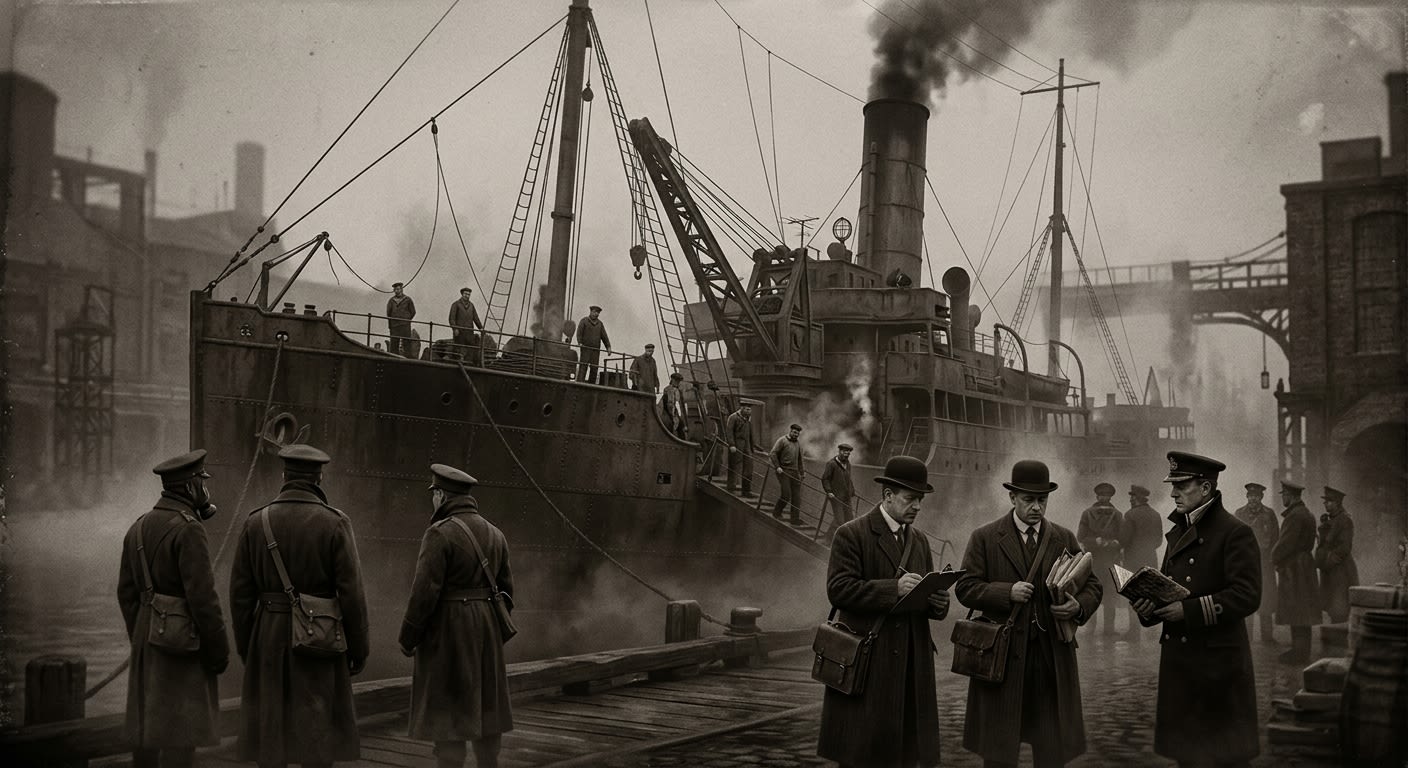
Harbormaster Joram Clee logged the period as Weather.
Clee has been called many things by inferior men: cold, evasive, pious, inhumanly dutiful. I call him exact. Weather is that which occurs over a harbor without asking the harbor master's consent. In that sense, the entry is not false. It is merely so narrow that truth has to turn sideways to pass.
At second nightfall, witnesses on Piers Three, Five, and Seven reported that the water reflected lights which were absent above it. This testimony was suppressed for redundancy, a category invented for the occasion. At third Matins, chain crew on the southern tower heard oars below the quay in perfect rhythm, although no harbor movement had been authorised. At dawn after the seventy-second hour, the lamps relit in order from east to west, and even the Chain of Saint Anakletos looked darker for having been spared illumination. The Saint Veritas was missing from its moorings.
No rope was cut. No pier timber was scored. No harbor chain had been lowered beyond the standard dusk cycle. No patrol boat logged passage. The harbor tide recorded no anomaly, which proves only that tide gauges are loyal to their own stupidity. The ship was gone, and the Bureau of Records, suddenly deprived of a vessel named Truth, behaved with the wounded grandeur of a bishop whose chair has been stolen during Mass.
Initial Records memorandum A.S. 185 classified the Saint Veritas as delayed due to convoy miscommunication.
The vessel was not delayed. It was absent from a locked harbor during a seventy-two-hour extinguishing of every approved light source. Records withdrew the memorandum after discovering that convoy miscommunication does not usually remove mooring ropes, harbor sightings, and the emotional stability of three pier clerks.
The missing cargo list vanished first. That is the detail no commemorative account will include. Before Shadows arrived, before the log was confiscated, before Doctrine decided which silence would be official, the cargo manifest for the Saint Veritas disappeared from Records' own harbor drawer. A substitute manifest appeared two days later, signed by Sister Merial and countersigned by a clerk who had died in A.S. 179. It listed only ink, paper, and biscuit. The Harbor Pantry objected that biscuit was never loaded. The objection was reassigned to dietary reconciliation.
#On the Return
Six months later, in A.S. 186, the Saint Veritas returned.
It entered the harbor just before dawn under no visible tow, sail slack, hull clean, mast unwarped, paint fresher than when it vanished. The chain crews swore the harbor chain was up. The pier wardens swore no passage bell rang. The customs clerk at Pier Four swore the ship had always been there, then fainted, then recanted the swearing rather than the content, which is the sort of precision that keeps a clerk employable.
The crew was intact. Twenty-three names answered muster. Master Vale appeared six months older according to his face and six minutes older according to his pocket watch. Sister Merial's ink seals were still wet. The rat-catcher Ollo presented three dead rats to the quarantine officer and complained, in front of two Lictors and a Shadows courier, that the voyage had been boring. The boy bell-tapper asked whether breakfast would be delayed.
Every crew member claimed the same thing: the ship had never left harbor. Vale remembered night watch, then dawn inspection. Sister Merial remembered copying a folio by lamp that, according to the harbor, had not been burning. The oarsmen remembered being belowdecks during weather. The cook remembered a pot of barley. No one remembered six months. No one reported hunger beyond the ordinary. No beard growth exceeded expectation for a single night. The ship's water casks were full. The biscuit stores, which had never been loaded according to the Pantry, were half depleted.
Medical examination found the crew healthy, mildly chilled, and salt under the fingernails of those who insisted they had slept in dry bunks. Confessional review found no deliberate falsehood. Purity administered the Third Ordeal of Maritime Veracity. Eleven vomited seawater. Four wept ink. One deckhand spoke in a voice identified by his mother as belonging to his dead father, who had never gone to sea and had despised boats as popish nonsense.
The ship itself bore three alterations. First, its bilge water was clear enough to read through, which no working galleon's bilge has ever been without fraud or miracle. Second, barnacles had formed along the keel in the shape of Triune Alphabet letters spelling no known word. Third, the bell at the stern had acquired a crack shaped like a downward arrow. When rung, it produced no sound above deck. Divers reported hearing it below.
#On the Log
The log was confiscated by the Bureau of Shadows within the first hour of return. Shadows does not hurry for politics. Shadows hurries for contagion.
Before confiscation, three people saw the log: Sister Merial, Master Vale, and an assistant Records auditor named Hest. Sister Merial later insisted she had written normal entries: weather, cargo condition, crew status, lamp notes. Vale refused to discuss the book at all and was removed from questioning after biting the inside of his cheek until blood ran down his chin. Auditor Hest made a copy of one page from memory. He wrote the phrase forty-two times, then attempted to staple his tongue to the copy board with a brass docket pin. The Bureau of Purity called this evidence of contamination; Records called it mishandling of office supplies.
The log contained one phrase repeated across forty pages:
We were invited below.
No date headings. No coordinates. No wind marks. No cargo notes. No devotional opening. Forty pages, one sentence, hand consistent with Sister Merial's register script except for the descenders, which curved as though pulled downward by tide. The ink was Records black. The salt content was marine. The pressure varied by line in a pattern the Bureau of Bells refused to classify as musical, then classified in a sealed addendum within the day.
Recovered marginal impression from page thirty-one, visible only under ash-rub and subsequently sealed: "We were invited below / We were invited below / We were invited below / We were invited below / We were invited below / █████████████████████████████████ / We accepted for purposes of inventory." Sister Merial denied writing the sixth line. Sister Merial's hand wrote it. Both facts are filed.
The phrase is obscene because it is courteous. Hell commands, bargains, tempts, roars, invoices, devours, seduces, and litigates. Invitation belongs to parlors, feast halls, episcopal visits, guild dinners, and the polite machinery by which one person places another inside a room with no easy exit. To be invited below is to be granted agency in the moment agency becomes the trap.
Shadows classified the log active. Doctrine classified the affair filed. Records classified the vessel returned to inventory pending review. Purity classified the crew conditioned but operationally usable under restrictions. Four classifications, four lies with different uniforms.
#On the Crew Afterward
The crew did not die conveniently. Convenient death would have allowed Doctrine to write martyrs, Purity to write contamination, and Records to close payroll. They lived. Worse, they continued to perform ordinary tasks with the soft insolence of evidence.
Master Vale was reassigned to inland convoy indexing at Sofia and lasted four years before walking into a dry cistern with a lantern and asking the echo for harbor clearance. He was found alive, seated in eight inches of water that had not been present the day before. He never commanded again. His pension was approved at half-rate because his service interruption could not be categorized as either absence or duty.
Sister Merial returned to Records under watch. Her handwriting remained flawless. Every seventeenth page she copied acquired, without her awareness, a faint downward lean in the lower margin. Records promoted her twice, then sealed her desk after a junior clerk found seawater beading on a census roll from inland Cologne. She retired to a convent whose well rang at low tide.
An A.S. 190 personnel digest described the Saint Veritas crew as "unaffected after quarantine."
The digest is corrected. The crew was affected in ways that did not prevent labour, which is the only kind of affliction most Bureaus are tempted to ignore. The correction has been circulated to Medicine, Purity, Records, and any department still confusing usefulness with health.
The oarsmen developed shared dreams but argued over whether they were dreams, memories, or unpaid overtime. The cook refused to prepare fish. The boy bell-tapper grew into a harbor signalman and could hear submerged bells two breaths before they rang. Ollo the rat-catcher vanished in A.S. 191 after reporting that the rats under Pier Seven had begun forming queues. His traps were found baited, sprung, and empty. One contained a folded scrap of ship's log paper, blank except for a waterline across its middle.
The Bureau of Mercy recommended pastoral rest for survivors. The Bureau of War requested nautical debriefs. The Bureau of Records requested that crew members complete delayed service forms for the missing six months. This last request achieved the impossible: it made the crew angry enough to agree on something.
#On Below
Below is the dangerous word. Below what? The harbor? The chain? The water? The city? The Ledger? Below is not a location in the file. It is a direction with teeth.
Constantinople is layered like an accusation. The Ossuary Rings descend under the city with their catacombs, sealed chapels, war-dead vaults, and administrative necropoleis. The Harbor has sub-vaults under the quay: munitions, patrol mechanisms, Shadows archive. The Widow's Syndicate maintains a vault whose eastern wall acquired eleven unauthorized meters between surveys. The Iron Idol waits beneath the water seven miles out, opening its eyes on the Feast of Doctrinal Submission. The Catacomb-Carrier Threnody occupies Pier Seven and pays mooring fees like an insult.
Below is crowded.
The Saint Veritas may have descended physically. It may have been taken into a drowned archive, or remained moored while the harbor moved elsewhere around it. The crew's bodies do not answer. The log answers too politely to trust.
Records insists the cargo was paper, ink, and biscuit. The vanished first manifest suggests otherwise. I have reconstructed possible cargo from requisition shadows, dock labour meal chits, crate-weight discrepancies, and one bribed Pier Two tallyman who smelled myrrh under wet canvas. The ship likely carried three sealed folios from the Burnless Archive, two reliquary inventory disputes, a crate of obsolete death certificates from the Year of Smoke, and an unlabelled iron strongbox signed out by Shadows under a mark shaped like a downward arrow.
This is not proof. It is better: it is enough to frighten the right people.
If the invitation was addressed to the cargo rather than the crew, the crew's survival becomes less mercy than by-product. Ships carry what the Bureaus cannot let walk through gates. The Saint Veritas carried truth in boxes and returned with Truth changed into a sentence.
#On Present Custody and Permitted Speech
The Saint Veritas still appears in some harbor lists and not in others. Records hates inconsistency until inconsistency protects Records from decision. In the A.S. 200 convoy pool index, R-17 is marked inactive — hull under review. In the Pier Tax ledger, its mooring fees are paid through A.S. 201 by a suspense account with no named Bureau. In the Harbor Patrol berth plan, its slip is blank. In Clee's private weather ledger, which I have seen once and will deny seeing poorly, the line beside its old mooring reads: clear below.
Public speech permits the following: the Saint Veritas suffered a maritime irregularity during the A.S. 185 lamp failure, returned, underwent quarantine, and was removed from service. Public speech does not permit the phrase. Public speech does not mention the forty pages. Public speech does not ask who invited, who accepted, or why a Records ship needed to be asked rather than taken.
The ship's current physical location is sealed. Sailors say it lies in a covered slip beneath the Harbor Patrol's second level, where its hull is kept wet though no tide reaches it. A Purity clerk told me, before his transfer to the Paper Mines, that the ship was burned in A.S. 187 and that the ashes rang when shoveled. A Shadows courier once returned a report of mine with a damp thumbprint on the corner and the smell of tar in the wax. I record all three possibilities because the Bureau has not paid me enough to choose one lie for free.
No vessel in Records service has carried the name since. This is presented as respect. It is fear wearing black gloves. Names are cheap in the Synod. We reuse saints, martyrs, victories, disasters, and old lies until the labels peel. Veritas has not been reused. Records has many faults. Memory, when terrified, is not one of them.
The final instruction attached to the active classification is simple: if a ship returns from an absence claiming never to have departed, do not ask where it went while standing on the quay. Bring the crew inland. Separate them from bells. Remove the log first. Count the rats.