
#On the Mercy That Comes in Lamp-Cups
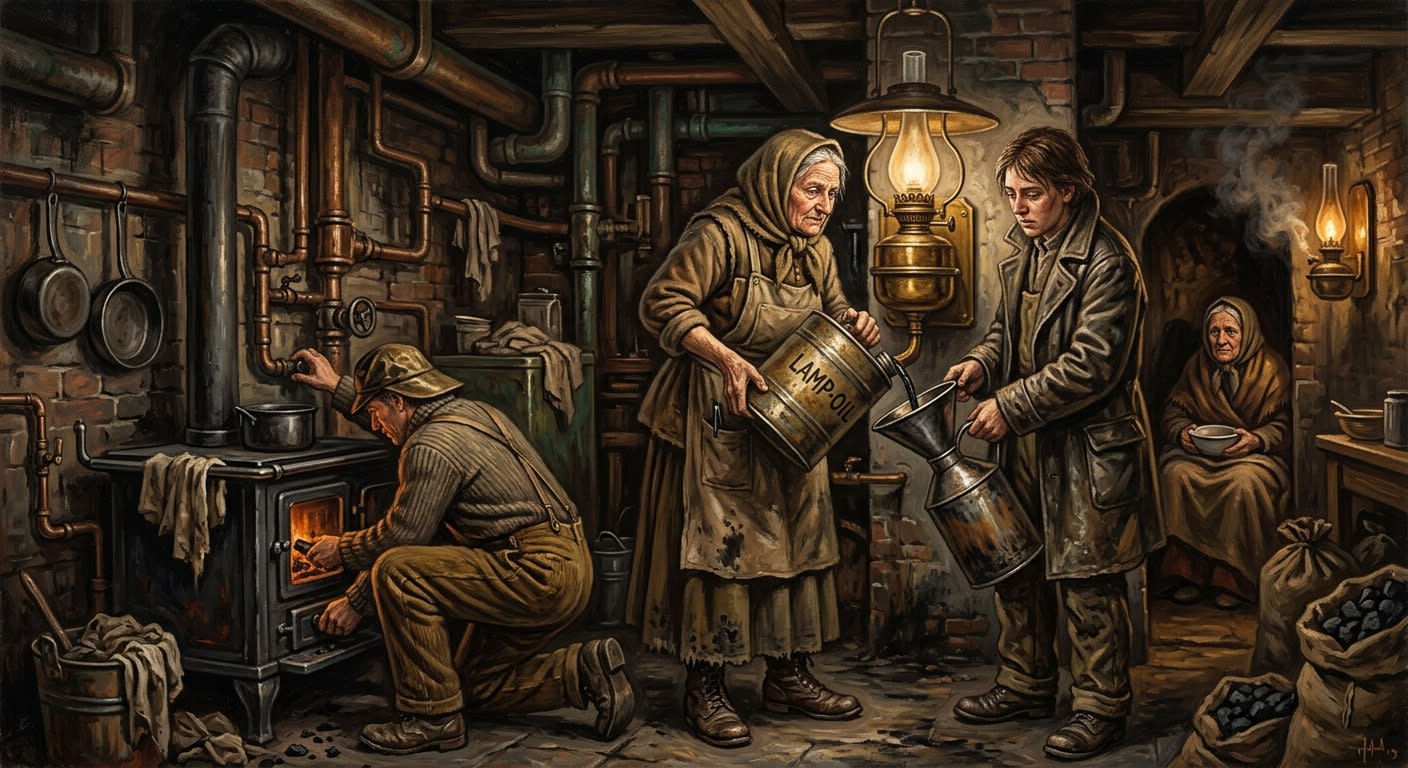
The Lamp-Mercers are the soft-handed faction of the Hidden Pipe-Runner trade, which is to say their hands are burned, blackened, split at the knuckle, and only soft by comparison with men who feed engines. They prioritise homes, lantern blocks, curfew kitchens, old women’s stove-niches, sickrooms, orphanage lamps, and the small stubborn flames by which a district proves to itself that it has not yet been abandoned to official warmth.
The parent profession delivers black diesel through pipes the Bureau of Engineering has surveyed three times and failed to find with admirable consistency. The Lamp-Mercer takes his portion of that invisible circulation and spends it on households. This makes him beloved. It also makes him poor, which is the usual price of being loved by people with no money.
A Lamp-Mercer is no lamp-seller. The name is vulgar convenience. He sells flow, pressure, hour, wick-clean cuts, and the right to keep one room bright after curfew without attracting a Fume-Inspector whose nose has been trained at public expense to ruin private survival. He deals in half-cups of fuel, fingertip valves, whispered schedules, and soot-marks hidden beneath window ledges. His customers pay in ration chits, mending work, bread heels, child-watching, funeral attendance, and silence.
#On Their Work Beneath the Floorboards
The Lamp-Mercer begins lower than the street, in the old practical kingdom beneath doctrine: sewer galleries, bricked tariff tunnels, ossuary drains, cellar cracks, pipe-crawl behind ration kitchens. He knows the domestic grid, which the Furnace-Hardliner despises as sentimental clutter and the Bell-Tapper ignores until a grandmother’s lamp starts humming in pre-Codex mode. Domestic lines are thin. Thin lines clog. Thin lines freeze. Thin lines are discovered by children, rats, saints, and inspectors in that order.
A Mercer carries the ordinary Pipe-Runner kit: tap key, listening rod, bone-clamps, wax-seal strips, soot chalk, vinegar rag. His private tools are gentler. Wick-needle for testing clean burn. Porcelain thimble for measuring a child’s lamp allotment. Rag filters sewn from old altar cloth because altar cloth catches grit well and blasphemy is warmer than reverence. A tiny pressure bell no larger than a plum, hung inside a wall; if it rings during curfew, the family knows to snuff the lamp and cough loudly as though illness, rather than fuel, has filled the room.
The trade’s domestic schedule is cruelly exact. One hour for the widow who cooks for three grandchildren. Half-hour for the fever cot. Two cups for the lantern-block by the stair where twelve families share one descent and one fall in the dark kills a man with exquisite legality. Kitchens receive their trickle after curfew drums, when smoke can be blamed on banked coals. Sickrooms receive theirs before dawn, when the chill does its best accounting. Orphanages receive irregular flow because regular mercy makes patterns, and patterns invite inspectors.
The Mercer’s ledger is his skull. He writes no customer list. He marks no door with anything a clerk could read without crawling, which clerks avoid as a matter of bodily theology. Households identify him by knock code, by smell, by the small crescent of soot on the left cheekbone, by the fact that children stop crying when he opens his bag.
#On the Lamp-Clean Cut
Black diesel does not become innocent because it is poured into a grandmother’s lamp. It remains unlawful, volatile, theologically sullen, and inclined under certain pressures to produce scripture-smoke. The Lamp-Mercers’ claim to virtue rests on cut and restraint. They buy lamp-clean fuel from Distillers when they can, thin furnace-grade fuel when they cannot, and refuse engine-grade stock for homes unless winter has placed its boot on the district’s throat.
Engine-grade fuel burns too hot. It smokes. It writes. It makes little lamps mutter syllables better suited to furnace quarters and sealed War registers. Lamp-clean fuel is quieter, though quiet is a comparative blessing. It still stains ceilings. It still turns coughs black. It still makes Fume-Inspectors smile when the reactive parchment blooms.
Bureau of Purity parish notices describe household black diesel use as “luxury contraband.”
Corrected. Luxury is what one burns after the official ration arrives. A mother heating soup with pipe-drip under curfew is committing arithmetic, not indulgence.
A good Lamp-Mercer can smell bad doctrine before it forms letters. Sour-metal smoke means overpressure. Bitter almond means Distiller fraud. Warm ink means scripture-risk. A blue fringe on the flame means bell contamination somewhere in the line; the Mercer bleeds the pipe into sand and walks away without discussing what the sand whispers. If the lamp hums, he lowers flow. If the wick sings, he kills it. If the flame speaks a name, he breaks the lamp and later apologises to the family, assuming the family remains available for apology.
#On Their Funerals
The Lamp-Mercers are loved because their crimes have faces. A Furnace-Hardliner supplies a trench engine and receives payment from men with seals. A Bell-Tapper sells danger to men already half in love with it. The Lamp-Mercer keeps a hallway lamp burning so a girl can carry water without falling. He heats a curfew kitchen so broth reaches the fourth floor. He saves an old man’s fingers from frostbite and earns two buttons, a cracked medal, and gratitude the Bureau cannot tax without first admitting it exists.
Their funerals are crowded. This is inconvenient. Criminals should die in narrow rooms with limited witnesses. A Mercer dies of fume-lung, pipe-burn, collapse, or confiscation, and half a district appears with candles it cannot explain purchasing, oil it cannot explain owning, and grief it cannot explain directing toward an erased profession. The priest reads a generic prayer for a “maintenance labourer.” The children know better. The grandmothers know best. Nobody says why they have come. Nobody needs to.
The Bureau tolerates these funerals because dispersing them produces testimony. Testimony produces names. Names produce routes. Routes produce darkness when broken. Darkness produces riot. Riot produces reports. Reports travel upward until some warm-handed official in Strasbourg asks why an old woman’s lamp became a public-order crisis. No district officer wishes to answer that question. Questions with grandmothers in them are treacherous.
PURPOSE OF ATTENDANCE — FUNERAL OF MERCER █████, A.S. ███ Recorded by Fume-Inspector auxiliary from crowd whispers: “Because he kept Mother’s stove alive.” “Because the child read by his cup.” “Because he took the raid can himself.” “Because he knew which pipe sang and closed it before █████████████.” Final line struck by district censor. Audio cylinder missing.
#On the Quarrel with the Hard Men
The Lamp-Mercers’ quarrel with the Furnace-Hardliners is old enough to have acquired politeness, which is the stage of hatred most likely to produce knives. The Hardliner says fuel belongs where it preserves industry, kitchens, engines, and the forward trenchline. The Mercer says a district whose children freeze will not man those kitchens or bless those engines. The Hardliner answers with tonnage. The Mercer answers with beds.
Both are right. This is why their meetings are unbearable.
Bell-Tappers sneer at them both. The Tapper’s profit comes from bellway proximity, acoustic cover, and the black grandeur of fuel that remembers too much. To a Tapper, a Mercer is a parish aunt with a tap key. To a Mercer, a Tapper is a suicide with pricing discipline. The profession requires both insults for balance.
During shortages, factional arbitration follows the Three Flames (Unregistered) custom: one cup to households, one cup to kitchens, one cup to strategic pipes. The custom holds until cannons fire, boilers fail, babies cough, or someone with a better knife declares a revision. Lamp-Mercers lose more often than they admit. They compensate by stealing back flow in quarter-hours: an extra seven minutes to a fever lane, ten to a stair block, three to an old woman whose sons are all in the mud and whose kettle, by any doctrine worth keeping, outranks a clerk’s brazier.
A Bureau of Purity digest labels Lamp-Mercer ration theft “anti-military fuel diversion.”
Amended for internal accuracy. The fuel was never military on paper, because the pipe did not exist; it was never diverted in law, because no route was acknowledged; and it was plainly anti-military for those who believe soldiers emerge from unheated childhoods without mothers.
#On Their Present Toleration
As of A.S. 201, Lamp-Mercers operate wherever the hidden pipes pass beneath inhabited misery: the Warrens of Bastion-Constantinople, winter districts near Bastion-Brest, overcrowded stair-blocks behind Bastion-Przemyśl, cellar lanes in Strasbourg’s poorer intake wards, and any town where the official fuel schedule has been blessed by men who sleep beside stoves they did not pay to heat.
The Bureau of Purity condemns them. The Bureau of Tithes counts heat anomalies. Settlement denies the households. Engineering denies the pipes. Doctrine condemns despair when it becomes public and condemns contraband when it prevents despair privately. The Ledger receives all these contradictions and, with magnificent discretion, warms its hands.
The Lamp-Mercers remain the least profitable and most mourned branch of the trade. Their margins are thin. Their routes are intimate. Their arrests are dangerous because the witnesses are old, numerous, and unafraid of losing comfort they never possessed. A district may deny every pipe under oath and still attend the Mercer’s funeral with candles cupped beneath coats.