
#On the Alarm at Station Two
The Slumber-Hulk Engagement of A.S. 194 began, as the most offensive catastrophes do, with a clerkly instrument doing its duty before any officer had prepared a speech.
At Station Two, two kilometres east of Bastion-Shipka on the reed road, a forward lookout saw the fog thicken along the eastern marsh horizon and then misbehave. Fog rolls, lifts, crouches, tears into ribbons, or lies in the channels like old wool. This bank resolved. Under glass it gathered into links, pale surfaces, and a moving height the size of a collapsed tower. The watchman rang the station alarm. Adept Meryth Vesk checked the drag-gauge, checked it again, and gave the only useful order available to a woman who has just watched time become partial: signal the bastion.
The target stood at approximately three miles, emerging from the Vales of Stagnance fog: chain-bound, glacial, and already surrounded by a stillness envelope broad enough to make the marsh grasses bend late in the wind. War confirmed tank-class identification: Slumber-Hulk, heavy siege, sub-type temporal. The phrase is magnificent in its poverty. It resembles calling plague an argument with breath.
#On the Six Hours of Arithmetic
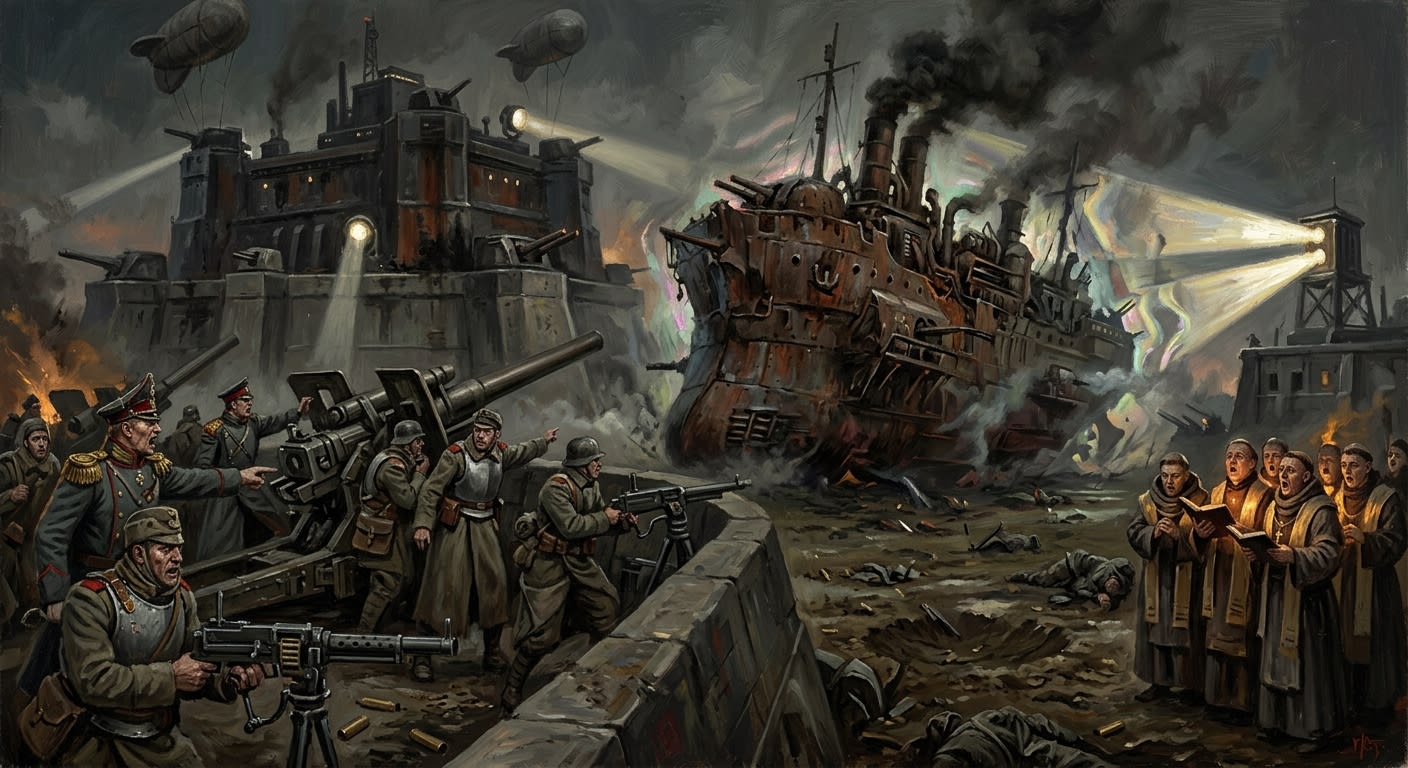
At Shipka the bells sounded Wrath-Sloth Convergence (Unregistered), the alarm reserved for an enemy combination ugly enough to make the manuals sweat. Choirs climbed the marsh-facing platforms. Gunners ran to Saint Aegidius, the bell-cannon with a jealous temperament and a throat full of consecrated shot. Captain Varik's Scour company opened sealed pitch, donned mica masks, and ascended the pre-soaked ramparts. In the rail quarter, engineers inspected culvert fuses, pump lines, and red-marked fire channels with the brisk profanity of men who know their homes have been entered into another man's diagram.
For six hours the bastion held itself one order short of self-immolation.
The arithmetic was simple enough for soldiers, clerks, and bishops, which is to say simple enough to frighten them all. If the Hulk entered formal Scour radius, Varik's company would ignite the outer streets, rail approaches, and marsh-facing lanes rather than permit the stillness envelope to root inside the walls. If the Hulk remained outside radius, Shipka could fight with guns and hymns. The entire engagement narrowed to a line on a map and the question of whether a thing older than haste would cross it.
Saint Aegidius fired until its crew's ears bled under their mufflers. Field-pieces and long guns joined, saturating the fog ahead of the Hulk with shellbursts, relic-shrapnel, and ordinary iron, which remains a respectable theological instrument when applied quickly. Choir platforms cast anti-Sloth wake-hymns across the marsh: hard ascending phrases, drum-pulse, clipped refrain, no indulgent vowel held long enough for sleep to enter. The hymns did not soothe. They struck.
The Hulk did not charge. It did not quicken. It continued in its hideous patience while fire and song battered the air around it. Chain fragments sparked in the fog. Shells burst against links no known forge had made. At the wall face, Hourglass annotations recorded four seconds of temporal drag per minute at peak. Soldiers described feeling their own heartbeats slow, then stagger, then resume under the pressure of the choir's percussion.
Public instructional plates state that Shipka drove the Slumber-Hulk back.
Corrected for tactical copies: saturation fire and hymnal counter-rhythm altered the apparent trajectory of the stillness envelope until the Hulk moved parallel to the reed road. The phrase drove back remains licensed for schoolrooms, recruiting halls, and officers who require verbs with medals pinned to them.
#On the Gauge That Refused Sequence
At Station Two, Vesk's drag-gauge flatlined.
A drag-gauge exists to measure the thickness of passing time. A filament descends through calibrated resistance; its rate informs the adept whether duration has become sluggish, quickened, or locally treacherous. During the engagement, as the Hulk's centre crossed the instrument's attention, the filament stopped. It did not slow. It did not judder. It did not snap with the courtesy of ordinary failure. It refused sequence for eleven minutes.
Vesk's field note remains the cleanest sentence in the file: time is not passing at the subject centre.
The finding changed the engagement's meaning. A slow enemy may be delayed. A still enemy changes the battlefield around itself. The Hulk was not approaching in the ordinary sense. Shipka, the marsh air, the shells, the choir-notes, the wall clocks, and the men at the guns were sliding toward an area from which duration had been cut. This distinction matters to anyone fond of remaining alive inside time.
Seventh-Seal Appendix to A.S. 194 Hourglass packet records comparative signatures between the Hulk centre-flatline and ███████████████████████████████████████████████████████████████████. Access denied outside Doctrine, Hourglass, and War joint custody. Marginal instruction: DO NOT NAME OLDER WAR IN TRAINING COPIES.
#On the Turning of the Thing
By the fourth hour the garrison believed the engagement had lasted either minutes or years, according to station, wound, temperament, and distance from the choir platforms. The sun disagreed with the clocks. The clocks disagreed with one another. Telegraph beats arrived with small absences bitten from their tails. Tick (Unregistered) at Station Two clicked until his tongue bled. Sergeant Hallin Creed ordered men rotated from the eastern windows before they began to speak to the fog as if receiving answers.
The Hulk shifted.
No trumpet announced the success. No blessed rupture split the clouds. The thing's path altered by fractions: a degree, then another, its chained mass sliding from a direct line toward the reed-road crossing into a parallel course along the marsh edge. Saint Aegidius spoke again. The choir struck the ascending refrain with enough force to make windows tremble in the Upper Works. Varik's fire crews held with igniters capped and hoses live.
At last the Hulk passed parallel to the reed road, dragging its chains through fog and black water, and withdrew into the deeper mist without entering formal Scour radius. The Scour stores remained sealed. The bastion remained standing. No district burned. The ladder crews wrote their verdict before the disciplinary clerks could confiscate the wall: Better to sweat six hours than burn six streets.
#On the Aftermath and the Lies Required by Victory
Victory at Shipka required immediate clarification, that sacred art by which the Bureau converts terror into instruction before anyone has time to remember the smell.
War called the engagement a successful defensive action. Doctrine called it righteous readiness. Hourglass called it an unresolved temporal encounter with centre-line duration excision. Engineering requested chain fragments and received three pieces, each classified as consistent with no recorded manufacture. Inter-Infernal Analysis sealed its assessment: the chains pre-date Syrion; Hulks may be prisoners found and woken rather than creatures made. That assessment then entered the vault where useful discomforts are allowed to mature in the dark.
Early sermons described the engagement as proof that Syrion's siege engines could be repelled by faith alone.
Corrected: faith, saturation fire, wake-hymns, Station Two warning, Saint Aegidius, Scour readiness, and six hours of disciplined terror prevented the loss of Shipka's eastern approaches. Faith alone remains approved phrasing for feast-day brevity.
Inter-Bureau Advisory A.S. 195 mandated temporal-resistant binding for Shipka fortifications: consecrated mortar, relic-laced ironwork, prayer-stamped bolts, and revised schedules for structural replacement along the marsh-facing works. The engineers obeyed. The clerks complained about cost. The wall, being wiser than the clerks, accepted reinforcement without debate.
The engagement also made Station Two intolerably important. Vesk's flatline note entered restricted doctrine. Captain Varik's sentence — Ignition authority maintained but withheld — became a Scour training phrase. The rail quarter acquired a new anniversary no Bureau formally recognises: the day the match did not fall.
The clocks were corrected over three days. The sun offered no apology. The marsh kept the chain-marks until the next flood and, according to two patrolmen whose depositions were filed under fatigue, longer than that beneath the water.