
#On the School That Teaches Clocks to Confess
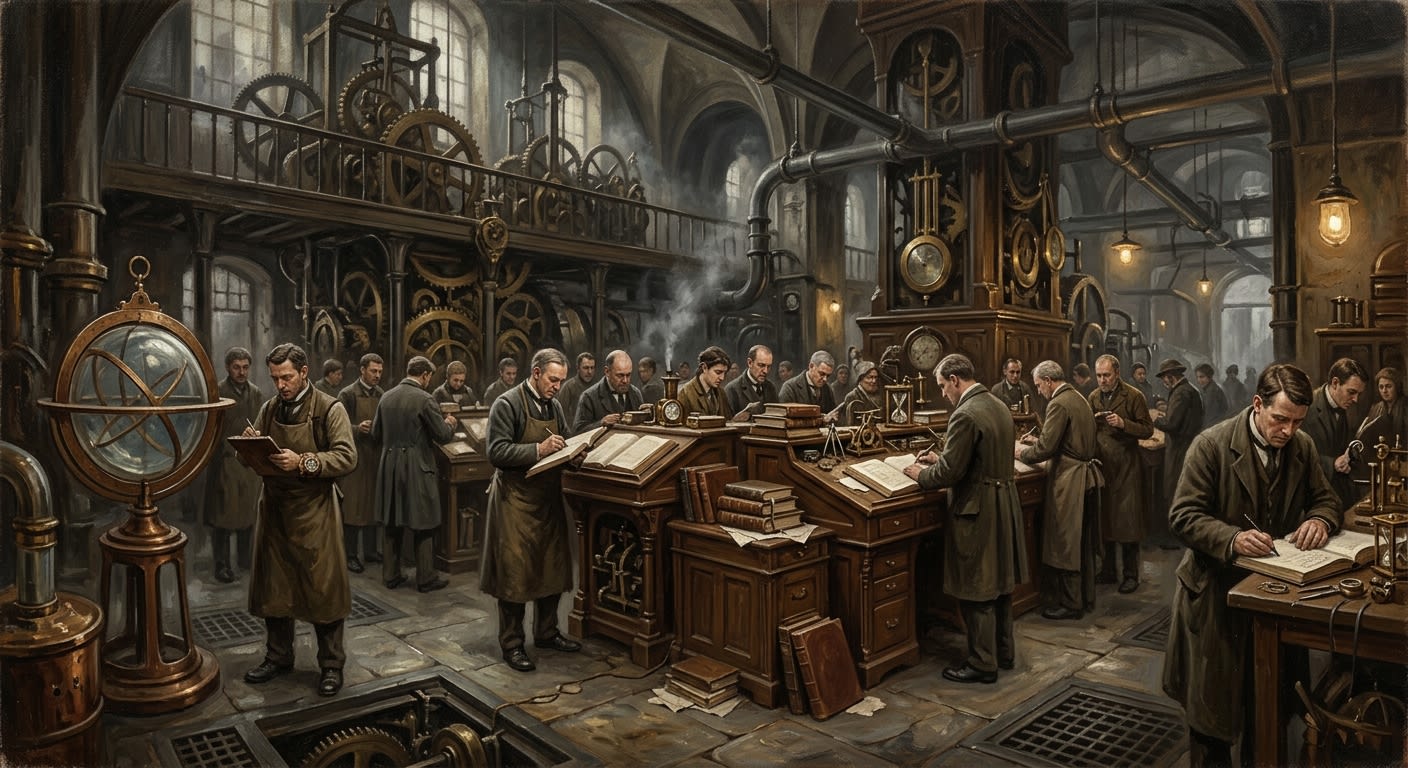
The Lyon Academy of Horological Sciences is the tolerated training-house from which the Bureau of the Hourglass draws its adepts, its instrument-keepers, its graph-maddened clerks, its field observers, and those thin sleepless persons whom soldiers along the Sagittal Line call clock-priests when they are being affectionate and worse when they are being accurate. It stands in Lyon, above the Rhône damp and below the city's opinion of itself, occupying a former Rationalist mechanics school, two requisitioned counting houses, a chapel whose saint has been removed pending interpretive settlement, and a sublevel whose public map ends before the stairs do.
It is not a university. The Synod does not require universities where a school, a barracks, a licensing desk, a tribunal room, and a locked cellar may be made to share rent. It is not a Bureau, though its graduates behave as if Lyon had an apostolic succession in brass. It is not a heretical institution, because Doctrine has inspected it fifteen times and never found heresy in a place convenient enough to close. It is an Academy: a useful suspect.
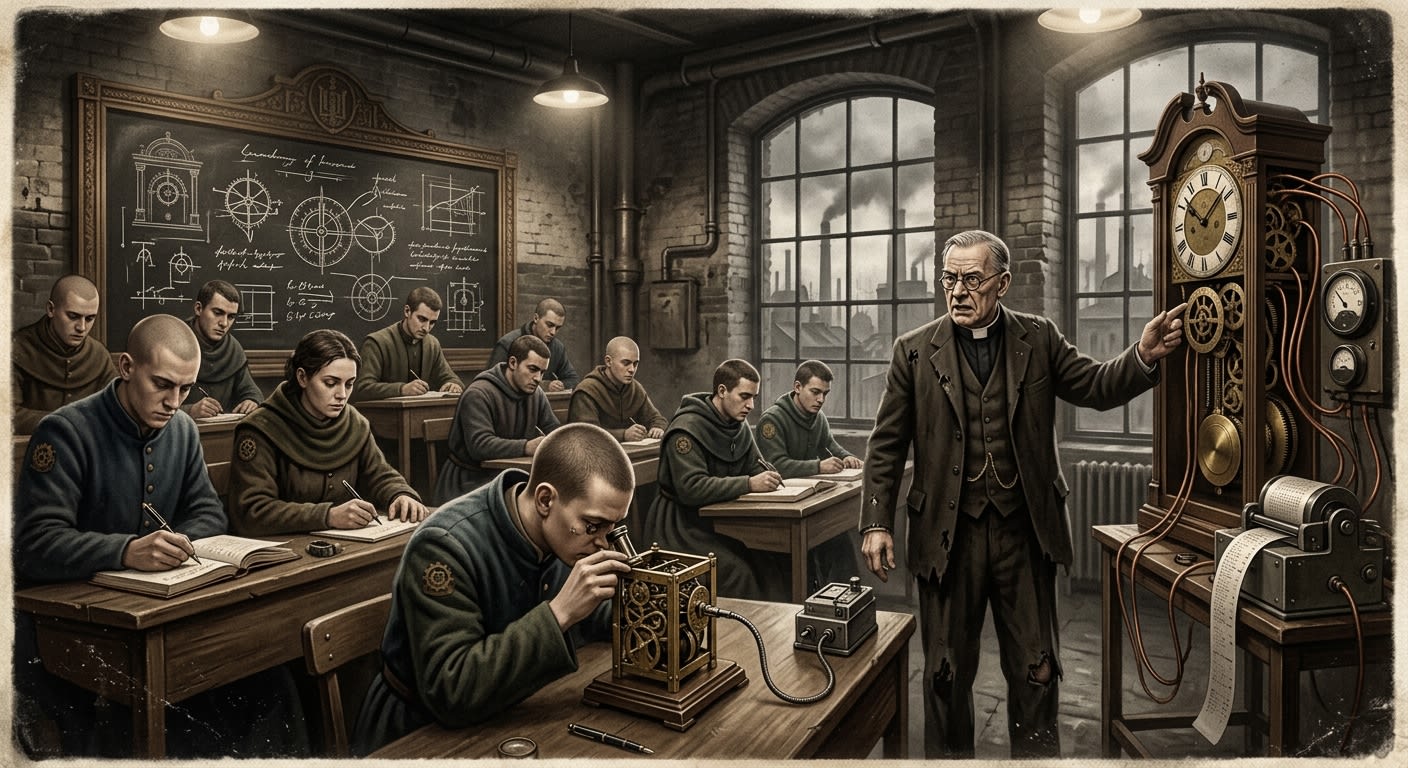
The Academy teaches bell-resonance analysis, oscillatory mathematics, telegraph synchronisation, candle-rate accounting, drag-gauge construction, pendulum drift, comparative chronometry, field notation, and the most difficult discipline in Synodal science: writing a true sentence blandly enough that it survives review by men whose principal instrument is a stamp.
Its motto, carved above the inner stair in austere black letters, reads: TEMPUS TESTATUR — Time Bears Witness. Doctrine has objected to the motto twice, on the grounds that witness belongs properly to souls, martyrs, relics, authorised officers, and certain categories of talking bone. The Academy answered that clocks witness only by analogy. Doctrine dislikes analogy almost as much as it dislikes being answered.
#On Its Foundation After the Clocks Began Lying
The Academy's authorised origin dates to A.S. 136, two years after the Bureau of the Hourglass was constituted in A.S. 134 by the Bureau of War, after the Drava clock-complaints had ceased being amusing, disciplinary, or deniable. The first Hourglass survey proved what every frightened rail crew had already known and what every senior office had spent four years not knowing: time along the Line could thin, drag, swell, refuse, and in certain foul localities accept correction only after being threatened with mathematics.
The Bureau needed staff. Staff require training. Training requires rooms. Rooms require budgets. Budgets require lies of attractive shape.
Lyon offered itself. Lyon is good at offering itself when the offering can later be sold as sacrifice. The city had old mechanics halls from the Rationalist period, river counting houses fitted for ledgers, clockmakers in sufficient number, bell-founders within tariff distance, and a civic habit of performance that could disguise fear as ceremony. Strasbourg approved the lease with the warmth of a man lending a knife to a barber he mistrusts.
The Academy began as the Lyon Hour Studies Annex, a poor little name with bad shoes. Its first cohort consisted of eighteen engineering clerks, seven bell-table assistants, four former artillery calculators, two monks of uncertain obedience, one widowed clockmaker, and a girl from the Rhône wards who could hear a pendulum flaw through a closed door. Within three years the Annex had produced timing tables valuable enough for War to fund expansion and alarming enough for Doctrine to appoint a resident observer.
The resident observer's first report called the place “spiritually dry.” The Academy framed the phrase and hung it in the Refectory of Measures. Doctrine ordered it removed. The Academy complied by moving it to the corridor where students queue for examinations, which is, according to the building plan, not a refectory. This was the first recorded act of Academy humour. There have been others. Most are worse.
Several later Academy pamphlets described the institution as “founded by the Bureau of the Hourglass in immediate fulfillment of its original mandate.”
Corrected. The Bureau founded an annex because it was understaffed, underbelieved, and frightened by its own survey. The Academy's nobility, such as it is, arrived afterward, like incense applied to a room that has already hosted an autopsy.
#On the Curriculum and the Sanctification of Boredom
The first lesson is listening.
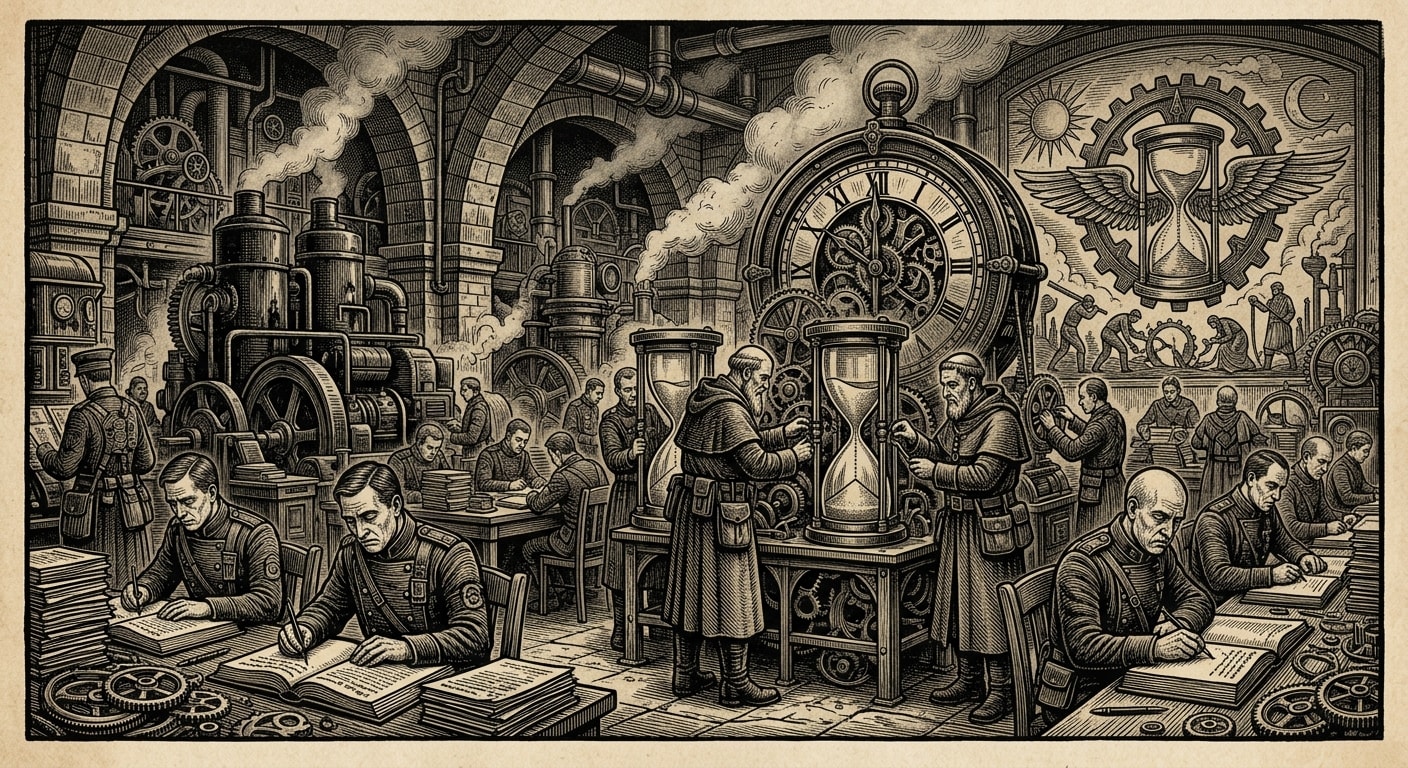
Students are placed in a bare room with twelve clocks, three bells, a water bowl, a candle, a telegraph sounder, a metronome, a pulse slate, and a senior instructor who will not repeat himself. They must identify which instrument is wrong, which instrument is lying, which instrument has been placed too near a relic fragment, which instrument is correct but offensive to the others, and which sound comes from the corridor because the building is old and Lyon refuses to repair anything that can be romanticised.
Most fail. Failure is useful. It teaches humility, and where humility does not take, exhaustion does.
The Academy's ordinary course lasts six years. The first year is arithmetic, mechanics, Latin for instruments, and devotional correction for students who pronounce “empirical” as if it were a sacrament. The second year is bell-resonance and telegraph beat. The third is pendulum irregularity, water-clock fault, candle-rate testing, and field sketching under mud spray. The fourth is drag-gauge mechanics. The fifth is Line taxonomy: Syrionic deceleration, oscillatory disturbance, stillness fields, extractive anomalies, and the black glyph of Class IV shown for exactly three breaths under supervision. The sixth is silence.
Silence, in Academy usage, does not mean absence of speech. It means disciplined non-interpretation. A student must learn to write reading exceeded baseline by forty-three seconds per hour instead of the fog wanted the patrol to sit down and die. Both may be true. Only one survives filing.
Students practise writing terror as inconvenience. A lesson might require converting “six men entered the fog and returned younger by three days” into “patrol encountered negative-age discrepancy, minor, personnel retained for observation.” This disgusts sentimental readers. Sentimental readers do not staff listening posts. The front has enough poetry. It needs warnings that can pass through seven offices before the paper starts screaming.
The Academy also teaches instrument piety, a phrase whose official definition is tedious and whose practical definition is: do not worship the gauge. Students bless tools, oil hinges, clean filaments, record serial numbers, and recite the Office of Saint Cadrin the Measured before examinations. They are forbidden to apologise to instruments after breakage. They do it anyway. Youth is sentimental even in graphite.
#On the Sublevel and the Black Standard
Beneath the Academy's west wing lies the Lyon Annex of the Bureau of the Hourglass, and beneath the Annex stands the Hourglass Monolith: the black central standard against which serious field instruments receive final correction. The Academy insists its students do not train upon the Monolith. This is true in the same sense that a cathedral school does not train children upon the Creator; access is limited, mediated, whispered about, and operationally unavoidable.
Senior students are taken once, hooded until the comparison chamber, then permitted to hear a drag-gauge descend near the sealed standard. They do not see the Monolith's surface. They see the attending adept's face. This is considered adequate instruction.
The lesson is usually effective. Three students in the last twenty years have requested reassignment immediately afterward. One became a Records clerk, one joined the Bureau of Tithes and now audits candle purchases, and one returned to class the following morning with white hair along the left temple and a dissertation proposal on reverse descent. The proposal was denied. The student later taught at the Academy for thirty-two years. His lectures were popular and badly attended, because the benches nearest him grew cold.
ACADEMY ACCESS LOG — SUBLEVEL TWO, A.S. 188 Cohort: Fifth-year calibration candidates, group size ██ Incident: student ███████ reported hearing examination questions before they were asked. Secondary: instructor's watch gained nine days during a six-minute lecture. Resolution: cohort passed; instructor transferred to administrative duties; watch sealed; questions reused after doctrinal cleaning.
The Monolith shapes the Academy even when unnamed. Its presence teaches the first law of Hourglass work: every measurement depends on a standard, and every standard is a hostage. The Academy's public clocks hang in courtyards and halls, bright, polished, civic. Its private standards sit behind doors, behind witnesses, behind prayers no one admits are prayers. Students learn the distinction. Some even survive it.
#On Students, Adepts, and the Vesk Problem
Academy students come from clockmaker families, bell-foundries, artillery schools, telegraph offices, cathedral timing desks, river navigation houses, and the occasional aristocratic household whose second daughter has displayed such intolerable brilliance that sending her to Lyon seems kinder than keeping her near marriage negotiations. The Academy has a talent for making inconvenient people useful. The Synod forgives much when usefulness arrives with tables.
Its most famous living graduate is Adept Meryth Vesk of Lyon, Senior Hourglass observer at Station Two, Bastion-Shipka, discoverer of the A.S. 199 ninety-second Skip report, refuser of Doctrine retraction in the matter of Somnolent Communion Cells, and author of the A.S. 194 Slumber-Hulk flatline analysis that taught War a monster may be still while the battlefield flows toward it.
The Academy claims her in public and apologises for her in private. This is maternal, cowardly, and recognisable.
Vesk's early papers on paired pendulum systems exposed to distant bell-strikes remain in the advanced curriculum under restricted notation. Students read the safe version, in which instruments respond to environmental disturbance. Instructors know the dangerous version, in which instruments respond also to attention, fatigue, ritual repetition, and the human wish to stop moving. Doctrine ordered the phrase observer-adjacent modulation struck from teaching plates. The Academy obeyed by replacing it with attentional variance, which was worse but shorter.
A.S. 190 recruitment broadsides praised the Academy for producing “obedient servants of measured truth.”
Amended after the Vesk correspondence. The current authorised phrase is “disciplined servants of measured report.” Truth remains Doctrine's jurisdiction. Report belongs to those poor devils who must stand in the marsh and count.
Graduates are assigned to Lyon calibration benches, bastion relays, rail synchronisation posts, bell-resonance stations, field survey teams, ossuary timing desks, and those unofficial listening rooms whose existence the Bureau of Shadows denies with such polish that one can see one's face in the lie. A few return to teach. Fewer return whole. Field service alters the good ones. They come back with narrower eyes, quieter hands, and the habit of pausing before answering any question containing the word “when.”
The Academy's failure rate is high. Its suicide rate is classified. Its marriage rate is low. Its graduates are prized by artillery officers, mistrusted by chaplains, courted by Bells, poached by Shadows, and occasionally arrested by Purity for possessing notebooks that look worse than they are. The notebooks are usually worse than they look.
#On Doctrine, Bells, War, and the Politics of Seconds
Four powers circle the Academy.
The Bureau of the Hourglass owns it in practice. The Bureau of Doctrine supervises it in principle. The Bureau of Bells covets its resonance tables. The Bureau of War wants its graduates near guns, bridges, marsh roads, and telegraph posts, preferably without the habit of explaining what their findings imply. War likes numbers. War dislikes consequences. This is why generals enjoy maps more than reports.
Doctrine's resident observer sits in a small office overlooking the Examination Court. The office has two clocks. They disagree. Academy tradition holds that no observer may request a repair without admitting dependence on local expertise. None has requested repair in sixty-one years.
The Bureau of Bells maintains a visiting chair in Cadence Distortion. The chair is literally a chair, bolted to a dais, because the first visiting lecturer from Bells walked while speaking and caused three students to faint by demonstrating cross-peal delay with boot taps. Bells people are dramatic even when counting. The Academy tolerates them because bells are the oldest honest clocks and because Hourglass adepts require allies with loud towers.
War funds field scholarships. A scholarship student signs six years of service after graduation and accepts assignment to any timing relay, rail clock, drag corridor, fog belt, or stillness post designated by need. The contract contains twenty-seven clauses and no promise of return. Students sign anyway, because poverty is the oldest recruiter and patriotism has learned to wear its coat.
The Academy's chief political crime is that it proves seconds matter before officers are ready to care. Seventeen seconds of telegraph drift can place artillery on the wrong ridge. Forty-three seconds of fog lag can make a patrol late to its own rescue. Ninety seconds can vanish daily at Station Two while Strasbourg discusses queue priority. The Academy teaches this arithmetic with chalk, bell, and humiliation. The humiliated do not always forgive.
#On Examinations and the Oath of Measured Silence
Final examination lasts three days, though several cohorts insist it lasts longer and one insists it occurred before matriculation. The official schedule refuses sympathy.
Candidates receive one faulty instrument, one correct instrument placed in a deceitful room, one true account written in unusable language, one false account written beautifully, one bell sequence from a front-line relay, one sealed fragment from the Monolith comparison archive, and one personnel file describing a soldier who hears his own childhood prayers during watch. They must classify, correct, rewrite, recommend, and remain awake. Sleep during the final examination is not automatic failure. It is data.
At the end, successful candidates swear the Oath of Measured Silence:
I will measure before I name. I will record before I interpret. I will warn before I am believed. I will not soften a number for comfort, nor sharpen a number for glory. I will keep the seconds entrusted to me until the Bureau comes to collect them, or until no Bureau remains to ask.
Doctrine dislikes the last clause. Students love it. Both facts are why it remains.
One candidate in A.S. 176 completed the final examination, collapsed, and continued writing for nine minutes after his pulse stopped. His answer sheet classified his own death as minor local discontinuity, non-hostile, self-limiting. The Academy awarded posthumous honours. Doctrine objected that dead men cannot graduate. Records found no rule against it. The diploma remains in the Hall of Late Submissions, where students leave sharpened pencils before difficult tests.
#On Present Condition
As of A.S. 201, the Lyon Academy of Horological Sciences remains open, licensed, inspected, underfunded, overproductive, doctrinally watched, and privately feared by every office that understands what its students are learning. It admits forty candidates in an ordinary year and graduates twelve to eighteen, depending on fog seasons, examination casualties, family withdrawals, and the number of students recruited mid-course by offices whose seals outrank decency.
Its courtyards smell of oil, chalk, wet stone, river mist, and the faint metallic dread that collects around instruments asked to testify against reality. The dormitories are narrow. The laboratories are clean. The chapel is undecided. The Refectory of Measures serves soup at exact intervals and bread by weight. Students steal seconds from sleep and minutes from meals. Instructors pretend not to notice unless the theft improves performance.
Lyon, of course, has made a little theatre of it. Clockmaker shops sell Academy-pattern watch chains. Festival hawkers offer toy drag-gauges to children who should not be taught such things cheaply. Mothers point at the black-coated students and warn that cleverness leads to bad posture, poor marriage prospects, and government service. They are correct on all counts.
At Station Two, Meryth Vesk continues to count the missing ninety seconds. At Lyon, her old Academy continues to produce the sort of mind that notices a missing interval and commits the social error of saying so. The Synod needs such minds, distrusts such minds, punishes such minds, and sends them east with notebooks.