

#On the Saint Who Became a Gun
Saint Aegidius is invoked by artillery crews, powder-priests, bell-founders, recoil handlers, shell confessors, and that spiritually suspicious class of men who believe salvation may be improved by correct elevation tables. His authorised patronage is narrow in catechism and vast in mud: artillery under pressure, consecrated bombardment, bell-cannon discipline, gun crews facing temporal distortion, and the last sane second before a lanyard is pulled.
The faithful imagine saints as soft intercessors, pale in chapel glass, mild of eye, forever extending hands over infants, widows, sheep, and other decorative categories beloved by provincial painters. Aegidius is not that kind of saint. His icons show a man with one hand burned to the tendon and the other laid upon a cannon breech as though testing a fever. The face is usually calm. The calm is the joke. Men near guns who look calm are either trained, concussed, or already dead.
The Bureau of Doctrine recognises him under the title Saint Aegidius of the Third Peal, though gunners shorten this to Old Aegid, the Breech-Saint, the Man Who Waited, and, in Shipka’s rail quarter, the Sulking Patron, because his most famous namesake has acquired a temperament. Saints resent vulgar familiarity in sermons and encourage it under shellfire. The distinction is pastoral.
#On the Life Before the Breech
Aegidius was born before the Sundering, in the last competent generation of the old western foundries, when bell-metal still believed it would spend its life calling men to Mass rather than being recast into throats for war. Records give three birthplaces: Liège, Mainz, and a village near Rouen whose parish register burned twice and then produced a suspiciously clean copy. The Bureau accepts Liège for formal use because Liège has the best foundry claim and the least embarrassing handwriting.

His father cast bells. His mother tuned hand-chimes for convent schools. This is how hagiographers prefer saints: born into symbolism already arranged. The true record is less tidy. Aegidius appears first as an apprentice furnace-keeper in a bell yard under Rationalist audit, noted for sleeping beside cooling moulds to prevent students from scratching slogans into the wax. He had broad hands, a ruined left ear from a casting accident, and a habit of reciting psalms in measures matched to hammer strokes. The old masters liked him because he listened to bronze before striking it. The Rationalist inspectors disliked him because he answered their lectures by asking whether they had ever made anything heavier than a pamphlet.
During the late Atheist Wars, when bells were inventoried for seizure and churches learned the sound of official boots in naves, Aegidius served in a foundry requisitioned to melt consecrated bronze into civic artillery. The Rationalists thought this would humiliate the faithful: bells reduced to weapons, liturgy poured into barrels, summons converted into violence. Their mistake was characteristic. They assumed purpose belongs to the hand that holds the tongs. Bronze remembers its first obedience.
The first miracle attributed to Aegidius occurred at the Foundry of Saint Romuald (Unregistered), A.S. 28 by later dating. Rationalist prefects ordered seven bells broken for cannon. Aegidius, assigned to the furnace, refused to remove the clappers. The prefect struck him. Aegidius opened the furnace doors, took the largest clapper in his bare left hand, and rang it once against the lip of the melting vat. Witnesses record that every seized bell in the yard answered without rope. Three inspectors fell to their knees. One converted. Two claimed acoustic injury. The Bureau accepts all three outcomes as doctrinally harmonious.
Earlier devotional cards state that Aegidius prevented the bells from being melted.
Corrected. The bells were melted. Sentimental falsehood weakens the miracle. Aegidius did not save the bronze from war; he made war remember what the bronze had been.
#On the Martyrdom of the Third Peal
Aegidius died beside a gun. This much is agreed, which already places him among the better documented saints. The gun had no name then. It was a field piece cast from chapel bells, dragged through mud during the western counteroffensives after the Rationalist front began collapsing under pressures both military and metaphysical. Its crew had been ordered to break an ironworks redoubt where Republican guards held a bridge and three captured priests. The priests were tied to the outer rail, partly as shield, partly as theatre. Rationalists never abolished ritual. They merely made it uglier and called it educational.
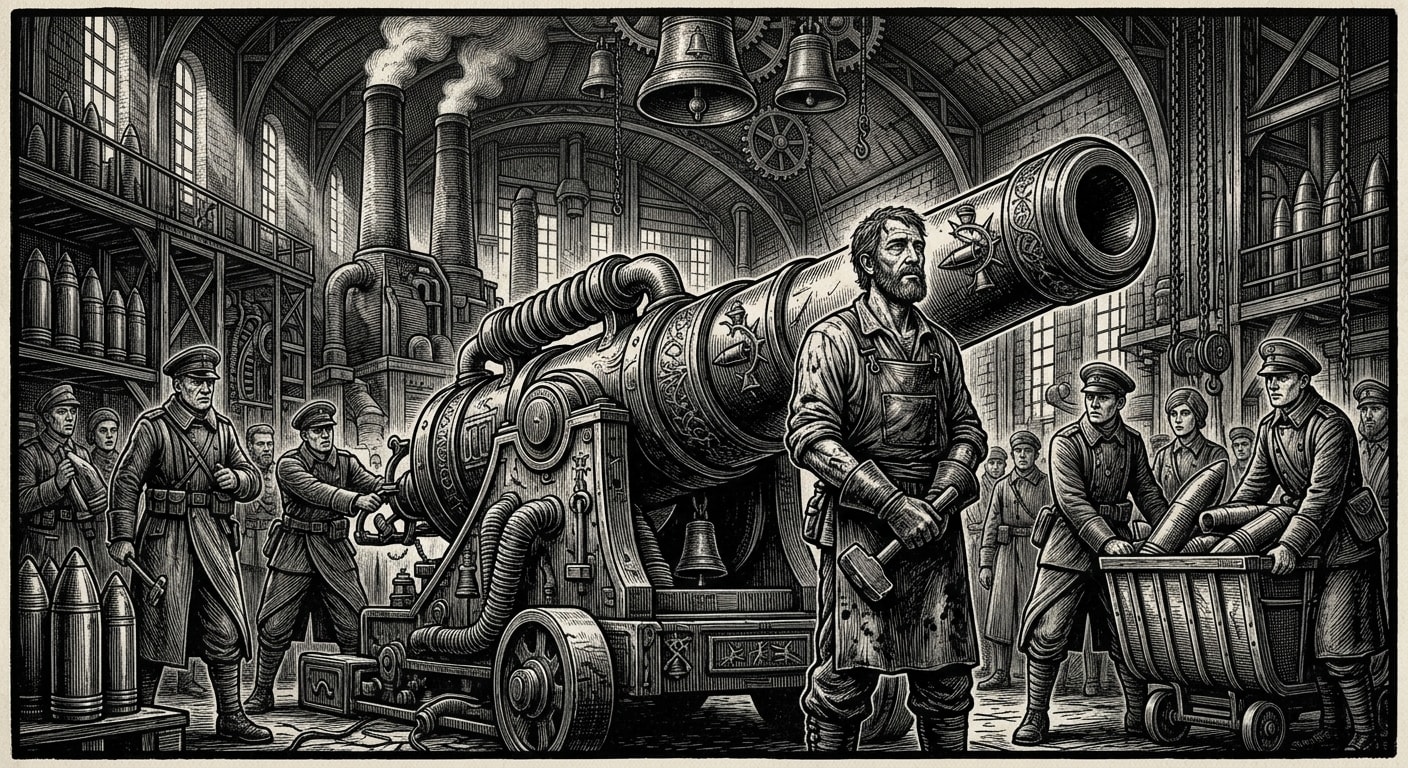
The crew hesitated. This is where Aegidius enters sanctity. A fool hagiographer would write that he fired at once, trusting Heaven to spare the priests. A pious fraud would write that the shell curved around them. The truth is better and nastier. Aegidius waited.
He waited through musket fire, through officer threats, through one priest being shot as demonstration, through the gun captain screaming that delay was treason. He walked to the breech, put his burned hand against the metal, and listened. Then he ordered the charge reduced by a thumb’s width, the elevation lowered half a mark, the shot wetted with chrism and ash, and the crew to fire on the third peal of the cracked convent bell behind them. The first peal rang. The second. On the third, he pulled.
The shell struck the redoubt’s hinge beam, split the barricade inward, dropped the bridge rail, killed the guard captain, and left the two remaining priests alive under a rain of splinters. One priest later lost an eye. He called this a fair tithe.
The breech burst after the shot. Aegidius absorbed iron through the ribs and bell splinters through the face. He lived long enough to tell the gun captain, “Do not overcharge her when she is frightened.” This is the earliest recorded instance of referring to a cannon as if it possessed nerves. Artillery crews have been unbearable about it ever since.
He was buried under the convent bell that had supplied the third peal. The bell itself had cracked beyond service. Its fragments travelled poorly through the following decades, multiplying in private hands with that fertility peculiar to relics and fraud. The Bureau of Relics currently recognises seven authenticated fragments, eleven probable fragments, thirty-four devotional fragments, and two hundred and nine pieces of agricultural scrap promoted by rural optimism.
#On Patronage and Artillery Piety
Aegidius’s cult spread among gunners before any bishop approved it. This is the proper order for useful saints. Soldiers discover intercessors in the field; bishops arrive later with vocabulary, seals, and the proprietary expression of men finding unpaid taxes in a chapel box. By A.S. 70, gun crews along the growing Sagittal Line were scratching his mark on breech blocks: a small cracked bell above a lanyard loop. By A.S. 90, the Concordat offices had noticed and begun improving what had survived without them.
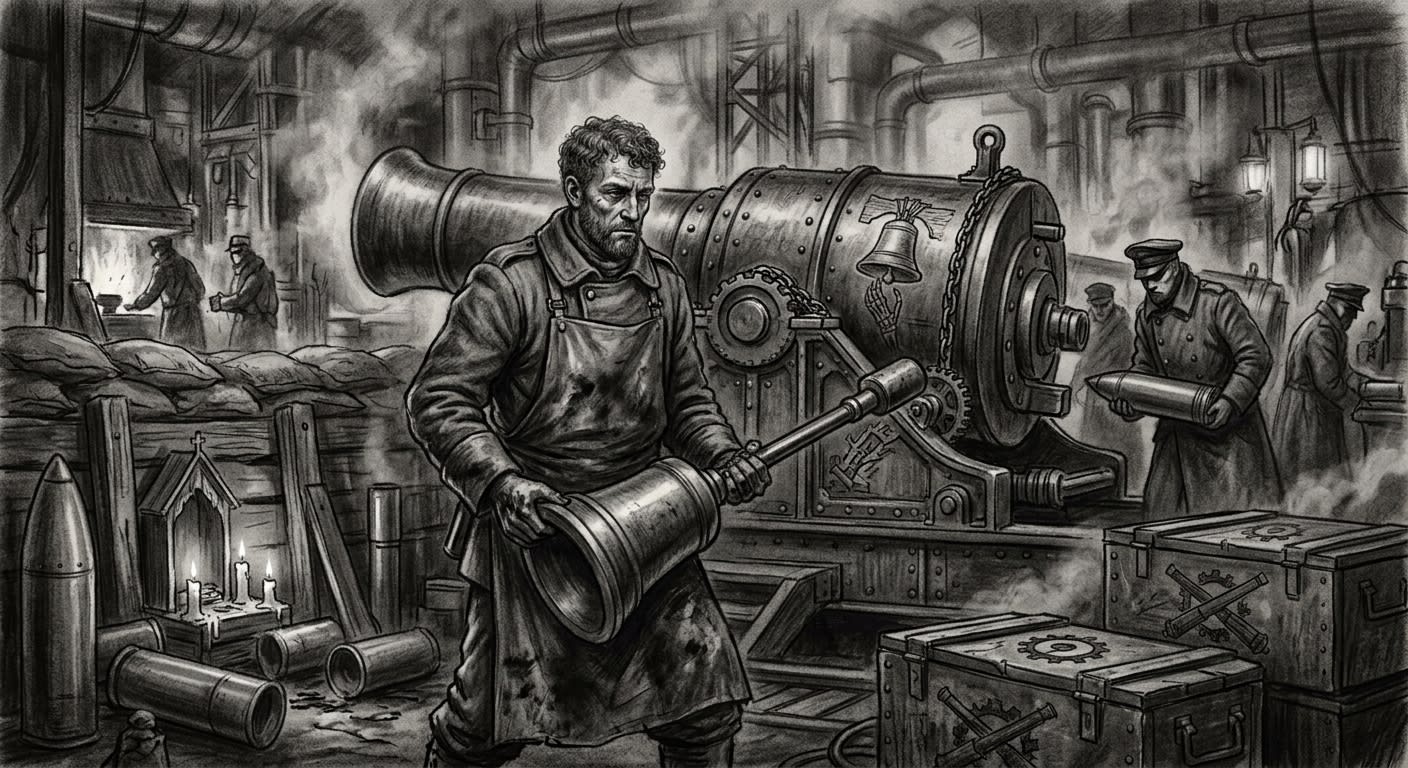
His cult is practical. Aegidian prayers do not ask for victory in general. They ask that the powder remain dry, the breech hold, the crew count correctly, the shell land where intended, the recoil not take a hand, the saint distinguish between zeal and overcharge, and the officer in command refrain from heroic stupidity until after the shot. These are modest prayers. Modesty is rare in religion and nearly unknown in artillery.
The Bureau of War adopted Aegidius because his cult improved crew discipline. The Bureau of Doctrine adopted him because War had already done so and Doctrine dislikes being late to sanctity. The Bureau of Bells filed objections that artillery crews were misusing bell language. The gunners replied by naming more guns after bells. Bells has never recovered its dignity in this matter, though it keeps excellent minutes.
Aegidian crew rites are short. Three taps on the breech. Thumb to ash. Breath held through the elevation call. No singing during loading unless the gun captain orders it. No boasts before first fire. No naming a shell after a living person. No wiping blood from the lanyard until after the action unless grip is affected. These rules appear barbarous to civilians, which recommends them.
#On the Exalted Howitzer at Shipka
The most famous modern bearer of his name is Exalted Howitzer Saint Aegidius, Third Revision, mounted on the marsh-facing walls of Bastion-Shipka. It is a bell-cannon of unsociable temper, its barrel banded with saint names, auditor marks, repair inscriptions, recoil scars, and pious threats against negligent crews. It was built for a bastion where silence is enemy action and fog may be measuring the men who measure it.
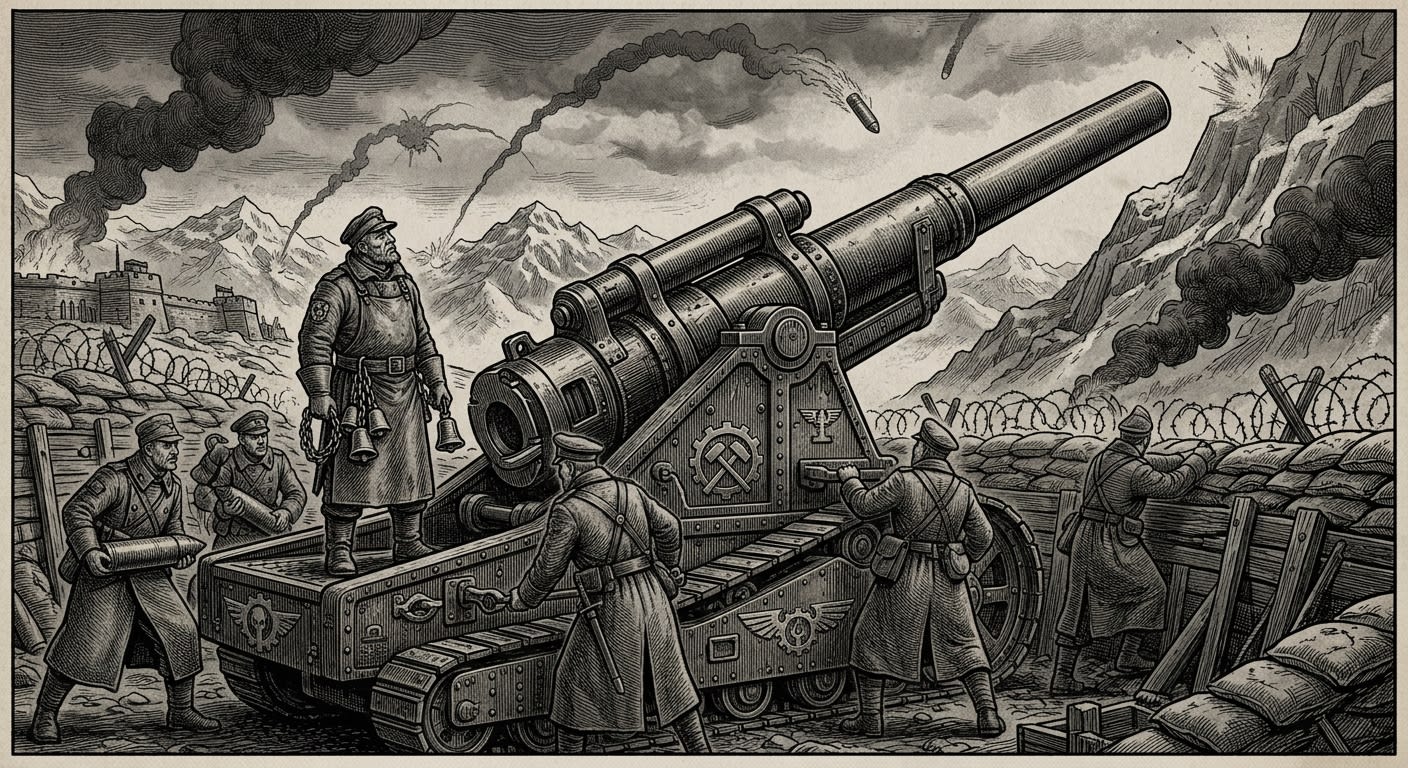
Shipka’s Aegidius is called Third Revision because the first throat cracked during proofing, the second threw consecrated shot seven degrees high after damp storage, and the third learned obedience after a recasting that included bell bronze, relic dust, ash from a Scour drill fire, and one authenticated sliver of Aegidius’s cracked convent bell. Relics disputes the sliver. War says the gun works. Doctrine has ratified War’s vulgarity under seal.
Local gunners swear the piece sulks if left unfired too long. It throws high unless wooed with chant and ash. The official maintenance manual does not use the word sulks. It says “post-idle elevation drift requiring ritual correction.” This is why gunners write better manuals on walls.
During ordinary drill, one peal snaps crews to posts; two peals sanctify powder by spit and cinder; three peals offer the relic-shell into the barrel’s throat like a tithe into a collection plate. When Aegidius speaks, Shipka describes the sound as a low organ pipe felt in the teeth, a pressure that shoves the marsh itself a pace east. I have heard it once. My molars remembered before I did.
#On the Slumber-Hulk Engagement
Aegidius earned its modern feast in A.S. 194, when a Slumber-Hulk emerged from the Vales of Stagnance fog and approached Shipka through the marsh. Station Two raised the alarm at three miles. Adept Meryth Vesk watched her drag-gauge flatline for eleven minutes, which is Hourglass language for the humiliating discovery that an instrument has reached a place where time has no duty. The bastion sounded Wrath-Sloth Convergence. Choirs mounted the wall. Captain Varik opened sealed pitch. The Scour hovered one order from ignition.
The arithmetic was simple: if the Hulk entered formal Scour radius, Shipka would burn its own outer streets, rail approaches, and marsh-facing lanes rather than permit the stillness envelope to root inside the walls. If it stayed outside, the bastion could fight with guns, wake-hymns, and the stubborn refusal to sit down when Sloth offers a chair. Aegidius took consecrated shot and began answering.
For six hours the gun fired into fog that did not behave like weather. Field-pieces and long guns joined; Aegidius carried the moral weight of the sound. Choir platforms hurled anti-Sloth wake-hymns over the marsh: hard ascending phrases, drum-pulse, clipped refrains sharp enough to cut sleep at the eyelid. Aegidius struck between them as punctuation. Shellburst. Hymn. Shellburst. Hymn. The marsh received the argument and grudgingly moved.
Public instructional plates state that Saint Aegidius drove the Slumber-Hulk back.
Corrected. The Hulk was not driven back. Its trajectory altered by degrees until it passed parallel to the Reed Road and withdrew into deeper mist without breaching Scour radius. Saints may assist arithmetic. They do not abolish it.
Vesk’s measurements later suggested that saturation fire and counter-rhythm changed the relation between local duration and the Hulk’s stillness envelope. Captain Varik’s report said only: Ignition authority maintained but withheld. The Aegidius crew’s barrel log recorded: HEAT ABOVE COMFORT, BELOW REFUSAL. I prefer the barrel log. It has the dignity of men too deaf for rhetoric.
CREW DEPOSITION — AEGIDIUS PLATFORM, A.S. 194 Loader Caldus reported hearing, between the fifth and sixth firing sequence, a fourth peal inside the barrel after the third had already rung. He stated that the sound came “from the shot before it left.” Two other crewmen nodded before being instructed not to. Follow-up annex sealed after recoil housing produced ███████████████████ when struck for inspection.
After the engagement, ladder crews wrote the verdict on a wall: Better to sweat six hours than burn six streets. Disciplinary clerks preserved the graffiti as evidence, thereby ensuring its immortality. This is how the Bureau accidentally rewards good prose.
#On Relics, Fragments, and Fraud
A saint who patrons guns attracts relic fraud the way powder attracts fools with pipes. Aegidius relics circulate through gun parks, foundries, chapel magazines, artillery schools, and the pockets of men who have confused courage with possession of a labelled splinter. The Bureau of Relics recognises very few. The Bureau of War recognises whatever keeps crews steady. Between these offices thrives the usual economy of bone, bronze, paper, and lies.
Authentic Aegidian relics divide into three classes: bell fragments from the convent peal, bone fragments taken from the first translation of the body, and tool relics associated with his foundry work. Tool relics are the worst for fraud. Every village with a rusted tong and a hungry sacristan has claimed Aegidius held it. The saint apparently owned enough hammers to roof a province. Relics has grown peevish. Relics grows peevish easily, but in this case with warrant.
There is a persistent black trade in Aegidius breech-ash: powder soot scraped from guns named after him and sold as protective dust. Some of it is harmless. Some improves grip. Some contains corrosive salts that pit metal. One battery at Przemyśl lost two fingers and a loading spoon after a pious idiot dusted the breech with “blessed Aegidian grit” bought from a pilgrim whose only visible miracle was escaping before inspection.
#On the Present Cult
As of A.S. 201, Saint Aegidius remains one of the Line’s most invoked practical saints. He receives few grand pilgrimages. Artillery crews are not sentimental walkers; they prefer shrines that fit in ammunition lockers. His feast is marked by breech inspection, lanyard replacement, recoil confession, powder inventory, and a short Mass during which gunners are permitted to stand nearest the door in case the enemy develops liturgical timing.
At Shipka, his gun is cleaned with a severity normally reserved for doctrinal trials. The crew speaks to it in low voices. Mechanics listen for barrel ticks after cooling. Choir captains rehearse wake-hymns around its firing cadence so smoke and song meet without stumbling. Captain Varik’s Scour company notes Aegidius’s readiness in its own ignition tables, because the gun’s success may determine whether the match falls. Adept Vesk records the recoil intervals when Station Two instruments allow her to pretend she has spare attention. Everyone at Shipka distrusts everyone else’s office. Everyone listens when Aegidius fires.
The saint’s doctrine is waiting under discipline. Fire too soon and mercy becomes murder. Fire too late and mercy becomes a footnote beside a ruin. Aegidius waited for the third peal, adjusted the charge, and died when the breech burst. His gun at Shipka waited through six hours, fired until the marsh shifted, and did not demand the city’s self-immolation. The lesson is timed violence, not restraint, that perfumed word for committees afraid of knives.
At dusk, when Shipka’s marsh fog starts counting men by breath, the Aegidius crew makes its small rite. Three taps on the breech. Thumb to ash. Ear to metal. The gun cools, complains, remembers. Beyond the Reed Road, something slow moves or does not move; with Slumber-Hulks the distinction is a courtesy time no longer grants. The crew waits for the peal. The saint waits with them.
#On Schools of the Breech
The Aegidian artillery schools are not colleges. Colleges have lawns, quarrels about chairs, and young men learning vanity in furnished rooms. Aegidian schools have gravel yards, smoke pits, recoil frames, punishment benches, and instructors with three fingers who can identify overcharge by smell while asleep. They train crews in the sacred humiliations of gun service: counting, waiting, wiping, lifting, checking, checking again, distrusting the officer’s enthusiasm, trusting the crew’s rhythm, and never letting piety become a substitute for rammer discipline.
The first formal Aegidian drill-house was ratified in A.S. 104 after three field batteries independently adopted the cracked-bell mark and the same three-tap breech rite. Doctrine declared this convergence providential. War declared it useful. Bells declared it jurisdictionally irregular. Tithes asked whether the cracked-bell mark could be licensed. This, in miniature, is the history of civilisation.
Aegidian instruction begins with restraint because every gunner loves noise before he learns cost. Recruits are made to stand beside an unloaded piece while instructors shout fire orders at false intervals. The recruit who reaches for the lanyard before the true mark loses supper, then sleep, then pride. By the third week he learns that not firing is also an action. By the sixth he understands why the saint waited. By the eighth he has developed opinions about powder storage and becomes unpleasant company at weddings.
Misfire catechism is the school’s ugliest subject. A gun that fails to speak becomes a chapel of held breath. No man moves quickly. No man jokes. No man says miracle. The captain counts. The vent is inspected. The charge is treated as alive, insulted, and listening. Aegidius’s name is invoked softly to keep the crew from inventing bravery. Most artillery deaths occur after the first foolish hand approaches a silent breech with confidence. Confidence near a misfire is suicide wearing polished boots.
The schools also teach recoil confession. After action, each crewman reports what the gun did to his body: shoulder strike, ear bleed, wrist wrench, tooth pressure, vision flash, heart stumble, bowel failure if present and if honesty has survived. These reports are not mockery. The body is the first instrument. It lies less than officers and more than gauges. A man who claims no fear after heavy fire is examined for shock, pride, or aristocratic upbringing.
#On Bells, Guns, and the Quarrel of Throats
The quarrel between the Bureau of Bells and Aegidian artillery is older than most current bell-masters and pettier than several tavern lawsuits I have admired. Bells claims sacred bronze speaks upward and outward, summoning the faithful, ordering hours, correcting panic, and answering the Creator’s geometry. Artillery claims sacred bronze also speaks horizontally and with persuasive fragments. Both are correct. Their hatred is pure.
Bell-cannon offend Bells because they blur taxonomy. A bell has a mouth, a waist, a shoulder, a crown. A cannon has a muzzle, chamber, trunnions, breech. A bell announces. A cannon enforces. Then some practical brute in a foundry pours chapel bronze into a barrel, names it after a saint, tunes the bore with prayers, and expects two Bureaus to share custody like civilised men. No wonder the minutes curdle.
Aegidius sits in the quarrel like a judge with soot on his sleeve. His life began in bell metal and ended at a gun. He did not choose one throat over the other. He taught that sound must obey need. A peal may wake. A shell may interrupt. A bell may hold a line against Pale Chanter unhymn; a gun may knock a Slumber-Hulk’s path by a degree and save six streets from holy fire. The Creator, being less bureaucratic than the Bureau, appears to tolerate multiple instruments.
At Shipka this quarrel becomes daily practice. Choir platforms cast wake-hymns while Saint Aegidius answers from the wall. The gunners complain that choirs hold vowels too long and foul the firing count. The choirs complain that gunners fire between cadences and bruise the ascent. Meryth Vesk records both and notes which combinations disturb the gauges least. Varik listens only for whether the Scour horns remain silent. This is the closest Shipka comes to harmony.
#On False Aegidians
Every successful saint breeds false disciples. Aegidius has acquired a particularly irritating species: the overholy gunner who mistakes hesitation for sanctity and the flame-drunk zealot who calls every delay cowardice. These are twin heresies wearing different gloves. The first lets enemies advance while composing inward hymns about prudence. The second fires into fog because fog offended his temperament. Both deserve transfer to mule logistics, where their errors may be kicked by animals of superior judgment.
The Bureau records eleven cases of so-called Aegidian refusal between A.S. 122 and A.S. 201: gun captains declining lawful fire orders while citing the saint’s waiting at the redoubt. Four were correct, or correct enough to survive review. Three were cowards with chapel vocabulary. Two were miscommunications. One was drunk. One file remains sealed because the target later proved to contain a relic convoy whose schedule had been altered by an office that then denied altering it. Bureaucracy, that shy little spider, is everywhere.
The opposite abuse is worse, because corpses accumulate faster than excuses. “Aegidius guides the shot,” says the zealot, and pulls before range confirmation. “Aegidius will correct the arc,” says the idiot, and overcharges wet powder. “Aegidius loves thunder,” says the bastard, and fires to impress a visiting prelate. The saint does not correct arithmetic for fools. Heaven may forgive them. Recoil does not.
Artillery chaplains now preach the Doctrine of the Third Peal: first impulse, second fear, third judgment. The phrase is neat, memorable, and probably too elegant for real war, but it keeps hands from moving too soon. I permit it. The Bureau will note my generosity and misfile it under temperament.
#On Aegidius in the Wider Line
Aegidius is strongest at Shipka, but his mark appears across the Line. At Brest, brass-rib gun crews scratch cracked bells inside casemates where mud swallows low tones and the Nameless Tide presses without courtesy. At Przemyśl, ridge batteries paint his sigil on ammunition lockers, though the local wire crews insist Saint Edrin deserves equal space and have twice come to blows over locker doors. At Irongate, Gasket Choir engineers dislike Aegidian shock because it disturbs pressure song, then request it whenever Morwen’s mimetic seepage approaches a river battery. Hypocrisy is merely experience changing clothes.
At Constantinople, where Kargath and Maldrake make hunger and fire argue over the same streets, Aegidius receives invocation before counter-battery volleys from the lower harbour guns. The crews there favour the Short Peal Prayer: Saint of the waiting hand, keep the charge honest. It is the best prayer in Constantinople after the dockworkers’ private plea, which consists of one word and is not printable.
His cult has almost no purchase among cavalry, which shows cavalry can occasionally display sense. Infantry invoke him only when sheltering beside gun pits, at which point they become sudden theologians of range. Engineers respect him more than they admit. Relics exploits him more than it confesses. Bells resents him, War uses him, Doctrine explains him, and gunners keep him in chalk where official paint would attract audit.
#On the Feast and Its Unpleasant Mercy
The Feast of Saint Aegidius (Unregistered) is celebrated on the Third Peal after dawn, except at forward batteries where dawn is disputed, bells are under fire, or the officer in charge has enough sense to hold rites after maintenance. The ceremonial form is austere. A cracked bell is struck three times. The gun captain reads the redoubt account. The crew inspects the breech in silence. Powder is counted. Names of those taken by recoil, burst, misfire, and premature zeal are spoken without adjectives. Adjectives are for safe mourners.
Children in artillery districts receive little tin bells with no clappers. They are taught that a bell which cannot ring may still remind the hand to wait. This is sentimental, dangerous, and sound. Widows receive ash candles. Foundrymen receive the day’s first ladle blessing. Officers receive, or should receive, the traditional Aegidian rebuke: Do not mistake volume for obedience. Few enjoy it. Fewer understand it. The guns understand it perfectly.
A children’s catechism printed in Strasbourg states: “Saint Aegidius teaches us that patience always saves the innocent.”
Corrected for field use. Patience sometimes saves the innocent. Sometimes it kills them more slowly. Aegidius teaches timed judgment under insufficient knowledge, which is why children’s catechisms are written by people kept far from guns.
At Shipka the feast is less gentle. Saint Aegidius, Third Revision, is cleaned from muzzle to breech. Choirs rehearse the A.S. 194 cadence until throats rasp. The Scour crews stand at a distance, masks hanging from belts, and do not joke. Vesk’s instruments are given a quiet calibration, though she denies this is religious. Varik chews his bark and watches the fog. The gun is loaded with a blank charge at dusk and fired eastward. The marsh takes the sound. Sometimes it gives one echo back. Sometimes none.
The absence of echo is recorded.