
#On the Hall That Mistook Laughter for Jurisdiction
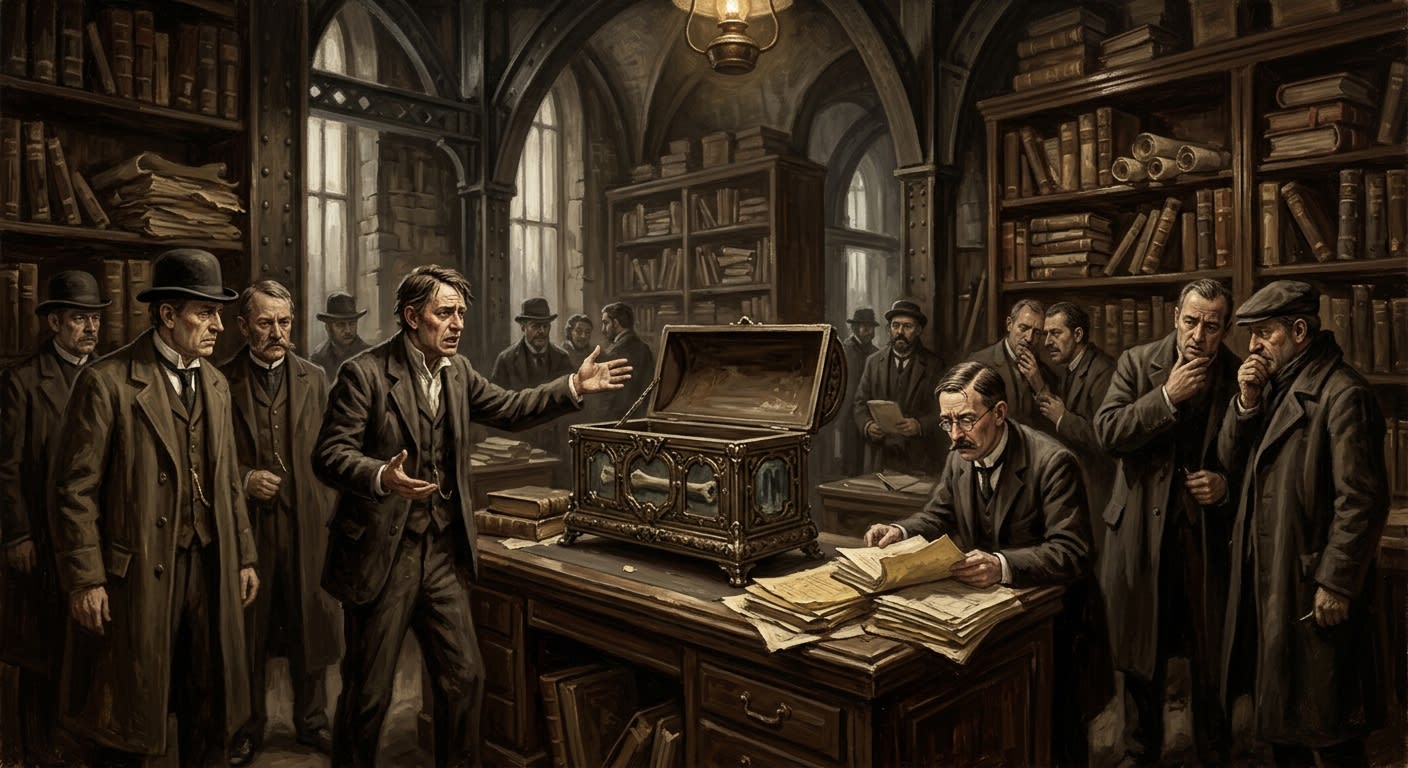
The Trial of Saint Aldebrand's Reliquary was held in Amsterdam in A.S. 11, though the word held gives the affair too much dignity and the word trial lends it furniture it did not lawfully own. No bishop summoned it. No canon permitted it. No court competent in relic custody sat over it. The Rationalists assembled a hall, a lecturer, two terrified priests, one displayed femur, several stenographers, a crowd trained to laugh before evidence had finished dressing, and enough Dutch paper to carry the insult across Europe by supper.
A tavern may also contain benches, witnesses, and a man shouting accusation over a bone. We do not call every tavern a tribunal, except in Cologne, and then only after the third bell.
The Rationalist genius lay in stagecraft. They had learned from the Year of Letters that sanctity can be wounded by arithmetic if the sum is placed in the hands of men who prefer mockery to kneeling. In –32 A.S. (1678 CE, before the Bureau's calendar), Van Hoorn, Lemstra, and de Waal had counted Aldebrand bones, femurs, skulls, finger-joints, healing splinters, and reliquary scraps until Europe began asking whether a saint might have possessed the skeleton of a regiment. Dr. Matthias Voll inherited the count and made theatre of it.
The hall chosen for the Trial had good acoustics. That detail matters. A heresy intended for print needs quiet margins; a heresy intended for humiliation needs laughter to carry. Voll understood the room. He positioned the priests where the crowd could see their faces and placed the femur where the candlelight struck it like a witness too pale to answer. Then he began counting.
#On Dr. Matthias Voll and His Centipede
Dr. Matthias Voll titled his lecture On the Statistical Distribution of Relics, a phrase so bloodless that one must admire how much injury it concealed. He was no drunken iconoclast swinging a hammer in a shrine. He was worse. He was orderly. He carried tables. He spoke in a measured voice. He made blasphemy sound like a correction to an invoice.
His argument was clean enough to be dangerous. If every reliquary claiming an Aldebrand femur were genuine, the saint would require more thighs than Providence usually assigns to a parish cleric. Cologne alone held seventeen authenticated femurs, each sole, each genuine, each notarised, each bearing seals from men who had never expected their confidence to be cross-examined by a Dutchman with chalk. Voll raised the displayed bone and named the conclusion: fraud.
The crowd laughed.
The priests seated before him were not there to argue. They were there to suffer visibly. The Rationalists had learned that a silent priest proves nothing, a defiant priest may become admirable, and a frightened priest can be made into a public instrument if the hands holding him know when to loosen the gag. They asked questions whose answers had been prepared by force. They demanded assent to a conclusion no man could resist without inviting a second lesson in Enlightenment manners.
The Trial acquired its famous confession in that manufactured misery: the femur was declared “pig fragment, common, undressed, of no liturgical significance.” The sentence travelled because it was ugly, short, repeatable, and cruel. A sermon limps where such a phrase runs. Within a month, it appeared in broadsides, tavern songs, student jokes, merchant letters, and chapel whispers from Amsterdam to the Rhine.
Certain devotional retellings state that the two priests freely confessed, then repented, then suffered martyrdom.
Corrected. The confession was coerced. The repentance belongs to later pious embroidery. The men were not martyrs in that room; they were victims made to hold the enemy's ink. A lesser office would prefer the cleaner story. Doctrine prefers the useful wound.
One priest signed his name backward. This detail escaped the stenographer, escaped the laughing hall, escaped the first printings, and later became dearer to Records than any whole paragraph of heroic defiance. A backward signature is not a sermon. It is smaller, meaner, harder to decorate. It says the hand obeyed while the soul spat.
#On the Femur's Disappearance
The femur vanished from the Amsterdam hall that same night. This is the part of the affair the Rationalists never learned to enjoy.
They had made the bone into evidence. Evidence, according to their catechism of little knives, should remain available for inspection, tabulation, reiteration, and smug pointing. By dawn it was gone. The locked case was empty. The guard had heard nothing. The stenographers disagreed about the hour. The hall porter swore that the candles burned blue after midnight and that something laughed under the table, which statement has been classified as fatigue, drunkenness, hostile invention, or correct in a manner unhelpful to public instruction.
AMSTERDAM NIGHT NOTE — UNSEALED COPY, LATER DAMAGED Object: femur from Voll demonstration. Case: opened without splinter, key, or broken wax. Witness: porter, later recanted after three conversations with men carrying no office badges. Recorded sound: “bone laughter” / “chair scrape” / ████████████████ Destination: where arithmetic cannot follow.
The Rationalists blamed clerical thieves. Clerical agents blamed Dutch thieves. Dutch thieves, displaying an almost sacramental prudence, blamed the weather. The Bureau of Shadows did not yet officially exist and filed no report, which is one of the firmest species of report it ever produces.
The bone's later custody is disputed because all interesting relic histories are disputed. It may have returned to Cologne. It may have entered the Reliquary of Saint Aldebrand as part of the mace borne at Vienna. It may have slept under a canal stone until some eel acquired a better theology than the entire Amsterdam Academy. The Bureau's public position is that the specific femur is unlocated. Its doctrinal position is that nothing required for Providence is ever lost. Its administrative position is sealed.
The disappearance damaged Voll's victory. Mockery wants a trophy. Without the bone, the lecture became a performance around an absence. Absence is dangerous ground for Rationalists; they do not control it. The Church, being older, has cupboards full of it.
#On the Transcript and Its Petty Annulment
The printed transcript did more harm than the hall. A crowd disperses. Paper marches.
Within weeks, copies moved through Amsterdam printers, Dutch merchants, university corridors, Lowland counting houses, and those discreet channels by which polite poison reaches parishes before bishops can afford antidote. The confession was repeated in forty cities. Shrine queues thinned. Aldebrand medals were returned, sold, hidden, or worn inside shirts rather than outside. Children in two recorded schools chanted the centipede joke until their instructors discovered courage by way of the cane.
The Synod answered with paleography. Praise the Creator, and praise the clerk who noticed the angle.
The Bureau did not annul the transcript chiefly by arguing duress. Duress is crude and obvious, and obvious injuries invite sympathy. Sympathy invites theatre. Theatre, as Amsterdam had just proved, may be stolen by the enemy. Instead, Records produced forty-seven pages on handwriting, pressure, slant, terminal flourish, ink hesitation, and the miraculous eloquence of one improperly leaning vowel. The letter e became a fortified gate. Through it, the whole confession was thrown back into the enemy's teeth.
The annulment was correct. It was also petty, evasive, overbuilt, and splendid. The Rationalists had used number against sanctity; the Synod used angle against transcript. They put a saint in arithmetic. We put their confession in penmanship. Both sides chose weapons. Ours had better manners.
The two priests were later removed from public view. Records says reassigned. Purity says secured. Mercy says treated. Doctrine says nothing beyond the fact that one backward signature remains in custody and is shown to advanced students only after they have ceased believing defiance must be picturesque.
#On the Broadside That Reversed the Room
The Synod Museum preserves the Trial as a two-register broadside in the Hall of Heretical Refutation. The lower register shows Voll in Amsterdam: femur raised, priests bound, crowd leaning forward with the bright, wet hunger of people discovering that another man's humiliation may be called inquiry. The upper register shows Vienna in A.S. 95: the Aldebrand reliquary mace blazing above the breach while Clemens Stahlhand advances on Althazar of Pest. An arrow commands the viewer to read upward.
This is proper pedagogy. Children understand height.
An earlier museum label described the Trial as “later disproven by miraculous evidence.”
Withdrawn for cowardice. The Trial was not disproven. It was answered by a reliquary mace at Vienna with enough force to shatter command, glass, skull, and the last polite refuge of Voll's arithmetic. Labels must stop apologising for miracles.
The broadside is vulgar and effective. Scholars dislike it because it refuses to pretend their objections matter. Pilgrims like it because it gives them what they came for: the sneer below, the blow above, the Enemy corrected in a language older than print. I have stood before it and watched a banker cross himself. There are few higher endorsements of graphic design.
The museum allows controlled viewing of a Trial transcript facsimile beneath the broadside. The original remains in the Forbidden Stacks, shelved near Voll's lecture and a Dutch pamphlet arguing that martyrdom should be audited for civic inefficiency. Students are made to read the transcript from bottom to top, beginning with the annulment. This improves the moral order of the page.
#On the Verdict Supplied by Vienna
A.S. 95 did what no memorandum could do. At Vienna, the reliquary mace struck Althazar of Pest; Saint Rupert's bells rang without hands; the attacking column broke; and the non-existent, mocked, erased, multiplied, jeered-at Aldebrand bone entered history by force.
The Trial did not become harmless after Vienna. No old wound does. It became useful. Doctrine keeps it because it teaches the faithful that laughter is not victory, that arithmetic is not authority, that coerced ink can be strangled by one backward name, and that a relic may wait eighty-four years before answering a lecturer. The Bureau prizes patience when Providence supplies it after the fact.
As of A.S. 201, Voll's centipede line survives in student mouths, tavern corners, Dutch private jokes, and Purity bait exercises. The Bureau permits limited circulation because rats prefer visible crumbs. Saint Aldebrand survives in relic, prayer, contradiction, and custody. His femurs remain too numerous. His mace remains too present. His patience remains insulting.
The hall laughed first. The bone answered later.