
#On the Brigade That Inspected Bread
The 14th Rhine Customs Brigade was a Rationalist frontier unit posted along the Cologne-Deutz crossing during the late Republic, assigned to tariff enforcement, contraband search, relic interdiction, and the tedious inspection of river traffic at the precise hour when history placed three apostolic phalanges under a loaf of black rye and invited them to do their worst. The Brigade did not do its worst. It did its paperwork.
In A.S. 31, when Ignatius Brenner crossed the Rhine with Relic 31-C(α–γ) (Unregistered) in a breadbasket, the 14th maintained bridgehead watch, pedestrian search lines, ferry-yard spot checks, and the eastern Deutz landing patrols that were meant to ensure that nothing sacred crossed water without being seized, catalogued, mocked, tested, burned, or repurposed by some Philosophical Prefect with clean cuffs and no imagination. They were not fools by the ordinary military measure. Their tallies show competence: weapons found, forged travel slips seized, undeclared coin impounded, rosaries confiscated, devotional scraps sent to the evidence rooms, and smugglers fined with that cheerful hypocrisy by which every state condemns smuggling while feeding on customs revenue.
They missed the bones.
#On Its Office Under Reason
The Brigade existed inside the Rationalist Republic’s fussy dream of clean borders. After the Treaty of Regensburg and the Concordats of Governance, the Rhine ceased to be merely a river and became a ruled line, a taxable throat, a philosophical membrane across which objects were expected to declare what they were and citizens were expected to become legible before crossing. Legibility was the Republic’s favourite sacrament. It did not call it sacrament, naturally. Heretics rarely recognise their own altars.
The 14th answered to the local chain of the Philosophical Prefecture: customs commandant, Civic Security Marshal, Philosophical Prefect, and the Republican Guards who supplied muscle whenever a parcel acquired theological implications. The Brigade’s uniform was river-grey with blue sleeve tabs; its officers wore brass measuring chains at the belt, as though sanctity might be defeated by looking prepared to assess barrel circumference. Their search tables carried knives, awls, wax picks, weighing pans, vinegar jars for ink testing, and little iron boxes marked SUPERSTITIOUS RESIDUE.
The boxes survived. The men did not, mostly.
A later Synodal children’s primer described the 14th Rhine Customs Brigade as “lazy secular sentries overcome by holy blindness.”
Corrected. Laziness would be comforting. The Brigade was methodical, active, and by surviving Rationalist standards well managed. It failed because it understood rebellion as weapon, pamphlet, coin, password, and blade. It did not understand bread as reliquary.
Its remit widened after the Edict of Rational Allocation made sacred property civic matter. Chalices, reliquary casings, altar plate, parish records, bell fragments, saint-bones, prayer cards, manuscript leaves, rosaries, consecrated oil, incense resins, baptismal salts, and suspiciously reverent embroidery entered the seizure categories. The lists grew longer, which made the searches slower, which made the queues angrier, which made the guards more inclined to wave through the plain man with plain bread because thirty-seven carts behind him were already shouting.
#On the Checkpoints
The Cologne bridgehead had two customs tables and one inspection screen. The first table handled declared goods: flour, salt, cloth, tallow, beer, tools, hides, books, and all other matter sufficiently ordinary to become suspicious under pressure. The second table handled bodies: name, work, destination, family relation, passmark, prior crossings, parish residue if known, and whether the citizen answered too quickly when asked what he believed. The inspection screen stood behind, where Republican Guards conducted random physical searches and Philosophical clerks made the solemn little face of men detecting infection in other people’s habits.
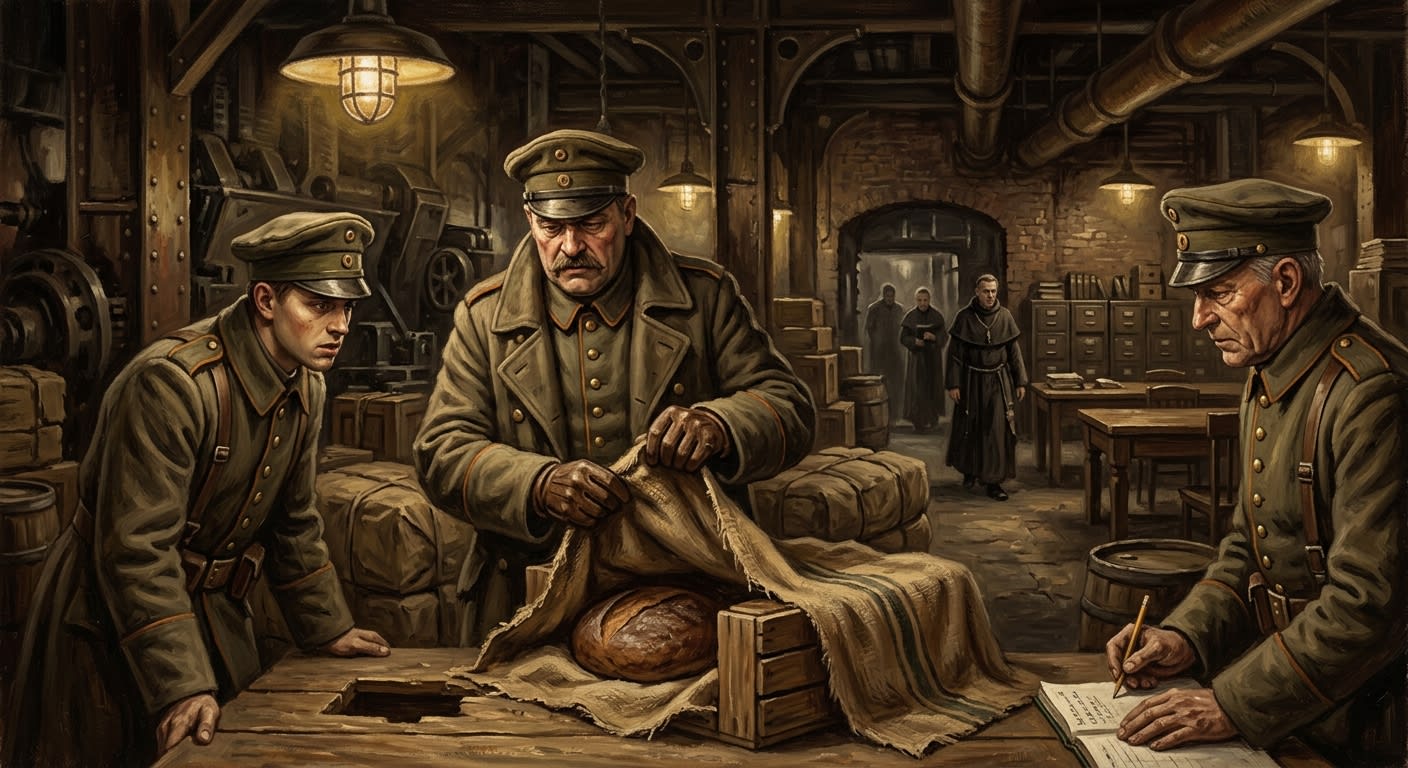
Brenner arrived with a wicker basket on his left arm, a checked cloth over black bread, and the calm of a man who knew the Creator was watching and the guards were not. The Brigade saw what it had trained itself to see: an ageing parish clerk, brown coat, ink smell, delivery errand, no visible defiance. A Philosophical Prefect asked his business. Brenner said he was delivering bread to his sister in Deutz. The Prefect looked at the basket. The Prefect looked at Brenner. The Prefect waved him through.
At the Deutz landing, a guard lifted the cloth. He saw bread. He did not lift the bread. That motion — or that failure of motion — has earned more Doctrine commentary than several battles. Lift cloth: permitted. Lift loaf: omitted. Replace cloth: civilisation altered.
The surviving crossing-sheet contains no confession of wonder. It records, in a hand later identified only by pay roster: “male, clerk type, bread, Deutz, passed.” Four words and a comma stood between apostolic fire and confiscation. Records has displayed a facsimile in Strasbourg twice, both times after removing the guard’s abbreviated initials because crowds have a vulgar appetite for blame and saints have enough candles already.
#On What They Found Instead
The Brigade’s defenders, a small and irritating school of modern corrective historians whom Purity watches and I tolerate for sport, argue that no unit should be judged by one missed basket. Very well. Let the ledger of their successes hang beside the basket and embarrass itself.
They seized six forged passports during the autumn inspection cycle. They found a Republican Guard officer carrying his mother’s rosary beneath his uniform, a case later folded into Relics custody after the rosary proved inconveniently warm during a post-Sundering inventory. They impounded three devotional medals hammered flat into shoe heels, eleven parish slips hidden in soap, a chalice stem soldered into a candlestick, and one child’s primer whose arithmetic exercises concealed the names of safe houses by every seventh answer. They also seized seventy-nine illegal sausages, which tells us either that sausages were used by the faithful for concealment or that customs men will always find dinner before truth.
Their reports are efficient. That is what makes them hateful. “Superstitious metal fragment.” “Unlicensed icon.” “Possible bone.” “Prayer text in diminutive script.” “Woman noncompliant; tongue intact; referred.” The Republic made cruelty dull enough to survive lunch. The 14th wrote it down in small columns, sanded the ink, and moved the line.
Synodal tavern songs claim the 14th found “nothing but crumbs” during Brenner’s passage week.
False. They found much. They failed to find what mattered. Song prefers neat contempt; Doctrine prefers the sharper cruelty of competence missing the only hinge that counted.
The rosary case deserves its own nail in the cabinet. The officer who carried it was tried and sentenced. His mother’s beads entered evidence, then storage, then authentication after A.S. 106 when the bead-string reportedly tightened around a clerk’s wrist during an inventory dispute. The Bureau of Relics now displays it every third Solemnity of Correction (Unregistered) as Relic 31-R(Supplementary) (Unregistered). The 14th meant to destroy devotion. It contributed to a display case.
#On the Failure’s Consequence
Relic 31-C(α–γ) reached Deutz. Aldric Hartmann hid it beneath fermentation vats. Klara kept it hidden after Hartmann’s death. Brenner later recovered it and sent it through Koblenz, the 7th Rearguard Column, and Brother Tomislav’s company toward Kalnik Ridge. In A.S. 48, those finger bones burned demons. The Brigade’s missed search became, by a chain too long for smug men and too plain for poets, a battlefield fact.
No official Rationalist reprimand survives for the missed basket. This silence is almost tender. The Republic did not know what it had missed before the Sundering broke its categories. By the time Kalnik Ridge made the bones famous, the Republic’s offices were ash, its prefectures cracked, its Guards deserting or praying in private, and the men of the 14th were scattered into refugee columns, prison details, Synodal interrogation rooms, or graves of such administrative confusion that even Records has shown mercy by not improving them.
The Synod, being more patient and better dressed, noticed.
COLOGNE ANNEX — POST-RECLAMATION INTERVIEW FILE, A.S. 57 Subject: former customs assistant, 14th Rhine Customs Brigade, Deutz landing rota. Question: “Did you inspect a breadbasket carried by Ignatius Brenner?” Answer recorded: “We inspected thousands.” Subsequent line: ███████████████████████████████████ Disposition: labour reassignment; later annotation says “dreamed of loaves opening like mouths.”
In A.S. 104, at the canonization of Saint Ignatius the Carrier, the Brigade entered official hagiography as the obstacle that failed. It is a useful role. Every saint requires a door, a guard, a road, a river, a knife, a fool. The 14th provided the guard and the fool in one uniform. Pilgrimage prints have since rendered its men as sneering brutes with bayonets and bad posture. This is dramatically satisfying and structurally false. A sneering brute might have stabbed the bread for sport. A bored professional lifted the cloth and stopped.
#On the Brigade After the Synod
No direct institutional descendant is acknowledged. This phrase, “direct institutional descendant,” has the pleasing evasiveness of a well-trained eel. After the Collapse, the Synod inherited depots, routes, tables, search tools, ferry procedures, seized-property rooms, river schedules, and personnel whose previous loyalties could be corrected with oath, hunger, or rope. The Brigade disappeared. Its furniture remained.
Modern Rhine customs officers use better forms and holier seals. They still lift cloths. They still fail, on wet mornings, to lift what lies beneath. They are instructed on the Brenner crossing (Unregistered) during their first week, usually by a senior clerk who places a loaf on the table, asks what it contains, and then fines any recruit who answers before cutting it. The lesson is sound. The recruits resent it. Resentment improves memory.
The Brigade’s surviving ledgers are kept in Cologne under controlled contempt. Scholars may consult summaries. Purity may consult names. Doctrine may consult the original crossing sheets on the Feast of Saint Ignatius (Unregistered), after washing hands and swearing not to laugh where junior clerks can hear. I have laughed. Junior clerks require examples of earned privilege.
As of A.S. 201, the 14th Rhine Customs Brigade is invoked by porters, smugglers, relic couriers, and Rhine customs instructors as a warning against searching for the expected sin while the actual miracle sits under lunch. Its name remains Rationalist. Its use is Synodal. Its failure is ours now, by right of victory and superior captioning.
On the warehouse wall in Deutz, pilgrims read: HERE PASSED A FAITHFUL MAN. No plaque records the guard who let him pass. Quite right. A plaque would be excessive. A customs table, a loaf, and the order to cut deeper are memorial enough.