
#On the Reckoning of What Was Lost
"They measured the world and found it wanting. The world returned the assessment."
I am Valerius Drax, Warden of the Sacred Ledger, and I will tell you of the day that Reason — which had conquered kings, burned cathedrals, melted crowns into secular coin, and rewritten every map from the Baltic to the Tagus — discovered that the thing it had spent a century measuring was measuring it back, and that its measurements had teeth.
The Collapse of the Rationalists is the name the Bureau of Doctrine has affixed to the events of A.S. 45, the year called 1755 in the dead calendar that Reason preferred. It is a misnomer, of course. A collapse suggests a structure that gave way. What occurred was an erasure — a nation, a philosophy, and an entire governing apparatus ceasing to exist with the abruptness of a candle meeting a boot-heel. The Rationalist Republic did not fall. It stopped. And in the space where it had been, there was nothing but fire, and fog, and the sound of something eating.
#On the Omens: A Decade of Ignored Memoranda
The Collapse did not arrive without warning. The warnings arrived without effect, which is a condition the Bureau recognizes as distinct from surprise. Between A.S. 30 — the year the Treaty of Regensburg proclaimed the triumph of Reason and dissolved the last ecclesiastical court west of Vienna — and A.S. 45, the Eastern Marches produced a catalogue of portents so specific in their malice that even the Rationalists, who had built a civilization on the premise that portents do not exist, were obliged to file them under categories.
They filed the wrong categories.
In A.S. 32, the sun declined to rise for forty days. The Rationalist astronomers of the Imperial Academy at Vienna published a joint memorandum attributing the phenomenon to a "natural eclipse of extended duration caused by atmospheric particulate originating from the Eastern Mediterranean." The memorandum was printed on excellent paper, bound in calfskin, and distributed to every observatory and learned society from Amsterdam to Rome. It is preserved today in the Forbidden Stacks at Strasbourg, where it remains warm to the touch — not from the heat of its argument, but from the proximity of things that burn without consuming. The Bureau of Alchemical Standards has tested the binding. The results are filed under Seal Amber.
In A.S. 34, the Danube boiled crimson for three weeks. The Rationalist hydrologists — and here I pause to note that they had hydrologists, which is to say, men who believed water could be explained — proposed volcanic runoff from the Transylvanian Alps. They were wrong. Water that boils crimson and drowns villages is not runoff; it is bleeding, and the wound was the earth itself, opening in preparation for what was about to walk through it.
In A.S. 38, the Balkan villages ceased all correspondence. Letters stopped. Merchants stopped. Refugee columns staggered westward with eyes that had been emptied of everything except the memory of running. The Rationalist border garrisons filed their reports: "Rural instability, Eastern Territories, Classification Pending." The classification is still pending. It has been pending for one hundred and fifty-six years. The Bureau of Records has inherited the file. I have read it. The ink smells of ash.
#On the Day Itself: 1 November, A.S. 45
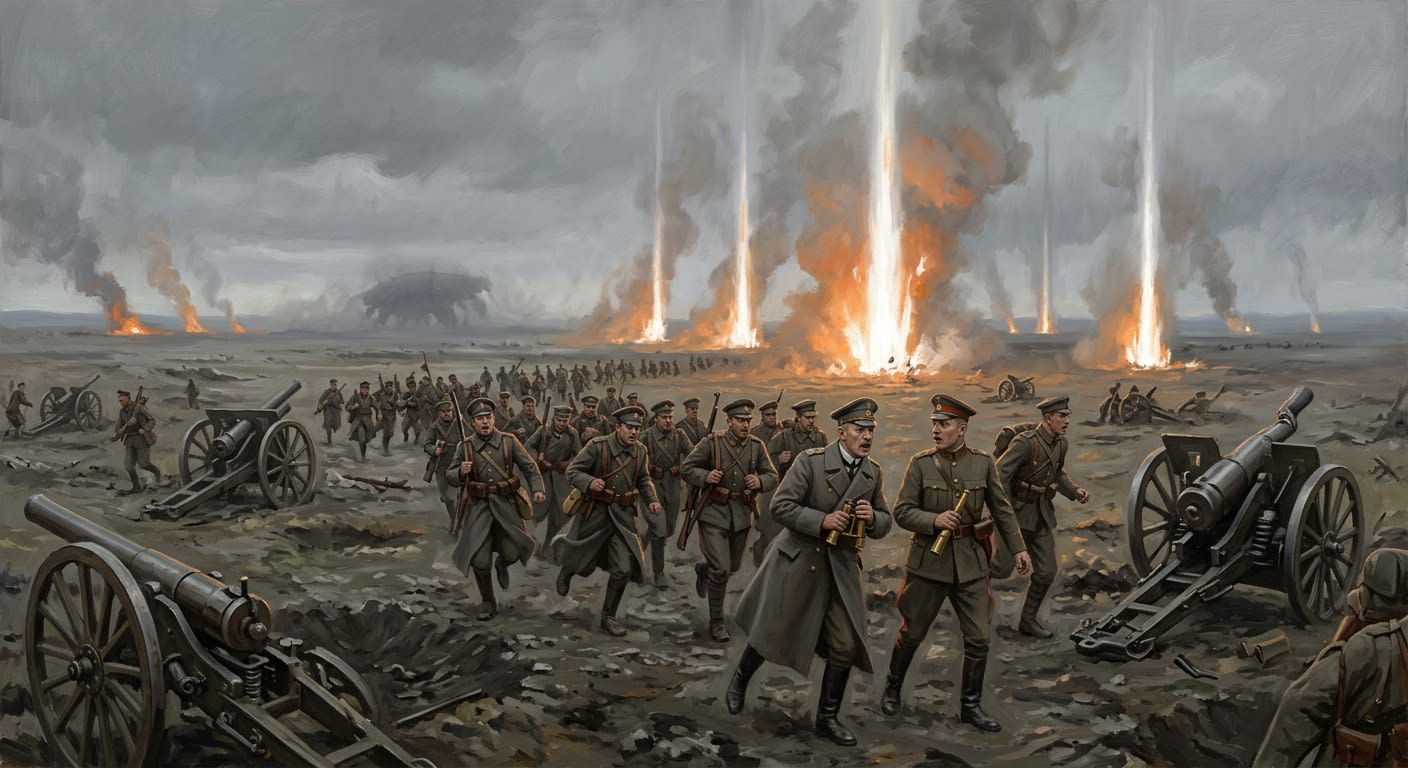
The Sundering is documented elsewhere in this Codex — the cracking of the Balkans, the eruption of the Seven, the first hours when Skopje and Novi Sad became meals and Belgrade became a memory. I will not duplicate the Bureau's official record of the day. What concerns us here is what happened on the other side — in the Rationalist heartlands, in the committee rooms and academies and officer messes where men in excellent coats received the news that their philosophy had been answered by something that did not recognize philosophies, and that their artillery — magnificent, clockwork-calibrated, the finest in European history — was presently being eaten by creatures whose flesh regenerated faster than iron could tear it.
The Battle of the Iron Plains is the event that broke the mechanism. Three full divisions of the Rationalist Second Army — well-drilled, well-supplied, commanded by graduates of the best academies Reason had built — advanced in textbook formation against what their scouts described as "a large enemy concentration." The scouts were correct the way a man who calls the ocean "damp" is correct. Fire fell from a cloudless sky. Twelve thousand men ceased to exist between the second and third volleys. The survivors ran. Many ran until their hearts burst. Bodies were recovered as far west as Bratislava, still facing away from the plains, the direction of their death stamped into the set of their shoulders.
At Debrecen, the catastrophe wore a different face. Kargath the Maw did not assault the Rationalist garrison. He did not need to. The Sin-General of Gluttony ate — every ration, every grain store, every barrel, every sack of flour within a radius of forty miles, consumed by the land itself, which opened its throat and swallowed provisions the way a sinner swallows his confession when the inquisitor enters the room. One hundred thousand men found themselves starving in a single night. Officers who had planned six-month campaigns discovered their supply lines had been digested. The retreat from Debrecen was a stampede. Men gnawed boot leather. Men gnawed each other. The testimony of Captain Elias Mürren, preserved in the Vault of Silences beneath the Basilica, records the consumption of his horse, his adjutant's horse, and — in a passage the Bureau has seen fit to obliterate — something the Captain describes with a brevity that suggests either remarkable composure or complete dissociation.
The Mürren testimony's final paragraph, before the obliteration, contains the phrase: "It offered itself to us, and we ate, and the eating did not stop." The Bureau of Purity classifies the substance consumed as "sorcerous provender" and the consumption as "involuntary heresy." No disciplinary action was taken, as the consumers were largely dead by the time the Bureau existed to take it.
City after city fell. The Rationalist chain of command, designed for engagements between reasonable men using measurable force, disintegrated upon encountering an enemy that did not negotiate, did not accept surrender, and did not obey the laws that the Rationalists had believed were the only laws. Generals who had studied the Principles of Mechanized Warfare discovered those principles were as useful as a parasol in a hurricane. The great Rationalist project — the domestication of the world through measurement — was swallowed by a world that had grown teeth in the night.
#On Vienna: The Capital That Consumed Itself
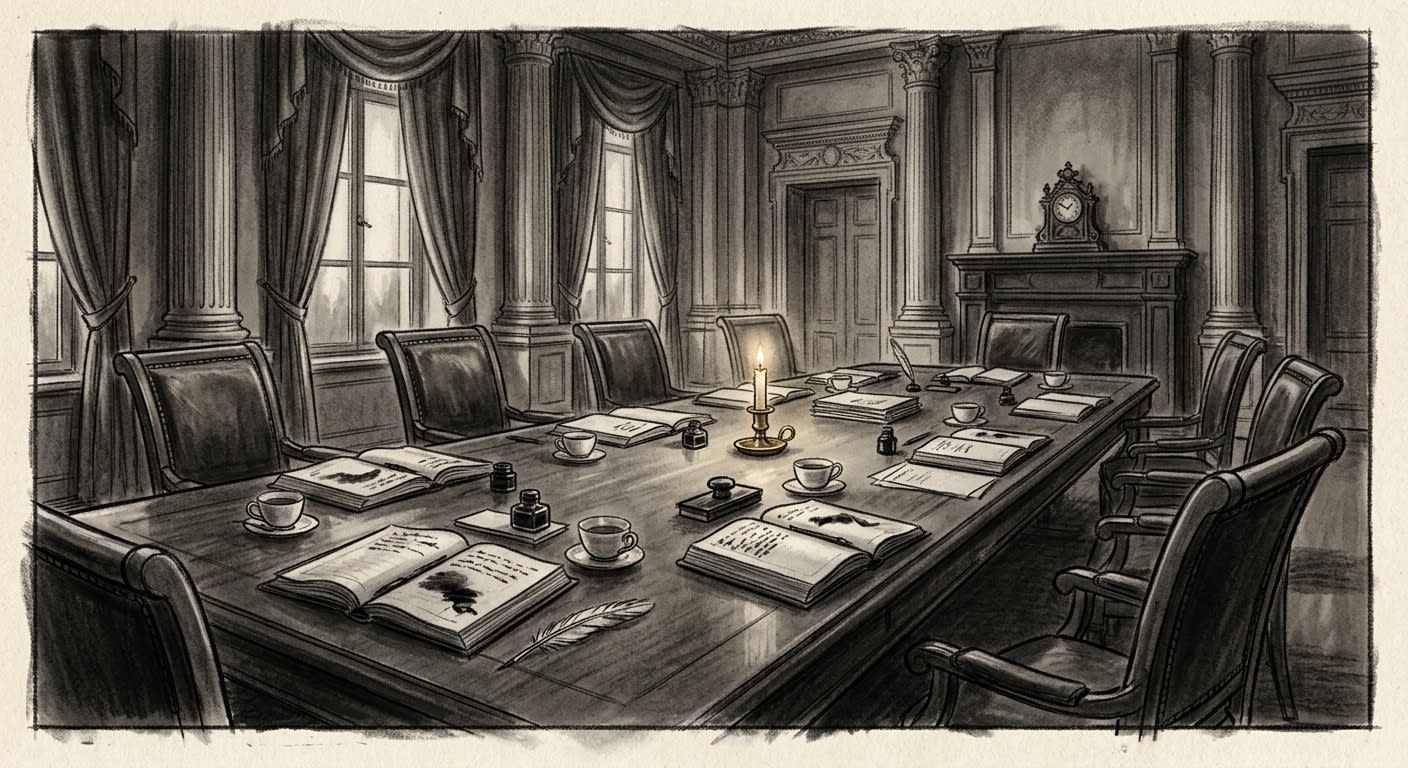
Vienna was the seat of the Rationalist Republic. The grandest city on the continent. Seat of the Council of Nine, those shadowed intellects who had orchestrated the Massacre at Saint-Malo, the Betrayal of Aachen, and the Treaty of Regensburg. Nine men — nine names the Bureau has sealed under triple lock, though I suspect the locks are less for secrecy than for the embarrassment of admitting that nine men in a committee room nearly destroyed the Church with pamphlets and parliamentary procedure.
When the Sundering struck, Vienna's central command broke. A surviving dispatch of the Rationalist Council of State ends mid-sentence: "Motion to authorize the Third Eastern Observation Expedition is hereby—" Its interruption marks the cessation of authenticated central instructions, not the instantaneous destruction of every council or western office. Local services continued unevenly and were displaced over time.
The Republican Guards — those secular soldiers who had fired on pilgrims at Saint-Malo and burned relics in the public squares — threw down their Broken Crosses in the streets. The arms they had borne with such confident secularity clattered on cobblestones still warm from the Black Procession of A.S. 30, when Rationalist elites had burned saint-effigies in the boulevards and the fires had given no warmth. Officers who had enforced the ban on religious observance ripped the secular badges from their tunics and begged for chaplains — but there were no chaplains, because the Rationalists had spent a generation ensuring there would not be. The apparatus of the Republic had been built on the premise that the Creator was unnecessary. When the Creator's opposite came walking through the Balkans with seven generals and a host that did not end, the apparatus discovered it had removed its own defences and bolted the doors from the outside.
The learned societies barred their doors. Then they burned their own archives. The Bureau finds this detail exquisite — the men who had burned churches now burning their own books, as though the fire that destroys truth is the same fire that destroys error, and both are equally useless against the fire that falls from a cloudless sky.
Earlier editions of the Codex stated the Council of Nine surrendered to Augustinus at Mainz, A.S. 50.
The surrender story is unsupported. Authenticated instructions cease in A.S. 45, and no public final proclamation survives. The nine members' individual fates, including whether bodies were recovered, remain sealed and unresolved. An empty chamber in later depictions establishes neither universal death nor supernatural disappearance. The administrative wind came from the east; some western files continued to move.
#On the Mechanism: Why Reason Broke
The Bureau of Doctrine has published — and I have authored, since the Bureau's publications are my publications with different seals — the authoritative analysis of why the Rationalist Republic collapsed with a speed that would be comic if the body count were not appended. The analysis occupies four volumes, twelve addenda, and a supplementary pamphlet distributed to catechism schools under the title Why Clever Men Die Screaming. I will spare you the pamphlet and provide the substance.
The Rationalists had, across a period of fifty years, systematically dismantled every spiritual defence the continent possessed. They had burned relics. They had closed monasteries. They had defunded parishes, imprisoned clergy, and converted cathedrals into lecture halls where professors explained, with admirable rigour, that the Creator was a hypothesis for which no evidence existed. In this they were diligent, thorough, and — the Bureau concedes with gritted teeth — effective. When they were finished, the spiritual landscape of Europe resembled a fortress from which the garrison had been removed, the gates unhinged, and the walls painted with a sign reading "COME IN."
The Rationalists' clockwork artillery — their proudest achievement, their answer to every military question — was designed to destroy physical fortifications manned by physical soldiers operating within physical laws. It was excellent at this. It was magnificent at this. It was, however, of no discernible use against creatures whose bodies were not physical in any sense the Rationalists' physics could accommodate. Cannonballs that could shatter castle walls passed through Maldrake's Wrathforged legions like stones through fog. Grape-shot that could scythe a regiment merely inconvenienced Morwen's Mirror-Stalkers, who reformed from whatever the grape-shot scattered. The Rationalists' instruments of war, so carefully calibrated, so painstakingly manufactured, operated on axioms that the enemy had not agreed to honour. Reason had built its defences against reasonable threats. The Adversary's threats were unreasonable by design.
#On the Aftermath: Ash and Scattering
The Rationalist Republic died in A.S. 45 and was buried in A.S. 95 at Vienna, where its remnants — degraded, desperate, shorn of every pretence at secular virtue — allied with daemon-cults in a final obscenity that proved what the Bureau had always contended: that Reason without Faith is a corridor, and corridors have two ends, and the end the Rationalists did not guard was the end through which the Adversary walked.
Fifty years separated the Collapse from the Siege. In those fifty years, the Rationalist remnants did what remnants do — they scattered, they hid, they mutated. Some became the inverse of what they had persecuted: clandestine cells passing fragments of De Vera Luce in the margins of prayer books, whispering the old heresies in the new world's confessional booths. Others, stripped of ideology and sustained only by spite, drifted eastward into the Charnel Lands, where the Adversary's agents received them with the warmth of an employer greeting the desperate. By A.S. 95, the alliance between Rationalist holdouts and daemon-cults was complete — Althazar of Pest commanded the merged host, Rationalist artillery wedded to demonic sorcery in a union the Bureau considers both blasphemous and, from a tactical standpoint, regrettably effective.
Bishop-Warden Clemens Stahlhand broke them at Vienna. The reliquary mace of Saint Aldebrand blazed in his fist — the same reliquary the Rationalists had declared pig bone in their pamphlets of –32 A.S., the same reliquary the old Church had ruled "never existed." The bone that was not bone struck the sorcerer who was not merely a sorcerer, and the bells of Saint Rupert tolled of their own accord, and the last capital of the Rationalist Republic became the first miracle of the age that followed.
#On the Lesson the Bureau Draws
The Collapse of the Rationalists is the single most cited event in Bureau of Doctrine pedagogy. It appears in every catechism textbook. It anchors every sermon on the dangers of doubt. It is invoked in every confession where a man admits to wondering, in the small hours, whether the Creator has truly spoken — because the Bureau can point to A.S. 45 and say: "You know what happened last time."
This is, I concede, instrumentally crude. It is also instrumentally effective, and the Bureau has never been embarrassed by the distance between sophistication and efficacy. The Rationalists are dead. Their Republic is ash. Their academies are barracks. Their Concordats are kindling. And the lesson — that doubt without devotion is a door unbarred, that measurement without prayer is an inventory of an empty house, that Reason Alone did not merely fail but summoned its own failure through the void it created — is the foundational catechism of the Synod, taught from the Baltic to the Tagus, from the Channel to the Sagittal Line, twice annually, with examinations.
The Bureau of Doctrine mandates that the Collapse be understood as follows: the Rationalists dismantled Faith. The Adversary arrived. Everything between those two facts is commentary. And commentary, as the Bureau knows better than any institution in history, is infinitely revisable.

Earlier classifications filed the Collapse under "Military Defeat, Category: Total."
Reclassified. The Collapse was not a military defeat. Military defeats imply a contest. The Collapse was a theological event — the Creator's displeasure expressed in the grammar of geography, the syntax of fire, and the punctuation of extinction. That the Rationalists interpreted it as a military event is, itself, the final proof of their inadequacy. They died measuring the thing that killed them.