
#On the Instrument
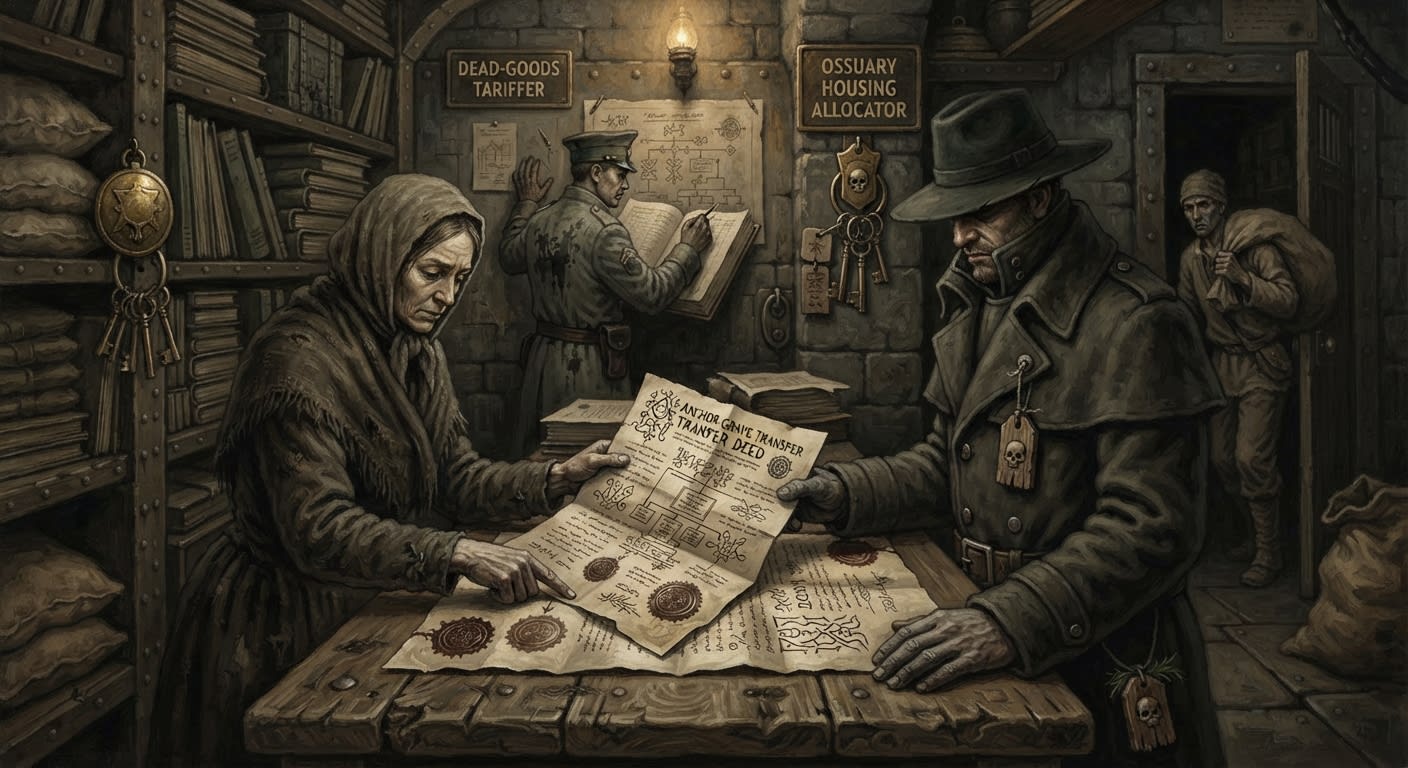
The anchor-grave transfer deed is a single folded sheet, sometimes two. On it a poor family sells the ground beneath its dead in exchange for permission to sleep beside strangers' bones. The Ossuary Allies carry it inside their coats the way a confessor carries his stole: folded, warm, and ready for the hour of weakness. Settlement abstracts call the transaction relocation. The Allies' own ledgers file it as caretaker transfer. The grave-field calls it the bone bargain, and the grave-field, as usual, has the better ear.
Every instrument in the Grave-Field Shanty Broker trade descends from the Deed Schism. That was the undated and much-cursed moment when a Ledger ruling declared interment rights transferable and created a market between one bell and the next. No clerk in my service will put a year to it, and I have stopped asking. For the purposes of this office, the deed's recognisable form belongs to A.S. 178, the year of Settlement Memorandum 14-R. The Saints, the Sharks, the Allies and the cult of Mother Vell all trace their paperwork and their grievances to that memorandum.
The deed is a hinge between two bodies of law that were never meant to touch. Burial right is ancient, consecrated, sentimental and nearly impossible to revoke. Housing right, for the poor of the Synod, barely exists. The deed turns the first into a counterfeit of the second, and every ossuary gate from Marrowgate to Constantinople honours the counterfeit.
#On the Parties and the Clauses
Five hands touch a proper deed. The family signs, makes its mark or presses a thumb in lamp soot. The Ally witnesses and keeps the counterpart. A Dead-Goods Tariffer amends the grave's clearance, so that the remains beneath it stop being Burial and become whatever the lane requires. An Ossuary Housing Allocator issues the occupancy tag. A bone-lime crew arrives afterward and signs nothing, because men who carry lime sacks have learned that signatures outlive their authors.
A sixth hand is often present and never recorded. It may belong to the Caretaker Saint who ran out of candle money, or to the Stone Shark who raised patrol dues in October. Neither wishes to be named on an Ally's instrument. Both feed it.
The surrendering clauses are few and absolute. The family gives up vigil access to the anchor grave and caretaker claim to the lane that grave protects. It gives up maintenance of stone, marker and soil, and every secondary certificate issued against the plot. It gives up the family-line claim by which descendants might later be buried beside their ancestors. Last comes the phrase that makes Rites clerks wince: "all private privilege of kin, spoken or unspoken." That clause is the Ally's masterpiece. It extinguishes rights the family did not know it possessed, including several the Bureau of Rites has never admitted exist.
The receiving clause is shorter. It grants the family permitted presence in ossuary space as allocated. That may mean a corridor bunk, a wall niche, a drainage alcove, a bone-walled room or a seasonal alcove permit. In the rare deed drafted by a drunk Ally for a favoured widow, it may mean a warmer cubby near a vent. The word residence appears nowhere. The deed keeps to the Allocator's corridor maxim in spirit, if not in text: You do not live here. You are permitted.
#On the Transfer Sequence
The deed is never offered in good weather. It arrives with arrears, with rumour of a sweep, with the first frost in the lane, or with a child whose cough has changed its note. The Ally sits on an upturned crate and speaks of dry stone and bell range. He does not mention the grave until the mother does.
Once signed, the instrument moves faster than the family. The Tariffer enters his amendment at the tariff-chapel that same night. The Allocator's tag follows within days, or within hours if the Ally has paid in fuel chits. The family moves by crate at dawn. Behind them, the anchor grave begins its second life. It may be reused for a paying interment. It may be rendered through the Lime Yards into mortar for the very walls that house its former owners. Or it may be re-anchored to shield a different lane under a different Broker's name.
At Marrowgate, rendering is almost routine. Bastion-Przemyśl prefers re-anchoring. There the grave-rings crowd the approaches through Târgu, and every paper passes three desks before breakfast. A rendered grave invites audit. A re-anchored one merely changes hats.
#On Fraud and the Hazard of Clarity
Every deed in circulation is fraudulent in some particular. This office does not consider that a defect.
The forged kin proxy is the commonest. A cousin, a neighbour or the Ally's own nephew signs as heir for a grave whose true heirs are dead, absent or at the front. The split tag follows: one grave sold to two lanes in halves, each half certified whole. Gray clearance, the Tariffer's expedited stamp, lets remains leave Burial before the waiting season ends. When heirs are stubborn, the sudden discovery of contamination in their plot usually persuades them. Duplicate secondary certificates let a single grave anchor two lanes at once, until someone counts.
That counting is the true hazard, because the deed survives by ambiguity. Its enemies are specific people. One is the son who comes home with the original certificate. Another is the relative who lodges a post-mortem objection, having died believing the grave was still hers. A third is the granddaughter who raises a family-line grievance a generation later and demands to be buried where her name says she belongs. To destroy an Ally, each of them needs only a clerk willing to lay two documents side by side. The deed dies of documentary clarity. The Allies therefore spend more on muddle than on bribes, and they consider the money well spent.
Bureau of Records guidance described the anchor-grave transfer deed as "a regularising instrument, bringing informal interment tenancy within Ledger oversight."
Corrected. The deed brings nothing within oversight. It moves the matter from one unaudited ledger to another and charges a fee for the walk. Records is advised to stop describing its own blind spots as achievements.
DEED COUNTERPART — COLOGNE CEMETERY BLOCK, A.S. ███ Grantor: widow ███, three children Anchor grave: husband, "interred A.S. ███, clearance Burial" Tariff amendment: Burial → Transport Allocator tag: seasonal alcove, renewable Marginal note, grantor's hand: "he will be moved gently" Ally's note beneath: "noted"
#On Mother Vell's Countersignature
The lanes do not consider a deed complete until Mother Vell has signed it. She never has. She is uncanonised, unregistered and very probably unlettered, so the Allies supply her signature in ritual. They spread lime dust on the threshold of the old shack and strike the transfer crate three times. They tie a skull tag with grave grass pulled from the surrendered plot. Through the first night, one candle burns at the shack and one at the new alcove. Before the crate is lifted, the Ally whispers her name into it so that the wall will accept its new tenants without complaint.
Families who skip the rite report walls that sweat and niches that will not hold a candle upright. Their children wake talking in voices the parents do not recognise. Rites classifies these reports as damp. Rites has never slept in an ossuary alcove.
#On Present Toleration
As of A.S. 201, the deed circulates wherever grave-field meets ossuary: Marrowgate, Przemyśl, Constantinople's Ossuary Rings, the Cologne cemetery blocks and the burial towns of Zones Two through Five. The revised caretaker shelter language of A.S. 194 does not mention it. Settlement estimated in A.S. 200 that forty thousand souls lived in informal interment-adjacent habitation, and that estimate does not mention it either. The silence shows that the estimate's author understood the deed perfectly.
The Synod will not suppress the instrument. Suppression would require the Bureau of Settlement to explain where forty thousand people ought to sleep instead. It would also cost the Bureau of Tithes the chapel fees, wall-maintenance levies and lime receipts that follow every signature. Records catalogues the consequences without cataloguing the cause. Doctrine observes. The deed turns the living into tagged occupants and the dead into reusable stock, and no Bureau has ever objected to inventory.