
#On the Grave That Holds a Lane
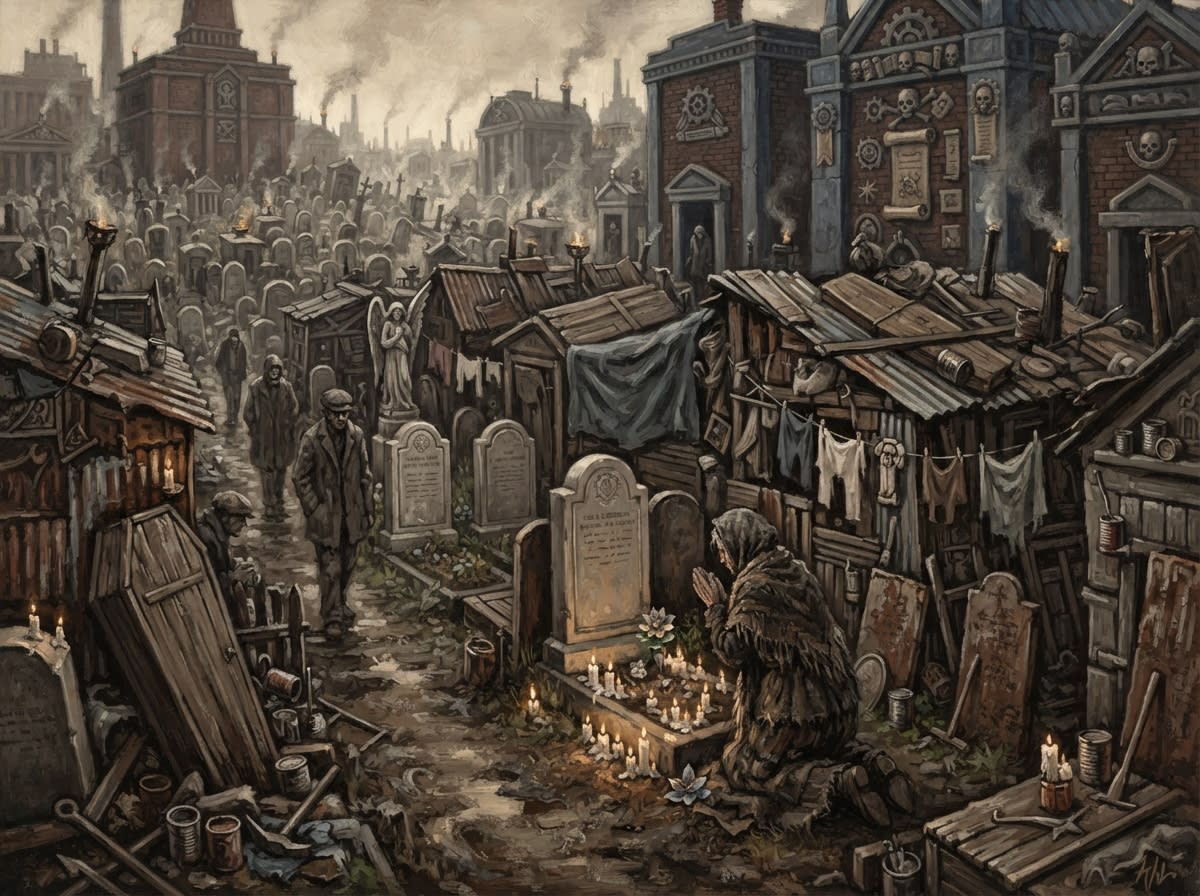
A grave-field lane has no foundation. Its shacks stand on pallet-wood and tarpaulin. Its walls are coffin-board and its roofs are slabs prised from sections no one visits. Three or four graves hold it to the earth: real graves with carved stones, clean death certificates, a family name in the burial register and a tithe entry at the tariff-chapel. These are the anchor graves. Everything else in the lane is a note scribbled in their margin.
The principle is old enough to be respectable and stupid enough to work. Consecrated ground lies under the joint hand of Rites, which blessed it, Records, which counted it, and Tithes, which bills it. Settlement has no standing there. A family that builds a shack on open ground is a squatter and will be swept by Thursday. A family that builds the same shack beside its grandmother's stone is a caretaker, and a caretaker belongs to a devotional category. Settlement Memorandum 14-R of A.S. 178 put it in language no clerk has since improved: such structures are "Caretaker Shelters," and the classification "does not constitute acknowledgment of residency, tenancy, or human habitation."
The dead own the ground first. The living sleep on the dead's paperwork.
A Grave-Field Shanty Broker opening a lane begins with anchors. He may acquire them honestly, through expired plots whose families died or were conscripted. He may acquire them otherwise, through parish stamps and ossuary clerks with gambling debts. One anchor is a grave. Two are a family matter. Three or four, spaced down a row with shacks between and behind them, make a lane that can survive an audit. The auditor must first prove that the people sleeping there are not tending the dead, and no auditor in the history of the Church has wished to stand in the rain arguing with a widow about grief.
#On the Rights Buried Under the Stone
A family attached to an anchor grave holds a bundle of privileges that no Bureau designed as a bundle. They arrived one at a time over generations, from the sentiment of Rites and the habits of Records. Together they are the most valuable property a poor household in the grave-rings will ever touch.
Vigil access is the right that matters after dark. A patrol that finds a man at a grave after the curfew bells must presume him at prayer. The caretaker claim carries the phrase "reasonable adjacent shelter," which has been stretched further than any clause in the Ledger except those concerning tithe. Secondary certificates are where the money breeds. Each extract issued against a plot can be shown to a different sergeant, clerk or Broker, so one grave with five certificates in circulation can shelter five households that have never met the corpse. The family-line claim gives the grave a future as well as a past. Private kin privilege is the residue: the rights Rites never wrote down, because writing them down would have admitted they could be revoked.
Burial right is old, consecrated and nearly impossible to revoke. Housing right, for the poor of the Church, barely exists. The anchor grave is where the first is quietly put to work as the second.
Settlement abstracts described anchor graves as "interment maintenance assets" and, following the revised caretaker shelter language of A.S. 194, as "caretaker stability points."
Corrected. An anchor grave is a housing foundation dressed for a funeral. Settlement will cease describing the foundations of its unacknowledged suburbs as stability points, since the phrase acknowledges them.
#On Brokers and Their Uses
The three factions of the Broker trade agree on what an anchor is worth and on nothing else.
The Caretaker Saints tend their anchors the way a household tends its only stove. They keep candles on the stones, speak the names at bell-change and set rent low enough that the family keeping vigil can afford to stay. A Saint knows that an anchor with no living caretaker is an audit waiting for its clerk. The lane lives another winter because someone is visibly mourning. Sometimes the mourning is even sincere.
The Stone Sharks treat anchors as collateral. A Shark lane sells patrol subscriptions, charges tolls for passage through its rows and writes anchor-grave liens against families in arrears. The grave stays theirs while its rights stay pledged, and on default the pledge becomes ownership whenever the Shark finds it convenient. Orderly extortion is still order. Shark lanes rarely lose an anchor to audit, because the Shark pays the auditor first.
The Ossuary Allies liquidate. Once rent and roof have both failed, an Ally offers the anchor-grave transfer deed. The family surrenders every right in the stamp above in exchange for permitted presence inside the ossuary: a corridor bunk, wall niche, drainage alcove, bone-walled room, seasonal alcove permit or, rarely, a cubby near a warm vent. An Ossuary Housing Allocator assigns the space. A Dead-Goods Tariffer reclassifies the remains as Burial, Transport, Salvage, Ornamental or Contaminated, according to what the lane requires. The grave may then take a paying interment or be re-anchored under another Broker's name. Otherwise it passes through tariff-chapel clearance into the bone-lime stream at the Lime Yards.
A lane that loses one anchor has lost a root. If it loses two, Settlement can see the shacks between them for what they are.
Over all three presides Mother Vell of the Crooked Stones, whose proverb, "a plot is a promise," is scratched into more lintels than any Bureau hymn. Her own grave is said to have been sold fourteen times. That makes her the patron of every anchor in circulation and the proof that none of them is final. Each faction keeps its own Vell. The Allies' Vell wears a lime-white veil and carries a skull tag in one hand and a transfer deed in the other. The crooked stones of her title are the ordinary headstones of the lanes, leaning into the mud. By custom the anchors are kept straight, so a stranger can find the legal roots of any lane at dusk by looking for the four stones standing up like clerks at an inspection.
#On Failure, Fraud and Objection
Anchors fail in the ways paper fails. In a forged kin proxy, the Broker's nephew signs as heir to a stranger's grandmother. In a split tag, one grave's remains are tagged in halves and each half is certified to a different lane. A disputed certificate means two families bring extracts for the same plot, both sealed, one by a parish warden who has since died conveniently. Gray clearance moves remains out of Burial before the waiting season ends. What remains is a stone over an empty hole, still anchoring a lane, because nobody has bothered to lift the stone.
Then come the objectors. One is the heir back from the Line with the original certificate wrapped in oilskin. Another is the post-mortem objection, a written protest left with a priest by a relative who died believing the grave was still hers. A third is the family-line grievance, raised a generation later by a granddaughter who demands burial where her name says she belongs. None of them needs a lawyer. Each needs one clerk willing to lay two documents side by side. The Saints can light no candle against documentary clarity, and the Allies have no deed for it either. The Sharks, to their credit, have tried to beat it with sticks.
LANE AUDIT — GRAVE-RING SECTION ███, TÂRGU APPROACH, A.S. ███ Anchor graves declared: four Anchor graves located: three Caretaker claims filed against Anchor 2: eleven households Family-line claimant present: one, returned from Line service, original certificate Claimant statement: "I came home to bury my mother beside my father. There are nine people living on him." Auditor's disposition: ███████████ Lane status: unchanged
#On Present Toleration
As of A.S. 201, anchor graves hold lanes at Marrowgate, across the grave-rings of Bastion-Przemyśl, along the approaches to Bastion-Constantinople, among the cemetery blocks of Cologne, in the rail-adjacent plague fields and in the burial towns of Zones Two through Five. Settlement's A.S. 200 estimate puts forty thousand souls in "informal interment-adjacent habitation." It counts the shacks and leaves the anchors uncounted, since counting them would mean naming them.
The Synod tolerates the practice because suppressing it would mean lifting the anchors, and lifting them would mean housing the people above them in something real. Rites will not desecrate. Tithes will not give up the grave fees. Settlement will not build. The anchor grave spares all three offices a decision, and no office has ever resented being spared one.