
#On the Use
Aurelite Use is the Codex's name for the manner of prayer that Saint-Bone Melters keep for their patron, Saint Aurel of the White Wall. The whole documentary estate is one attribution. A common kiln prayer circulates in the yards under the heading Aurelite Use, and every other claim made in the name has to be built outward from that heading, one careful brick at a time.
So the limits come first, because a clerk who omits them earns a reprimand. No order bears the name. No chapter house keeps a rule under it, and no abbot has ever been fined for violating it. The Codex borrows the word Use from the old liturgical habit of naming a local custom of prayer after whoever keeps it. Here the keepers are Melters, and the custom is what they say to a saint of deficient provenance while doing the thing he supposedly permitted.
That deficiency is on file and I will not soften it. No independent attestation of Aurel exists before A.S. 91. His first secure image is a Strasbourg broadsheet printed after the Concordat. The Bureau of Relics tolerated his occupational cult in a provisional note of A.S. 104, and that note stops well short of canonization. The Use prays to him anyway. So do the barrels.
#On Bone Made Shelter
The theology of the Use fits in the saint's hand. Aurel offers his femur to a besieged wall and, according to his approved legend, says, "Make me wall." Neither the man nor the sentence has been independently established. The Church has made the gesture carry a great deal regardless. Aurel stands for voluntary offering, and the offices extend his volunteering to fragments that shrine-keepers never offered at all.
The Saint-Bone Melting Acts of A.S. 96 fixed the material scope. Surplus, damaged, disputed, duplicated and unassignable fragments may pass under licence into sanctified mortar. Protected fragments stay protected unless a separate review lowers their station. Aurelite devotion adds no permissions to this list. A Melter who invokes Aurel over a Tier 1 reliquary has committed an offence and sung while doing it, and the Bureau of Purity regards the singing as aggravation.
The Church's claim, as taught by its offices, is that holiness continues through shelter. The shrine loses devotional access, and the sanctified function is redistributed along a defensive surface. The Bureau of Tithes calls this multiplication and cites the familiar figure: a femur in a reliquary inspires one chapel, while a femur rendered to lime holds a thousand feet of the Sagittal Line. I have looked for the survey that measured those thousand feet. It is a sermon figure. It has been repeated so often that Engineering now quotes it back to Tithes as if the number came from Engineering.
The evidence that persuaded the committees came earlier and from the south. During the Cracked Ring Sieges at Bastion-Constantinople, common mortar cracked under Maldrake's bombardment and bone-lime held. Those reports came before the Acts and before the Use, and they record a wall standing. They say nothing about consent.
Early sermon copies stated that the Acts "restored the ancient Aurelite custom of voluntary structural sanctification."
Correction: the secure Aurelite paper trail begins too late to justify the word ancient. The custom was restored after being required.
#On the Yard's Prayer
The prayer, as attributed:
Bone to lime. Lime to wall. Wall to mercy. If mercy objects, refer it to the eastern gate.
Four lines. The first three follow the material chain and give each stage a single sentence. The yard leaves the rhetoric to the fourth line, which is an instruction on routing. It makes no promise that mercy will be satisfied. It names the place where mercy is to be sent once it has become an inconvenience. I have asked Melters at several yards which eastern gate is meant. Each yard names its own, and one Batch Scribe said, "Whichever one has the longest queue." Nothing in the record supports the idea of a gate tribunal. What the line records is the habit of forwarding an objection until its sender tires or dies.
No author is known and no melody survives. No manuscript preserves a first performance, which is fitting for a prayer designed to be said when nobody important is listening.
It is said at work, and its short lines suit a mouth coated in lime dust. It accompanies the ledger as often as the fire. The Batch Scribe writing up a crate may say it, and so may the Kiln Tender pulling a finished barrel. Scribes have been known to invoke Aurel in the margins of Form R-14, the certificate that ends with the grim promise that after thirty days the wall will have set. Such margins do not alter the form. They show where the scribe's conscience was pressed hardest.
The Use should not be confused with the law that surrounds it. The Purity Kiln Decree of A.S. 142 was issued jointly by the Bureau of Rites and the Bureau of Engineering, with Purity writing the punishments. It fixed a mandatory chant wheel: First Feed, Rising Heat, White Glow, Full Calcination, Cooling, Slake Preparation, Final Set. Those are stages of heat. The yard's seven operations are a different sequence: intake and classification, cleansing, calcination, slaking, mixing, stamping, delivery. The chant wheel is binding, and a wrong hymn becomes wall-risk. The Aurelite prayer is voluntary, and a missed recitation becomes nothing whatever.
Between cleansing and calcination comes the quiet hour, when fragments lie under linen in a sealed room with no bell, no chant and no attendant. The Aurelite prayer is not said there. Its absence at that point in the process is the one thing both the Use and the Decree require.
#On Aurel Eve
Several kiln yards keep a tolerated observance on the eve of the first winter convoy. No calendar day is fixed. The convoy decides, and convoys are governed by roads, weather and the temper of a quartermaster, so the feast moves. Yards that have lost a convoy to snow have in effect lost their feast too, and they rarely mention it.
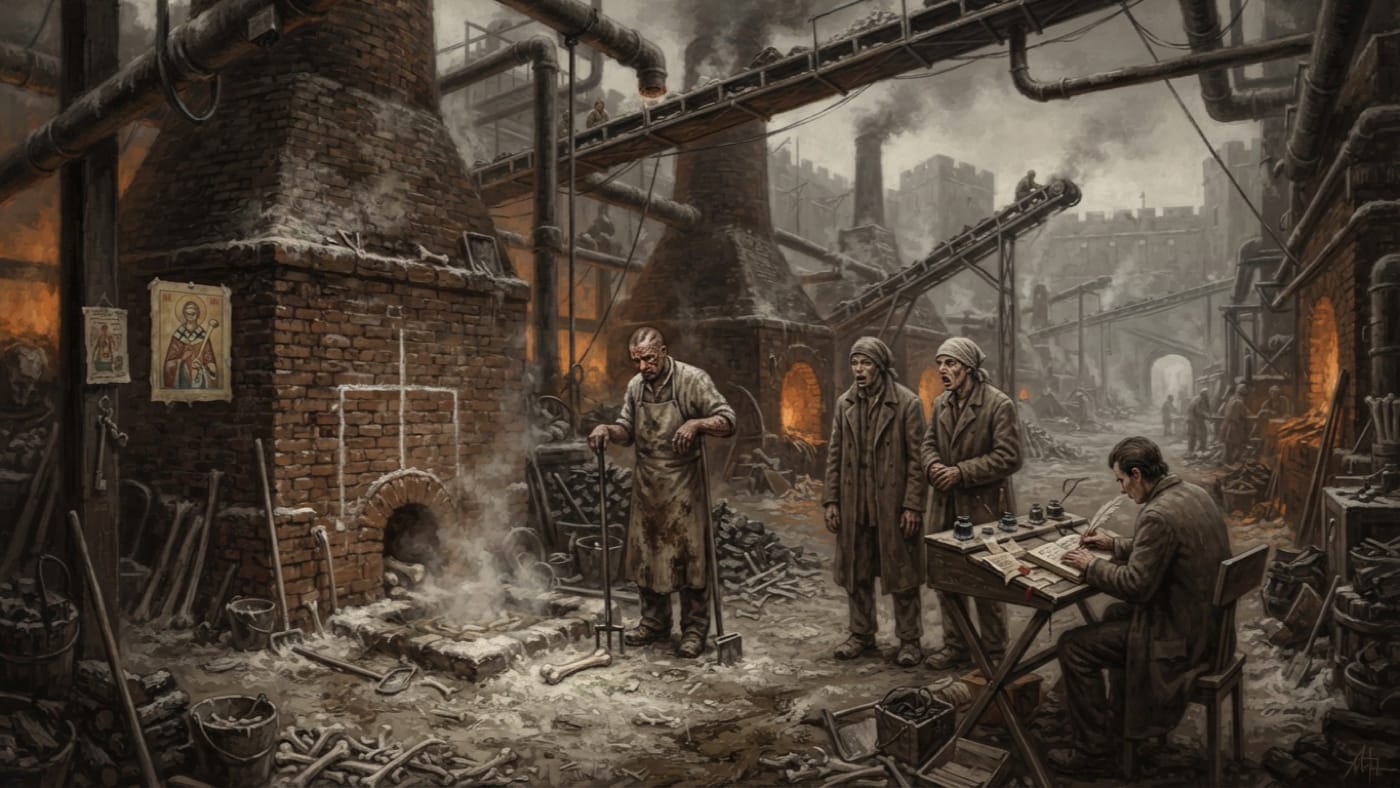
The documented observance takes very little. A white line is chalked on the kiln wall. A clean femur, usually an animal's, is laid before the slaking pit. The batch ledger lies open. The Master Melter says, "What shelters remains." The apprentices answer, "What remains is numbered." Then the day's first batch begins.
Nothing else is in the record. The workers are the same exhausted people who worked the day before. Their wraps are stained with lime, their veils are grey, their scarred hands are already on the tongs. The chalk line is crooked in most yards because it is drawn by whoever has the steadiest hand at the end of a shift, and at the end of a shift nobody has one.
The animal bone gives no licence to counterfeit relic matter. Placed before the pit, it represents the offering. A Melter who puts a saint's fragment in its place has committed substitution, which is one of the four additions the parent record forbids. The others are public procession, blood oath and complaint songs. Doctrine permits the observance because it keeps the trade's guilt inside the yard walls. A guilty yard that has been given a small rite turns up for work, and one given nothing tends to turn up in the courts.
#On Consent and Objection
Both factions of the trade claim the same femur. The Purity Melters read Aurel's offering as proof that consent has conditions: verified provenance, a correct cadence, a quiet hour observed in full, every tag checked three times. On their reading the saint gave properly, so every fragment must be received properly. The Siege Melters read the same bone the other way. Aurel said make me wall, the tower was besieged, and he asked for no form. On their reading a crack widening at nightfall justifies the abbreviated burn, and the saint would have signed the emergency order himself.
The shrine-keepers accept neither reading. They say the Use turns loss into surrender. If Aurel gave, every chapel may be asked why its splinter has not. Their counter-prayers are unlicensed and mostly unprintable. Doctrine keeps its answers in several drawers.
Each office handles the consent question with its own tools. Relics holds Aurel's classification at provisional and argues over the tier of each fragment. Rites maintains the prayers and certifies the withdrawal of devotional access. Tithes works the arithmetic of deployment. Doctrine supervises the public account and keeps it tidy enough to teach. None of these offices has the job of asking the fragment.
The yards ask anyway, after their fashion. When mortar sets white and then darkens, sweats, ticks or sings, the Melters' theory is that the fragment remembers what it was and objects. Rites has given its own explanations in turn: condensation, aggregate harmonics, wind. Each account is someone's attributed opinion. Black lime does not prove that Aurel lived. It does not certify or cancel anyone's consent, and it has not revealed its mechanism to any office I can cite.
UNREGISTERED ICON VARIANT — PRZEMYŚL KILN YARD, CONFISCATED A.S. 149 Aurel shown with both legs absent; wall behind him darkened; inscription altered to: "ASK HIM IF HE AGREED." Disposition: image burned; carver reassigned to silence labour; three apprentices questioned; one returned with white hair.
#On Present Observance
As of A.S. 201, Aurel's image hangs in kiln yards at Bastion-Przemyśl, Bastion-Irongate and Bastion-Sibiu, and in the southern mortar annexes that supply Constantinople. In some copies the femur is whole and in others it is cracked. The Irongate copy with the empty hand remains unauthorised and remains on its wall. The common kiln prayer is said wherever a Melter chooses to say it. Aurel Eve is kept in several yards and kept nowhere by statute. Relics has not moved the classification in either direction. Rites has not withdrawn the prayer. The lime yards keep burning on schedule.