
#On the Siege That Taught Calcium to Pray
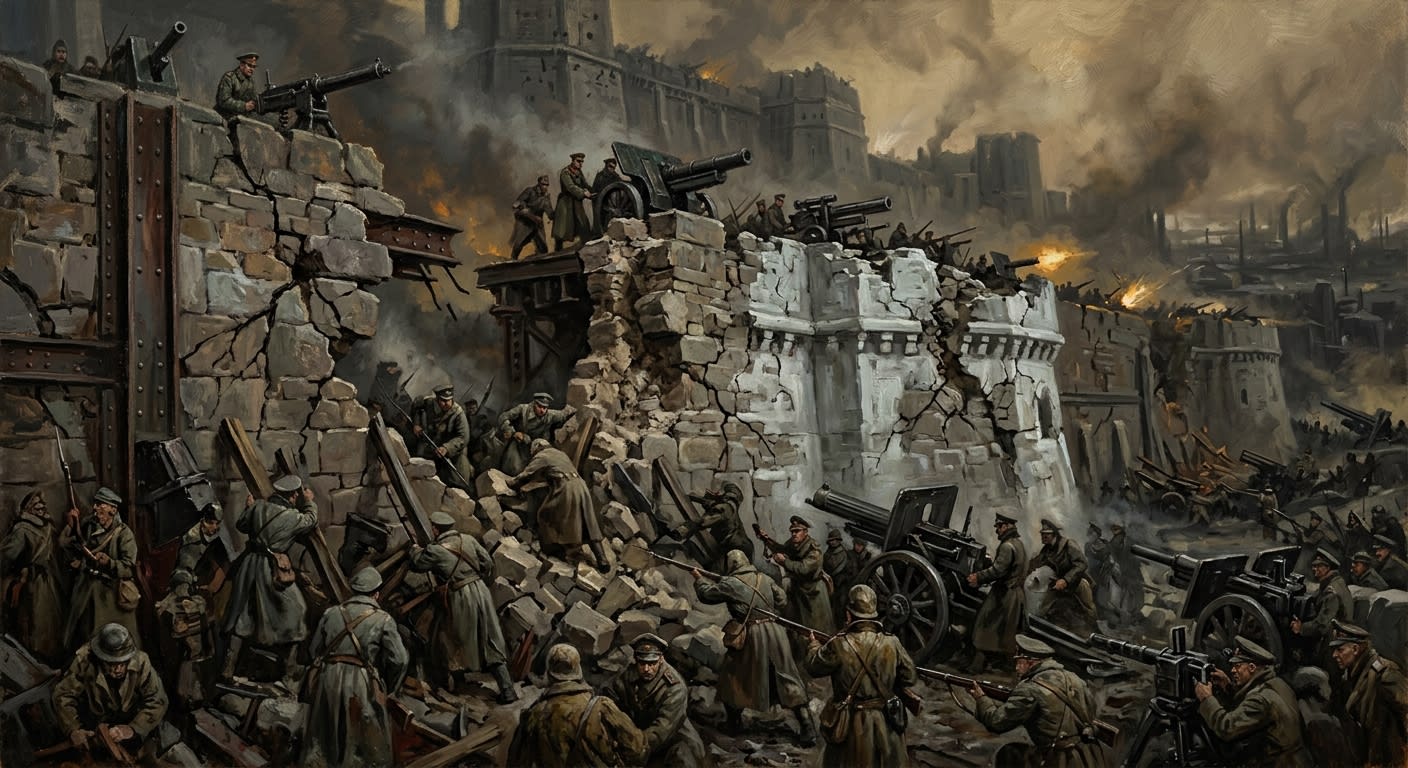
The Cracked Ring Sieges were the rude lesson by which Bastion-Constantinople taught Strasbourg that reverence, left idle on a shelf, is a luxury purchased by men who have never watched a wall open.
The phrase names a cluster of bombardments, wall failures, emergency patchings, night-kiln improvisations, and official denials that gathered around the outer ossuary rings of the southern anchor in the years before the Saint-Bone Melting Acts of A.S. 96. The southern reports do not agree on month, duration, casualty total, or which Bureau arrived first to take credit. They agree on the only fact that mattered under shellfire: common mortar cracked; bone-lime held.
Bastion-Constantinople had been designated in A.S. 68 as the Line's southern lock, a hinge of stone, chain, water, relic, cannon, and panic where the Sagittal Line met the Bosphorus and discovered that seas also require paperwork. The city beneath it was ancient enough to resent every new wall and frightened enough to pay for most of them. By A.S. 90, Concordat authority had given the bastion more seals than sleep. By A.S. 96, Maldrake had given those seals a practical examination.
#On the Rings Themselves
The outer ossuary rings were never meant to be beautiful. Beauty is a rear-city disease. They were low, thick, ugly circuits of stone, lime, bone vault, listening niche, drainage throat, powder alcove, reliquary shelf, and repair trench, thrown around the older southern works in concentric impatience. The engineers called them pressure buffers. The soldiers called them the Graves. The masons called them hungry.
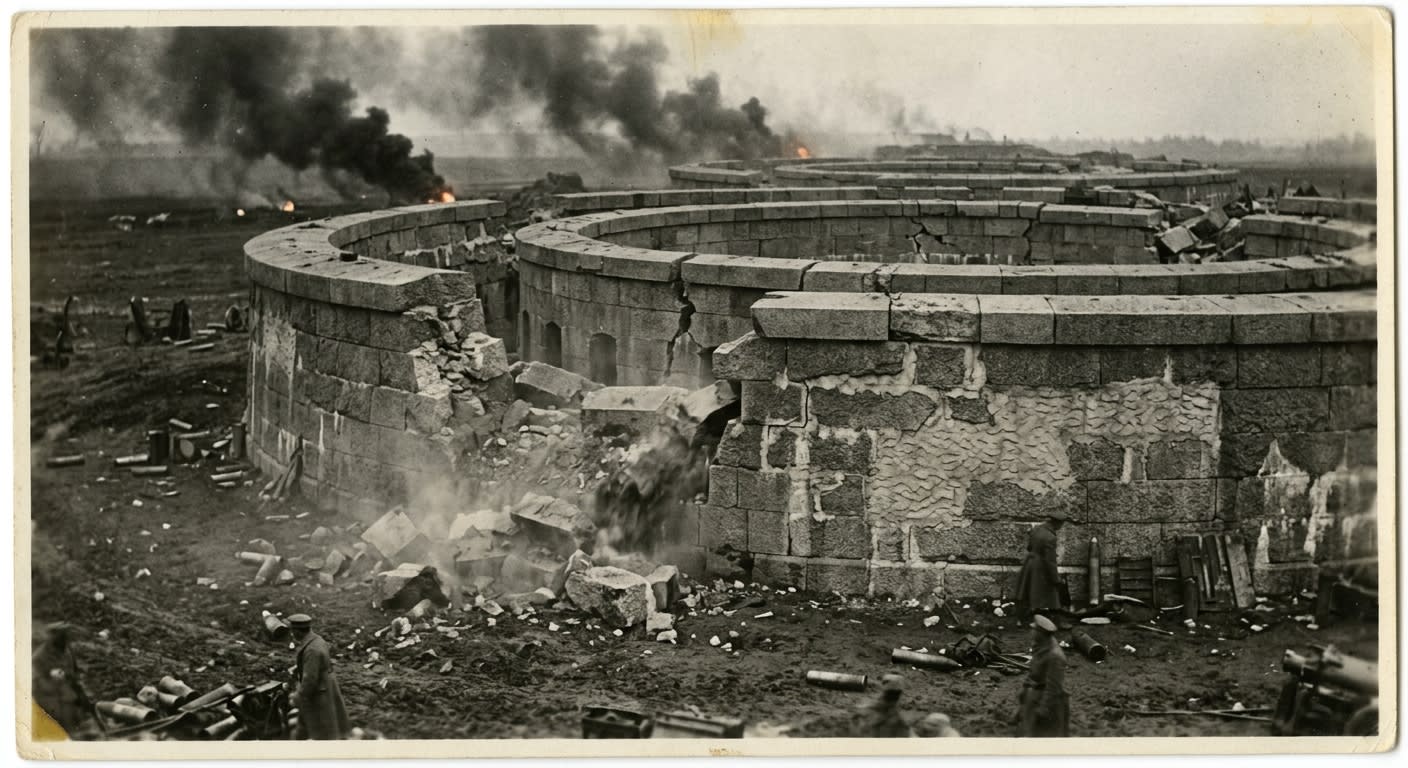
Their purpose was to absorb impact before the inner curtain received it. A shell struck the outer face. The shock dispersed through packed rubble and ribbed buttress. Damage was marked, prayed over if time permitted, patched, logged, and forgotten until the next shell improved the crack. The design assumed ordinary artillery, ordinary heat, ordinary pressure, and ordinary dead remaining docile inside ordinary mortuary architecture.
Maldrake does not provide ordinary conditions.
His bombardment came as iron, heat, and spiteful rhythm. Shells hammered the ring faces in patterns that made masonry fatigue along old joints. Incendiary bursts dried the lime too quickly and then shocked it with night cold. Furnace-wind entered cracks and widened them by breath. Men standing inside listening niches reported that the wall groaned before impact, as if warned from the wrong direction.
The first failures were dismissed as workmanship variance. Workmanship variance is the phrase used when a structure betrays its maker and the maker still controls the report. Common mortar shed from seams in pale scabs. Patchwork applied at sunset cracked by Prime. Buttresses sweated mineral dust. Drainage throats spat hot grit. One ring segment near the old chain-road bulged outward three handspans over six hours, then settled back into place after a bell peal, which frightened the masons more than collapse would have done.
#On the First Cracks
The earliest surviving report bears no title, only a scorch mark, three signatures, and the sentence: Ring Two admits pressure. Records prefers documents with dates. War prefers documents with maps. This document has neither. It has terror, which is often better evidence.
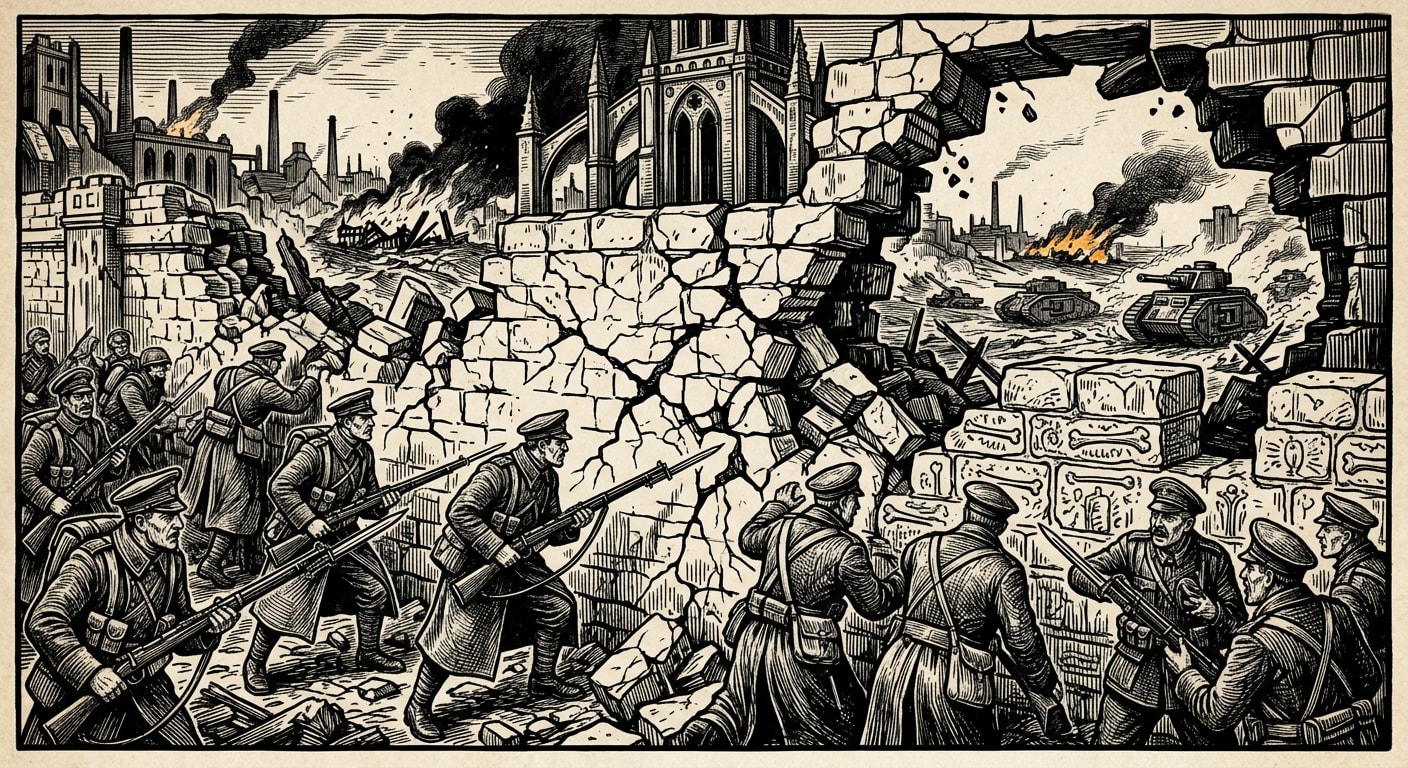
A crack opened below reliquary shelf 14-South, widened across a patch seam, split the common mortar, and exposed a hollow behind the facing stone. The hollow contained ash, finger-bone splinters, two old prayer tags, and one iron nail bent into a shape the Bureau of Rites declined to identify. A Mason-Sergeant ordered common lime mixed. The patch failed before the slake steam cleared. A second patch failed after Vespers. A third patch, mixed with powdered bone swept from a damaged ossuary crate, set hard in under an hour and held through three impacts.
Early Engineering copies describe the successful third patch as “experimental aggregate variation.”
Corrected for doctrinal record. The aggregate was sanctified bone residue taken without full provenance from a damaged ossuary crate. The theft became experiment after it worked. The experiment became doctrine after Strasbourg learned to pronounce it calmly.
This was the first useful scandal. More followed. Ring Four split at a gate-spur after a heat shell. Common mortar failed twice. Bone-admixed lime held. Ring One lost a parapet seam after midnight pressure. Quick-kiln ash from a reliquary salvage sack held. Ring Three produced a black sweat after an over-hasty patch, was scraped, patched again with cleaner bone-lime, and ceased misbehaving loudly enough for the report to close.
The lesson spread faster than permission. Masons began asking for bone crates. Quartermasters began misplacing them toward the walls. Shrine delegates began sleeping beside reliquary wagons with knives under their pillows. Melters were not yet a licensed profession, but the trade had already entered the world in apron, burn, and lie.
#On the Night of Three Seams
The Night of Three Seams gave the sieges their name in field memory. Maldrake's batteries struck the eastern-facing ringworks from dusk until the Ninth Bell, then paused with the discourtesy of an executioner letting the condemned hear the crowd. During that pause, three seams opened on Ring Two: north of the chain-road, below Saint Anakletos Station, and at the lower ossuary throat behind a shuttered chapel.
The first seam admitted smoke. The second admitted heat. The third admitted a hand.
The hand was not large. Operational notes call it infantile in size and iron in colour, with nails hot enough to hiss against stone. It reached through a crack too narrow for any full body, flexed once, and began pulling mortar inward grain by grain. A Covenant private struck it with a rifle butt. The wood charred. A Siege mason drove a chisel through the wrist. The hand withdrew, leaving the chisel molten at the tip.
SOUTHERN ANCHOR NIGHT REPORT — THREE SEAMS Lower ossuary throat breach. Auditory condition: knocking from inside wall; no answering personnel located. Object through seam: hand / claw / child-sized thermal extrusion. Private L— touched by index finger; body temperature rose until boots smoked. Disposition: remains classified as lime-adjacent; family notified of heroic fever.
The repair crews had no time for full rite. They burned damaged relic fragments in trench braziers, raked the calcined powder into tubs, slaked by eye, mixed with sand, ash, and brick grit, and carried the paste in helmets to the seams. The prayer was shortened to three lines. The provenance tags burned. The lower seam stopped moving before dawn.
By sunrise, the phrase cracked ring had left the masons and entered the barracks. By noon, it had entered dispatch. By the end of the week, Strasbourg was receiving packets marked urgent, sealed, contradictory, and stained white at the edges.
#On the Dead Pressed into Service
The Cracked Ring Sieges did not create the surplus dead. The Ossuary Overflow Winters had already done that ugly charity. They had filled forward racks, chapel shelves, pit ledgers, feeder ossuaries, and mortuary annexes with bodies, fragments, duplicate saints, orphaned knuckles, powdered claims, and holy grit nobody wished to classify while alive men still required sleep platforms.
Constantinople turned storage failure into military resource. Damaged reliquary lots went first, because damaged things have fewer defenders. Then disputed fragments. Then duplicated fragments. Then unassignable bins, that paradise of useful theft. The holy dead passed from shelf to kiln to slake to trowel to wall, and the rings stood whiter after every night.
Shrine-keepers objected. Of course they objected. They had been trained to guard saints from thieves, skeptics, damp, rats, bad glass, ambitious vicars, and the soft-fingered appetites of Relics officials. They had not been trained to surrender the finger-bone of a martyr to a lime pit because a wall had developed a convincing cough.
Some wept. Some bargained. Some hid fragments under vestments. One old custodian from the Chapel of Saint Mildred reportedly swallowed a tooth rather than surrender it. The tooth passed two days later and was rendered anyway. The report lists this as devotional delay.
#On the Birth of Siege Practice
The Cracked Ring crews became the ancestors claimed by Siege Melters for the plain reason that they did the work before the law learned to bless it. Their doctrine had no school copy. It had a shovel. The wall either holds or it does not.
They shortened rites under bombardment, deferred provenance, used heat by colour, judged slake by violence, patched first and stamped later, and trusted masons who had lost enough fingers to understand pressure. They were not impious. They were tired of being alive only because a previous shortcut had succeeded.
Their enemies came later with clean sleeves. Purity Melters would insist that the chant wheel must turn complete, that quiet hour must be observed, that tags must be read, that relic status must be confirmed before the kiln received what the wall demanded. The Siege answer was the Cracked Ring answer: the crack will not wait.
Later licensing histories describe cracked-ring practice as “preliminary field application under implicit Synodal authority.”
Correction: nobody at the lower ossuary throat paused to infer Synodal authority while an iron hand pulled mortar through the seam. Authority arrived afterward, looked at the surviving wall, and claimed paternity.
By A.S. 96, the Acts made law from panic. The Bureau of Tithes declared sanctity deployable capital. Rites learned to withdraw devotional access without admitting destruction. Engineering requested ratios. Relics complained until valuation soothed it. Doctrine found Saint Aurel of the White Wall, or found her useful, which in hagiography is often the same verb wearing cleaner shoes.
Aurel's offered femur supplied the missing consent. The Cracked Ring reports supplied the proof. Bone-lime had held where common mortar failed. A saint who shelters saves. A relic in a wall multiplies along a defensive surface at rates pleasing to Tithes and terrifying to shrine widows.
#On Maldrake's Lesson
Maldrake intended to break the southern anchor. He improved it. This is an unforgivable courtesy and one of the more irritating forms of enemy assistance.
His bombardment exposed material weakness, accelerated relic policy, birthed emergency rendering law, hardened southern masonry doctrine, and gave the Bureau a sentence it has been dining on for more than a century: holiness must bear weight. The Bureau of Engineering still pretends the lesson was material. Tithes pretends it was economic. Rites pretends it was liturgical. Doctrine, being staffed by wiser serpents, knows it was humiliation converted into ordinance.
The wall did not become invulnerable. Let no fool read comfort into this file. The rings cracked again. Bone-lime sweated, chipped, sang, blackened, and in at least two reports named dead masons with excellent pronunciation. Quick-kiln batches failed when rushed too far. One patch near Chain Battery Seven set so hard it pulled adjoining stone inward and snapped a drainage throat, flooding a powder alcove with saint-lime slurry. The slurry later cured around three barrels of shot. War requested salvage. Rites refused. Tithes valued the mass. Records sealed the argument and built a shelf around it.
The useful truth survived the failures. Under Maldrakean pressure, sanctified mortar gave the wall time. Time is what fortifications sell. Time for reserves. Time for bells. Time for sappers to close a breach. Time for a priest to finish a prayer he should have begun earlier. Time for Strasbourg to receive a report, ignore its moral contents, and extract policy.
#On the Present Memory
As of A.S. 201, the Cracked Ring Sieges remain less an article of public commemoration than a trade scar. Bastion-Constantinople keeps no grand festival for the nights when its walls were saved by hurriedly burned saints. Festivals attract questions from children, and children have a genius for walking straight through varnish. The southern kiln yards remember. Siege Melters invoke the rings whenever a Purity clerk begins lecturing too slowly near an active crack. Saint Aurel icons show a white wall whose first true whiteness came from panic, theft, heat, and excellent timing.
The surviving ring segments have been rebuilt, faced, refaced, blessed, patched, and renamed by enough committees to make the original failures administratively faint. In certain maintenance tunnels, old seams remain visible below later skin: pale veins across darker stone, stamped with obsolete batch marks and small finger-scratches left by men carrying hot mortar in helmets. The marks are not part of the public tour.
The eastern face still takes bombardment. The rings still require lime. The Melters still wash in vinegar at midnight. Shrine-keepers still hate Aurel. Maldrake still hammers. Constantinople still stands.
The wall answers.