
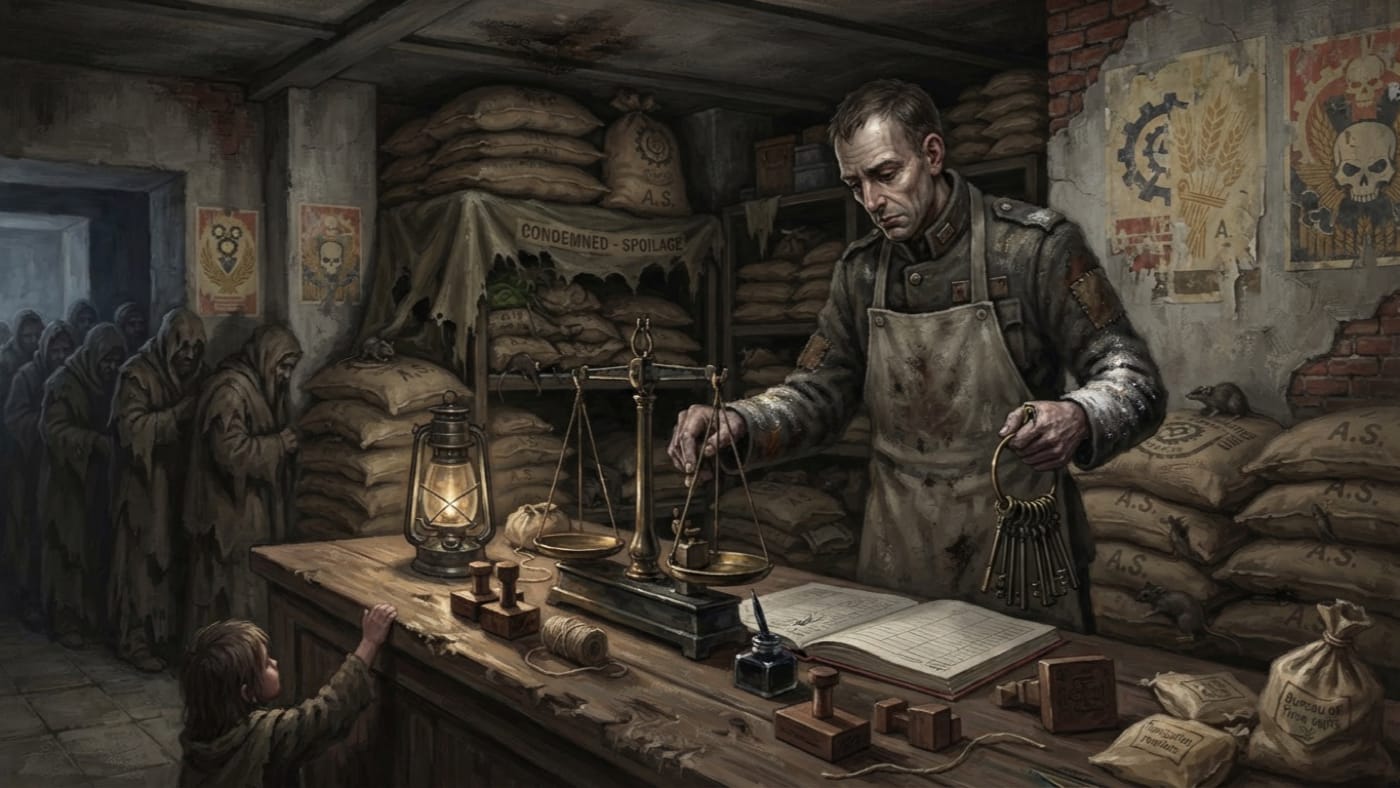
#On the Station
"Equal weight, unequal hunger." — whispered over the scale at the start of shift, and found in no approved catechism
Of all the titles the Church grants to people who carry keys, Auxiliary Store Warden is the one least likely to be read aloud at a feast. It names the keeper of a licensed granary office and of whatever the office governs: the connected stores, a wagon shed, a loft above a mill, a parish alms room that smells more of bread than of prayer. I have found no charter for the post, no statutory grade and no prescribed dress. What the post has is a key-ring, and the key-ring is what matters.
The Bureau of Tithes extracts grain and accounts for it. The tariff-chapel weigher fixes the measure and blesses it. The store stands between that blessed measure and the mouth. In the store sits a person with scales, stamp blocks, ration ledgers, seal twine and fumigation powders. Every item is issued and inventoried, and every item works in both directions.
This is the formal title of the Grain Keeper, fifth of the proscribed heresies. A Keeper needs grain, dry storage, an honest-looking scale and a lawful reason to be seen handling sacks at unlawful hours. In its wisdom the Synod supplies all four, and a wage besides.
Every Auxiliary Store Warden in the western provinces is a Grain Keeper wearing the Bureau's own apron.
The post is found in bastion granaries, trench-town depots, pilgrim-route waystations and the back rooms of bakeries throughout Zones 1 to 4, west of the Sagittal Line. The buildings differ. The dust is the same in all of them.
#On the Daily Account
"Count sacks like sins." — Bureau of Tithes, Granary Inspection Manual
At dawn the Warden unlocks the official store with cold iron keys and conducts the public weigh-in before whoever has come to watch. Usually that means the queue captains, a parish clerk, and a widow who has learned that watching is the only audit open to her. The Warden taps the scale three times and recites the ration catechism aloud: Bread is obedience made edible. The watchers mouth the words along with it. A sack goes onto the pan, the beam settles, and the figure goes into the ledger in ink that is dry before anyone can dispute it.
The figure is correct. Between correct and exact lies the width of a thumb resting on a counterweight, and the Warden's thumb is already black with stamp ink, so nobody notices one more smudge.
Midday belongs to the queue. Chits cross the counter gone soft with sweat. Queue order is an official measure of the Warden's performance, so sick children carried to the front are carried back again. Someone offers a wedding ring for one sack. Someone always does. The Warden refuses loudly enough for the watchers to hear, and makes other arrangements too quietly for anyone else to hear.
Late in the day comes reconciliation: chits against signatures, manifests against arrivals, spoilage reports against bins. This is where the store pays for itself. A bin is condemned for damp and written off as ruin. Its contents go into sacks marked for disposal. The sacks are loaded for a transport, and the transport reaches a bakery. There grain becomes bread and bread becomes church alms. Nobody weighs charity, because weighing it would imply suspicion of the priest. The oven is the last clerk to handle the file, and ovens keep no copies.
Night brings back doors, mercy deliveries under curfew and patrols paid in bread. By then the store keeps two ledgers. The first lies on the counter and will be audited. The second lies somewhere else and records what the first leaves out: who received, who owes, and which cellar holds how much. The first ledger is kept for the Bureau and the second for winter.
At Wexel, grain passes the Scale Gate already counted, on scales the Gate's own Authority calibrates. A Warden downstream inherits those figures and has to make them agree with mouths the Gate has never seen.
#On the Keys and Their Holders
"Never hoard alone." — Keeper idiom
The title has no place on the Keeper ladder. Sack-Hand, Scale Clerk, Cache Runner, Cellar Warden and Keeper-of-Keys describe the people who carry, count, move and control the grain that is concealed. Auxiliary Store Warden is the name painted on the office. Behind that office a Scale Clerk may do the misreading and a Sack-Hand the carrying. A Cellar Warden who has never stood at this counter may answer for the district's hidden stores. The Keeper-of-Keys may be the Warden, or the Warden's patron, or the old woman fourth in line. The office provides access, and the ladder decides what the access is used for.
The supply comes from millers, wagoners, port grain masters, harvest gangs, and ledger clerks bribed in salt and paper. The grain goes out to bakers, soup kitchens, hospital wards, families and resistance cells. Curfew-Fog Tavern Runners exchange food for calm. Night Papers Couriers provide paperwork cover, and grave-field brokers rent out cache space among the dead. Over all of it stands a patron: a parish canon, a ledger prefect or a trench commissary officer who wants stability and has no wish to hear the details.
The same counter serves three masters. Mercy Keepers feed children first, ask nothing and die poor. Quota Men keep the official store so correct that nobody thinks to look underneath it. Hunger Brokers learned that the counter where rations are handed out is also where loyalty is bought, and they priced it accordingly. All three work with the same scales, the same keys and the same bins.
#On Inspection
"No one audits a famine." — Keeper proverb. The Bureau audits everything else.
The official measures of the post are distribution compliance, spoilage rate, queue order, chit reconciliation and unrest incidents. The unofficial measures are how quiet the ward stays, who owes the Warden, how many children live through winter, and how rarely the inspectors come. Different people keep each set of books, and the Warden answers to both.
An ordinary audit weighs the bins, tests the grain, inspects the seals, matches chits to signatures and questions the queue captains. A careful Warden survives it. The sacrificial bin exists for exactly this purpose, full and sound and ready to be found. Caches are kept in threes: the inspectors find one and two survive.
The dangerous audit comes with fresh scales, calibrated somewhere else by someone the Warden has not paid. It also brings a Purity Fume-Inspector in a mask, carrying a ledger-lantern and a quota. The Fume-Inspector has not come to smell the grain. The Bureau of Purity needs its evidence witnessed and certified, and produced if the quota requires it. When fresh scales and a Fume-Inspector arrive together, someone has talked.
No Warden survives hidden sacks that match missing ledger entries. After that match is made, the penalties are public shame, forced confession in front of the queue, reassignment to a trench depot, immurement, and erasure from the registers. A Ledger Auditor, a Parish Canon or a Quartermaster-Provost can ruin the post with one signature. A patrol sergeant, a granary doorman or a fumigation chief can be paid to delay that signature, and the payment rarely holds past one audit.
The store also does its own harm, without any tribunal. Mould gets into the lungs. The grain dust leaves a cough that stays after the post is gone. Rats bite. Floors give way under false bins that were never built to bear loads. The queue turns violent when the bread runs short, and it runs short every winter. And at the end of each day the Warden has to decide whom to refuse. No audit records that decision.
Every Auxiliary Store Warden in the western provinces is a Grain Keeper wearing the Bureau's own apron.
Withdrawn. Some Wardens are exactly what their appointment slip says. They weigh, they stamp and they reconcile, and their bins hold what the ledger claims. Neither the Bureau of Purity nor this archivist can tell them from the others by the flour on their sleeves. The tribunals have been known not to try.
#On the Present Application
"Let the priest bless the sack." — Keeper idiom
The First Ration Reforms of A.S. 104 standardised the chit and made the counter predictable. Predictable systems attract people who learn their habits. In the Weevil Year of A.S. 157, grain in lawful custody rotted in the silos while unlawful caches fed whole districts. From that year the Synod has known, and declined to say, that the counter and the cellar belong to one apparatus.
The Bureau of Tithes tolerates the post out of pragmatism: a Warden who keeps the queue quiet keeps revenue moving. The Bureau of Purity prosecutes it by the order of A.S. 134. The Bureau of Shadows is said to lose interest halfway through the personnel file. It reads the second half anyway, because the network that feeds a ward also knows every patrol, every patron and every cellar in it. A dull title gives the Warden cover. It has never given anyone immunity.
The Warden unlocks at dawn tomorrow, taps the scale three times and recites the catechism for the watchers.
The beam settles, the figure is correct, and the Bureau asks for nothing more.