
#On the Name
No guild is called "Bone Splitters." No charter bears the name, no hall hangs it over a door, and nobody uses it to introduce themselves in a room they mean to leave alive. It is an insult coined by the Paper-Only faction of the Femur-War Broker trade and applied, with archival impartiality, to everyone else in it: the Peace Brokers, who saw reluctantly, and the Profit Brokers, who saw with appetite. One habit puts both camps under the label. They put their hands on the saint.
That habit is the whole definition. A Bone Splitter is any relic mediator who, when the paperwork requires it, will open the crate, lay the bone on cloth and divide it so that several claimants can each go home with something to kiss. Ethics do not enter into it. A grey-corded Peace Broker who has refused eleven saw-jobs and accepted the twelfth is a Bone Splitter on the morning of the twelfth. The Paper-Only men are particular about vocabulary and careless about mercy.
#On the Inherited Contradiction
The surplus founded the trade. The saw came later. When the Cellar Saints gave up their hoards, the Church found itself holding more authenticated bone than the saints had carried in life, and the Reliquary Schisms of roughly A.S. 140 to 160 turned that arithmetic into duels, processional brawls and murdered bishops. The Edict of Authentication, ratified at the Fourteenth Doctrinal Congress in A.S. 147, declared every notarised femur authentic. That settled the law. The surplus went on travelling in crates, and the crisis ran for another thirteen years.
The Triplicate Femur Incident of about A.S. 148 supplied the model everyone still copies. Three left femurs of Saint Maurus of the Burnt Lantern, two in Rhineland shrines and one in a ward-niche at Bastion-Brest, collided on a single manifest weighed at Rheinscarp. Elder Noxa separated them by calendar and jurisdiction. Nobody cut anything.
Earlier custodial digests described Noxa as proving the authenticity of the Bastion-Brest femur.
Withdrawn. She proved no such thing. She put three truths on a schedule and touched none of them. The Paper-Only faction now quotes that fact at Bone Splitters as regularly as an antiphon.
Division is a later and coarser remedy for a problem Noxa solved with a calendar. It persists because calendars run out. A feast can be moved once. A shrine that demands its saint on the same day as its rival, every year, for ever, will eventually settle for a piece of him.
#On the Cut and the Certificate
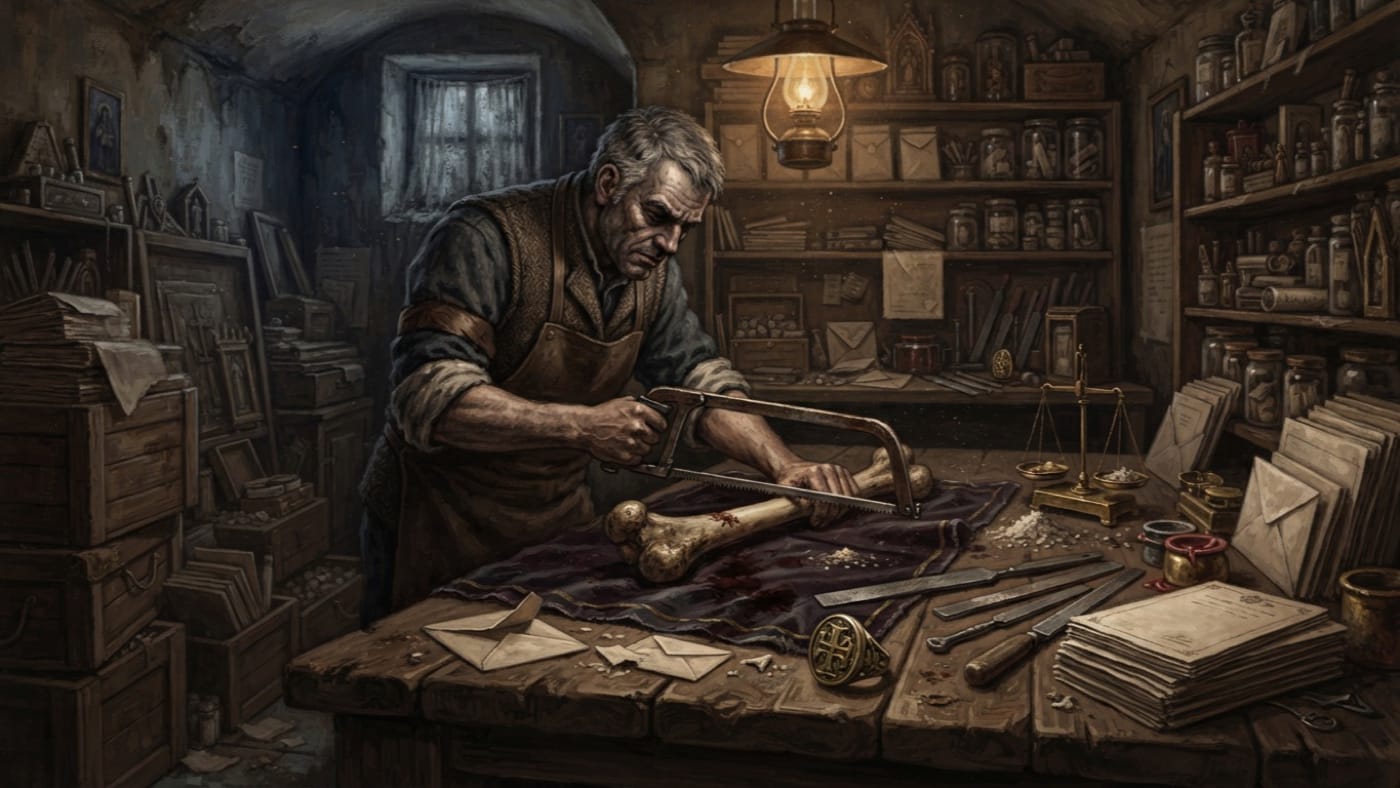
The work happens wherever a door locks and a lamp can be angled: a backroom chapel, a port warehouse, a reliquary antechamber, or the upper room of a tavern whose keeper charges extra for silence. The bench is ordinary. The kit is a fine-toothed saw, filing implements, a dark cloth, a dust brush, soft wax envelopes, split labels, small brass scales, a stack of blank provenance packets, and a seal ring whose faces unscrew.
Intake comes first. The bone may come from a shrine that wants ready money, from a custodian with overflow, or from a Reliquary Salvager who recovered it somewhere no one will name on paper. Sometimes it already carries a certificate from a Relic Authenticator whose generosity was bought in advance. The splitter weighs it, writes the weight into two ledgers that will never agree, and lays it on the cloth.
Then the saw. The major portion goes to whichever claimant has the most money or the most militia, and the chips and filings go to the second and third. Shavings are swept, weighed, folded into wax and labelled. Each portion is wrapped separately so that no fragment is ever found in another's company. In the Profit houses the ladder goes further: dust caught in the cloth becomes contact sanctity, the cloth becomes associated material, and the crate lining is cut into squares. That ladder is Profit practice. A Peace Broker stops at the fewest pieces that will keep two parishes off each other's steps, and sweeps the dust into the brazier.
The cut is the cheap part. A fragment without a certificate is a splinter of an old man's leg. Every portion leaves the bench paired with its own provenance packet: a custody chain, an Examiner's abstract, and a local sanctity disclaimer worded to hold true in one canton and go unheard in the next. The seal ring changes faces between packets. Where the risk is high, the splitter lays official wax over an underwax that carries a different registry number. An auditor who lifts the top seal finds a second truth waiting underneath.
None of this authenticates anything. Sawing a femur does not prove whose femur it was. No ruling of the Bureau of Relics holds that a sixth of a saint works a sixth as well, or that it works at all. Recognition comes from the paper. The bone supplies the thing pilgrims touch.
Routing follows. Papers travel by one road and fragments by another, past checkpoint marshals who have had their candle-money, past ferrymen and customs clerks, and occasionally past a friend in the Bureau of Records. The buyers are the usual frightened sanctities: shrine houses, bastion custodians, ward chaplaincies, pilgrim chapels, and noble patrons who want a saint above the family altar and a document saying he belongs there.
The trade should not be confused with its neighbours. The Salvager recovers the bone and the Authenticator recognises it. The Ritual Bone-Stamper registers the dead, and the Saint-Bone Melter reduces fragments to material for the walls. The Bone Splitter divides devotional stock and sells each piece with a story attached.
#On Peace, Profit, and the Untouched Bone
The quarrel is over whether the bone needs touching at all.
The Peace Brokers say it does, rarely and under protest. Their doctrine, which they trace to Noxa, puts delay before division: move the feast, misplace the warrant, borrow a substitute reliquary for a weekend, and saw only when every calendar has failed. They cultivate senior Relics custodians, who warn them of Examiner tours in exchange for an absence of riots. The Paper-Only clerks call them timid Bone Splitters, which describes their habit correctly and their motive wrongly.
The Profit Brokers say it does, constantly and gladly. Each competing provenance chain is a separate customer, and each customer pays. A femur that can be talked into nine portions has eight more patrons than a femur left whole. Profit men think the Peace men squeamish and the Paper-Only men cowards, afraid of anything that might glow.
The Paper-Only faction calls the bone theatrical furniture. In their own words, the seal is the miracle, and anyone still sawing in a backroom chapel has misunderstood where the Church's authority lives. The position is coherent, and it belongs to them alone. The Church has never ruled that a relic is inert. Reports of bones that warm, hum and speak suggest the furniture sometimes holds opinions. Clients will pay for a packet, but they kiss only fragments.
All three camps rely on the same apparatus: seals, jurisdiction, timing, and the iron rule that two contradictory certificates must never reach the same auditor. The splitter simply adds sawdust to the paperwork.
#On the Risks of Handling
The first hazards belong to the butcher. Bone dust settles in the lungs and in nicked knuckles. Old saint-matter carries whatever the crypt carried, so splitters collect coughs, wax burns and festering cuts their confessors are too polite to examine. Custody disputes turn violent in warehouses where everyone present has a knife and a grievance. Rivals swap seal-heads. Clients hand their brokers to the White-Mantled Inquisitors as soon as a fragment becomes more embarrassing than useful. Seal-sickness and provenance drift afflict splitters as they afflict every broker. The local strain of drift is forgetting which portion came from which end of the bone.
The last hazard lies on the cloth. Published accounts record fragments that glow under rival seals, shavings that hum in their wax, dust that warms through paper, and a rib that whispered a broker's name. In three documented cases, a bone cracked along lines that split it into exactly as many pieces as there were claimants. The Bureau of Relics calls this coincidence and the brokers call it a warning. Some preachers credit the Creator's patience, while others smell the Great Deceiver. The Ledger records the reports and certifies none of the explanations. A consignment that responds is a quarantine problem and a delivery problem. It does not prove that sawing makes miracles, however much the Profit men would like that printed on a label.
#On Present Toleration
The Bureau of Relics has renewed its standing advisory every year since A.S. 148: it authenticates, it distributes, it does not broker. At this survey of A.S. 201, fifty-three years on, it has received no reports. Several custodians who sign the renewal keep a splitter's address in the same drawer.
Assessment 77-R of A.S. 199 counts two hundred to three hundred and forty brokers across Zones 1–5, moving eleven hundred to sixteen hundred relics a year. Those figures cover the entire Femur-War trade. Nobody has separated out the Bone Splitters, and the Bureau of Shadows has no appetite for doing so. A count implies a list. A list implies arrests, and arrests imply a Bureau explaining to forty chaplaincies why their saints arrived in pieces and with whose help.