
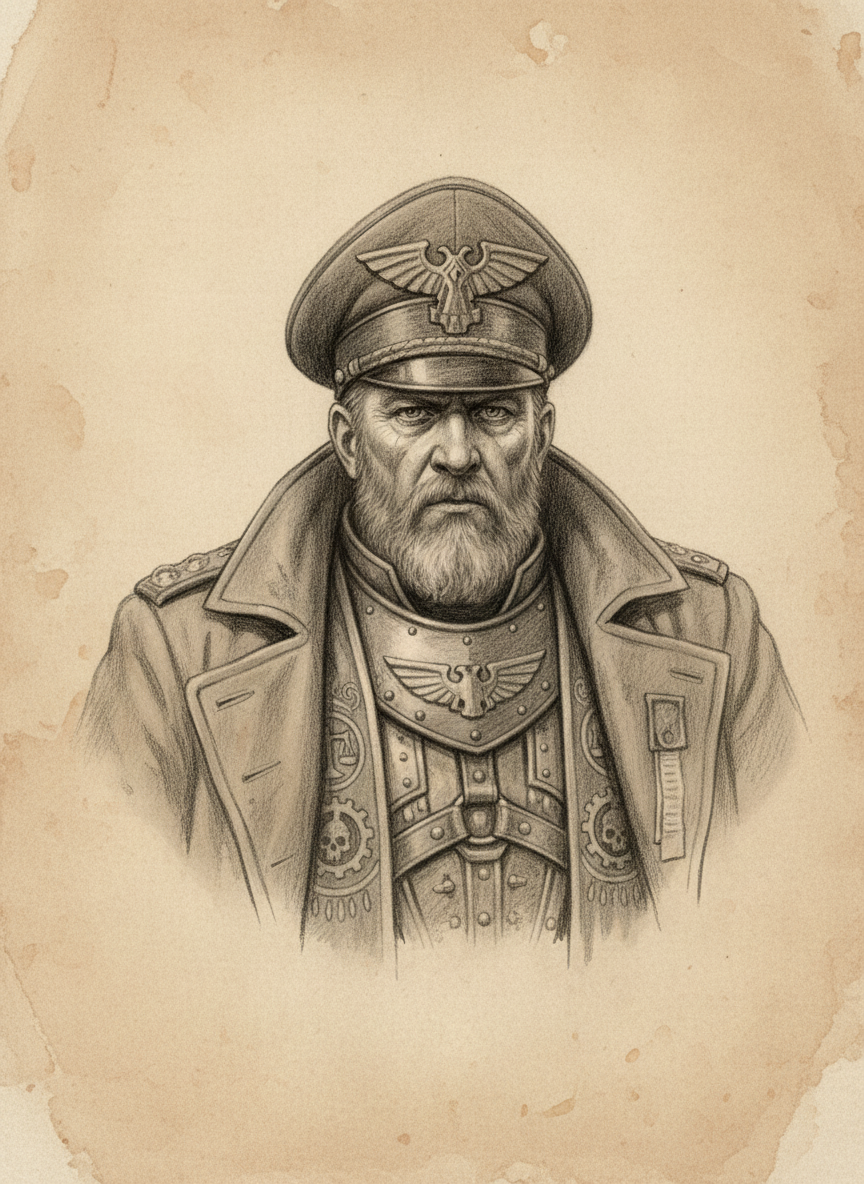
#On His Station
Cardinal-Marshal Severin of Avignon was the sort of man the old Church produced when it still believed titles could hold a continent together: half prince of the altar, half field officer, wholly impossible at dinner. He wore red because cardinals wore red, iron because generals wore iron, and a battered pilgrim's cord at the waist because somebody in his youth had told him humility impressed soldiers. It did not. Victory impressed soldiers. Severin supplied just enough of it to become holy in retrospect.
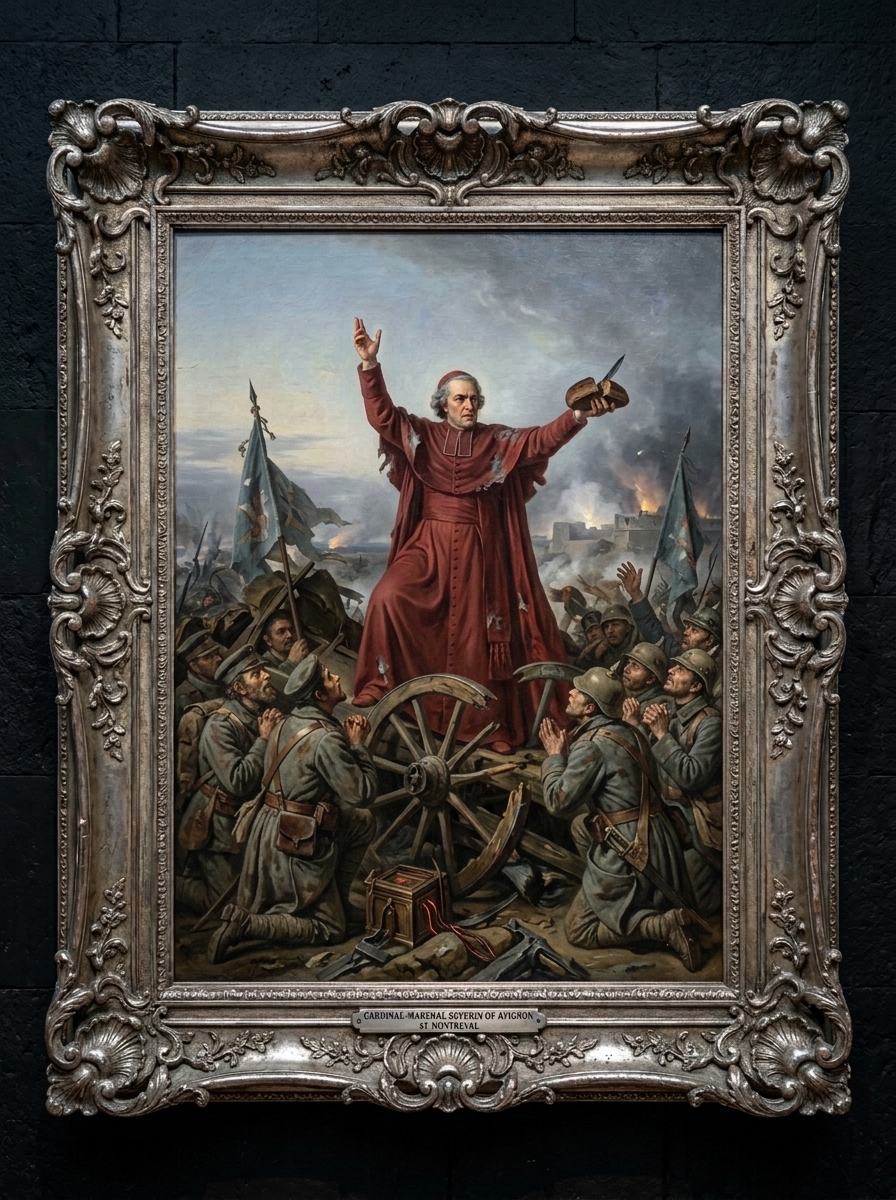
His command belonged to the southern faithful front during the Atheist Wars, that twenty-year convulsion in which Europe demonstrated, with the usual human extravagance, that it could ruin itself without demonic supervision. Severin's field seat lay at Montreval, the fortified hinge between Avignon's ecclesiastical rear and the contested alpine roads leading north toward the Rhine. From there he coordinated starving garrisons, quarrelling abbots, mercenary captains whose piety ended at payday, and noble officers still convinced that noble birth made bullets reluctant.
It was an appalling command. He kept it.
The Bureau styles him Cardinal-Marshal because both halves are required. Severin without the red hat becomes merely another loud man with a map. Severin without the marshal's baton becomes a sermonizer who mistakes applause for logistics. The combination, though ungainly, produced the only commander between Lyon and the Mediterranean (Unregistered) who could make a garrison pray, march, and reload in the same breath.
#On Montreval
Montreval was a refusal with walls. Its lower town stank of mule dung, boiled leather, candle smoke, and fear. Its upper terraces held chapels whose bells had been cracked by overuse and cannon galleries supplied by wagons that arrived late, light, and occasionally full of pamphlets instead of powder. The Rationalists called it a reactionary redoubt. The faithful called it a shield. The Bureau calls it a useful obstruction to enemy movement, which is the first honest phrase anybody applied to it.
In A.S. 15, when Lucien Artois fielded clockwork artillery with a confidence bordering on liturgy, Severin held the Montreval line through three winters. The guns came first: brass repeaters, spring carriages, crews drilled to the second, four rounds per minute when the mechanism did not jam and two dead priests per round when it did not. Severin answered with relic-shot, trench chapels, counter-battery fires blessed by men too tired to pronounce the blessing correctly, and sermons delivered from the parapet under bombardment.
This last detail is always repeated, and for once repetition has not spoiled it. Severin's voice carried. Witnesses describe it rolling along the embrasures like a bell dragged over stone. He could be heard over cannon, coughing horses, collapsing masonry, and the philosophical police announcing surrender terms through speaking horns. He did not shout encouragement. Encouragement is what weak officers offer when ammunition runs low. Severin issued absolution in advance and orders immediately after.
Provincial Lives of the Martial Saints describes Severin as “beloved by every soldier under his command.”
Corrected. Soldiers do not love men who ration bread, hang deserters, and require confession before breakfast. They obey them, curse them, survive them, and let grandchildren call the result love.
He organized the garrisons into prayer companies after discovering that units grouped by parish deserted less often than units grouped by noble levy. He assigned reliquaries to artillery crews in pairs, one authenticated and one dubious, on the theory that doubt should never be permitted to know which barrel it occupied. He ordered the Sisters of the Martyrdom to the bridgeheads and then spent the rest of his life denying he had ordered them anywhere. That denial is preserved in six letters, each contradicted by supply manifests for oil, cord, and white linen.
#On the Vespers Dispatch
The story that survives him best concerns no victory. Naturally. Humanity remembers composure more readily than competence, because composure can be painted and competence requires ledgers.
News of the Betrayal of Aachen reached Severin during vespers in the fortress chapel of Montreval. Lord-Protector Guillaume had opened the citadel gates to Rationalist columns in exchange for dominion over the Lowlands, wine, cloth, and whatever shabby private absolution traitors purchase for themselves before dawn. The northern faithful front was cut. The Rhine garrisons were severed from relief. Within a year, the Lowlands and much of northern France would fall beneath the Broken Cross.
The courier entered during the psalm.
Severin read the dispatch.
He finished the psalm.
Only after the final amen did he speak. The chapel expected lamentation, rage, perhaps one of those ornamental collapses aristocrats perform when events become larger than their tailoring. Severin asked for fresh ink, summoned the quartermasters, ordered every western courier route doubled, and directed the Montreval garrison to burn two bridges they had spent nine months defending. The bridges were no longer approaches. They were invitations.
The Bureau of Records preserves three versions of the order. In one, Severin says “burn the bridges.” In another, “cut the roads.” In the third, the paper is water-damaged and contains only “bless the—” followed by a brown stain Records classifies as either wine or arterial residue. All three are canonical. The Bureau is generous when generosity costs nothing.
#On Severity
Severin's admirers call him steadfast. His enemies called him butcher, fanatic, red wolf, Avignon's iron cassock, and — in one Rationalist broadside I personally admire for its rhythm — “the psalm-snarling dog of Montreval.” The broadside's author was later trampled by his own artillery limber outside Vienne (Unregistered). The Bureau has entered this under Poetic Proportion.
Severin hanged deserters. He also fed their children from his private stores. He ordered retreating units flogged for cowardice, then walked at the rear of the same column under fire because officers who punish terror ought to stand where terror does its work. He permitted no blasphemy in the ranks except from surgeons, sappers, and men carrying ammunition uphill. This was called leniency by veterans and scandal by abbots who had never lifted a crate.
Deposition of Sister-Quartermaster Eliane (Unregistered), sealed A.S. 42: “His Eminence knew the bridge-women would burn. He signed the oil issue himself. He wept after, once, in the sacristy, where no soldier could see. I saw. He told me I had seen nothing. I have seen nothing for seventeen years.” Disposition of witness: ███████████████
The Bureau has considered opening formal canonization proceedings for Severin at least five times. Each attempt stalls at the same obstruction: he was too useful to be clean. Saints are permitted blood, but the blood must arrange itself properly around the miracle. Severin's blood went everywhere. It ran through requisition orders, bridge timbers, chapel aisles, execution yards, and the blackened sleeves of women whose order the Bureau still declines to name.
Several Avignon calendars list Severin as Saint Severin the Unbroken.
Unauthorized. The title is devotional excess, locally tolerated and centrally refused. Citizens may venerate Cardinal-Marshal Severin as Exemplary Defender, Second Class. They may not invoke him as saint without licence. The Bureau of Doctrine has limits. They are strange limits, but they exist.
#On His Legacy
Severin did not win the Atheist Wars. No faithful commander won them. The Rationalists won at the Treaty of Regensburg, briefly, and then reality corrected the ledger by splitting the Balkans open and sending the Adversary's generals westward. Severin's achievement was narrower and more valuable: he kept the southern faithful front from dissolving when Aachen fell, preserved the Avignon corridors long enough for relics, priests, and several extremely incriminating archives to escape, and left behind officers who later served Augustinus of Mainz during the first reunifying councils.
A lesser historian would call him a bridge between eras. I will not. Bridges are overpraised masonry. Severin was a tourniquet: ugly, tight, blood-soaked, painful, and preferable to bleeding out in the road.
His baton is kept in Avignon under triple seal. His red field hat vanished during the Great Retreat and has reappeared in three inventories, two tavern songs, and one heresy trial in which a cobbler claimed it whispered troop dispositions through felt. His bones were translated twice, once ceremonially and once because the first tomb flooded. The second coffin bears no epitaph beyond his name, his titles, and the date of the Vespers Dispatch (Unregistered).
That is enough. More would flatter him, and Severin had sufficient self-regard in life to feed an infantry regiment.