
#On the Origin of an Office Without a Birthday
The Directorate of Acoustic Enforcement is the office within the Bureau of Purity that licenses punitive voices. It sets the standard they must sing to, reads their records against everyone else's, and disciplines whichever throat the reading condemns. It is no Holy Bureau. It holds no chair at Doctrine's table and sends no envoy to the Strasbourg processions. It is an organ inside Purity, and like most organs it gets noticed mainly when it fails.
The problem it solves is older than its letterhead. Purity learned long before it gave the lesson an office that flesh under the iron will not hold still. Backs arch and breath scatters. The Brand-Smith's line wanders after the flinch, and a wandering line produces a confession nobody can read, which Purity treats as a confession nobody made. At Mainz, Inquisitor-General Severian answered with psalmists borrowed from the Bureau of Orison and Song. They held a drone while the brand came down, and he found that a steadied body writes cleanly. The documented borrowed-choir years run from A.S. 94 to A.S. 104. In A.S. 104 Writ 14-C sealed the Brand-Singer corps into existence and attached licence, inspection and a standard rite to it.
The Writ names the corps as the office it creates. It does not name the Directorate. At some point between the first borrowed tenor and the present ledgers, supervising those singers acquired a desk, a seal and a title, and no charter I have found records the day. I decline to supply one. A Directorate that cannot produce its birthday has at least the decency not to celebrate it.
An early Orison digest described Writ 14-C as "a cooperative loan framework between sister Bureaus."
Corrected by Purity objection. A singer assigned to a penitential rite passes under Purity's penitential jurisdiction for as long as the rite lasts. Orison supplied technique. Purity took the throat.
#On the Licensed Throat
The Directorate recognises three standings. The Ash Chorister holds drones, learns breath pacing, and carries the hymn slate for a singer senior enough to have one carried. The licensed Brand-Singer leads the rite and gives the cues. The Cantor-Marshal sets protocols, trains and audits. The Resonance Warden stands to one side, assigned to rooms that have begun to answer and to emergencies, and no paper I have read ranks that post above the Marshal.
A licence is a body made readable to an examiner. Throat inspection comes once a year. The examiner reads the cords by mirror and lamp, measures the scar ridges, and has the candidate hold a drone against Purity Standard C while an assistant reads out false charges and family names. Renewal comes quarterly, at Matins on the first day of each quarter, when the singer presents slate, throat seal and prior anomaly reports. Neither should be confused with the weekly stamping of the throat seal, or with the salt-and-ash rinse every singer performs before work and no examiner thanks them for.
The white wrist cord gains a strand for each examination passed and loses one for each failure. The throat seal keeps its corrections for good. A parish cantor may have a lovelier voice than any Brand-Singer in Strasbourg. Having no cord, no seal and no file, the cantor owns, in the Directorate's eyes, only an attractive noise.
#On the Rite as Evidence
The six-stage rite is what the Directorate really produces. Each stage leaves paper, and the Directorate checks paper.
Room tuning comes first. The singer taps the tuning rod against stone, sets the bell-hour metronome token, and hears and chalks the cracks before the condemned is brought in. The baseline from this stage is the measure for everything after it. The Opening Hymn puts the subject's breath under outside command, so an auditor can later ask whether panic was governed or merely survived. Stage cues give identity, charge, recantation, forfeiture and sentence each a distinct note pattern. The scribe writes to them and the Brand-Smith strikes to them. In synchronised application the iron lands on the cadence. The Closing Tone under Standing Order 22-S descends in three notes and seals fourteen witnessed heartbeats of silence. Documentation closes the rite and opens the audit.
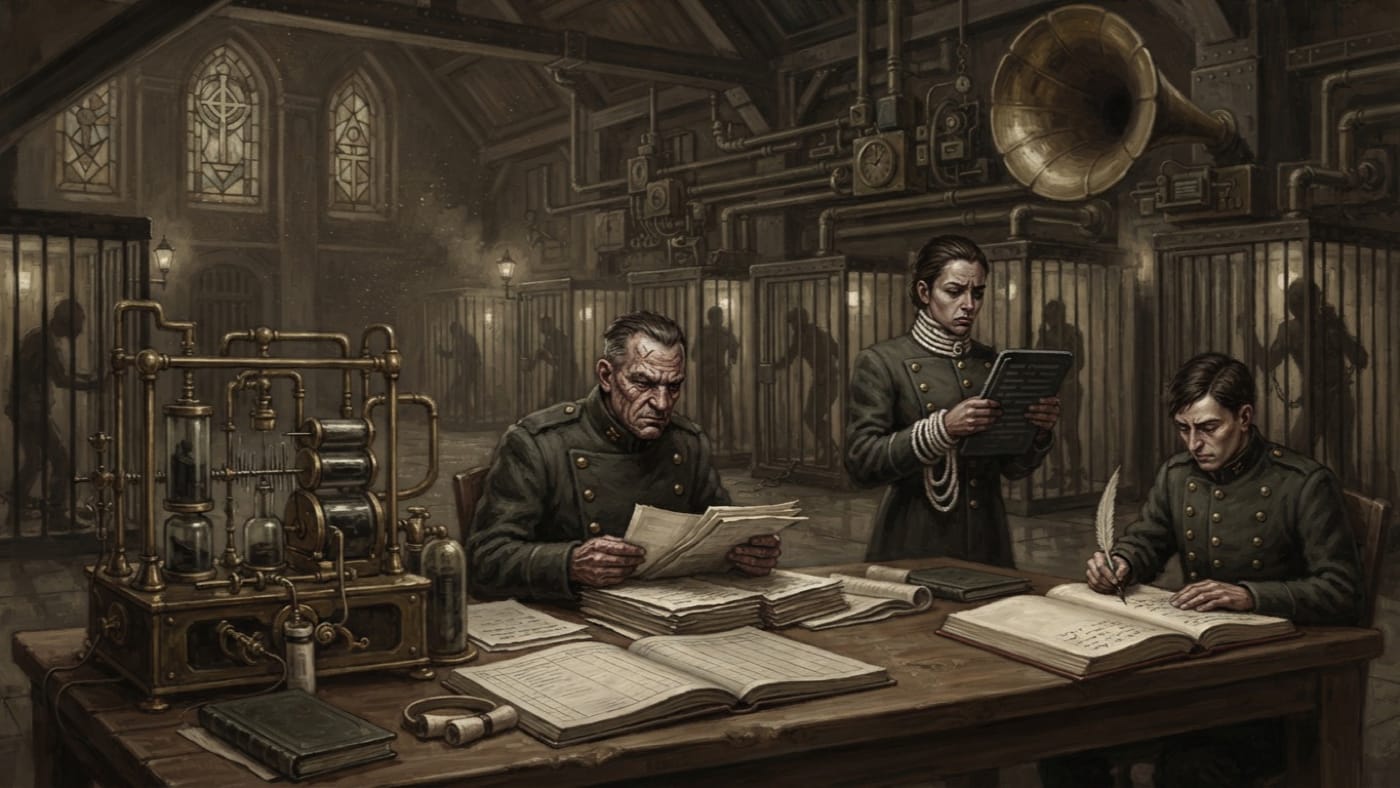
Three documents meet on the Marshal's table: the singer's pitch-anomaly report, the Brand-Smith's alignment log and the scribe's inscription record. If they agree, the file closes. If they disagree, someone has failed, and the Directorate exists to name that person before the Bureau of Records names one with less charity. The audit form lists its causes in a tidy column. Blaming smith misalignment brings out a guild steward. Room response means Doctrine referral and forty days' delay. Nobody defends against novice drift, and the Chorister at the threshold learns early what the column is for.
The Synod teaches that a rite performed this way seals truth into the skin. That is Doctrine's claim. The Directorate claims less: the result can be read, compared and filed, which is the only kind of truth it knows how to audit.
#On Mainz and the Wider Service
The Iron Choir of Mainz is the Directorate's most public duty and its least hidden quarrel. Along the road to Strasbourg the cages hang weathered on their stanchions, and Directorate singers keep the acoustic schedule from matins to compline. They listen at each cage for voices that are weakening, and they change hymn assignments when contrition thins into fluid. Where speech has been cut away, they tie bells to the wrists. When an occupant dies, the schedule passes to the next, and the row never falls into civic quiet.
Purity owns the sentence and the singers. Orison supplied the technique, still classifies the hum and audits the cages' upkeep, and reminds everyone at every opportunity that it only tuned the instrument. Records owns the forms and the final notation. Each Bureau calls the Choir its own, and each is right about some part of the cage.
Beyond Mainz the Directorate's writ covers the Strasbourg penitence halls, tribunal basements, rooms next to infirmaries, and the forward discipline wards. At Bastion-Przemyśl singers pitch over wire hiss. At Bastion-Brest Judgment cadence carries across the bridge-forts. At Bastion-Shipka fog makes the fourteen-beat count a liar. The Directorate has no authority over bell towers, broadcast work or military music, and it once had to state in writing that its singers are not issued to steady banquets.
Purity credits Severian's Article 19 of A.S. 134 with more prosecutions than any other article of the Catechism. The Directorate has made no complaint about the work this sends its way.
#On the Schools and the Answering Room
The Directorate licenses three rival methods and favours none of them in public. Mercy Tone holds sustained drones that keep the subject breathing and the confession going, and it is prized wherever Records wants more names. Judgment Tone sharpens the cadence to finish faster, and it is prized wherever the cells overflow or a prefect has promised completion by Vespers. The Silentists cut sound down to tap cadence and slate signal, on the view that a voice invites hostile attention. Their anomaly ledgers are suspiciously clean, and their competitors say so often.
Purity tolerates the feud because three schools audit each other more cheaply than one school can be audited. All three claim Saint Orla of the Steady Note as patron, and each takes from her what suits it. Mercy takes her held breath, Judgment her Closing Tone, the Silentists her last command.
That command is where the discretion of every rank ends. When a chamber makes a sound no licensed throat made, the Bureau of Doctrine records residual liturgical resonance, Orison records acoustic reflection, and the singers say echo weather. The Directorate does not rule between them. It requires only that nobody answer. No one harmonises, corrects, completes or asks a question. A Cantor-Marshal with thirty years of clean audits is bound exactly as the Chorister holding the slate is bound. Rank buys a tuning rod and a signature. It buys no reply.
WRIT 14-C SEALED ADDENDUM — AS HELD IN DIRECTORATE FILES When response exceeds authorised reflection, attending personnel shall ███████████████ and shall not ███████████████. Personnel who harmonise remain personnel only until ███████████████.
#On Present Protocols and the Accounting of Voices
Approved Hymn Protocols Revision 14 was sealed in A.S. 199 and in A.S. 201 governs every hall, road and ward the Directorate holds. A singer may no longer certify her own pulse, and a throat-witness must countersign the count. The scribe writes the cause of each restart beside its slash. Metronome tokens are calibrated quarterly against Standard C, with the slip filed beside the licence slate, so a token that drifts in a damp cellar now drifts on the singer's account. Every anomaly is graded, and the grade is sealed before anyone leaves the room.
The singer pays with the body. Cords scar and the cough settles in. Soot gathers in lungs that have sung twenty winters in the penitence halls, and the infirmaries file the humming in sleep as bell-sickness. A suspended singer serves silence weeks, road-cage maintenance or Chorister instruction. In the worst files, the singer is reassigned to the other side of the iron. Every licensed singer fears the anomaly, because the report she writes in the room is the first document the audit reads against her.