
#On the Hour That Refuses Its Owner
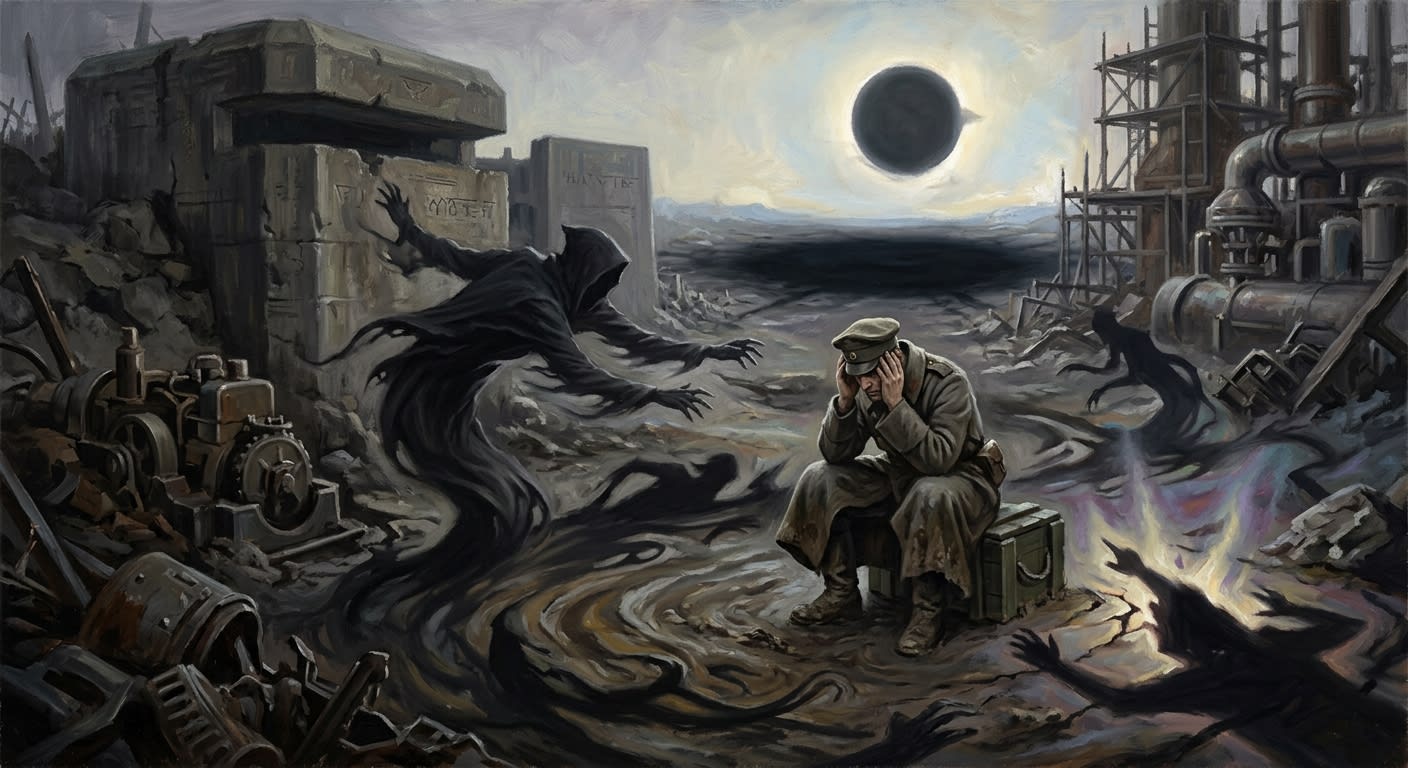
Shadow Noon is the field name for a Zone Five temporal-luminous contradiction in which the sky brightens while shadows lengthen in the wrong direction, dragging equipment, command, prayer, and men toward places no object has earned by position. The Bureau of War calls it hostile behavioural weather. The Bureau of Engineering calls it directional light failure under battlefield saturation. The Bureau of Doctrine calls it matter disobeying witness. Infantry call it sit down, shut up, and wait.
Infantry, here as in most offices where survival has not been polished into theory, are correct.
Shadow Noon is not an eclipse, although frightened men have wasted that word upon it. It is not dusk, glare, fog, smoke, heat shimmer, prayer-jam, or ordinary artillery dazzle. It has occurred under clear noon, ash noon, storm noon, and once under a bell-dead sky so white that men vomited from brightness before the shadows moved. The sun may stand overhead. Lamps may burn steady. Survey flags may show no wind. Then the darkness under a rifle begins to pull east while the barrel points north, and the sensible man places his backside upon the nearest crate before Creation asks him to follow.
The phenomenon has been recorded across multiple sectors of No Man's Land: the low approaches below Bastion-Brest, the shell bowls east of Bastion-Przemyśl, the Knife-Mile, the dead flats where Flesh-Mud lies under apparently dry crust, and certain forward approaches to the southern sectors where the Line's bells grow too numerous and the air acquires the harassed expression of an overworked clerk. It favours no single Sin-General. This frustrates the analysts, who prefer evil with a postal address.
#On the Signs by Which a Man Keeps His Feet
The first sign is length. A standing man casts a seated shadow. A rifle casts the shadow of a ladder. A coil of rope throws darkness like a road. The second sign is disagreement. Shadows cease sharing source logic. The helmet pulls west, the chin strap pulls south, the bayonet points toward the old trench line, and the soldier's own feet suggest, with increasing emphasis, that the rest of him has misunderstood the route.
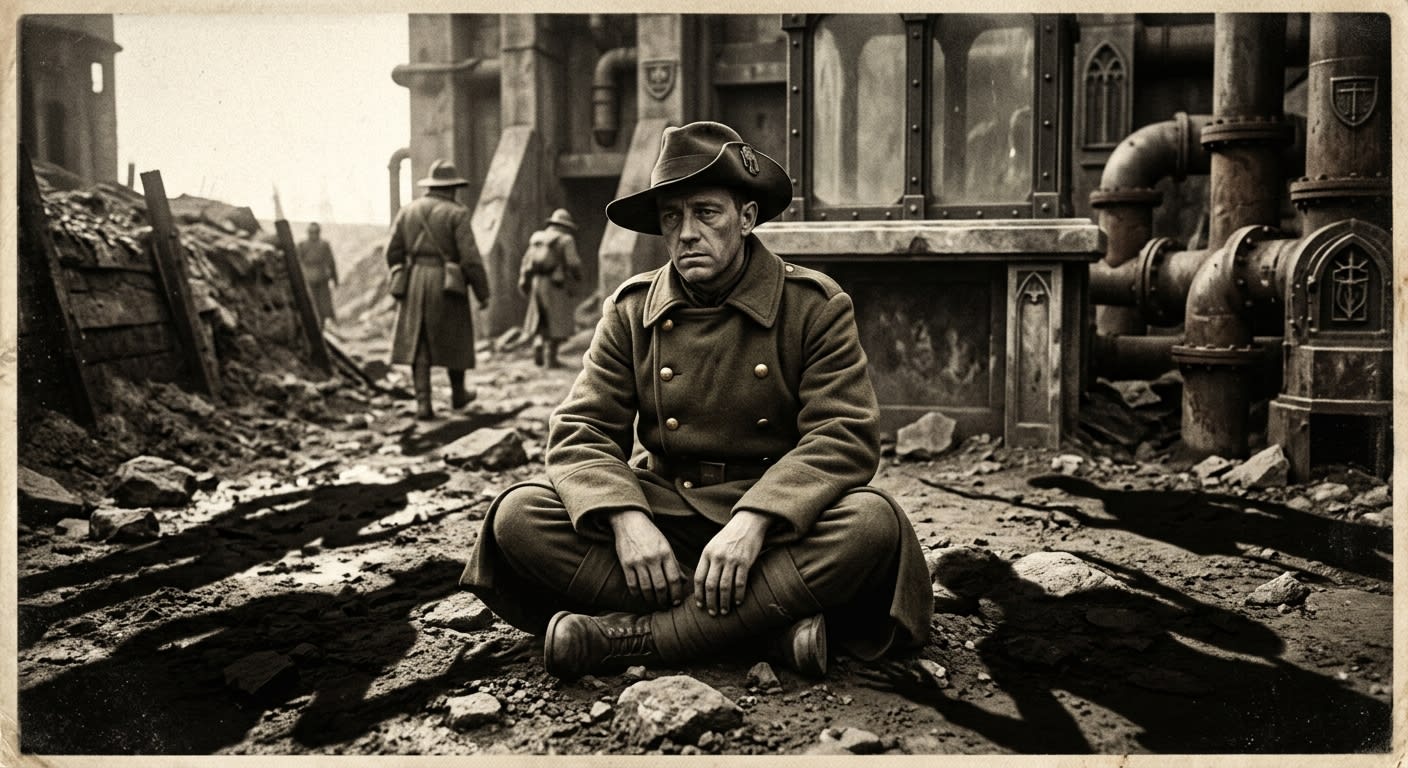
The third sign is traction. Equipment becomes heavier in the direction of its shadow. A satchel drags toward a shell hole. A charge box leans off a plank road. Survey poles bow without bending. Horses refuse to move, which is one reason I trust horses above officers in this matter. A horse knows when the ground has begun reading from another rulebook. An officer knows only that the schedule has a superior.
The fourth sign is cadence hunger. Men walking in step become easier prey. The shadows lengthen with the beat, grip the rhythm, then correct it. A marching file begins to lean before it knows it is leaning. A hymn sung in proper measure provides a convenient handle. Drum calls stretch. Bells sound late in the bones while arriving on time in the air. This is why the Shadow Noon halt order breaks cadence first. Stop the boots. Stop the chant. Stop the heroic little metronome by which men help the field count them.
The fifth sign is courtesy. Shadow Noon often offers a visible destination: a ditch, a berm, a plank road that appears shorter than it was, a safe patch without wire, a dead comrade standing in darkness where no body stands in light. The young move toward it because youth has been taught to interpret invitation as mission. Veterans sit down. They smoke, count fingers, touch knife handles, and wait until the ground remembers which way obedience lies.
A pre-revision training slate described Shadow Noon as “an optical hazard manageable by disciplined formation.”
Withdrawn. Disciplined formation worsens losses under contradictory shadow. Formation gives the phenomenon a grammar. A mob may scatter and lose six. A perfect file may become salt in ranks fit for inspection.
#On Theories, Each Damned in Its Own Hat
Engineering blames fracture in the battlefield's light-bearing medium caused by bell density, artillery glare, ash particulate, saint-dust, sorcery residue, and repeated over-pealing. The vulgar clarity of this theory recommends it. Bells denies the premise with a musical violence that would impress me more if the denial did not arrive stamped on paper slightly singed at the edges. Orison says sanctioned sound cannot injure Creation. Engines & Furnaces mutters, in memoranda later corrected by Records, that a saw remains a saw even when the carpenter sings hymns while using it.
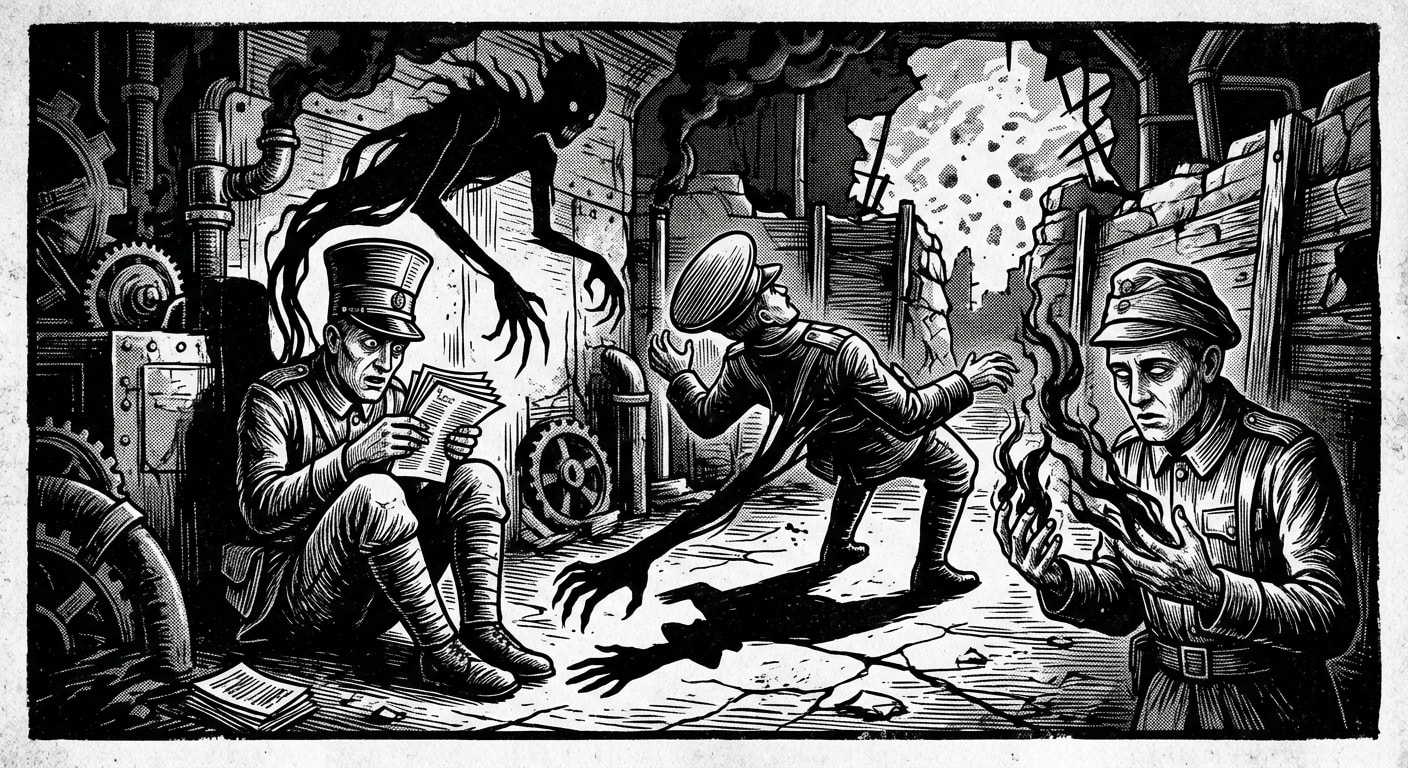
Doctrine blames the Lie. This is safe, elegant, and annoyingly true in the way a locked cupboard is true: it contains the answer and prevents inspection. The Lie mocks relation. Shadow belongs to body, object, light, and lawful position; Shadow Noon loosens those bonds and lets the dependent part claim mastery. The shadow walks. The owner follows. If the owner resists, weight, balance, and fear become the shadow's advocates.
War blames enemy conditioning, though it cannot reliably name the enemy. Maldrake may heat the air until light behaves like beaten metal. Syrion may slow the soldier's response until shadow seems to arrive before motion. Morwen may teach a reflection to covet the object that made it. Atheron may make light kneel to height. Velmora may do nothing at all and later sell the remedy. Every theory has produced at least one useful countermeasure and three foolish procurement requests.
Field chaplains advance a harsher explanation. No Man's Land has heard too much command. It has been told advance, halt, kneel, stand, fire, pray, dig, hold, die, and rise across two centuries of bells, drums, whistles, sermons, death warrants, and screamed last orders. Shadow Noon occurs when the field repeats command without caring who issued it. A man's own darkness becomes a little officer. Naturally, it orders him badly.
#On the Salt Division
The A.S. 201 Shadow Noon Incident supplied the cleanest warning and the filthiest comfort. A Litany-Engineer division advanced across a supposedly dry sector of No Man's Land under War seal, Engineering co-seal, and a chaplain's blessing written in the confident hand by which calamity usually signs its first draft. Their task was ordinary: establish charge points along a failed enemy berm, sink proof rods, prepare the ground for a later Shield-Paladin movement.
The map marked the sector dry. Weather slates showed no rain for six days. The Flesh-Mud register showed no active patch within a mile. Veteran supply men halted when shadows began reaching backward across the plank road. One old sergeant sat on an ammunition crate and refused to move. A young captain threatened him with contagious hesitation. The sergeant saluted from the crate and said he would accept the charge after noon behaved.
The Engineers pressed forward singing Counter-Sorcery Verses. Their cadence was exact. Their satchels were tight. Their hymnals were oil-dark and correct. The shadows moved with them, then ahead of them, then against them, each man's darkness turning home while the man continued outward. At the third verse, the line vanished behind glare.
They were found at second bell, upright, ranked, white, open-mouthed. Salt statues, said the public plate. Calcified personnel, said Engineering. Devotional mineral remains, said Doctrine, proving that cowardice can wear incense and still smell of paper. The boots were packed with Flesh-Mud to the knee: dark, living, dense with hair, thread, nail parings, and pale rootlets that withdrew from light. Rods sunk beside the formation struck wet resistance at twenty-two inches. Rods sunk ten yards west struck chalk. Rods beneath the sergeant's crate struck gravel and cigarette ash, which remains the most persuasive countermeasure yet discovered.
ENGINEERING RECOVERY ANNEX — CONTRADICTORY SHADOW SITE Sample A: salt accretion from Engineer-Sergeant ███████, mouth interior. Sample B: mud from left boot, same subject. Test result: chloride content incompatible with local soil; organic response to spoken surname. Additional note: when Verse III was recited, Sample B climbed the glass and formed █████████████████. Disposition: transferred before repeat test.
Families requested bodies. The request was legally inconvenient. A man transformed into salt remains a man for grief, a mineral for jurisdiction, and evidence for every Bureau except Mercy. War offered sketches. Records offered certified extracts. Doctrine offered a sermon on preservation. Mercy offered protest, briefly, beautifully, uselessly.
#On the Halt Clause
The A.S. 201 revision to the Doctrine of Layered Death added the halt clause: no layered advance during contradictory shadow unless Chaplain, Engineer, and Paladin Captain concur. The clause sounds prudent until one observes that prudence requires no committee to avoid marching after one's own disobedient darkness. The clause exists because fear must be stamped before young commanders will obey it.
Layered Death depends upon sequence: wall, charge, ash, rhythm, dividend. Shadow Noon corrupts every layer. The wall follows the wrong outline. The charge crawls toward the wrong seam. The ash falls against the wind. The rhythm gives the field a handle. The dividend becomes too neat, as the salt division proved. There is something especially offensive in dead men arranged more tidily than living officers ever managed them.
The halt clause has already saved lives. Officers dislike this. Saved lives become witnesses, and witnesses acquire opinions before Records can reach them. Veterans obey with theatrical laziness. They sit on crates, helmets, ammunition boxes, dead machines, or one another if terrain is scarce. Litany-Engineers ground charge satchels. Ash Chaplains cap thuribles. Shield-Paladins unlock knees without unlocking ranks. No hymn is sung. No drum is answered. The Line holds by refusing motion, which offends every manual and pleases every survivor.
A training broadsheet described the Shadow Noon halt as “optional under conditions of superior zeal.”
Withdrawn. Superior zeal has no optical authority. Shadows moving contrary to source-light suspend advance unless the required concurrences are obtained in writing or the officer ordering movement agrees to march first, alone, carrying the unit ledger in his teeth.
#On Countermeasures and Liturgies of Stillness
The first countermeasure is immobility. This appalls institutions that mistake movement for obedience. Halt. Sit. Ground metal. Shorten ropes. Break step. Close hymnals. Stop pointing. A finger's shadow may tug harder than a boot if the finger is issuing orders. Officers are instructed to lower swords, canes, flags, and all other vanity rods by which darkness may acquire purchase.
The second is reattachment. Men place palms flat on the object that owns the shadow: rifle stock, wheel rim, crate lid, shield face, boot sole, the earth itself if no better parent remains. Chaplains mutter the Ownership Formula: The shadow follows; the flesh does not answer. Bells dislike the formula because it is barely music. War likes it because it works often enough to print.
The third is ugliness. Mirrors are covered. Polished buckles are muddied. White cloth is turned inward. Bright icons are wrapped. The field already has enough suggestions without human vanity casting clean edges for it. Veterans smear ash across cheekbones and weapon barrels, not to hide from the enemy but to make the shadow stutter. Beauty is dangerous in No Man's Land. This explains, at last, the survival of so many officers' moustaches; they are too ridiculous to be useful to Hell.
Salt may be thrown but not trusted. Salt preserved the lost division; preservation is not rescue. Censer smoke sometimes thickens the air enough to shorten shadows. Too much smoke gives Flesh-Mud cover. Counter-tolls from Bellways have mixed results: a low peal can steady a perimeter, a high peal can sharpen shadow edges, and over-pealing may wound the air more deeply, assuming Engineering's vulgar little measurements are to be believed. They are often vulgar. They are too often right.
#On Bellways and the Air That Remembers Being Cut
Bellways were built to make movement lawful under hostile sound: routes, peals, corridors, and broadcast sanctities by which men cross air that would rather be enemy property. Shadow Noon humiliates the Bellway because the correct peal may sound while the wrong shadow moves. A table can be clean, a tower tuned, a march authorised, and still the field will reach sideways for the men inside it.
This has produced ugly quarrels among Bells, Orison, Engineering, and War. Bells claims peal discipline reduces Shadow Noon spread. Engineering claims bell density correlates with atmospheric malfunction. Orison claims sanctified sound cannot be causal. War asks, with rare intelligence, whether the argument can occur after the convoy crosses. Doctrine holds the minutes and improves nothing except the prose.
Field reports suggest a pattern the public manuals avoid. Shadow Noon often gathers near over-used crossings, repeated command corridors, bell-saturated trenches, and sectors where Flesh-Mud has been frozen, bridged, salted, and crossed too many times. The air remembers being forced. The ground remembers being denied. The shadow, being the cheapest part of any object, is the first to defect.
The old superstition says a man should spit into his own shadow before crossing No Man's Land. Purity forbids the practice as unsanitary and doctrinally incoherent. Veterans continue it. I decline to condemn any rite that costs one mouthful and may save the rest of the man.
#On Present Classification
As of A.S. 201, Shadow Noon remains classified as a Zone Five hostile atmospheric-behavioural phenomenon with temporal-luminous characteristics, flesh-terrain interaction, and doctrine-level movement implications. This phrase is long enough to trip over, which makes it suitable for the subject. Public instruction is shorter: if your shadow walks wrong, sit down.
The salt statues remain where reports need them to remain. Maps shift the site by administrative need. Patrols see a white line of men in the distance, mouths open, singing nothing. Other patrols see empty ground crusted with salt and boot prints facing west. The old sergeant's crate sits in a training shed at Bastion-Przemyśl, touched by apprentices before their first trench march. At certain hours, when lamps burn too bright and shadows lean toward the wrong wall, salt gathers beneath it in a neat crescent. The instructors sweep it up. The broom is replaced monthly.
No Man's Land continues its catechism. Gas sings. Mud remembers. Bells quarrel with air. Shadows audition for command. The wise sit. The ambitious advance. The Ledger receives both, but the wise make it wait longer.