
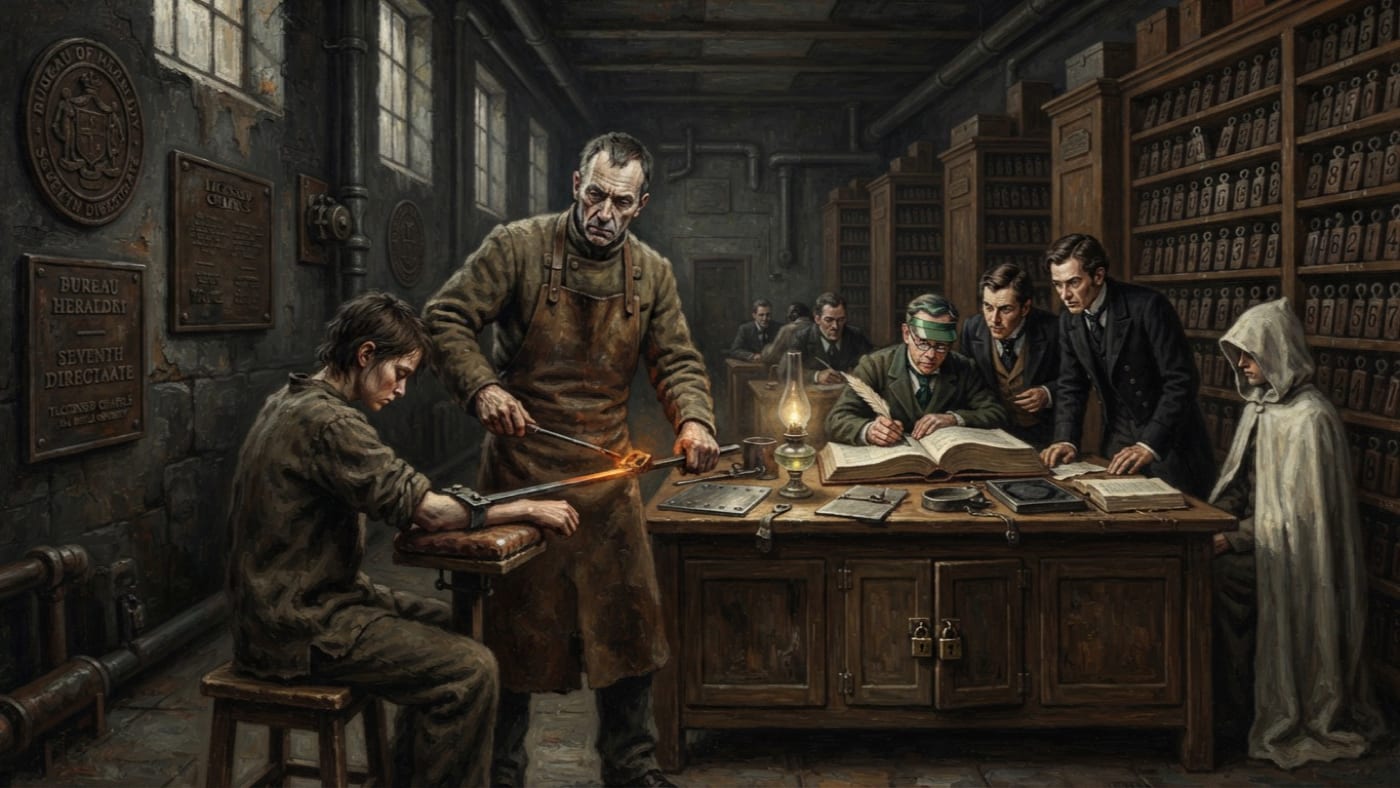
#On Authority and the Complete Rite
Full Witness Protocol is the Licensed Chapel standard for complete bodily proof. It is performed in sanctioned premises under the authority of the Bureau of Heraldry, Seventh Directorate. It does not ask whether a sentence is just. It asks whether the mark on a given forearm can later be proved to have been put there by this iron, under this authority, before these eyes, on this body and no other. A mark that survives that interrogation is admissible. The Bureau prefers admissible to true, because admissible can be audited.
No founding day survives for the Protocol, and I decline to manufacture one for the comfort of librarians. The Geometry Brand-Smith Corps was constituted in A.S. 104 under the Catechism Third Revision, and its earliest chapels already kept serial irons, swatch plates and witness seals. The Paper Plague of A.S. 112 at Bastion-Przemyśl taught Heraldry that paper could carry two hundred false names through a gate and leave eighty-seven dead behind three days of lockdown. The Compulsory Marking Decree of A.S. 113 answered with skin. It set seven identity classes and tripled the Corps before anyone had built enough chapels to hold it. The Angle Riots of A.S. 119 then proved that a lawful iron could lie, and the Chapel purists hardened what they had into the form described below.
Earlier Chapel circulars described Full Witness Protocol as "the universal and original rite of lawful heat."
Withdrawn. The Protocol governs complete bodily proof in sanctioned premises. Field carts, muster sheds and emergency intakes were branding under lesser forms before the Chapels possessed the marble to claim precedence.
#On Identity, Iron, and Witness
The rite begins with the iron, because the iron is the only participant the Bureau fully trusts. It is withdrawn from its locked cupboard under two signatures. Its serial is read aloud and the reading is entered. The swatch plate is uncovered, the measuring frame laid beside it, the lamp trimmed, the record plate set by the open ledger. Witnesses are assigned to the bench before the subject is permitted through the door.
Chapel practice seats an assigned clerk and an independent observer. Where the Bureau of Purity has taken an interest, a white cloak occupies the end of the bench and contributes silence. I record this staffing as the Chapels practise it. I do not promulgate a statutory number. On close reading, neither has Heraldry, which speaks of two witnesses in one circular and three in the next with the serenity of an office that has never been asked to count aloud.
What the bench must do is see. A valid tag tied to a ledger entry establishes nothing about presence. The Protocol requires the observer to watch the act itself, close enough to smell the hair go.
Identity is confirmed by two instruments, or by one instrument and one sworn witness. The instruments are evidence of identity, and their kinds vary with the authority that accepts them. Heraldry has published no closed list. The omission is deliberate, since a closed list would be a shopping list for the Shadow Angle.
Class and authority are settled before heat. The Ledger-Scriber reads aloud the class, the authority under which it was assigned, the application site, the iron serial, the witness names and the allowable aftercare. The Frame-Hand aligns the frame against the approved swatch plate. The Master Brand-Smith answers for the iron and for the standard. The Angle-Runner carries tags and tools and herds the bench. Carrying a tag gives the runner no more authority over a class than carrying a hymnal makes a choirboy a bishop. A runner who lays a serialized iron on skin has committed an offence, however true the geometry.
The reader will confuse one distinction, so I state it plainly. The Decree has seven identity classes: civilian, military, clerical, ward, penitent, pilgrim and condemned. These are separate from the three heresy categories of the older brands. A pilgrim's triangle is a credential. A heresy geometry is a sentence. The Protocol serves both and confuses neither, provided the Scriber has read the right line.
#On the Application and Its Record
The site is washed. The frame is seated and checked against the plate, and the Frame-Hand tells the Master the triangle will close. The prayer sequence is completed in full. In Chapel opinion, a Chapel that abbreviates the prayers is a cart shed with tiles.
The Master speaks the Triune Formula: Measure, Witness, Refusal. The refusal is not the subject's. The Compulsory Marking Decree permits no ward or levy boy to decline, and no instructor who wished to keep his badge has read the third word otherwise. The classroom cards assign other triads to the triangle's three points, Order, Sacrifice and Obedience among them, and change them whenever Doctrine revises its cards. The Formula spoken at the bench belongs to the bench. The Chapels have not settled its sense, and I shall not settle it for them.
The iron descends under observation.
The ledger takes entries before heat, during heat, after heat and again after the first bandage. The record plate is impressed between the third entry and the fourth, while the wound is still open and legible. It records location, class, serial and the authentication of the witnesses who watched. That plate is the hinge of the whole apparatus. It binds a particular body to a particular page, so that neither may later wander off and claim to be someone else.
Before release, a re-read is scheduled for the ninth day. The scheduling precedes release. The subject need not be held for nine days, only entered for them. Field clerks confuse this with the nine-day levy ink of the muster sheds. It has nothing to do with the levy ink.
No station may be omitted, shortened or reordered without a superior writ, and the writ must exist before the deviation. A queue is not a writ. Neither is shelling, though a great many sheds have treated it as one.
#On Re-reading and Suspended Examination
The nine-day reading examines authenticity and healing compliance. The mark is held under the fixed lamp against frame and swatch plate. The ledger is set against the witness seals, and the seals against the custody sheet for the iron. Where the geometry fails tolerance, the matter passes to a Re-inspection Brand-Smith. With authority, that specialist may burn a corrective overlay through the scar within two degrees of arc. Heraldry calls this amendment. The subject calls it the second time.
A moving mark is another case entirely. Under the A.S. 199 revision of Form 14-G, any Brand-Smith who observes drift in a mark applied within the preceding seventy-two hours must seal the subject and notify Purity. Further examination is then withheld until an Inquisitor of the Third Degree grants clearance. The nine-day re-read is subject to the same restriction. A complete Protocol, scrupulously observed, buys no exemption from it. The Chapels themselves have filed sheets on marks applied beneath their own cushions.
Purity enters such drift as Category Two Demonic Interference with Heraldic Instruments. Heraldry enters it as Geometric Instability, Under Investigation. The two entries have shared the sheet since A.S. 147. I am instructed to record both and resolve neither, an instruction I have found unusually easy to obey.
#On Admissible Error and Present Application
The Chapels cite Bastion-Irongate at every hearing. In A.S. 119, during a Purity sweep, a miscalibrated iron applied inverted doubles where identity singles should have stood. 1,400 civilians received second-category heresy marks. Three hundred were detained. Forty-seven went to the Paper Mines of Ulm. Eleven were executed under Standing Order 22-D before correction arrived. The marks were invalid from the first heat. They were obeyed anyway, because Standing Order 22-D reads a mark as evidence that executes itself. Invalidity is a finding that someone must make, and that someone needs a horse as fast as the cart.
The Chapel position is that full witness, fixed premises and a proper re-read would have prevented it. That is the Chapel's claim, and I attribute it accordingly. The record is less obliging. The Irongate iron bore a valid serial and had passed custody check at departure. It was cleaned, heated, witnessed and applied according to form. The sweep was not a complete Chapel rite, and no one can now prove what a tiled room would have caught. What Irongate does prove is that witnesses watched a lawful instrument write the wrong sentence, and sealed what they saw.
Herein lies the Protocol's arithmetic. It reduces lost irons, substituted tools, infection, class drift and later dispute. It also stacks more seals behind each classification. A wrong mark therefore arrives at the gate defended by a clerk, an observer, a Scriber, a Frame-Hand, a Master and, on bad days, a white cloak. The witnesses certify the chain. None of them was asked whether the sentence was just, and the form has no box for the answer.
A forged authority read aloud with confidence survives the Protocol. So do a corrupt class assignment and a bought observer. So does a subject who jerks under heat and tears the lower point, leaving a mark that is perfectly documented and wrong. Mercy Branders practise delayed witness capture: the iron touches skin before the final tag is tied, and the tag is chosen after the wound has been watched. Shadow Angle crews launder witness-tags, borrowing the Protocol's grammar so that a cellar job arrives at the gate speaking Chapel. Quick Burners simply lack the hours. A convoy will not wait in sleet while a queue of four hundred watches the lamp being trimmed.
As of A.S. 201, the Protocol is observed in rear cities, court annexes, orphanage intake halls, debt tribunals and the larger checkpoint complexes, wherever architecture can keep pace with authority. Elsewhere lesser forms serve, and the Chapels file objections. The Seventh Directorate receives them, stamps them and orders more cupboards.