
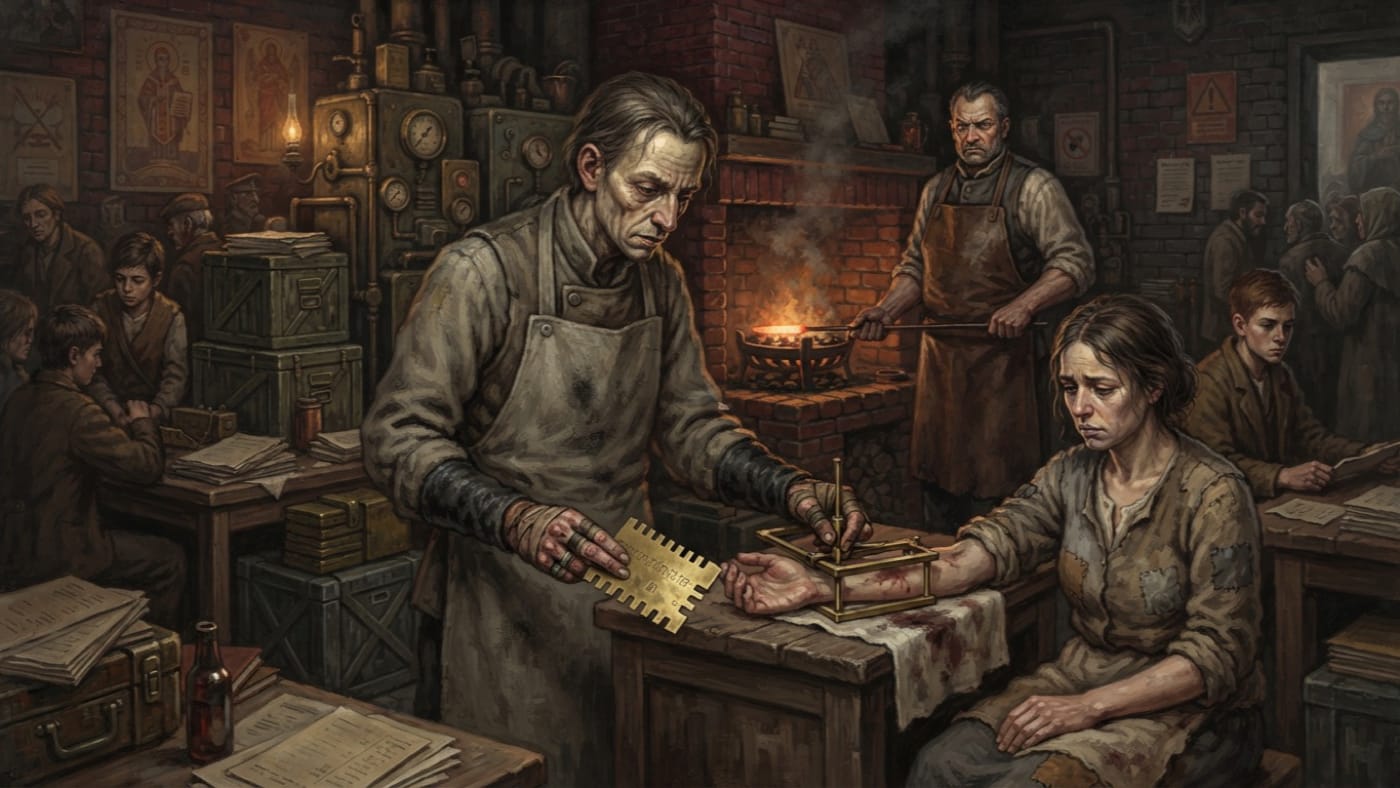
#On the Hand and the Frame
"Point, Point, Point — Hold."
The Frame-Hand stands in the middle of the Geometry Brand-Smith ladder, and in the Synod the middle is where the work piles up. Below is the Angle-Runner, a youth with a cord of witness-tags and a gift for fetching tongs. Above is the Master Brand-Smith, who keeps custody of the serialised irons and of the standards those irons obey. Between them, ranked with the Ledger-Scriber and the Inspector's Assistant, sits the Frame-Hand. This is a mid-rank servant of the Bureau of Heraldry, and the title names the instrument first and the human appendage second, which is the correct order of importance.
The measuring frame ensures the angles. The swatch plate shows what the angles ought to be. The Frame-Hand lives in the small space between those two pieces of brass and a living forearm. In the licensed chapels the posture never varies. The frame sits braced against skin and the plate is lifted to the eye, while the master's iron waits in the brazier like a sentence nobody has read aloud yet. Class selection belongs to the writ and the master, and sealing belongs to the witnesses. The Frame-Hand's share is smaller and more intimate: making sure the geometry the state has chosen lands where the state intends.
The trade calls a careless practitioner a "soft hand" and a good one a "true frame." In certain districts both are insults.
#On Three Weeks of Instruction
The rank is older than its disgrace. The measuring frame was already issued equipment when the Corps was constituted in A.S. 104, and somebody had to hold it. Nobody recorded when that somebody received a title. I will not invent a founding that the Bureau of Records never troubled to file.
The disgrace, by contrast, has a date. In A.S. 112 the Paper Plague brought two hundred false identities through the western perimeter of Bastion-Przemyśl. It left eighty-seven dead of record and kept the district sealed for three days. Heraldry blamed paper, and Heraldry won the argument. The Compulsory Marking Decree of A.S. 113 required a tri-mark at every forward-zone checkpoint, in one of seven classes: civilian, military, clerical, ward, penitent, pilgrim, condemned. The Corps tripled. Angle-Runners were recruited from the orphanage rolls. Frame-Hands were put through three-week courses.
The Bureau of Doctrine later reviewed those courses and called them "adequate to the task, which is not a compliment." I have read a great many Doctrine judgements. That is the only one I suspect of honesty.
Three weeks is long enough to learn a swatch plate by heart. It is too short to learn anything about the arm under the frame. The ledger needed numbers, so men and women who had held brass for twenty days were set beside braziers in muster sheds and orphanage intake rooms. They were told to be the figure already written next to their office.
Earlier editions of this Codex taught that the Compulsory Marking Decree, and the hurried certification of Frame-Hands under it, originated with the Bureau of Purity.
Corrected. The decree came from Heraldry, and Purity enforced it. A Frame-Hand trained in A.S. 113 learned geometry from one Bureau and fear from the other, and was never told which lesson would be examined.
#On Measurement under Witness
A lawful marking follows a fixed liturgy, and the Frame-Hand serves at one station of it. First the identity claim is presented: paper, sponsor, writ or roll. Next the class is selected. Then the geometry is verified with frame and swatch plate. Witnesses observe and seal. The mark is recorded by location, class and serial, and a follow-up inspection is set for authenticity and healing compliance. Frame work belongs to the third station. Nothing else in the sequence can be trusted until it is done.
What that means on the chapel floor is simple enough. The frame goes onto the forearm, wrist or cheek and is held without trembling. Its seat is checked against the plate. The master is told the triangle will close. The master's iron then comes down inside angles the Frame-Hand has guaranteed. A frame that slips by the width of a thread turns a civilian into something else, and in this system the iron does not forgive a slip.
The working dress is the trade's: ash-grey apron, soot on the cuffs, fingers wrapped against heat and blood. The shift opens the way every Brand-Smith's shift opens. Witness-tags are counted in threes, the badge is touched to the swatch plate, and the Measure Line is said. A Frame-Hand with a stammer is excused from nothing.
The venues vary, and so does the pressure. In a licensed chapel the purists wait at the master's elbow with full witness protocol, and a frame can be held as long as the geometry requires. In a trench muster shed the Quick Burners count wrists and look at the clock, and a Frame-Hand who takes a second look slows the levy line. Court annexes bring the sentencing surges. Orphanage intake brings forearms too small for the frame's lower bar. Whichever master owns the room decides how long true measure is allowed to take.
#On False Measure
Brand-Smiths are judged on throughput, geometric compliance, infection incidents, audit cleanliness and correction frequency. Only one of those five can be blamed on a frame. Every audit checks the iron serials first, then reconciles the ledger against the witness-tags, and then sends inspectors into the streets to see whether the marks still hold. A rising correction count follows the hand that held the brass. Depending on the master, that hand may be dismissed or protected. Usually it is protected until someone higher up needs a name to offer.
The general discipline of the trade applies with no special mercy for middle rank. It runs from demotion to the trench carts, through public badge-stripping and trial for false measure, to erasure where a body has been made to lie on purpose.
The Angle Riots of A.S. 119 showed the cost of bad proof at scale. During a Purity sweep through the southern districts of Bastion-Irongate, hastily trained teams working with a miscalibrated iron gave second-category heresy marks to fourteen hundred civilians. Three hundred were detained. Forty-seven were sent to the Paper Mines of Ulm. Eleven were executed under Standing Order 22-D before the correction arrived. The file names no Frame-Hand as the culprit, and I will not supply one to make the sermon tidier. The disaster created the Re-inspection Brand-Smith and the habit of reading old marks twice.
Moving marks are another matter. They are a catastrophe of a different kind. Since A.S. 147, Purity has called drifting geometry demonic interference and Heraldry has called it instability under investigation, and the two have never reconciled. Standing Order 14-G, revised in A.S. 199, puts sealing, notification and Form 14-G in the Brand-Smith's hands. A Frame-Hand who sees lines crawl has a single duty, which is to fetch the master. Ordinary mismeasurement is far more common, and it is human and dull.
#On the Hands That Leave
The Frame-Hand is the cheapest pair of hands within reach of a serialised iron, and the market has noticed. The trade's own ledger of corruption names frame-hands among those who receive bribes, alongside scribers, masters and witness-tag keepers. The payers are deserters, gangs, ambitious guilds, parents, lovers and smugglers. Payment comes in paper, fuel, protection, or a name quietly taken off a list. In the chapels a bribe is called "extra wax" or "lantern oil." A frame seated half a degree generously costs less than a master's silence and is easier to deny.
Some leave through pity. The first Mercy Branders after the decree included tired chapel hands and frightened Frame-Hands who had held brass against too many wrists marked harder than the offence deserved. There was the debt widow classed as condemned, and the levy boy with the whistling lung. These hands learned what the frame was designed to teach, which is where a line can fall. Not every Frame-Hand becomes a Mercy Brander, and a licensed rank does not license mercy. Most of them hold the frame where they are told.
Others leave through dismissal. By A.S. 114 the first Shadow Angle cellar frames had been cut from stolen chapel brass. The earliest crews were small, practical arrangements: a dismissed Frame-Hand, a runner with chapel access, a salve-woman, a clerk who could borrow witness-tags, and a heavy man at the stair. Failed Frame-Hands still turn up in crew rosters at the Constantinople warrens, in the Shipka sheds and in the back courts of Brest. The riots of A.S. 119 did not create that trade, though they did make it persuasive.
Mercy Branders and Shadow crews despise each other with the intimacy of rivals who were trained on the same brass.
#On Present Service
The Corps listed some six thousand four hundred licensed Brand-Smiths in A.S. 201. Heraldry publishes no separate count of Frame-Hands. That is consistent with Heraldry's habit of counting irons more carefully than the hands that hold them.
The documented promotion path runs from Angle-Runner to Frame-Hand, then to Master, then to Court Notary-Brand, and finally into the service of a Measure Prefect. Promotion is documented, but nobody is promised it. A Frame-Hand's prospects depend on the master: on that master's custody record and patrons, and on whether the master's correction count can absorb an assistant's. The master's errors stay in the master's own ledger. A Frame-Hand's errors are entered against the frame.
The work leaves its mark on the worker as well. Brand-Smiths measure doorframes by reflex and count in threes. A Frame-Hand develops one particular reflex: meeting a stranger, the eyes go to the forearm before the face, and the fingers start to bracket a wrist that nobody has offered.
The demand does not ease. Gates still read skin, and as long as they do, somebody must hold the brass while somebody else heats the iron.