
#On the Instrument
Deviation is defect. Defect is closure. — the decree's most quoted sentences, as Guild crews chalk them above section-house stoves
The Gauge Standardization Decree is the instrument by which the Bureau of Engineering, in A.S. 136, ordered every rail within the Dominion laid to one measure: 1,435 millimetres. Sections that departed from it were to be corrected. Sections left uncorrected were to be closed. The decree did not ask for agreement, which is why it obtained some.
Forty years of committee had failed to move a single sleeper. One sentence of closure moved thousands of kilometres of them, though ink moves nothing by itself. The law reached the ballast by way of an iron bar. A Track Engineer with cold hands laid the gauge rod, a rigid length set to the standard, across the inside faces of the rails. If the rod seated true, the Dominion's will had been done. If it rocked, jammed, or dropped into the cinders, the will had been insulted and a section would go dark.
I possess no account of a signing. There is no surviving procession, no candles, and no Archon pressing wax with the expression of a man founding a civilisation. The tradition records the order and what followed from it.
#On the Measures Inherited
The decree disciplined an existing body. The Guild of Rails had held its charter since A.S. 94 under the Codex Ferrum, and within two years its iron was quarrelling with itself. Northern sections kept one width, southern sections another, mountain spurs a third. Certain private yards kept a measure whose only justification was the yard master's grandfather. The Gauge War of A.S. 96 to 136 followed.
Its mechanics were humble and lethal. Every wagon stopped wherever two widths met. Cargo came down by hand and crane, crossed a platform, and went up into rolling stock of the other measure. Flour spoiled during the wait, and shell crates cracked under hurried handling. Hospital trains stood while the wounded were carried across the boards. Along the Sagittal Line, from Bastion-Königsberg on the Baltic to Bastion-Constantinople at the Bosphorus, hunger reached the trenches days after its cause had been filed as a transfer delay in some yard far to the rear.
Central supply toward Bastion-Przemyśl and Bastion-Sibiu suffered worst, because it was handled at Bratislava and again at Budapest before it ever saw a mountain. Northern traffic toward Bastion-Brest and Königsberg had its own breaks and its own excuses. So did the southern feeds toward Bastion-Irongate, Bastion-Shipka and Constantinople.
#On the Decree's Substance
The substance can be recited before a kettle boils. As the Guild and Engineering abstracts represent it, the decree imposed the standard measure across the whole Dominion. It declared deviation a defect and made defect grounds for closure. It also provided that a closure under military emergency was actionable by the Bureau of War and reviewable by Engineering. The Guild's own abstract adds that local exception was abolished.
The decree says nothing about how a sleeper is adzed, how deep the ballast lies, or how often a bridge plate is tapped. It sets a common width rather than a maintenance code. Everything else the Guild already knew, or was about to learn at expense.
The emergency clause was the clever part, and Engineering wrote it knowing exactly whom it would annoy. War could act against a closure when the front demanded it, and Engineering could review whatever War had done. A general might force a train across a section the rod had condemned, and the record would follow him afterwards like a bailiff. The decision was split between the office that wanted speed and the office that would have to explain the wreck. Neither has forgiven the other, and both find the arrangement useful.
The Bureau of Doctrine describes the outcome as "an administrative disagreement, resolved by technical consensus." That is Doctrine's sentence. In practice the consensus was one Bureau giving an order and the others discovering that they had agreed.
#On Inspection and Closure
A penalty needs someone to find the offence, and the Guild supplied him. Crews of four to six walked the corridors with gauge rod, spike maul, tie tongs, chalk and ledger. Wherever the rod failed, the ledger received a line and the section received a verdict. The Stationmaster above them could withhold passage over track he judged unsafe. After A.S. 136 he could cite the Dominion's own measure while doing it.
This is how compliance acquired force. Strasbourg could not see a loose spike in a Danube cutting, but a man with a rod could, and the decree made his finding the law's finding. Certification became the condition of movement. Iron the Guild had measured, entered and passed was open. Iron it had not passed was closed, by the decree's own logic.
War found this intolerable within a season and indispensable within a year. Military urgency did not repeal physics. An ammunition train sent over an uncertified section reached its battery late, or reached the river early. The generals kept their emergency clause and learned, at cost, to use it rarely.
#On the Relaying
Compliance in law was immediate. Compliance in iron took three years of double shifts under wartime conditions, while the war went on demanding trains over the very track being torn out beneath them.
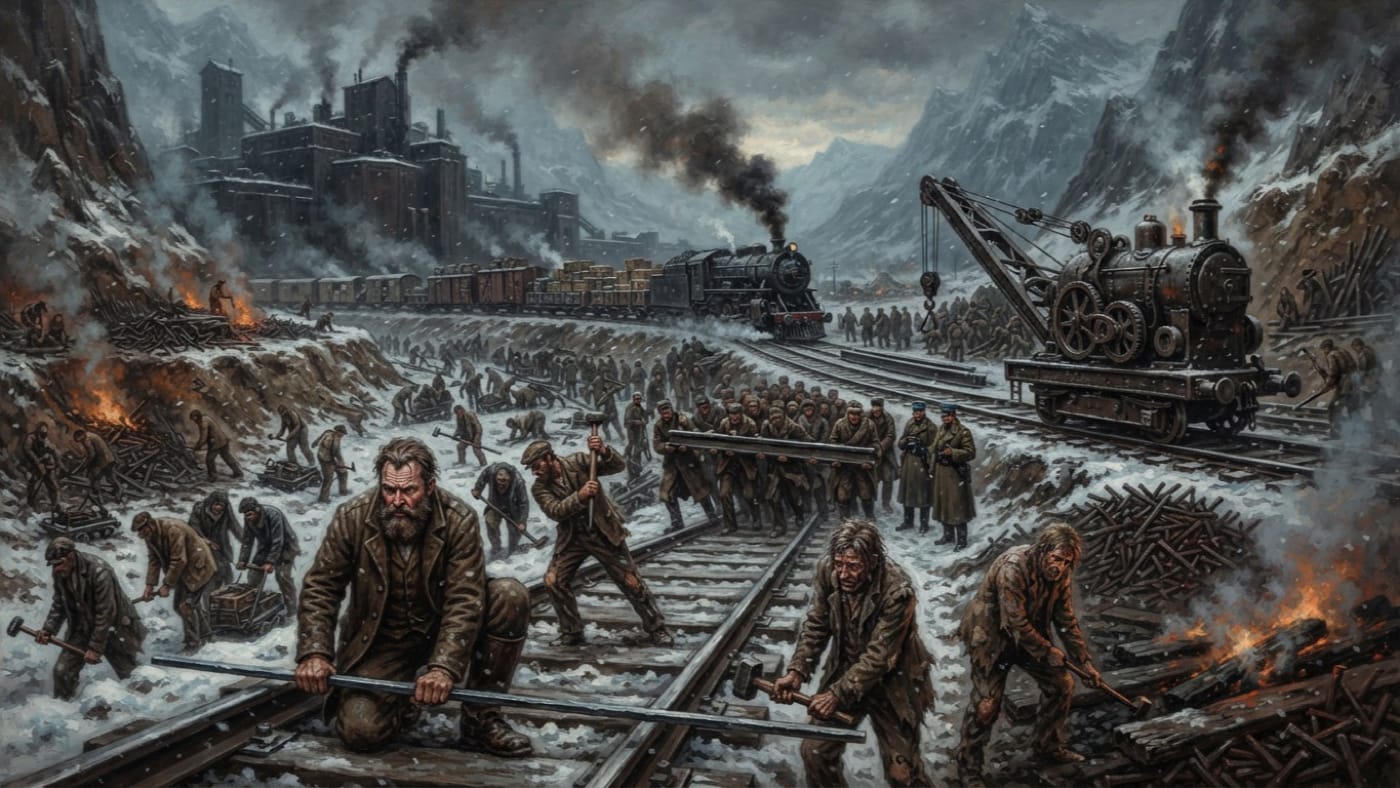
The work list reads like the inventory of a cathedral being demolished. Sections were lifted and relaid. Bridges were jacked up on timber cribs while the river ran below. Tunnel mouths were shaved back, yard throats recut, and turntables dismantled. Rolling stock was converted: wheels were reset, or the axles were scrapped outright. Ledgers were rewritten and schedules replaced, because every timetable in the Dominion had been built around stops that no longer needed to exist. Old sleepers, wet and still spiked, went into burn pits beside the line. Their smoke hung over the new works for as long as the works lasted.
The skilled labour came from the Guild's crews. Pressed labour worked beside them: condemned men brought up by transport chain, military assistants lent by their units, and prisoners counted by whoever happened to be counting. Hammers rang through the night shifts. Hearing went first. Hands went next, closing over the years into the curve of a maul handle and staying there.
Approximately four thousand people died in the relaying, and the figure is a reconstruction. Payroll offices counted their workers, transport chains their condemned, military units their own, and prison registers whoever they had been ordered to keep alive. The dead fell between these ledgers as easily as they had once fallen between platforms. The figure covers the relaying alone. The forty years before it kept their own count, and kept it badly.
Public histories describe the Gauge Standardization Decree as "bloodless administrative modernization."
Corrected by the Guild memorial count and Engineering casualty abstracts. "Administrative" stands; that part of the business was in fact bloodless. "Bloodless" is withdrawn. Approximately four thousand dead are entered against the relaying, and Records will amend its public copy when its public copy can bear it.
#On the Measure in Present Use
The standard delivered what Engineering promised. Gauge-break transfers fell away along the main corridors. Trains ran from Strasbourg toward the Line with fewer halts, and War began counting movements in days instead of transfers. Records could follow a wagon from yard to yard without renumbering it at every platform. The Carpathian mule roads remained mule roads. The decree governed rail, and the mountains declined to become rail on instruction.
The Guild came out of the relaying with its hand on the throat of the Dominion's supply. Every corridor after A.S. 136 ran on certified track, and certification was Guild work. The Military Track Corps would later carry that certification under fire. A Stationmaster who closes a doubtful section today invokes the measure of A.S. 136 the way a priest invokes a canon: rarely by number, always with confidence. The decree made the rails interchangeable, but it did not make them safe. Nor did it end the quarrel between the office that needs the train and the office that must answer for the wreck. It moved that quarrel onto a ledger page, where it has lived ever since.
The section houses keep the memory. Relaying veterans get the warm seat and the first cup. Memorial nails are driven for the dead, and the Four Thousand Nails roll is named among the Guild's records of them. At the winter observance of the decree's anniversary, a gauge rod is laid across the supper table. Nobody eats until the oldest hammer veteran lifts it. Saint Vandrail is invoked over the meal, as the Guild invokes him over most things. Nobody in the room claims he wrote the decree, and that is the condition on which Doctrine tolerates him.