
#On the Emergency Authority
The Joint Classification Mandate of A.S. 78 is the instrument by which the dead of the Rhine Corridor stopped being a private sorrow and became a licensed category. It was issued jointly, under emergency authority, by the offices later chartered as the Bureau of Records, the Bureau of Rites and the Bureau of Tithes. This was twelve years before the Concordat of Strasbourg gave any of them a formal Synod to serve. The Bureau names are retrospective. The fear was contemporary.
Its causes are filed elsewhere and need only their invoices here. The Ossuary Overflow Winters of A.S. 73–76 had filled the racks past honesty. The Great Plague added more dead, and the Lull of Names took their names away. Pits were sealed badly and tags froze and tore. Along the corridor the buried ground began making noises after dark. Records entered these as post-interment atmospheric settling. The diggers called them screaming. Neither term has been ratified as the cause, and I decline to ratify one now.
At Marrowgate, on 17 Frostwane, a remains-cart corrected a clerk's manifest in the clerk's own voice, and the burial queue broke toward the pits. That date belongs to the riot. No copy I trust records the day the Mandate was sealed. They record only that it arrived before the mud of that queue had dried, with the speed of frightened offices discovering a shared liability.
#On the Clearance Requirement
The rule survives in the First Ossuary Panic file in this form: no remains may be interred, transported, processed, displayed, rendered, sold, housed, exchanged, or piously retained without stamped clearance from a licensed tariff-chapel clerk.
Read the list again and attend to its tail. Piously retained. A mother keeping her son's finger-bone in a tin beneath the bed now held uncleared goods. The Mandate did not trouble to separate commerce from devotion, because by A.S. 78 the corridor had shown that the two travelled in the same cart and bribed the same watchman.
Each issuing office bought something with its seal. Records acquired a chain of custody from intake tag to final ledger, so that a name lost in the Lull might at least be lost in the correct column. Rites acquired a checkpoint where shortened funerals could be detected and charged for completion. Tithes acquired the dead as an assessable flow, which it had wanted since the first overflow winter and was too well bred to request aloud. Identity, sacrament and revenue now waited on a single impression of wax.
The commerce chapels that weigh grain and salt claim their own sacramental birth after the A.S. 97 Bread-Scale Uprising, and the tariff-chapel file honours that claim. The mortuary desks of A.S. 78 are an older and colder relation. The Mandate licensed clerks to classify the dead. It did not invent every scale in the Church's provinces.
#On the Five Classifications
Five words. Every clerk at a mortuary desk can recite them faster than the Creed, and several cannot recite the Creed.
Burial is the category every family requests and few receive at the first asking. It permits ordinary interment once identity and rites have both been cleared. Failure on either count produces a hold, and a hold in summer has a smell.
Transport authorises movement to an approved destination: chapel, kin, ossuary, front or kiln. It permits the remains to travel, which also permits them to be lost at a ferry.
Salvage marks remains fit for sanctioned extraction or processing. Bone becomes lime, ash and mortar. The Lime Yards of Marrowgate were cordoned permanently because Salvage needed somewhere to happen.
Ornamental permits regulated decorative handling under tax. A skull may go to a magistrate's mantel once it is cleaned, graded, sealed and paid for. This category earns the Mandate its reputation and most of its revenue, and the Bureau regrets neither.
Contaminated frightens the clerk more than the family. Such remains are kept in restrictive custody and handled under restriction, and they are never released in the ordinary way. They are not to be sold, kissed, pocketed, polished or argued with.
The conflict sits between the last two. Ornamental pays and Contaminated costs. A skull that might be either forces the clerk to choose between the treasury and the purity lamp, and the treasury rarely waits for the lamp to finish flickering.
Two further words belong to the desk, not to the Mandate. Cleared and held are decisions about release, however loudly the queue treats them as verdicts. The trade's market talk of industrial lots, cargo, relic-grade and waste is dialect. The five names are law. Suspected relic matter raises questions of custody and authentication, and it never creates a sixth category.
Public notices posted along the corridor in A.S. 78 omitted the Ornamental classification and announced that all decorative handling of remains was forbidden.
Corrected. Decorative handling was taxable. The notice-writers either misread the Mandate or read it perfectly and judged that a prohibition would bring fewer mourners to the desk with a jawbone and a purse.
#On the Clerk and the Cordon
The Mandate formalised the man who would become the Dead-Goods Tariffer. In the first years he answered to Remains Classification Clerk, Mortuary Tariff Officer or Ossuary Customs Man, and to worse names in the markets. The title and most of the ritual hardened later.
His working sequence is practice, and I do not dress it up as a numbered clause of the original. Intake and tag match. Classification. Purity inspection under the lamp. Assessment of the rites owed and the tariff due. Clearance or hold. Routing. At the close of day, the ledger is reconciled: skull count against coffin count against ash sack. The order is the discipline. Nothing is priced before purity, and nothing is released before the stamp.
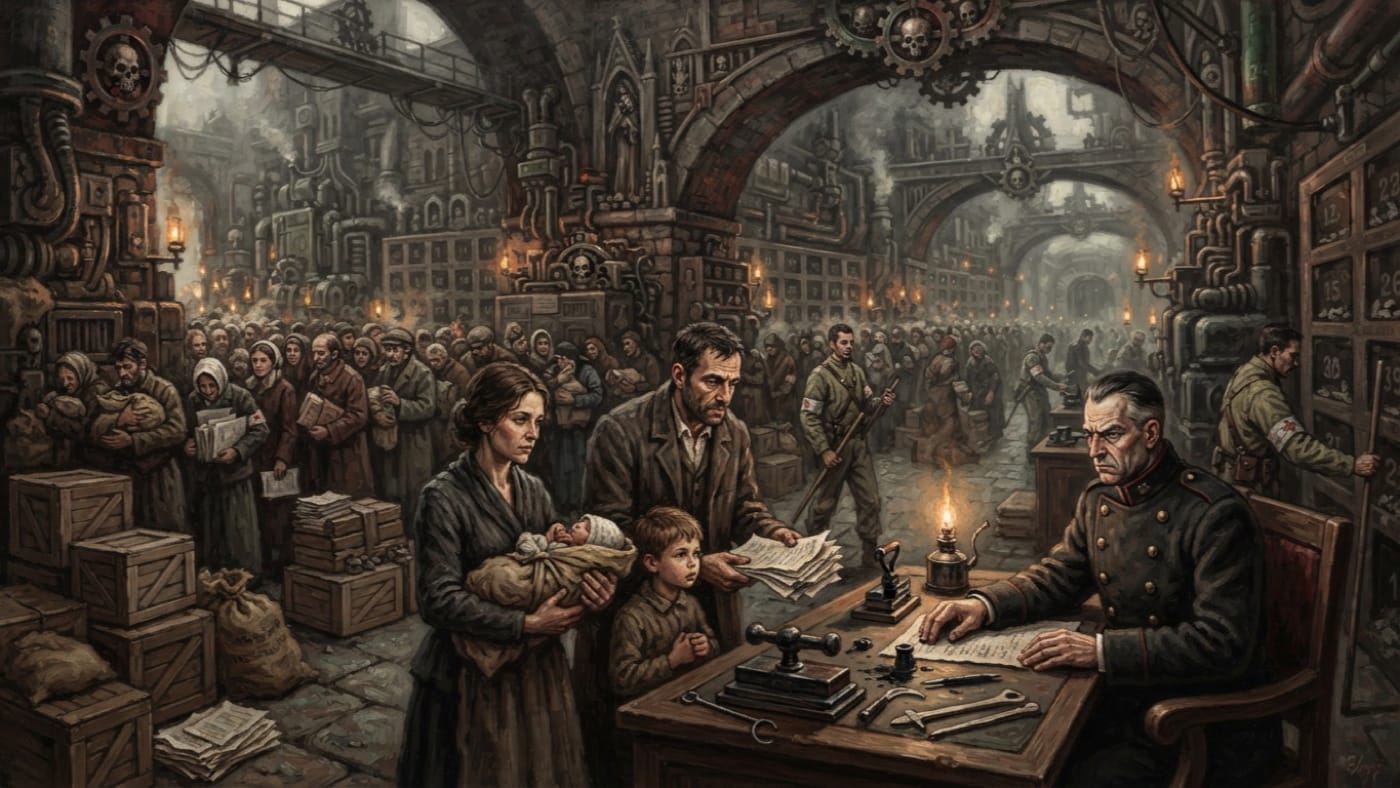
His tools are the seal press, the tariff codex, the purity lamp, bone calipers, scales, lime measures, and the hooked ledger stylus with which he writes without touching skin. His room has cold stone and lime grit under the nails, and vinegar against the rot. His fingertips carry ridges of wax. A crate scrapes forward a yard at a time, and now and then the seal press comes down hard enough to end a conversation.
The family's side of the table is less furnished. They arrive holding their papers in both hands. They wait while a stranger measures the eye-sockets of someone they used to feed. Mourning once ran unbroken from deathbed to grave. Now it stops at a desk and resumes only when the slip is shown.
The Sanitation Chapter of the Bureau of Mercy stood on the other side of that queue. It painted the lines, ran the cordons and inspected the living who dragged the dead. Its powers meet the Mandate's at the table and nowhere else. A clean paper from Sanitation lets a porter cross a line. It does not clear the shroud on his shoulder. Clerks who confuse the two documents are retrained. Porters who confuse them are fined twice.
#On Exceptions Claimed and Titles Corrected
The lesser offices of A.S. 78 had their say before the ink set, and later chroniclers have given them Bureau names they did not yet hold. Military officers, whose office later took the name of the Bureau of War, endorsed the Mandate because unprocessed bodies blocked roads. Mercy endorsed it because the plague wards needed exits. The purity organs that came before the Bureau of Purity appended warnings. The relic custodians, whom a later settlement made into the Bureau of Relics, demanded separate custody for fragments suspected of being a saint's. They assented after inserting three paragraphs and one insult disguised as a definition. Suspected relics got their own shelf, never their own category.
Saint Morin of the Sealed Mouth claims the Mandate as his birth certificate. The claim is devotional.
Instructional woodcuts issued to tariff-chapel novices describe Saint Morin as "First Tariff-Chapel Prelate of Marrowgate, appointed under the Joint Classification Mandate."
Corrected. The Mandate appoints no prelate, names no saint, and records no wax-mouthed hauler among its drafters. Morin's Marrowgate tradition of A.S. 78, his Rheinscarp tradition after A.S. 124 and the composite reading remain incompatible, and all three are tolerated. His usefulness to the profession is beyond question. His biography is not.
#On the Revisions
An emergency instrument that lasts a century has stopped being an emergency and become furniture. The Mandate has been revised four times, and each revision is the receipt for a later embarrassment.
In A.S. 104 the tariff-chapel language was brought into line with the custody of terminal testimony. Confession Reform had taught the offices that the last words of the dying and the handling of their bodies were a single chain. In A.S. 134 fears of ossuary breaches tightened the witness rules for mouth-seals. In A.S. 187 the Ornamental class was overrun by forged permits and a noble fashion for bone, and a dinner service in Mainz was found to be made from twelve unrelated martyrs. In A.S. 199 the procedure for speaking remains was updated. Records insists the update was preventative.
During the Plague Winter backlog of A.S. 157, desks working under Gray Clearance reduced the five categories to two words in practice. The Mandate was never amended to allow this.
#On Present Application
As of A.S. 201 the Mandate is in force at every mortuary desk from Marrowgate to the bastion ossuaries, and nobody has proposed that the emergency expire. It works. Burials are cleared, Contaminated lots are confined and Ornamental skulls are taxed. The pits no longer riot.
It also sells. Fast clearance can be bought, friends get their remains downgraded to Ornamental, and rivals find Contaminated marks on their goods. Misclassification remains the profession's commonest sin and its least prosecuted. Prosecution requires a second clerk to reclassify the first, and the second clerk has a family.
One matter remains unresolved: the dead who answer. The A.S. 199 procedure governs what a clerk does when remains speak at the desk. It does not say what is speaking.
RECORDS ANNEX — SPEAKING-REMAINS PROCEDURE, A.S. 199 REVISION Desk reports received since revision: █████ Reports corroborated by living witness: ███ Causal finding: none entered. Instruction: suspend queue; screen the desk; record; do not answer.