
#On the Low Ground
"The lowlands are a page the Creator ruled and never wrote on." — Drax, margin of the northern survey sheet
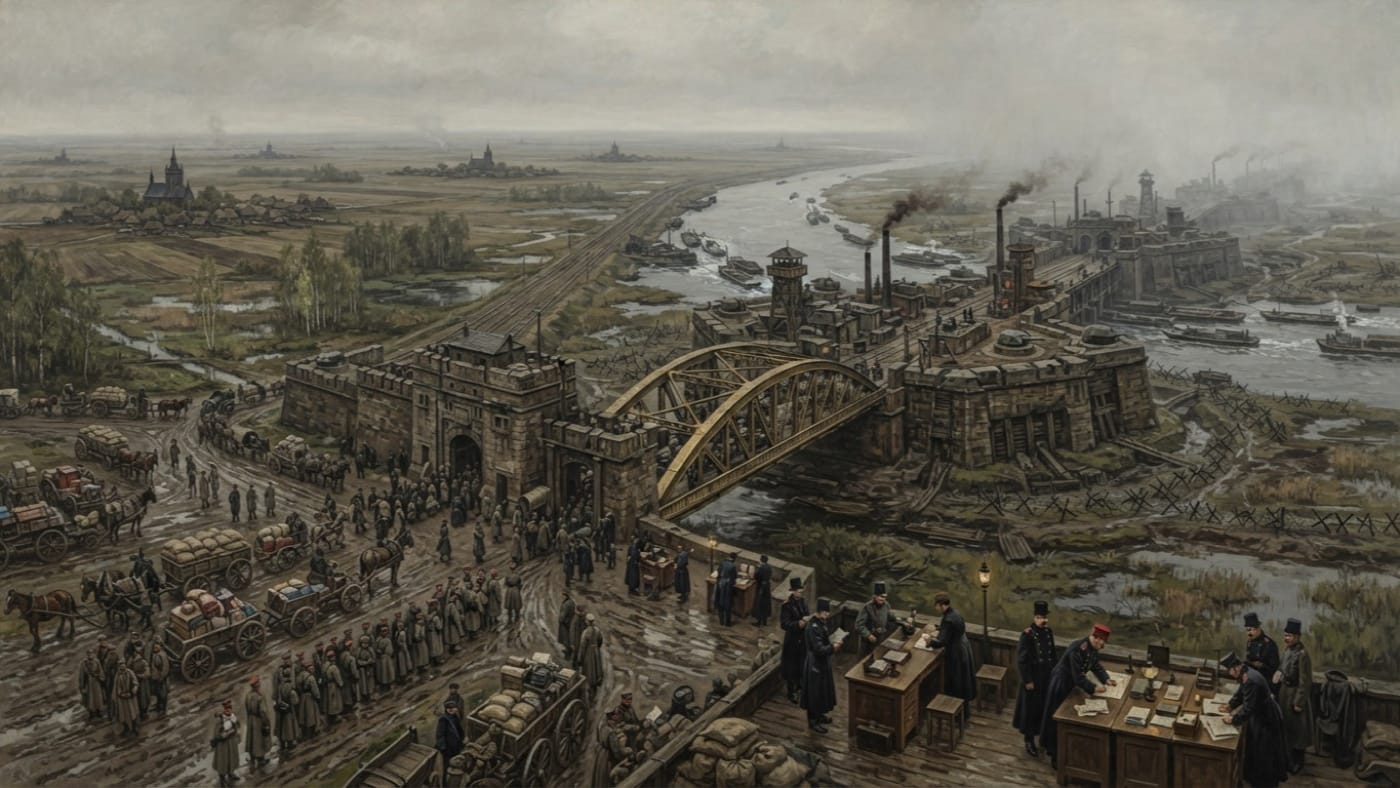
The Polish lowlands are the ground left over after the mountains were finished. From the Vistula east to the Bug the country lies flat and stays flat: rye, potatoes, fen, birch stands, drainage ditches cut straight by men who had no hill to follow, and a church spire every few miles to tell a traveller which parish he is sinking into. To the south, the garrison of Przemyśl holds the Carpathian ridges and the narrow passes between them. To the north, Königsberg keeps the Masurian lakes, a wet maze that punishes any army too proud to learn it. The lowland stretch of the Sagittal Line gets neither. It gets distance.
On a clear day an observer on the western embankments can watch the weather come for an hour before it reaches him. There are few clear days. Mist rises off the floodplain most mornings and lies on the marsh until noon, and inside it the cartographers' famous sightlines shrink to the length of a rifle. When the air is clean the plain hides nothing, and when it is wet the plain shows nothing. The garrisons have learned to fear both.
The Bug is the one mercy in the whole survey. It runs north to south, cold and broad, a moat that no clerk had to requisition. Everything in the region that matters to the Bureau of War is arranged around the few places where a man may lawfully cross it.
#On the River and the Line
Bastion-Brest is the second of the seven bastions counted from the Baltic. It stands at Brest-Litovsk, at roughly 52.1°N, 23.7°E. Those figures locate the bastion and nothing else. The region has no surveyed perimeter, no capital, no common charter and no arms, and a clerk who writes Brest's coordinates as the middle of the lowlands should have his nib confiscated. What the bastion does have is the lock. Its brass-ribbed span is the controlled crossing on the river, and the ground on either side shows why a lock was needed. There are floodplain meadows that go under in the spring thaw, marsh that swallows a laden wagon to its axles, and in winter, ice that grinds against the pylons and has to be broken by hand, by crews nobody envies.
This part of the Line was settled before it was ever drawn on a map. After the Sundering of 1 November A.S. 45, the Great Retreat drove soldiers and refugees west across this plain for the better part of two decades, and the river was the first obstacle that held. Around A.S. 65–68 the sector became part of a Line that could be defended, though it was not yet finished. Those first works were raised under the improvised authority of the wartime Church, and the offices the Codex now gives them by name are a later convenience. The Concordat of Strasbourg did not give that authority a constitution until A.S. 90. The bridge-fortress that stands today came after that, and its own entry records it.
To cross at Brest a person needs a confession receipt checked against an identity file, an absolution token, and transit authority from the Crossing Bureau. The Bridge Tribunal judges disputes, and the Gun-Cantor command decides what the guns are for. All of this applies to the bridge. A farmer three parishes west owes his tithe, his levy and the ordinary sacraments. He does not owe a wax token to walk to his own barn. The lowlands depend on Brest's machinery for a simpler reason: everything sent east has to pass through it.
#On What Goes East
The supply route is the Northern Corridor, and its logic is plain. Hamburg takes in what the sea brings. Kanzleiburg, which was Berlin before the Synod renamed it, governs the northern theater, sorts the freight and sets its order, and joins the western rail to the Polish approaches. Warsaw, on the Vistula, stages everything bound for Brest and Königsberg. Warsaw is Zone Three and Brest is Zone Four. The difference shows up in the bread. It leaves Warsaw warm and reaches the bridge at whatever temperature the wait allows.
The ground makes the engineer's work easy. A lowland locomotive meets no grade worth the name, and the Bureau of War's rail officers will talk at length about how cheaply the plain is laid with track. The plain is not where the delays come from. They come from the paperwork. Replacement columns leave Warsaw late and arrive later, and the convoys back up at Brest's eastern gatehouse while each man's confession file is checked against the last one he gave. Boots rot in the sidings and biscuit goes soft. The soldiers due to be relieved at the wire stay on, their six-month tours stretching while their replacements wait under a wet tarpaulin a day's march behind them for a seal.
The system works. Every cartridge and sack of meal that reaches the eastern trenches has been counted, and every man who reaches them has been heard in confession. Nobody has yet worked out how to count the days the counting costs, so the Bureau doesn't bother.
#On Those Who Live Behind It
Remove the guns from the survey and what is left is farms. The Bureau of War recruits Brest's garrison from Warsaw, from Kanzleiburg, from the Polish lowlands and from the flat farming belt in between, on the reasoning, which the Bureau has put in writing, that men raised on flat ground fight best on it. I have no view on whether this is tactics or idleness. The farms have a clear view. Each son sent east is a pair of hands missing at harvest. Each wagon taken into convoy work is a wagon that will not haul the parish's own grain. Each horse the remount officers pass as sound is a horse that will not plough.
So the households that feed the front also give it their sons, and the front sends back what it has room for: the wounded, the discharged, letters at intervals that someone in Kanzleiburg considers reasonable, and families from the eastern approaches with handcarts and nowhere to go. Some refugees stay in the western parishes and become tenants. Some go on to Warsaw, a city the Bureau has never managed to empty. Some go back east once the pressure eases, and the clerks write them up as "returned" because the forms have no column for "gave up."
Life goes on. The rye is sown and the tithes come in. Village churches ring the hours, and the levy lists are read out from the same pulpits that read the banns. The lowlanders are not heroes and would think it silly to be called that. They are the material the northern front is built from, and they know their worth to the war with the exactness of people who have been requisitioned.
#On the Eastern Reports
East of the river the open fields become contested ground, and then ground that the reports describe only from a distance. The force facing Brest is the Nameless Tide. I can say what the Northern Theater reports allow and no more. The Tide builds up. It presses the eastern wire in surges that follow no weather and no tactic the Bureau of War can model. It does not answer to hymns or relics. The Bureau of Doctrine holds it under Absolute Suppression and has issued no classification. I give it no origin, no rank, no purpose and no mechanism, because no one with the authority to give them has done so.
At Königsberg the garrison faces the Grey. The two are listed separately. They look alike, and I have said so in writing and at length, but a resemblance in the observation reports does not make them the same thing.
Velkara has no bastion of her own and works in every theater. On the lowland front she shows up as forged seals, bribed sentries and altered manifests, worked through people who chose to take the bribe. That corruption is a danger to the crossing's paperwork. It does not explain the Tide.
The Confession Echo, in which sins spoken in Brest's confessional booths come back, has been reported at the bridge since A.S. 199. Nobody has proved what connects it to either unnamed force. My suspicions about it are on file and remain my suspicions.
Earlier entries in this Codex, including the Hieromnemon's own entry on the Grey, treated the Grey and the Nameless Tide as one phenomenon under two names.
The northern assignments list the Grey opposite Königsberg and the Nameless Tide opposite Brest as separate forces. The similarities are on record. Whether they are one thing is not established, and the Hieromnemon's opinion has been filed as an opinion. He accepts the correction and keeps the opinion.
#On the Present Condition
In A.S. 201 the lowland sector is held. The northern rail runs. The convoys arrive late, but they arrive. The bridge at Brest still turns each crossing into an interview, the ice crews still break the winter at the pylons, and the dredgers still clear what the spring floods leave against the piers. West of the river the parishes plough and pay their tithes and send their sons. The eastern approaches are watched by men who see a great distance on a clear morning and nothing at all in the mist.
The region has no government to praise and no capital to blame. What it has is a river, a railway and a population whose labour has been assigned to all three.
Disposition: retain under Northern Theater supervision, continue the levy, and ship the bread warm.