

#On the Authority of Correction
The second string is the cheapest lawful object in the Cloister of Miscounted Beads and the strongest thing most pilgrims will ever hold. Its doctrine is short enough for a child to recite and sharp enough to keep six thousand adults on their knees: correction outranks origin.
An ordinary pilgrim string is a portable record. Prayers, stations, vows and penances sit in its beads, and while the count agrees with the route slate, the string is the bearer's credential before Heaven and the gate. When the count fails, the string becomes a suspect. Many suspects are settled at the desk by explanation, filing or fee. The rest go to the Chapel of the Second String, and there the discrepancy is pronounced, the correction recorded, and a new cord issued that takes precedence over everything the old one carried.
The old string may have touched relics at licensed shrines. It may have spent a winter in a coat lining, been gnawed by a teething infant, or been retied by a dying mother whose knot no binder in the Cloister could reproduce. The new one was tied that morning and smells of glue. The new one governs. The old one testifies.
#On Its Statutory Place
The doctrine has no recorded inventor, and good doctrine usually arrives that way: it accumulates. The Concordat of A.S. 90 settled the apparatus. Pilgrim traffic then thickened at Strasbourg's western gates until, in A.S. 94, the Cloister grew out of temporary tables, holding yards and orders that never expired. The Chapel took shape at its centre. Nobody has produced the date on which the first corrected cord was tied, and I decline to invent one for the comfort of antiquarians.
The Pilgrim Reconciliation Statutes, promulgated in A.S. 97 and revised in A.S. 187, gave the practice legal bones. Their sequence still governs every failed count: string received, name checked, route compared, count pronounced, discrepancy named, correction priced, disposition sealed. They routed the irreconcilable to chapel reconciliation. They made the corrected cord the governing credential and reduced the original to evidence. The obedience came first. The Statutes gave it a docket number.
#On the Cord and Its Issuance
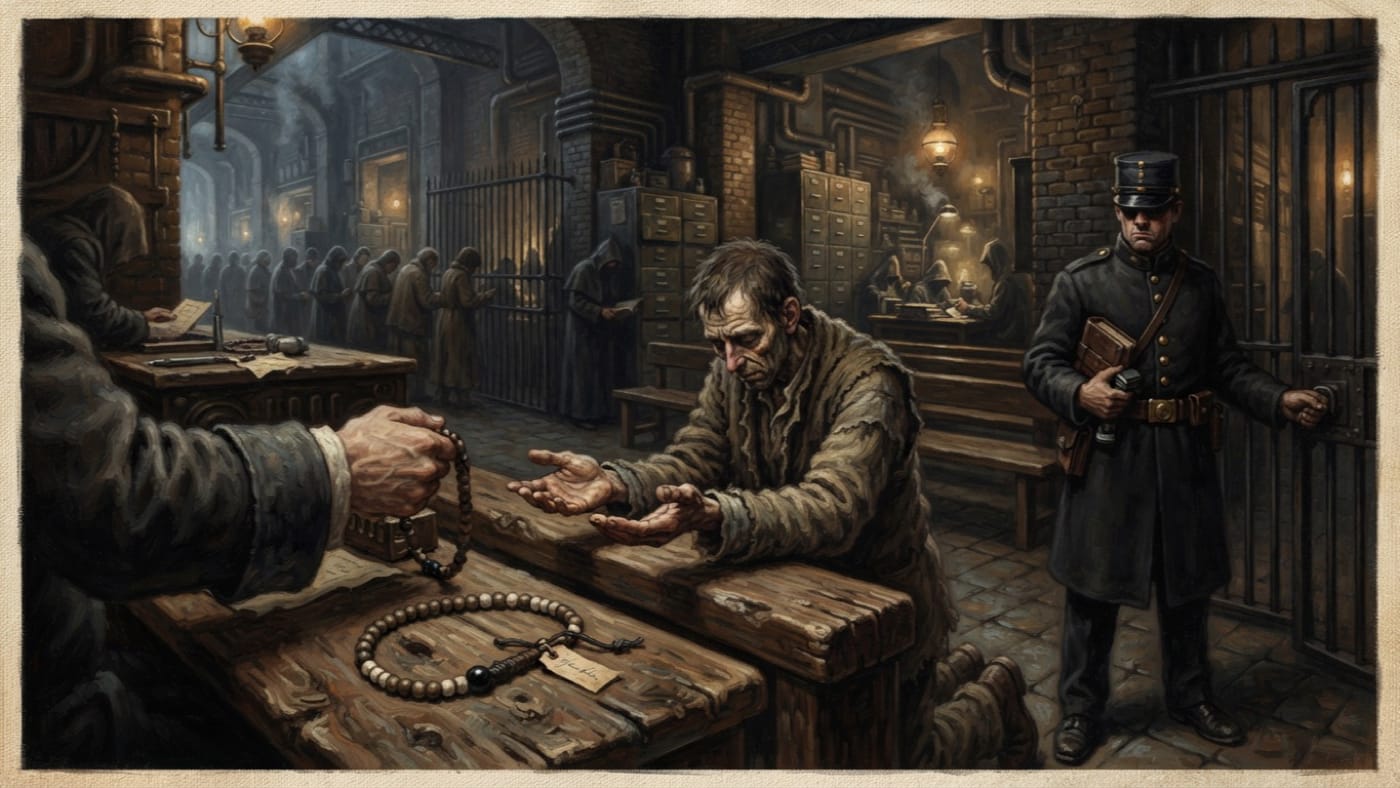
The approved cord is deliberately plain: dull wooden beads and bone-white counters, one black witness bead, one waxed knot, and a tag bearing the reconciled name. There is no gilt and no dyed silk. The material is cheap, and the cheapness is the theology. A cord of no value in itself can only take its value from the issuing office.
Two conditions must be met before issuance. A count has failed, and a correction has been recorded. Without both, a string-binder's work is haberdashery. The Bureau of Records supplies admissibility and documentation, the Bureau of Pilgrimage administers the devotional movement the cord will license, and Chapel personnel perform the rite.
The pilgrim kneels at the rail. The old string is surrendered, or, under later practice, entered as absent, since roads lose things and so do yard guards. The chapel clerk reads the failed count. The discrepancy is pronounced. Penance is assigned. The penance prompter then reads the corrected count, and the pilgrim repeats only that one. Stumbles mean starting again. The cord is laid across open palms and never around the neck, because the Chapel keeps its categories even where the distinction has become ornamental. When ordered, the pilgrim kisses the black witness bead. Where the case requires, the old name is sealed and the tag carries the reconciled one. Not every corrected pilgrim is renamed. Many simply leave with a different arithmetic.
Variants exist for conditions the Chapter has foreseen. A widow whose dead husband remains admitted to the Great Ledger receives an ash bead in her cord. The Ledger has kept him. The Cloister makes a note of it and moves her along.
Recounting after correction is forbidden. A pilgrim heard murmuring the old total in the dark has committed a small, specific offence with a small, specific penalty, and the Dorm Rows report such murmurs in the morning with the punctuality of choir-boys.
#On What the Second String Governs
Once issued, the corrected cord controls the pilgrim's administrative existence. It decides movement within the compound, dorm assignment and release, station credit, and the file on which clearance review proceeds. Before issuance, a guard asking for a pilgrim's string meant the old one. Afterwards he means the new one, and the old one cannot be offered in its place.
The original goes into evidence. Depending on warmth, moisture, smell, sound and the archivist's frown, it is stored, destroyed, or sent for restricted handling at Desk Eleven. Anything beyond ordinary handling passes to the Bead Vault under Archivist Keth, whose custody is careful and whose explanations are rare. Permanent keeping is not promised. A mother's knot may be cut for analysis, salted, or burned.
"Issuance of the second string restores the pilgrim's original road." — devotional commentary, as corrected in the Statutes.
Corrected. Issuance restores admissible movement. Neither the road, nor the shrines on it, nor anything the pilgrim did there is restored, revised or returned. The Chapel offers lawful passage into the next room.
Issuance and release are separate acts. A pilgrim holding a perfect cord can still sit in the Dorm Rows for weeks, because the cord says only that the count has been corrected. Whether the soul attached to it may pass the chain at the Clearance Gate is for Prior-Scribe Erem Vale to decide. Vale conducts no rites. He authorizes the categories that make them admissible and keeps the small black-horn clearance seal whose face bears the Second String mark and a fine Records counterline. Without the seal, the second string is a lawful cord in a locked yard. With it, the gate opens.
Outstanding conditions survive issuance. So does an anomaly cordon. Sponsors can speed ordinary business, and their wax has warmed many slow files. Sponsor money cannot lawfully set aside an active anomaly declaration, though the brokers keep bringing the question back each quarter.
#On Obedience and Its Price
Correction is a service, and the Cloister charges for services. Before the cord there is the supplementary filing. After the filing comes the confession addendum. Penance hours turn into labour hours in the Supplementary Entry Office, and the pilgrim who cannot pay leaves with a cord and a debt, and the debt lasts longer than the cord. No fixed tariff for a second string has ever been published. A published tariff would be honest, and the revenue would fall.
The poor understand all this perfectly. In the Rows they call a detainee second-stringed from the moment correction begins, long before any cord is tied or any gate opened. It is an insult, a diagnosis, and sometimes a condolence.
Pilgrims resent the cord, and I have watched them do it at the rail. A widow holds it the way one holds a dead rat for the inspector. A soldier mutters the corrected count like a man reading the charges against himself. Then the guard asks for the string, and each of them presents it correctly, palms open, black bead uppermost. Resentment costs nothing. Moving through the Cloister costs compliance.
#On the Count That Refuses Correction
Circular 881-R of A.S. 199 fixed the official position: a bead count is fixed at the moment of filing, and any later discrepancy reflects handling error. That position is load-bearing for the second string. If counts drift by nature, every correction is provisional, every corrected pilgrim may appeal to his old cord, and the Chapel's revenue begins coughing blood. The Circular therefore says nothing drifts. It is obeyed with salt, vinegar, silence hours and lowered voices.
The reports keep arriving anyway. Black witness beads have turned warm in the palm. Recited corrected counts have come back from the nave in a voice other than the prompter's. In some reports, a boxed and sealed first string has been heard clicking under the new cord in the same pilgrim's hands. The Statutes' severe protocol has a category for what officials call second-string echo, and the Chapel's anomaly order forbids any open first string during issuance and any second string within three paces of basin water. The Circular says nothing can drift, so the Chapel's order regulates how close nothing may be placed to water.
Such cases go to restricted handling, with salt-wax sleeves, silence tests, sealed routing and Desk Eleven. Nothing is solved there. Every incident is put in its proper drawer.
ISSUANCE NOTE — CHAPEL, ANOMALY WEEK Corrected count recited, second string issued. Sealed first string, held separately in transit box, clicked ███ times. Click total matched ████████████████. Disposition: Vault referral; no comparison to be minuted.
The Quiet Thread reads these reports as scripture. Its people teach that the original count comes first, that drift can be directed, and that a correction can itself be corrected. Its detainees whisper "correction is temporary; count is prior" over the cords they were issued. The cell keeps alive the rumour of the First String, a single uncorrected measure that, if it existed, would make every cord the Chapel has ever tied a borrowing rather than a decree. The Vault has never confirmed that it exists, and the Bureau's denial stays on file. An archivist's custody of uncomfortable cords proves custody and no more.
One caution for the zealous inspector. The cell's members are said to hold the cord across the palm without closing the fist. The Chapel requires exactly the same posture. Arresting everyone at the rail who obeys the rubric would empty the Chapel and fill the Purity cells by supper, and Purity has complained of overcrowding already.
#On Present Application
As of A.S. 201, the Chapel issues second strings at a pace its founding plan never imagined. Western-gate intake has run beyond capacity since A.S. 198. The Counting Hall sends more failed counts, the Rows send more night offences, and five anomaly weeks are projected for the year, though not yet endured. The beads arrive warped from damp storage. The request for a second licensed string-binder was denied pending intake review, so the debt apprentice ties faster and badly.
The doctrine has not weakened. It is cheap, repeatable, enforceable on stone, and it takes its authority from the office that issues it. A cord that depended on the truth of the road would need witnesses. A cord that depends on the issuing office needs only a clerk.